

Most advice about tweed golf hats starts with style and ends with nostalgia. That's backwards. A tweed cap earns a place in your golf bag when the course is cold, exposed, and damp, conditions where a light synthetic cap can leave your head chilled, clammy, or overexposed to the wind.
Tweed isn't the universal answer. It can feel too warm in summer and won't replace a properly engineered rain or sun hat. But on a blustery links course or a cool early tee time, the dense wool weave gives you a useful combination of insulation, wind resistance, and moisture control. The right question isn't whether tweed looks traditional. It's whether the fabric matches the round you're about to play.
Why Tweed Golf Hats Still Matter on the Course
The heritage-only view misses tweed's practical advantage. Wool fibers have a naturally crimped structure that creates tiny air pockets, while the dense weave helps slow moving air across the fabric. That combination gives a tweed golf hat more thermal buffering than a thin, smooth cap, particularly when wind keeps changing the temperature around your head. Textile guidance on tweed and wool insulation describes this air-trapping construction and wool's ability to retain insulating performance when damp.
That matters on exposed fairways. A synthetic cap may dry quickly, but quick drying isn't the same as warmth. If a cold breeze arrives during a long walk from the tee to the green, a low-profile tweed cap can take the edge off without the stiff, sealed sensation associated with some waterproof headwear.
The conditions where tweed earns its keep
Tweed works best when you're dealing with:
- Cold wind: The compact weave creates a useful barrier against moving air.
- Cool, changeable temperatures: Wool moderates the microclimate around your scalp instead of ventilating it.
- Light drizzle: Wool can absorb moisture vapor without immediately feeling wet, and the fabric handles intermittent dampness more comfortably than many slick finishes.
- Walking rounds: The material's breathability helps reduce the clammy buildup that can occur when your head alternates between exertion and exposure.
Don't mistake this for storm protection. A tweed golf hat is a weather buffer, not a waterproof shell. Heavy rain still calls for technical protection, and a short-brimmed cap leaves more skin exposed than a broad-brimmed design. A golf-apparel study found that only 19% of hats marketed to golfers used a wide-brim design, which highlights the coverage compromise built into many traditional styles. The golf apparel sun-protection study supports choosing brim coverage based on exposure, not appearance alone.
If you're planning a golf trip and want to match the hat to the course, start with these handpicked Orlando golf recommendations. In warm, high-UV destinations, I'd usually choose a lighter technical hat with broader coverage. Tweed's strongest case is the cool, windy round, not the blazing resort tee sheet.
The Scottish Roots of Tweed Headwear
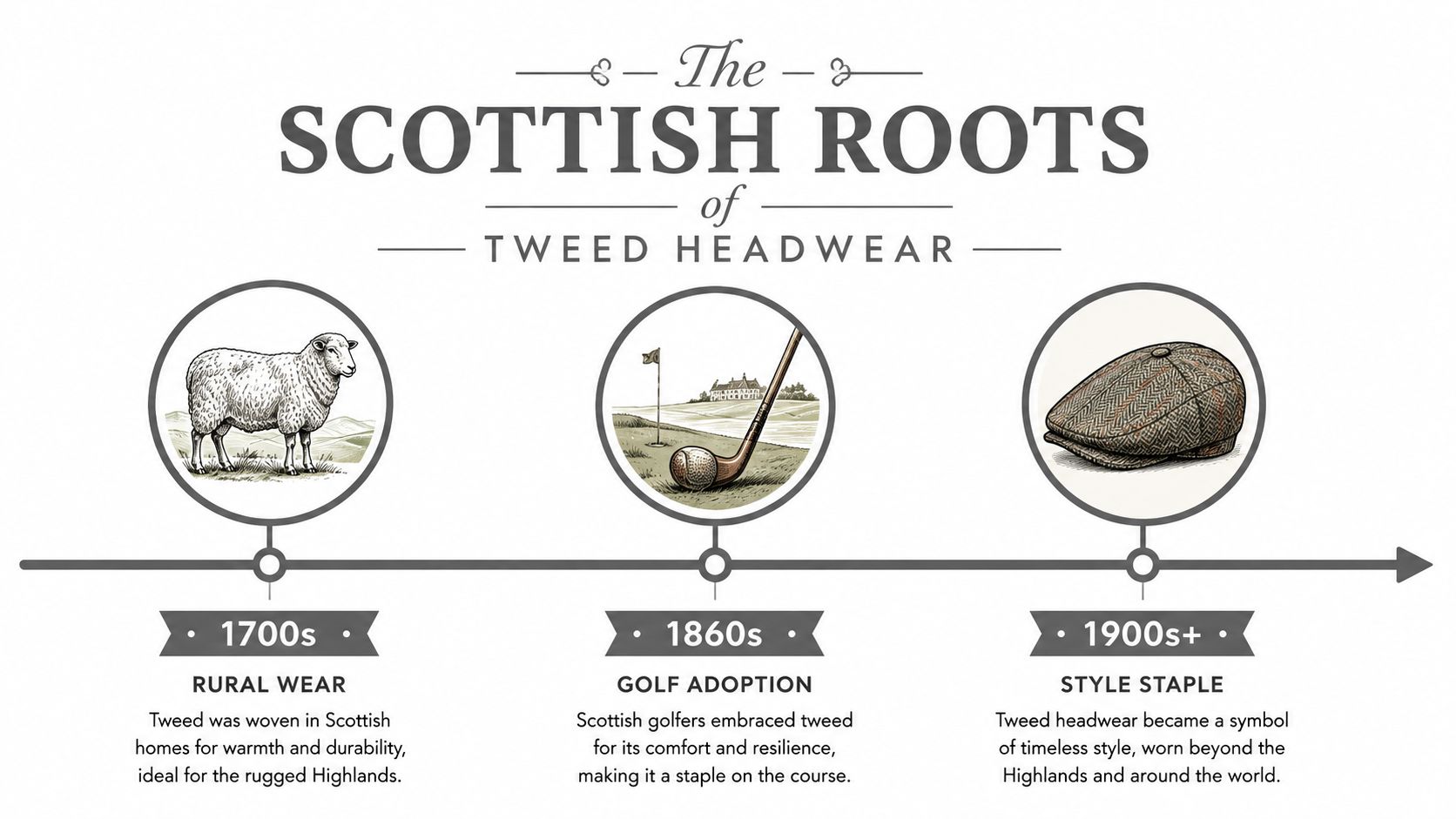
Tweed became associated with golf because it grew out of the same outdoor clothing tradition that served Scottish fields, estates, and coastal terrain. Players needed clothing that could handle cold, wet links conditions, and wool was an obvious choice long before “performance fabric” became a retail category.
The documented story starts earlier than golf. A clothing-history account traces the legal and social roots of the wool cap to 1571, when an English Parliament act required males over age six to wear wool caps on Sundays and holidays or pay a fine of three farthings per day. The short-peaked wool cap had become established by the end of the 16th century, then developed into a recognizable marker of rural and urban working life. The historical account of golf caps and tweed headwear also connects the long-peaked flat cap with political and class identity, including its association with Keir Hardie, the first Labour MP.
The golf connection arrived through use, not branding. A fashion-history source notes that tweed was already worn for field sports by the 1830s, became much more widely worn from the 1870s, and was especially prominent in the 1890s. It remained popular into the 1920s and 1930s, when flat caps and related ivy-cap silhouettes fit naturally into sporting wardrobes. The history of tweed on the fairways places golf within that broader sporting-clothing timeline.
From working cap to course identity
The flat cap wasn't invented as a golf costume. It carried practical and social associations first, then moved into leisure settings as country pursuits became fashionable. Golfers adopted the shape because it was compact, wearable, and compatible with the weather. That origin gives tweed golf hats more credibility than a purely decorative retro accessory.
Modern golfers can borrow the silhouette without copying an entire period outfit. A charcoal flat cap works with a quarter-zip and fitted trousers. A brown herringbone driving cap fits easily beside modern outerwear. The history matters because it explains the design logic, but you don't need to dress like a historical reenactor to benefit from it.
How Tweed Fabric Actually Performs in Wind and Rain
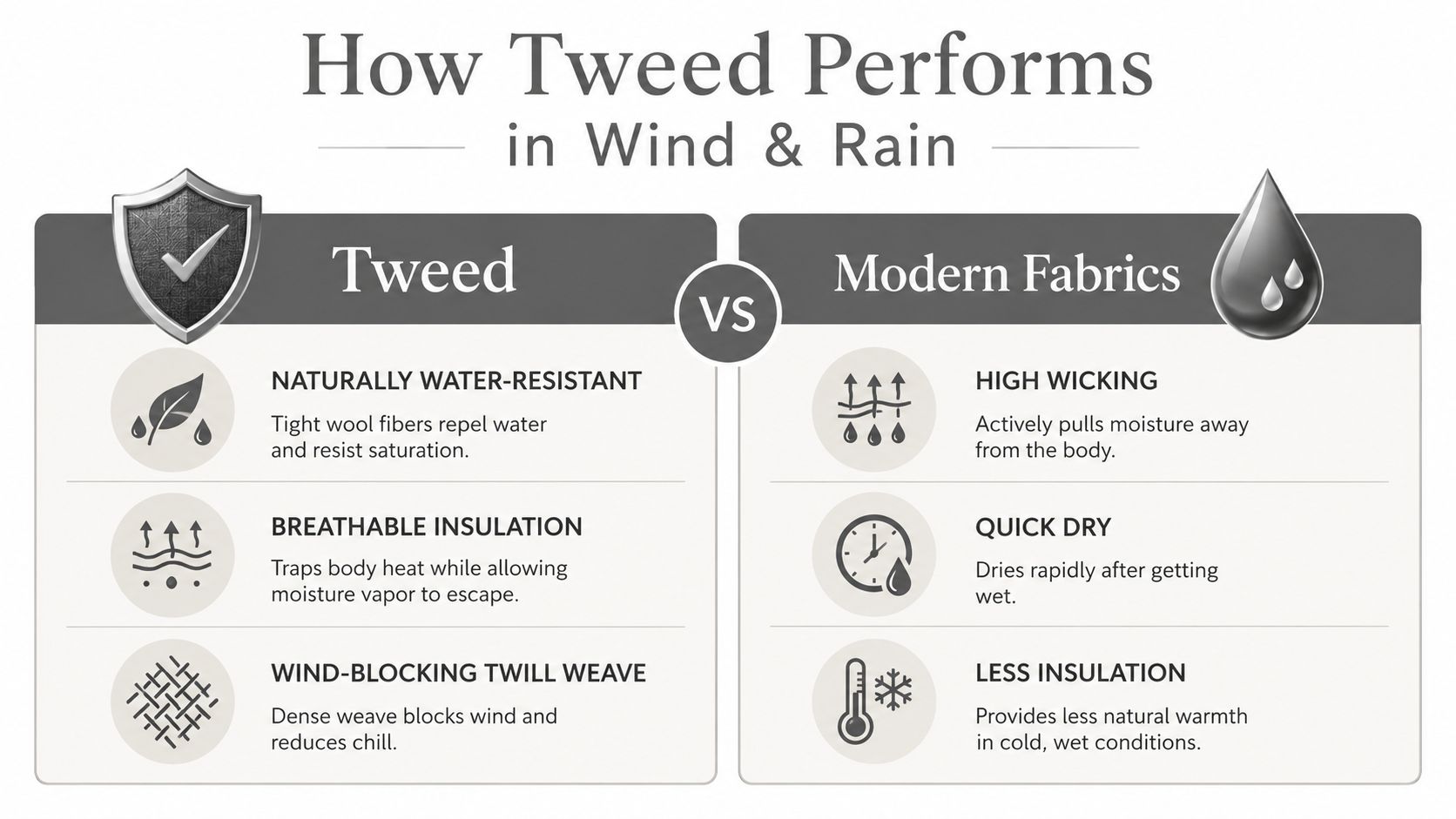
Tweed's performance comes from structure, not magic. It's a wool-based fabric, often woven with a dense texture that holds air between fibers and resists direct airflow. Wool's crimped fibers create microscopic pockets that contribute to insulation, while the woven surface remains more breathable than an impermeable plastic barrier. Independent textile information on tweed's construction and wool behavior explains why wool can remain insulating when damp and absorb moisture vapor without immediately feeling wet.
On the course, that produces a particular sensation. Tweed doesn't feel cold the moment the wind rises, and it doesn't turn into a sealed greenhouse as quickly as some tightly finished synthetic materials. The cap still allows some vapor movement, which is valuable when you're walking uphill or searching for a wayward drive.
What happens in light rain
Wool can handle light drizzle better than its reputation suggests, but the distinction between drizzle and sustained rain matters. A tweed cap may shed or delay light moisture because of its texture and natural fiber behavior. Once the fabric becomes saturated, however, it gets heavier, loses some loft, and takes longer to dry than a quick-dry synthetic cap.
That gives tweed a clear operating profile:
| Weather factor | Tweed response | Practical verdict |
|---|---|---|
| Cool wind | Dense weave reduces airflow and preserves warmth | Strong choice |
| Light drizzle | Wool manages dampness without an instant clammy feel | Suitable |
| Sustained rain | Fabric can become saturated and slow to dry | Carry rain protection |
| Sweat during walking | Wool absorbs vapor while maintaining breathability | Comfortable in cool weather |
| Strong sun | Coverage depends heavily on brim design | Check the silhouette |
Practical rule: Choose tweed to manage cold and wind. Choose a waterproof technical hat to manage prolonged rain.
The brim creates another performance tradeoff. A traditional short brim may deflect a little rain from your face, but it won't protect your ears, temples, or neck as effectively as an all-around brim or integrated neck covering. The sun-protection research cited earlier makes the point clearly. Fabric thickness can't compensate for uncovered skin.
Where the fabric loses
Tweed loses its advantage as heat and humidity rise. In hot conditions, the insulation that feels welcome on a coastal morning becomes unnecessary weight. A lightweight synthetic or natural-fiber blend with deliberate ventilation will usually feel better when your main problem is sweat evaporation rather than heat retention.
I also wouldn't use a tweed cap as your only weather option on a wet trip. Pack it for the cool opening or closing round, then switch to a technical model if the forecast turns into persistent rain. Good headwear buying is less about loyalty to a material and more about assigning each fabric the job it performs best.
Flat Caps, Driving Caps, and Newsboy Styles Compared
The silhouette changes the experience more than many buyers expect. A tweed golf hat can be warm and well made, yet still feel wrong if the crown shifts, the brim collapses, or the shape catches every gust. I judge the three main styles by stability first, then fit, then visual character.
Flat cap
The flat cap has the lowest profile. Its crown sits close to the head, and the short brim usually attaches cleanly to the front without adding much bulk. That makes it my first choice for exposed links, especially if you dislike adjusting your hat after every strong crosswind.
It suits smaller to medium head profiles particularly well, though the test is the internal sweatband and sizing. Look for a brim with enough structure to hold its line in drizzle, but not so rigid that it becomes uncomfortable when you bend over a putt.
Driving cap
A driving cap generally gives the crown more room and uses visible seaming or panel construction to create a fuller shape. It's the better option for golfers who find flat caps restrictive or who want a little more separation between the fabric and scalp.
The extra volume can improve comfort during a long walking round, but it may also give wind more surface to work against. Choose a snug fit, not a loose one, and avoid a crown that balloons above your head.
Newsboy cap
The newsboy, sometimes called an ivy cap in retail descriptions, has the fullest crown and a buttoned, multi-panel appearance. It delivers the strongest vintage identity and works well with heritage golf clothing, but it's the least aerodynamic option of the three.
| Feature | Flat Cap | Driving Cap | Newsboy Cap |
|---|---|---|---|
| Crown profile | Low and close | Moderate and roomier | Full and rounded |
| Wind stability | Strongest | Good with a secure fit | More vulnerable to gusts |
| Headroom | Limited | Moderate | Highest |
| Visual character | Clean and restrained | Classic but adaptable | Distinctly vintage |
| Best use | Windy links | Variable weather and longer wear | Style-led casual rounds |
A good hat can also become a personal customization project. If you're exploring machine embroidery for golf accessories, review the advanced embroidery hoop only option from B-Sew Inn to understand the type of cap-frame equipment involved. Keep any added decoration low-profile and secure, because bulky stitching can create pressure points.
For outfit coordination, plaid and tweed naturally belong to the same visual family, but they can become noisy together. Use the plaid golf hats guide for ideas, then let one pattern lead. A patterned tweed cap usually looks sharper with solid outerwear and trousers.
Caring for Your Tweed Hat to Make It Last
Tweed is forgiving on the course and unforgiving in a washing machine. Heat, agitation, and careless drying can shrink wool, distort the brim, and flatten the crown. Treat the hat as a structured wool garment, not as washable sports equipment.
The routine after each round
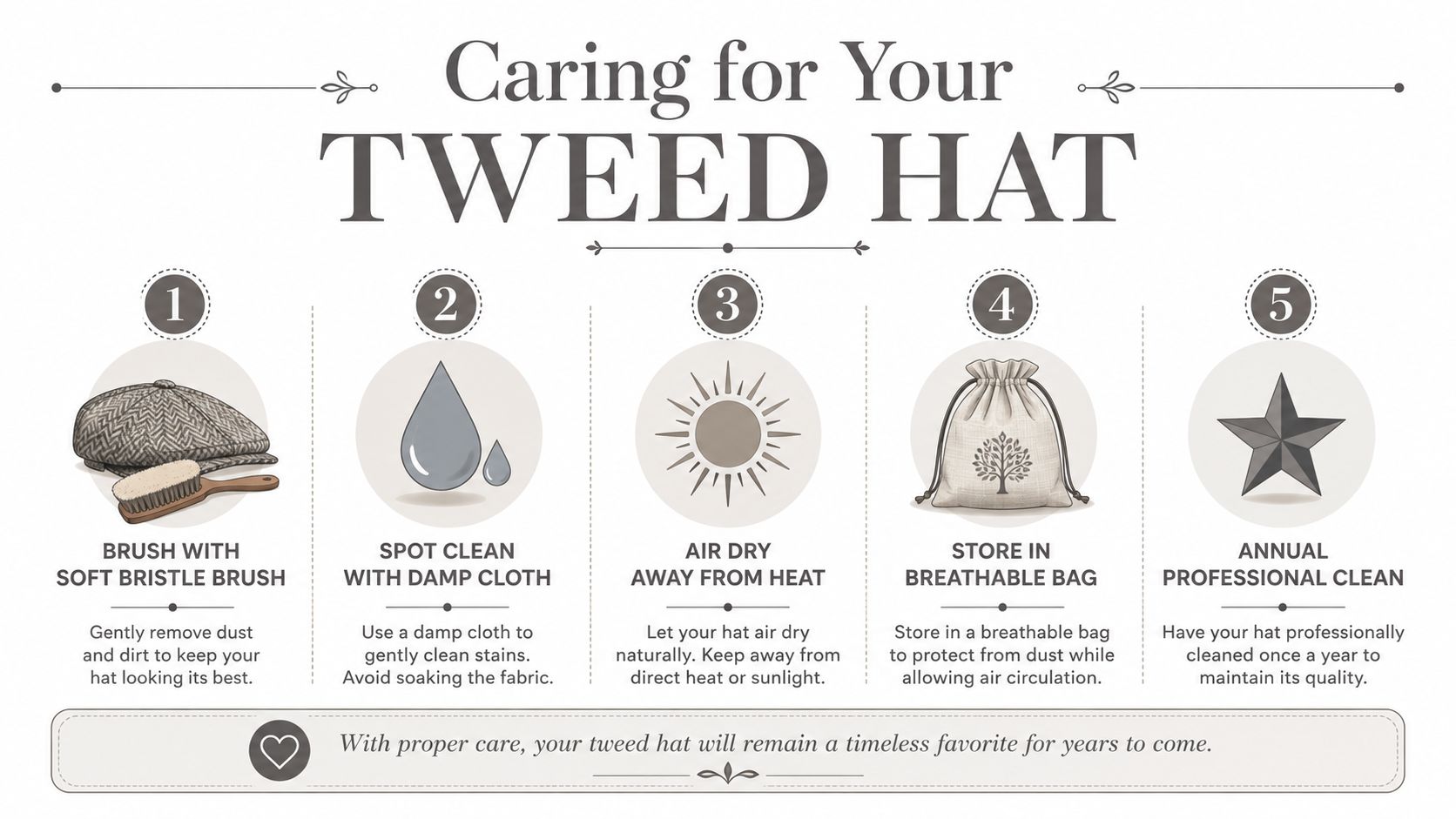
Start with a soft-bristle hat brush. Brush away dried grass, dust, and surface grit before it settles into the weave. If the cap is damp, let it dry naturally in a ventilated room before brushing it, and don't place it on a radiator or near a forced-air heater.
For a small mark, use a barely damp cloth and gentle dabbing. Don't scrub aggressively, and don't soak the crown to solve a surface stain. Wool-specific detergent is appropriate only when the care label allows hand cleaning, and lukewarm water is safer than hot water.
Reshape before the fabric dries
If the crown has softened after rain, place a rounded form inside it, or use a loosely balled towel to support the shape. Let the hat air-dry away from direct heat. This keeps the crown from setting into a collapsed position and reduces the chance of a warped brim.
Avoid these common mistakes:
- Machine washing: Agitation can felt and distort wool fibers.
- Clothes drying: Heat can shrink the cap and alter its proportions.
- Direct ironing: A hot iron can flatten the texture and leave a shiny mark.
- Plastic storage: Trapped moisture encourages stale odors and can damage natural fibers.
- Damp locker storage: A closed, humid environment is a poor long-term home for wool.
For long-term storage, use a breathable garment bag and keep the hat upright or supported on a hat rack. Cedar blocks can help discourage moth activity without the strong odor associated with mothballs, but they shouldn't press directly against the fabric.
If you make golf accessories at home, a printable golf head cover pattern from The Fabric Company can be useful for planning coordinated covers and protective storage pieces. For broader cleaning guidance, compare the handling advice in how to clean golf hats, then follow the specific care label sewn into your tweed cap.
When to Choose Tweed Over Modern Performance Fabrics
Modern polyester, nylon, and technical blends dominate golf shops for good reasons. They're light, often quick to dry, and easy to pair with sweat-management systems. But they solve a different problem from tweed.
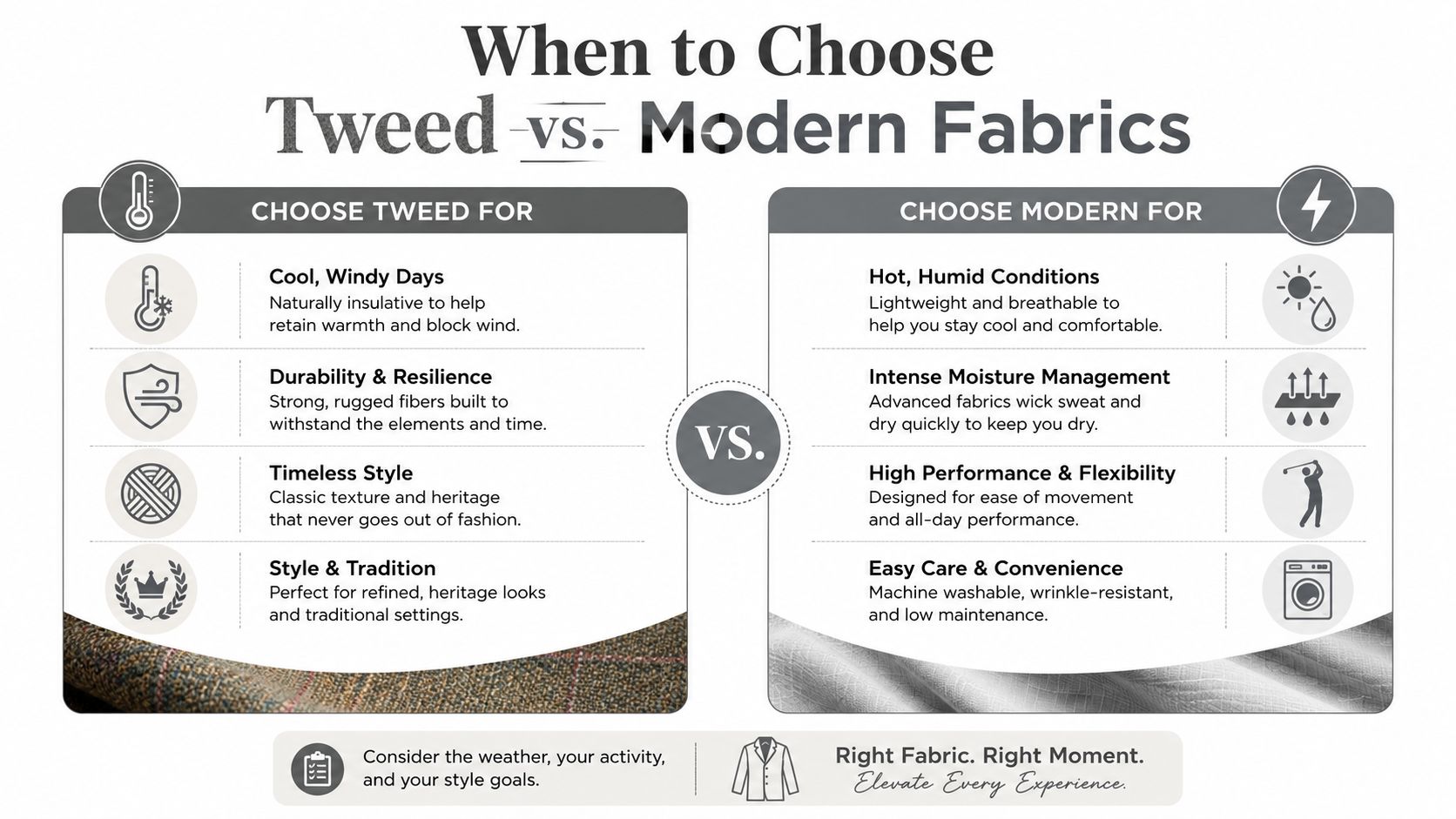
Choose tweed when the round starts cold and the wind is the main nuisance. Wool's insulation and dense weave make it especially suitable for 40°F to 65°F conditions, as outlined in the practical performance guidance in the textile reference on wool and tweed construction. That range covers many shoulder-season mornings in the United Kingdom, Ireland, and the northern United States, where the course can feel colder than the forecast once wind reaches the fairways. The textile source discussing tweed's thermal behavior supports this cool-weather use case.
A straightforward fabric decision
| Course condition | My recommendation | Reason |
|---|---|---|
| Cool and windy | Tweed golf hat | Retains warmth and limits wind exposure |
| Cool with light drizzle | Tweed, with rain backup | Handles dampness but isn't a storm shell |
| Hot and dry | Lightweight modern fabric | Less insulation and better ventilation |
| Hot and humid | Technical performance cap | Faster moisture management matters more |
| Strong sun | Broad-brim technical design | Coverage matters more than texture |
| Competitive, high-output round | Modern performance fabric | Sweat control and low weight take priority |
Above 80°F, a tweed cap usually becomes the wrong tool, especially if you're walking and producing significant heat. In tropical humidity, choose the cap that keeps sweat moving and dries quickly. Style can't rescue a fabric mismatch.
The buyer's rule: If you need warmth, wind control, and visual character, buy tweed. If you need evaporation, minimum weight, and maximum sun coverage, buy modern performance fabric.
That doesn't make technical hats boring, and it doesn't make tweed old-fashioned. They're different pieces of equipment. A wardrobe that includes both will serve more rounds than a single “do everything” cap.
For hotter days, compare the practical cooling principles in stay cool with performance golf hats. The choice should follow the conditions, not the logo.
This short video adds a visual comparison point for choosing headwear by weather and activity:
Your Tweed Golf Hat Buying Checklist
Buy the hat for your course, not for the product photograph. Before ordering, work through these decisions.
- Match the fabric to your climate: Confirm how much wool the cap contains and whether your usual rounds are cool and windy or hot and humid. A wool-rich tweed makes more sense for shoulder-season play than a lightweight blend designed for transitional wear.
- Pick the crown for stability: Choose a flat cap for exposed wind, a driving cap for more headroom, or a newsboy cap when volume and vintage character matter more than aerodynamics.
- Inspect the sweatband: It should sit smoothly against your forehead without scratching, sliding, or creating a pressure ridge. A secure fit matters during the swing and during long walks.
- Check the brim: Make sure it holds its shape and offers the amount of facial coverage you need. A short brim won't provide the same protection as an all-around brim.
- Assess the finish: Look for even stitching, a clean lining, a stable crown, and a brim that joins the cap without puckering.
- Plan the care: Have a soft brush, breathable storage, and a safe drying location ready before the first wet round.
- Coordinate intelligently: Herringbone, checks, and flecks work best when the rest of the outfit stays relatively quiet.
- Know your alternative: If your normal golf is hot, humid, highly competitive, or sun-intensive, a modern performance cap is the more sensible purchase.
2ndShotMVP offers golf hats, beanies, and lifestyle apparel for men and women, including FlexFit and open-back golf-hat collections, so it's a useful place to compare non-tweed options when your playing conditions demand lighter headwear.
If your course regularly delivers cool wind and intermittent dampness, go ahead and buy the tweed cap. If your rounds are mostly hot, humid, and sun-heavy, leave the tweed for off-course wear and choose performance fabric instead.
2ndShotMVP offers premium golf hats, beanies, and lifestyle apparel with fun designs made for wear on and off the course. Visit 2ndShotMVP to compare golf headwear options and choose a cap that fits your game, your wardrobe, and the weather you play in.

