

You're standing on the 14th tee in July. Your forehead is slick, your cap's sweatband is saturated, and the brim keeps sending little drops onto your sunglasses. The hat looked fine in the mirror. After a few hours outside, it feels like a damp lid trapping heat against your head.
That's the problem with most summer headwear. People choose by silhouette, color, or logo, then blame the weather when the hat becomes uncomfortable. The best hats for hot weather are built around less glamorous details: breathable fabric, useful ventilation, a sweatband that manages moisture, a brim shaped for real coverage, and a fit that stays put without squeezing.
Sun protection still matters alongside comfort. For a practical overview of UV exposure and skincare habits, read this guide to UV safety for skincare enthusiasts. A hat helps, but it should support, not replace, the rest of your sun routine.
Why Your Hat Feels Terrible in the Heat
A hot-weather hat fails when it traps more heat than it helps remove. A solid crown with little airflow holds warm air against your scalp. A stiff, dense fabric slows evaporation. A soaked sweatband turns the hat into a wet ring pressing against your forehead, and a poor fit makes every movement feel irritating.
That's why a traditional cotton cap can seem comfortable when you first put it on but become heavy during a long round or hike. Cotton absorbs moisture readily, but once saturated, it can stay damp and cling to your skin. The issue isn't that you're sweating. Your hat isn't giving that moisture a sensible way to move or dry.
The silhouette can fool you
Two hats can look almost identical from across the room and perform completely differently outdoors. One may have a smooth polyester crown with no meaningful openings. The other may use mesh side panels, perforated sections, a lighter lining, and a moisture-managing band. The second hat usually feels easier to wear because it addresses heat and sweat instead of merely covering your head.
Brim shape creates another trap. A small curved visor keeps your sightline clear and works naturally with golf clothing, but it leaves your ears and neck exposed. A broad brim shades more skin, though it can feel warmer if the crown has no ventilation. You're always balancing coverage against airflow, not choosing one universal winner.
Practical rule: If you can feel heat building under the crown before the rest of your body feels uncomfortable, stop blaming the temperature. The hat's construction is probably the problem.
A good summer hat should fade into the background once it's on. It should shade the areas you need protected, move air where heat accumulates, keep sweat away from your eyes, and stay secure as you walk, swing, or run. A stylish shape is useful only if you'll keep wearing it.
The Four Levers Behind Every Hot Weather Hat
Every warm-weather hat comes down to four decisions: material, ventilation, sweat management, and fit with coverage. Check those before judging the color or silhouette.
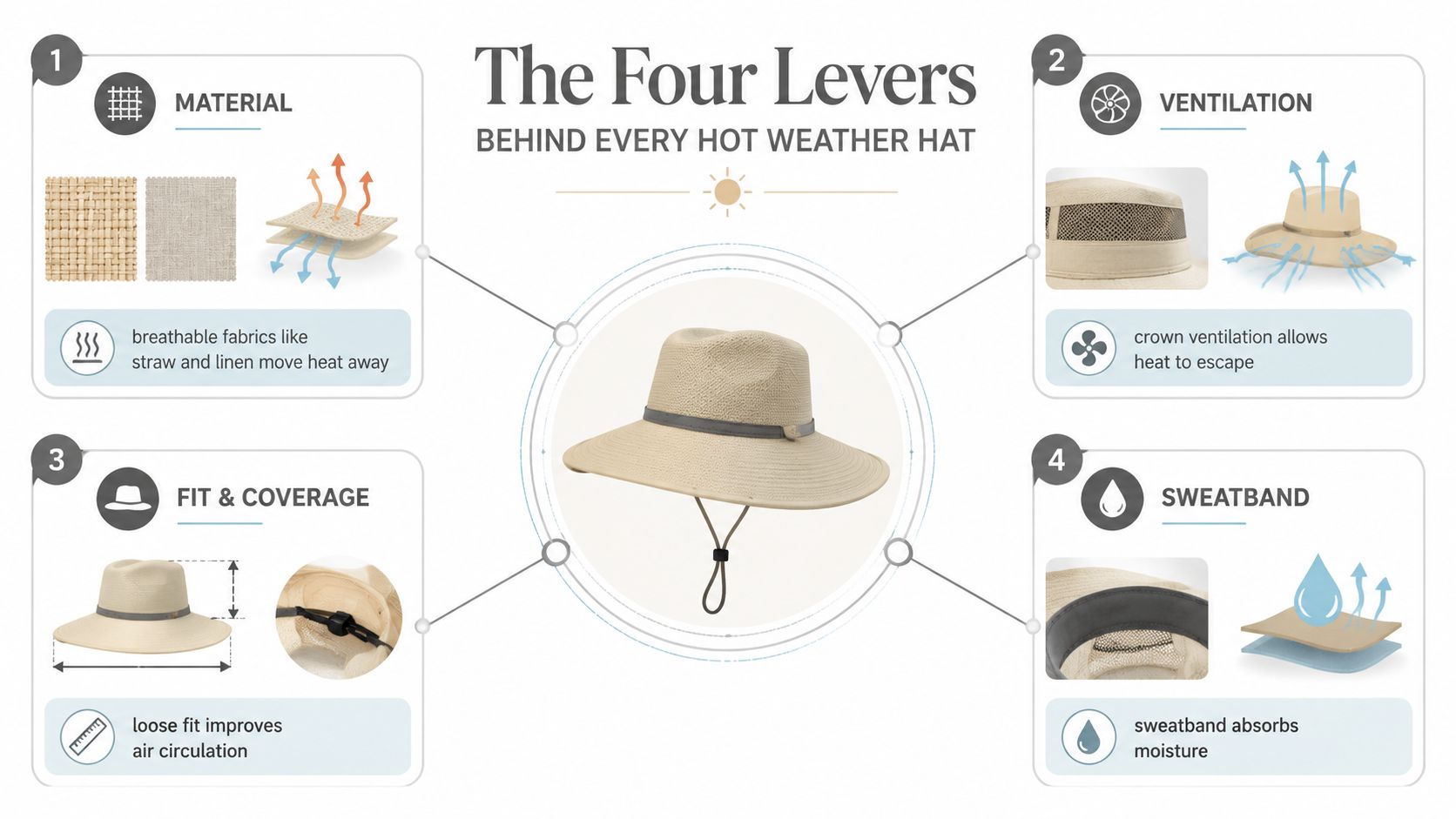
Material controls heat and moisture
Fabric affects how quickly heat moves away from your head and how moisture behaves once you start sweating. Lightweight nylon, polyester blends, linen, straw, and performance knits can all work, but they solve different problems. A solid polyester baseball cap may resist wear and keep its structure, yet feel sealed shut on a hot course. A vented running cap can feel much lighter because the crown allows more air to circulate.
Cotton has a pleasant hand feel and often feels cool at first touch. Its weakness appears after it gets damp. Lightweight woven naturals can feel airy in dry conditions, while a technical knit may be the better choice when sweat needs to move outward and dry quickly.
Ventilation is a construction feature
Don't accept “breathable” as a complete explanation. Look for mesh panels, eyelets, crown cutouts, laser perforations, or open weaves, and notice where they sit. Ventilation near the sides and upper crown helps warm air escape. Decorative holes that don't connect meaningfully with the interior won't transform a stuffy hat.
A golf cap with several embroidered eyelets may offer useful airflow, but it still depends on the fabric and lining around those openings. If you want a closer look at course-ready construction, the guide to performance golf hats is a useful comparison point.
Sweatbands decide whether sweat drips
The sweatband is your first defense against moisture running into your eyes. A soft band that spreads and manages sweat is more useful than a plush band that holds water. Interior lining matters too. A quick-drying lining reduces the clammy feeling that makes you want to remove the hat halfway through an outing.
Fit and brim must work together
A loose hat can improve circulation, but too much movement creates rubbing and instability. A tight hat creates pressure and leaves less room for air. Look for an adjustable closure or stretch fit that feels secure without compressing your forehead.
Brim design determines the shade you receive. A narrow, rigid brim may stay stable and look sharp, but a wider or wraparound shape covers more of the face and neck. The right choice depends on whether you're swinging a club, running, hiking, or sitting on an exposed beach.
Matching Fabric to Your Climate
Fabric choice should follow the weather you face, not the weather in the product photos. Dry desert air rewards light, airy construction because moisture can evaporate readily. Humid coastal conditions demand faster drying and better sweat movement, since damp fabric can remain uncomfortable for much longer.
| Fabric | Breathability | Drying Speed | Best Climate | Drawback |
|---|---|---|---|---|
| Polyester mesh | High when well placed | Fast | Active use and humid conditions | Open sections may reduce uniform coverage |
| Nylon | Moderate to high | Fast | Travel, trails, mixed weather | Can feel less airy when tightly woven |
| Cotton canvas | Moderate | Slow when damp | Casual wear and dry conditions | Gets heavy after absorbing sweat |
| Cotton-linen blend | High | Moderate | Dry heat and everyday summer wear | Wrinkles and loses comfort when soaked |
| Straw and woven naturals | Very high in open weaves | Fast in dry air | Beaches, patios, and dry climates | Less reliable in wet conditions and wind |
| Treated performance knit | High when lightweight | Fast | Running, golf, and humid activity | Can feel warm if the knit is dense |
Pick for humidity, not appearance
For humid golf rounds or high-output exercise, choose a lightweight synthetic or performance knit with a sweat-managing interior. Those fabrics are generally better suited to moving moisture away from the skin and drying during continued activity. Mesh can improve airflow, but an all-mesh crown isn't automatically ideal if it sacrifices too much sun coverage.
Cotton and linen blends make more sense for lower-intensity wear, especially in dry heat. They feel natural and relaxed, which is exactly what you want for errands, patios, and casual travel. They're less convincing when you'll be sweating heavily for hours.
Straw earns its place in dry heat
A well-made straw or woven natural hat is hard to beat for airflow in dry conditions. The open construction can make a broad brim feel less oppressive than a dense synthetic shell. It's a strong beach or resort choice, but not the most dependable option for running, wet weather, or rough travel.
Treated performance knits sit in the practical middle. They can combine light weight, stretch, moisture management, and packability, making them a strong choice when you need one hat for movement rather than a statement piece.
Brim Style and What It Actually Protects
Brim width matters because shade is uneven. A brim can protect the forehead while leaving the cheeks, nose, ears, and neck exposed. Australian radiation guidance notes that brimmed hats can provide strong forehead protection but considerably weaker coverage on areas such as the cheeks, nose, and neck, which is why wraparound styles outperform simple caps for side and rear exposure. The archived heat advice on hats lays out that distinction clearly.
A practical minimum for a wide brim is 7.5 cm, about 3 inches, to adequately shade the face, ears, and back of the neck, according to the same public-health guidance. A brim that size won't guarantee complete coverage in every position, but it gives you a much better starting point than a small visor.
| Brim Style | Average Width | Coverage Areas | Wind Stability | Best For |
|---|---|---|---|---|
| Curved golf visor | Narrow to medium | Forehead and eyes | High | Golf and everyday movement |
| Wide flat brim | Broad | Face, ears, and some neck | Moderate | Beaches, sidelines, and open trails |
| Bucket with neck flap | Medium to broad | Face, ears, sides, and rear neck | Moderate | Hiking, fishing, and intense sun |
| Legionnaire style | Medium to broad | Face, ears, and full neck | Moderate | Long outdoor work and trail use |
| Floppy lifeguard brim | Broad | Face, ears, and neck | Low to moderate | Beach lounging and low-wind settings |
What the UV evidence tells you
A 2018 study comparing hat styles found that, on a cloudless summer day, a wide-brimmed hat produced the lowest mean UV dose to the entire face at 1.7 standard erythema doses, while the unprotected entire face received 3.3 SED in summer midday compared with 1.3 SED in winter midday. The study published through PubMed also reported that no hat delivered complete protection at every facial skin zone, with the maximum predictive protection factor reaching about 76%.
That's the important conclusion. A hat reduces exposure, but it doesn't create an invisible shield. Broad coverage remains the smarter choice, and sunscreen still belongs on exposed skin.
For course play, a curved visor is usually the best compromise because it protects the eyes without interfering with peripheral vision. For extended exposure, choose a bucket or legionnaire style. The guide to golf hats for sun protection can help you compare course-friendly shapes without treating every cap as equally protective.
Sweat Management Where It Counts
A hat that feels fine for a short walk can become unbearable during a full round. The difference usually sits inside the crown, where the sweatband and lining decide whether moisture gets absorbed, spread, evaporated, or dumped directly into your eyes.
Thin terry cloth can feel soft, but softness alone doesn't guarantee good moisture control. A moisture-wicking polyester band generally moves sweat across a larger surface so it can dry more efficiently. Merino liners can also manage moisture and odor well, though the feel and drying behavior depend on the specific construction.
Look beyond the word breathable
Crown ventilation matters because the scalp produces heat under the hat, not just around its edges. Mesh side panels, laser-perforated walls, and open-weave crowns create escape routes for warm air. A few decorative eyelets won't compensate for a dense crown and heavy lining.
The most comfortable designs balance airflow with protection. A crown that's completely open may feel refreshing at first but expose more of your scalp to direct light. A solid crown with strategically placed ventilation usually makes the better all-day compromise.
Wear-test standard: After putting on a hat, bend forward, turn your head, and walk briskly. If the band shifts, the brim blocks your view, or heat pools at the crown, the design won't improve just because the afternoon gets hotter.
Use this feature filter
- Moisture-wicking sweatband: Choose a band that moves perspiration instead of becoming a saturated sponge.
- Hidden vent channels: Look for openings positioned where warm air can leave without compromising the hat's main coverage.
- Quick-dry inner lining: This reduces the wet, sticky feeling that turns long wear into a chore.
- Dark under-brim: A darker underside helps reduce reflected glare around the eyes, particularly on bright courses and open terrain.
For a plain-language explanation of how moisture-wicking materials behave, this resource on moisture-wicking fabric is worth keeping nearby when you compare labels.
The Right Hat for How You Move
The best hat changes with your activity. A hat that excels on a golf course may bounce during a run, while a floppy beach brim can become a nuisance in wind. Choose the performance profile first, then find a shape you'll enjoy wearing.
Golf and the course
Pick a structured cap with a pre-curved brim, a moisture-wicking sweatband, and a dark under-brim. The curved visor protects your eyes while preserving the visual space you need to read a shot and follow the ball. Structured panels also help the hat hold its shape when you're moving between the range, fairway, and clubhouse.
Ventilation should come through eyelets, perforated panels, or a lightweight fabric rather than through an oversized crown. You want enough airflow to manage sweat without letting the hat flop, shift, or interfere with your swing.
Trail running and high-output exercise
Running demands less structure and more stability. Choose a lightweight cap with mesh sidewalls, a shallow crown, and an adjustable stretch fit. The crown should sit close enough to avoid bouncing but not so tightly that it creates pressure during sustained effort.
A flexible brim works better than a stiff, broad one when you're moving quickly. It packs easily, bends during activity, and keeps the hat from feeling like a rigid object attached to your head. Prioritize fast-drying fabric and a sweatband that won't become slippery.
Beach and pool days
Go broader here. A wide-brim hat with a UPF-rated fabric offers more practical shade for your face, ears, and neck than a standard cap. Add a chin cord if you'll be near water or exposed to wind. A hat that blows away after one gust provides no protection at all.
Straw and woven naturals work well for relaxed, dry conditions, while lightweight synthetic fabric makes more sense if you expect splashes, damp storage, or frequent packing. Avoid choosing a floppy brim solely for its appearance. It should still hold enough shape to shade your face.
Casual everyday wear
An unstructured dad cap is the comfort-first option for errands, travel, and low-intensity outdoor time. Choose one with a lighter fabric, a breathable back section, and an adjustable closure. It won't cover your ears or neck like a broad-brim hat, so treat it as a convenience piece rather than your only sun defense.
A breathable straw fedora offers more shade and airflow while still looking intentional with summer clothing. It's a good pick for patios, outdoor events, and travel when you want more coverage without looking fully technical.
Care Tips That Keep Shape and Breathability
A hot-weather hat collects sweat, skin oils, dust, and sunscreen residue. Care keeps those materials from clogging the interior and helps the brim retain its intended shape. Treat the care label as performance guidance, not paperwork.
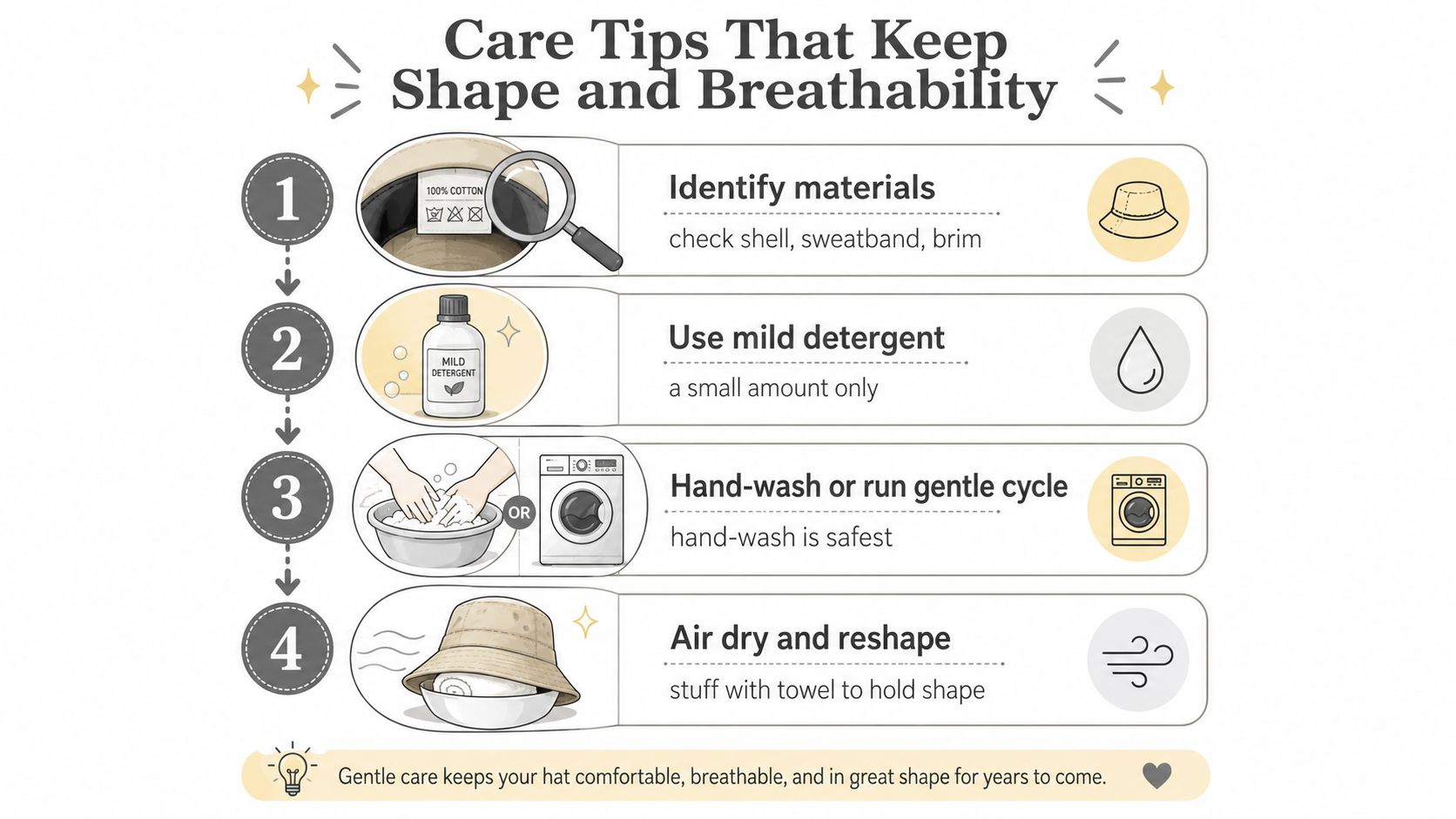
Clean it without wrecking it
Start by identifying the shell, sweatband, lining, and brim materials. Use a small amount of mild detergent, then hand-wash the hat or use a gentle machine cycle only when the label allows it. Skip fabric softener and bleach, and avoid aggressive top-loader agitation that can distort panels, weaken finishes, or crush a structured brim.
Blot visible sweat promptly instead of letting it dry into the band. Brush away dust with a soft brush, then clean the sweatband regularly because it's usually the dirtiest part of the hat. A hat-safe antimicrobial spray can refresh the interior, but only use one that's compatible with the fabric.
Dry and store it properly
Never seal a damp hat inside a gym bag or hot car. Air-dry it in the shade, reshape the crown, and lightly stuff it with a clean towel so it keeps its form. Direct sunlight can fade fabric and weaken some materials, especially when the hat is already damp.
Store the hat upside down or on a broad hook in a cool, dry place. Don't bury it under a pile of clothing. Check the stitching, elastic, and brim periodically, and repair small damage before it spreads. If you're traveling for several days, rotate hats so each one can dry fully between wears.
The cleaning process is simple enough to follow at home:
Your Hot Weather Hat Buying Checklist
Start with the activity, not the outfit. A golf cap, trail-running cap, beach hat, and everyday fedora all make different compromises, so a hat that looks versatile may perform poorly outside its intended use.
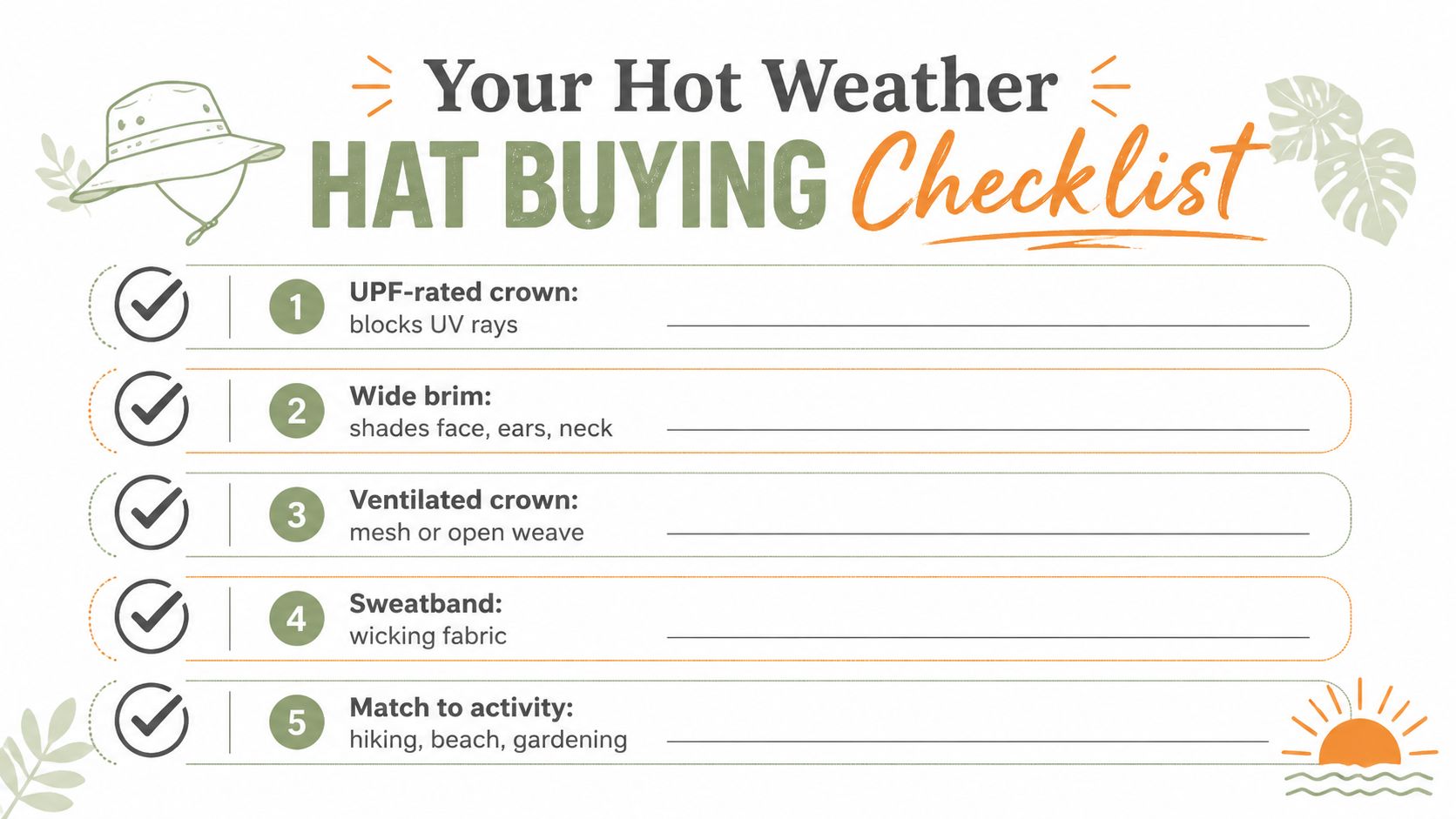
Use this before you buy
- Coverage: Choose a UPF-rated crown and a brim that shades as much of your face, ears, and neck as your activity allows.
- Ventilation: Look for mesh panels, laser-cut openings, eyelets, or an open weave. Don't assume “performance” means cool.
- Sweatband: Check for moisture-wicking fabric, a comfortable depth, and a lining that won't send perspiration into your eyes.
- Brim construction: Use a flexible, packable brim for running and travel, and a broader, firmer brim for beaches, sidelines, and long exposure.
- Fit: Choose an adjustable or shaped fit that stays secure without pressure, slipping, or chafing.
- Climate match: Read verified customer feedback that mentions heat and humidity, not just appearance.
- Claims: Treat cooling, antimicrobial, and UPF language seriously only when the product explains the construction or rating clearly.
- Use frequency: A washable, ventilated hat that holds its shape is often a smarter purchase than a trend piece that becomes stiff or smelly after repeated wear.
A hat also shouldn't carry the entire sun-protection load. If you're building a complete face routine, you can compare tinted sunscreen for your routine alongside your hat choice, especially for skin that remains exposed below the brim.
The short version is simple. Pick the fabric for your climate, the ventilation for your sweat level, the brim for your exposure, and the fit for your movement. For a course-ready option, 2ndShotMVP offers golf hats and lifestyle headwear that can fit this framework, including breathable designs intended for wear on and off the course.
If you want a golf hat that balances course style with practical summer details, visit 2ndShotMVP to browse breathable golf hats, beanies, and lifestyle apparel for men and women. Choose the model that matches your game, your climate, and how long you'll wear it.

