

You're standing on the first tee in a jacket that felt fine in the parking lot, then the wind shifts somewhere around the turn and suddenly the sleeves feel too stiff, the back feels too warm, and you're thinking about the clubhouse instead of the pin. That's the problem with most golf outerwear, it looks right on a hanger, but it doesn't solve the weather you play in.
The golf jacket mens market has grown into a serious category because golf apparel is no longer a tiny niche. Fortune Business Insights values the global golf apparel market at USD 9.47 billion in 2025 and projects it to reach USD 14.83 billion by 2034, which points to a steady 5.19% CAGR from 2026 to 2034. That scale matters because it explains why the rack is crowded with jackets that all promise the same thing, while only a few handle rain, wind, temperature swings, and post-round wear without compromise. For a style-forward comparison of how outerwear came back into everyday wardrobes, the ultimate windbreaker for trendsetters is a useful reference point.
The Search for the Perfect Golf Jacket Mens
The wrong jacket usually announces itself late. It's the one that feels light enough until a gust hits the fairway, or waterproof enough until your swing starts feeling boxed in by a clammy shell. I've worn jackets that nailed one condition and failed the next, and that's why the search usually gets frustrating fast.
The problem isn't choice, it's mismatch
Most shoppers aren't short on options, they're short on a filter. Product pages pile up words like lightweight, windproof, stretch, and waterproof, but those labels don't tell you whether the jacket belongs in a rainy coastal climate, a dry windy course, or a colder shoulder season round. That's where the buying process breaks down.
The better approach is to start with your weather, then work backward to the jacket. A player in Dublin, Seattle, or the Scottish links needs different outerwear from someone teeing it up in Arizona or Texas. If you build from conditions instead of marketing copy, you end up with fewer regrets and less gear sitting unused in the closet.
Practical rule: buy the jacket for the weather you face most often, not the weather you hope shows up.
The category has the commercial weight to support that kind of specialization. Analysts still see growth rather than stagnation in golf apparel, which tells you the market is big enough for everything from pure rain shells to crossover lifestyle layers. That's also why the smartest buyers now think in terms of use case, not just style.
The Evolution of Golf Jacket Design

A golf jacket used to be part of a formal uniform, not a performance layer. Early 20th-century golfers often dressed in heavy tweed jackets, knickerbockers, starched collars, and ties for warmth and respectability, which suited the clubs and customs of the time, but it did little for rotation, balance, or comfort through a full swing. The clothing looked right for the era, yet it asked the player to work around it.
By the 1930s, golf dress had started to shift toward lighter, more practical pieces, and the 1933 US Open heatwave pushed that change further because players and organizers saw how poorly rigid clothing held up in real heat The History of Golf Attire in the UK. That matters because golf apparel did not change only through style trends. It changed because players needed clothing that could handle movement, airflow, and concentration in difficult conditions.
What the old game got wrong
Heavy tailoring could look sharp, but it made the round harder than it needed to be. The jacket was not built around a backswing, a follow-through, or the temperature swings that come with walking eighteen holes, so the clothing controlled the experience instead of supporting it. Modern jackets handle that problem better by reducing bulk and adding stretch, but the bigger change is in how the garment is used.
By the 1950s, golf apparel had moved much closer to what many players recognize now, with lightweight knitted shirts and more casual trousers replacing rigid layers. That shift explains why modern jackets place so much emphasis on mobility, weather protection, and breathability. A good golf jacket now has to function like sportswear first and outerwear second. For a closer look at how wind layers fit into that shift, see men's golf windbreakers and how they evolved with play conditions.
Why that history still matters
The history explains the feature list. A stiff jacket can still look polished in the mirror, but if it pulls across the shoulders on the downswing, it repeats the same mistake the old game already solved the hard way. The best designs keep the cleaner silhouette while removing the parts that get in the way.
Key Features That Define Quality
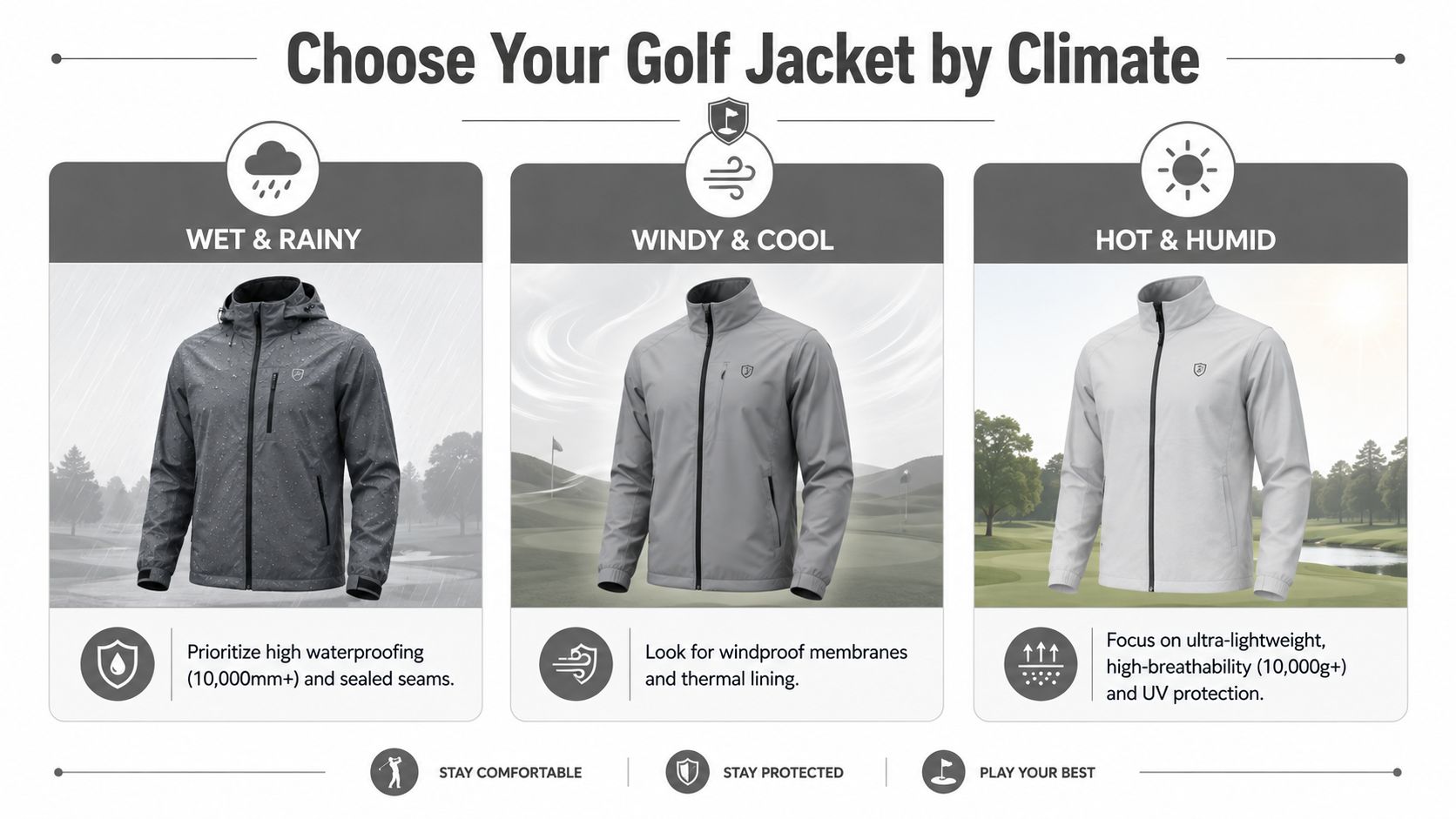
A serious golf jacket lives or dies on two numbers, waterproofing and breathability. The common high-end benchmark sits around 20,000 mm hydrostatic head waterproofing and 20,000 g/m²/24h breathability, because golf is stop-start and rotational, not continuous and straight-line. The jacket has to block rain and still let sweat vapor escape while you're swinging, walking, and waiting.
KJUS states that 20,000 mm waterproofness is the threshold across its men's golf rainwear collection, and pairs that with 30,000 g/m²/24h breathability in its Pro 3L 3.0 Jacket KJUS golf rainwear. That combination shows the trade-off. If the shell traps humidity, you can stay dry from the outside and still feel uncomfortable inside.
What to look for beyond the headline spec
A jacket can post strong numbers and still play poorly if the cut is wrong. Articulated sleeves matter because they follow the swing path instead of pulling across the upper back. A slightly dropped or shaped hem helps coverage without bunching around the hips.
Ventilation matters too. Pit zips, mesh-backed vents, or other controlled airflow features can make a waterproof jacket feel much more usable during warm wet weather. Without that release, even a premium shell can turn into a steam room after a few holes.
A jacket that keeps rain out but traps heat in isn't really solving the round, it's just changing the discomfort.
If you want a useful comparison point, the typical windbreaker discussion in the 2ndShotMVP golf windbreakers guide helps frame the difference between a true golf layer and a casual outer layer. The key distinction is always the same, course movement beats generic style every time.
Choosing Your Golf Jacket by Climate
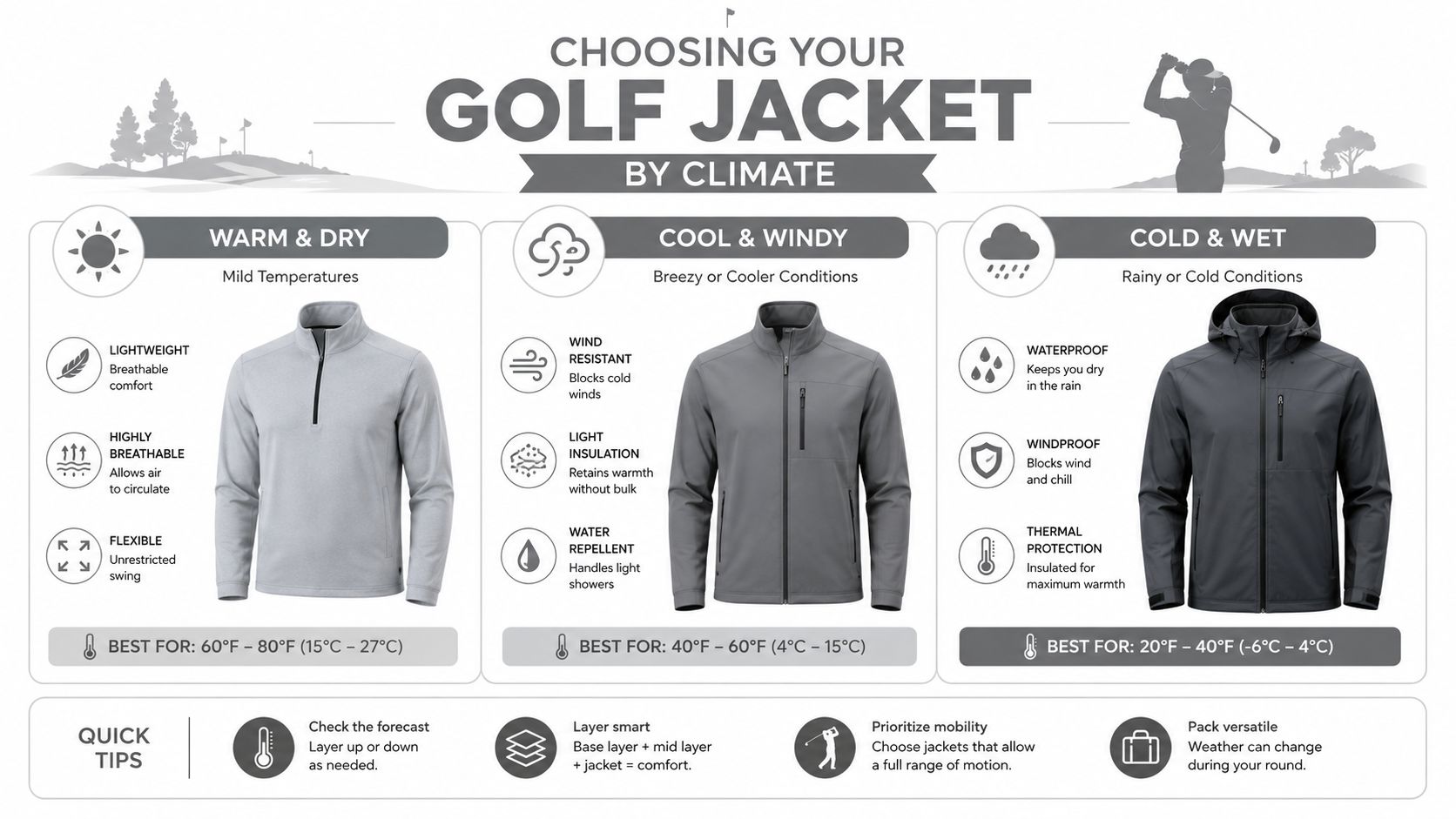
The cleanest way to buy a golf jacket is to stop asking, “What has the most features?” and start asking, “What weather do I play in?” A neutral expert source recommends a three-jacket strategy, rain, wind, or warm/cold-weather outerwear, based on local climate and travel routine The three-jacket strategy for golf. That's the most practical framework I've seen because it respects how golfers really live.
Rain, wind, and cold each need a different answer
A lightweight rain jacket is the right move if your rounds get interrupted by sudden showers or you travel often and need something packable. It should disappear into a bag easily and come out when the sky changes, not weigh you down before the weather turns. In wet climates, waterproofing is the priority.
A wind-resistant softshell makes more sense for crisp, dry days. It doesn't need to be a storm bunker, it needs to cut the chill without blocking movement. Golfers in breezy inland or desert regions often get more use from this category than from a heavy rain shell.
For cold-weather rounds, you need insulation, not just resistance. That might mean a warmer outer layer or a jacket that works over a proper base and mid-layer system. The wrong choice here is buying a rain jacket and expecting it to act like a winter piece.
Match the jacket to your routine
If you play near the coast, rain protection deserves the budget. If you travel for golf and don't know what weather waits at the destination, packability becomes more important. If your local course closes down only when it's miserable, the cold-weather layer earns its place.
The biggest mistake is overbuying features you won't use. A jacket that does everything on paper often does nothing especially well in practice. The climate-first method keeps the purchase honest.
If you want a deeper cold-weather comparison, the best cold weather golf gear guide is a helpful companion when temperatures drop and layering starts to matter.
Sizing, Fit, and Layering Strategies
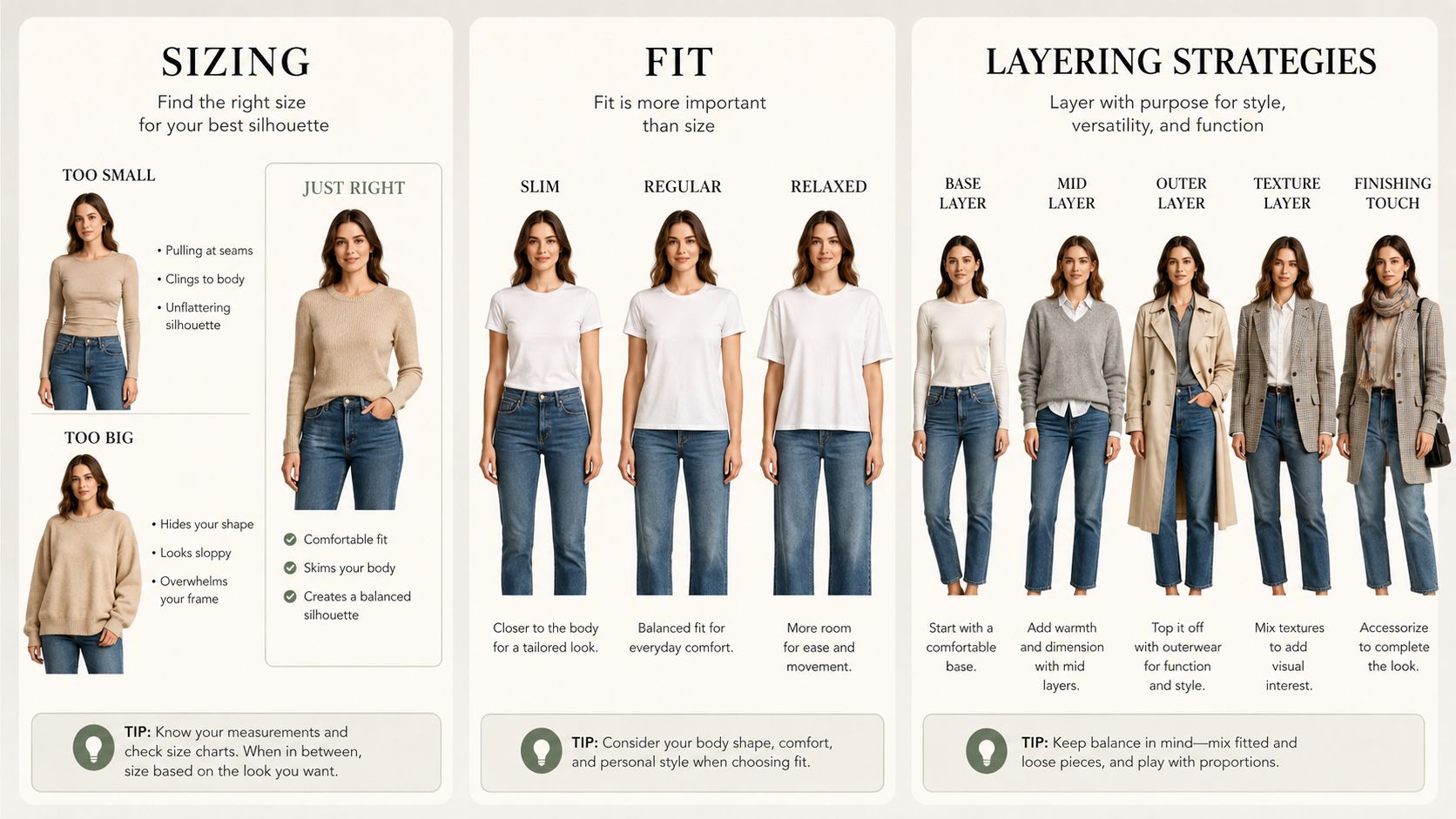
Fit decides whether a jacket feels athletic or awkward. Too tight and the jacket grabs during the takeaway. Too loose and you get extra fabric flapping in the wind, plus a shape that looks more borrowed than chosen.
The fit test I use
Stand tall, then make a full mock swing. Your shoulders should turn freely, the back shouldn't pull across the blades, and the sleeves should still cover the wrist without climbing halfway up the forearm. If the jacket passes that test over a polo, it has a real chance of working on the course.
Layering changes the equation. A lightweight merino wool or synthetic base layer works well under most golf jackets because it regulates temperature without adding much bulk. For colder conditions, a fleece mid-layer adds insulation, but the wrong fleece can make the jacket feel tight fast.
Packability matters more than most shoppers admit
Travel golfers and executives need jackets that compress easily and don't wrinkle into a mess after a flight or a long commute. That's where the category overlaps with lifestyle wear, not just performance gear. Brands are already marketing men's golf jackets alongside outer layers and everyday apparel, which reflects how often these pieces leave the course Straight Down men's golf outerwear.
If you're packing for a trip where weather can change quickly, a practical list helps more than a pile of gear. The Iceland packing guide from Explore Effortlessly is a good example of how a travel-first mindset changes what belongs in the bag. Golf jackets behave the same way, the best one is the one you can carry, layer, and wear again.
Small details that pay off
- Sleeve length: It should meet the wrist cleanly and stay there through the swing.
- Shoulder room: You want freedom, not billow.
- Compressibility: If it won't pack, you'll leave it behind.
- Wrinkle resistance: Important if you move from airport, to car, to course, to dinner.
A good fit does more than look polished. It makes the jacket more usable in real life.
From the Course to the 19th Hole
A golf jacket earns its place when it looks natural after the round, not just during it. The cleanest options move from the 18th green to the clubhouse bar, then into a casual dinner without making you look like you forgot to change. That's the sweet spot, technical enough for the course, restrained enough for everything after.
How to style it without overthinking it
Dark jeans or chinos do most of the work. Pair them with a neutral jacket, then let the texture and cut carry the outfit instead of loud branding. Navy, charcoal, and olive usually give the most mileage because they read as intentional rather than overly sporty.
A well-chosen golf hat can finish the look without making it feel costume-like. 2ndShotMVP's headwear and golf lifestyle pieces fit naturally into that course-to-city lane, and their stylish golf apparel notes reflect the same crossover idea. For a bit of clubhouse attitude and tradition, the Ecuadane 19th hole flag is a nice reminder that the post-round setting has its own style language.
The strongest off-course jacket is usually the one that doesn't try too hard.
That's why minimal branding helps. Clean lines, good proportions, and a muted color palette do more for versatility than extra zips or aggressive panels. If a jacket can sit comfortably in a city café and still look right on the course, it has earned real value.
Care and Maintenance Tips
Technical jackets fail faster when people wash them like regular cotton outerwear. Use the care label first, then treat the jacket gently, because the membrane, coating, and finish all matter to performance. A front-loading washer on a gentle cycle with cold water is usually the safer route for technical shells.
Avoid fabric softeners. They can clog the membrane and reduce breathability, which defeats half the point of owning a performance jacket. If the jacket is waterproof, reapply DWR, durable water repellent, when water stops beading and starts soaking into the face fabric.
Keep the shape, keep the function
Air drying is the safest option for most golf jackets. If you need a dryer, use the lowest heat setting and keep the cycle short. Heat that's too aggressive can stress technical materials and shorten the jacket's useful life.
Storage matters more than most golfers think. Wide hangers help preserve shoulder shape, and a dry, ventilated closet keeps mildew and lingering moisture from becoming a problem. If a jacket comes home damp from a rainy round, don't cram it into a gear bag and forget it.
A little maintenance keeps the performance intact. That's the return on investing in quality outerwear, it keeps performing as long as you treat it properly.
Final Thoughts on Golf Jacket Selection
The right golf jacket starts with your climate, not a product wall. If you mostly play in rain, buy for waterproofing. If wind is the issue, buy for resistance and mobility. If cold cuts the season short, buy for warmth and layering.
Fit, packability, and off-course style all matter too, because the best jacket works in more than one part of your week. The smartest purchase is the one that fits your local weather, your travel routine, and your wardrobe without forcing compromise.
If you want golf headwear and lifestyle pieces that fit the same course-to-city mindset, visit 2ndShotMVP and build around outerwear that works in real weather. Their premium hats and apparel are easy to pair with a jacket that leaves the tee box ready and the clubhouse look intact.

