

You're standing beside the green, your playing partner is ready, and your ball marker has vanished into the bottom of your pocket. You find a coin, drop it, pick it up, and try not to hold up the group. A women's golf hat with magnetic ball marker removes that small annoyance by putting the marker where your hand naturally goes, on the brim.
That sounds like a minor upgrade until you use one through a full round. Then the differences become obvious. The right system feels invisible during your swing, stays accessible around the green, and works with more than a standard baseball cap. The wrong one snags fabric, slips in wind, or turns a stylish visor into an uncomfortable piece of hardware.
This guide focuses on the details product pages often skip, including bucket hats, ponytail designs, sweat, wind, brim construction, and long-round comfort. The recommendation is straightforward: choose the hat for its fit and performance first, then judge the magnetic marker as an integrated piece of golf equipment rather than a decorative extra.
Why Magnetic Ball Markers Are Changing Women's Golf Headwear
A marker clipped to your hat makes sense the first time you need it. You reach up, remove the marker with one hand, place it beside the ball, and continue. There's no pocket search, no loose coin hiding beneath a glove, and no pause while your group waits.
Golfers once improvised with coins, tees, and small pebbles. As the game became more commercialized, dedicated markers appeared, followed by magnetic versions that attach to a hat brim or visor. The appeal is practical. A marker stays immediately available and is less likely to disappear than a loose object stored in a pocket, as described in historical summaries of magnetic golf ball marker development.
The market is changing with the golfer
The timing matters. The National Golf Foundation's account of female golf participation reports that 28.1 million Americans played on-course golf in 2024, the highest level since 2008. Women made up 28% of those players, and women and girls represented the highest share recorded in that data.
The same NGF data reports that female on-course participation climbed 45% from 2020 to 2025, adding 2.5 million players and bringing the total number of female on-course golfers above 8.1 million. Women and girls accounted for 52% of net participation gains in green-grass golf during that period, while female representation in the traditional golfer population rose to 28% from 20% in 2012. That's a substantial shift in who buys golf apparel, accessories, and course-ready headwear.
Golf hats now have to do more than block glare. They need to manage sweat, stay comfortable during movement, complement an outfit, and look appropriate beyond the first tee. That makes a magnetic marker especially useful because it adds a course function without requiring another accessory.
Convenience should still look polished
A marker doesn't need to dominate the design. The best versions sit close to the brim, match the hardware, and avoid the look of an afterthought. That same balance applies to wider golf styling, especially for players building a wardrobe that moves between sport and everyday wear. Resources such as modern modest clothing from House of Saint can help with ideas for polished coverage and versatile silhouettes that pair naturally with functional headwear.
My view is simple. If you regularly play, a magnetic marker belongs on at least one hat in your rotation. It won't lower your score, but it removes a needless interruption and gives a purpose-built accessory a place in modern women's golf apparel.
How a Magnetic Ball Marker Hat System Works
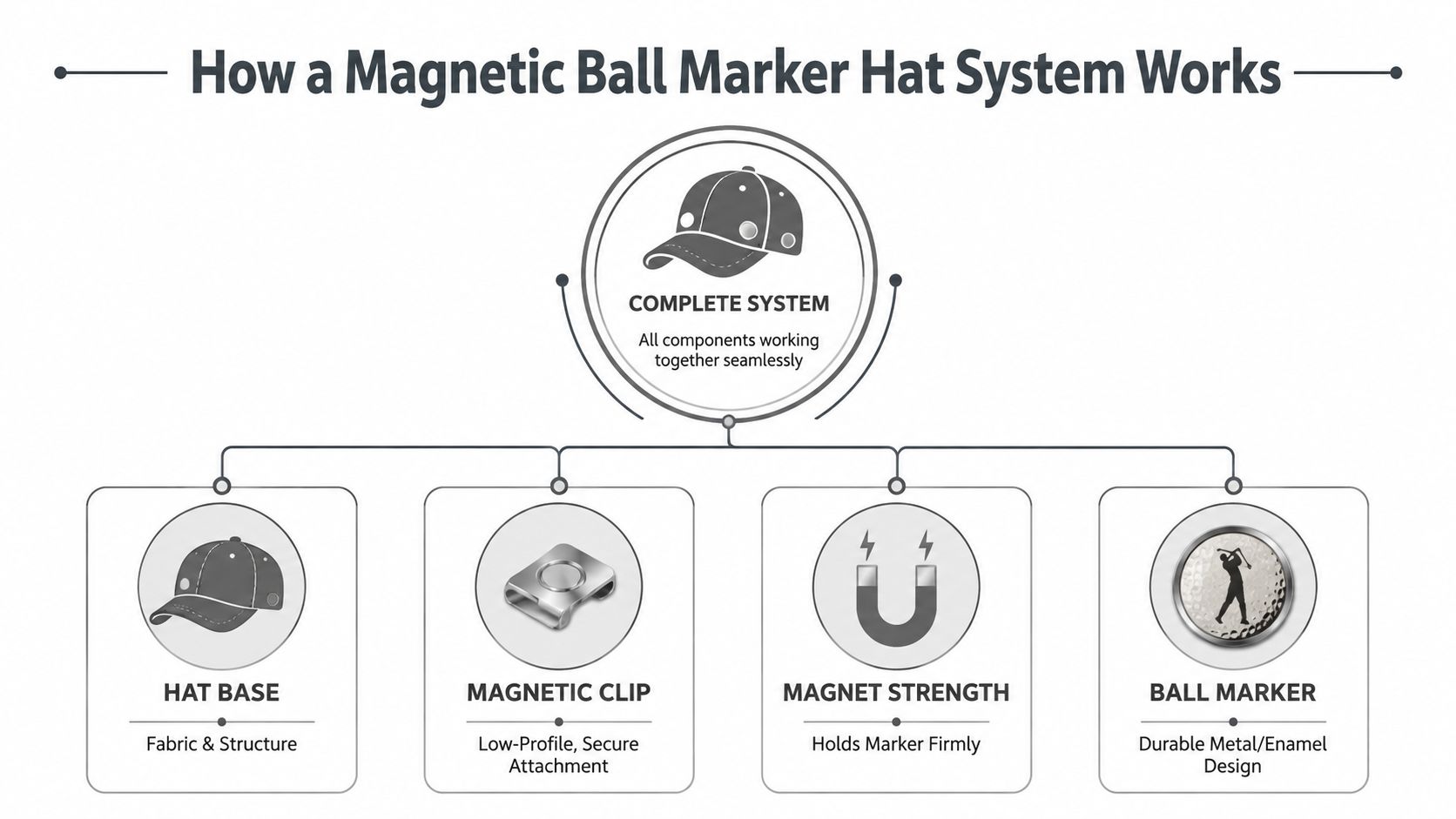
A magnetic hat system has four parts. The clip, magnet, marker, and brim must work together, or the accessory becomes more trouble than it is worth.
Start with the clip
The clip grips the brim, so its shape and material determine how well the system stays put. Choose a low-profile clip made from corrosion-resistant metal or a soft polymer. Repeated attachment concentrates pressure in one spot. A rigid, sharp edge can deform fabric, leave marks, or abrade lightweight performance material. Flexible clips protect the hat better, although an overly soft clip may slip on a thin brim.
Product specifications commonly list zinc alloy or stainless steel for the clip and iron or steel for the marker. Clip diameters around 25 mm are common, while magnets often measure around 10 to 12 mm, according to the Golf Swag magnetic marker clip specifications. That compact format gives the marker enough contact area without making the brim feel crowded.
Judge the magnet by access and security
Magnet strength affects the one-handed grab. A firm connection keeps the marker attached until you pull it away deliberately. Too much pull can shift the clip, especially if the marker catches on another metal object in your golf bag.
The marker should feel substantial enough for repeated handling without dragging the brim out of shape. Metal with an enamel face provides a clean, durable finish. Inspect the rim before buying. A rough edge can catch hair, gloves, or fabric whenever you reach for it.
Match the system to the brim
Structured caps offer the most dependable platform. Their firm front panel gives the clip a stable grip and prevents the marker from pulling the brim downward. Reinforced visors can provide similar support, but balance matters more because there is less fabric around the front.
Soft bucket hats and thin fashion brims require a hands-on test. A clip that holds securely on a structured cap may slide or twist on loose fabric. Attach it near the front or side, then move your head and rehearse removing the marker. Test the motion after a full round as well, since sweat, repeated handling, and fabric movement can loosen a marginal fit.
If the hat shifts before the marker releases, the system is poorly balanced. Select a sturdier brim or leave the marker off that hat.
Practical rule: The marker should come away in one clean motion. If you need two hands or must pinch the brim to stabilize it, keep shopping.
Performance Across Different Hat Styles and Conditions
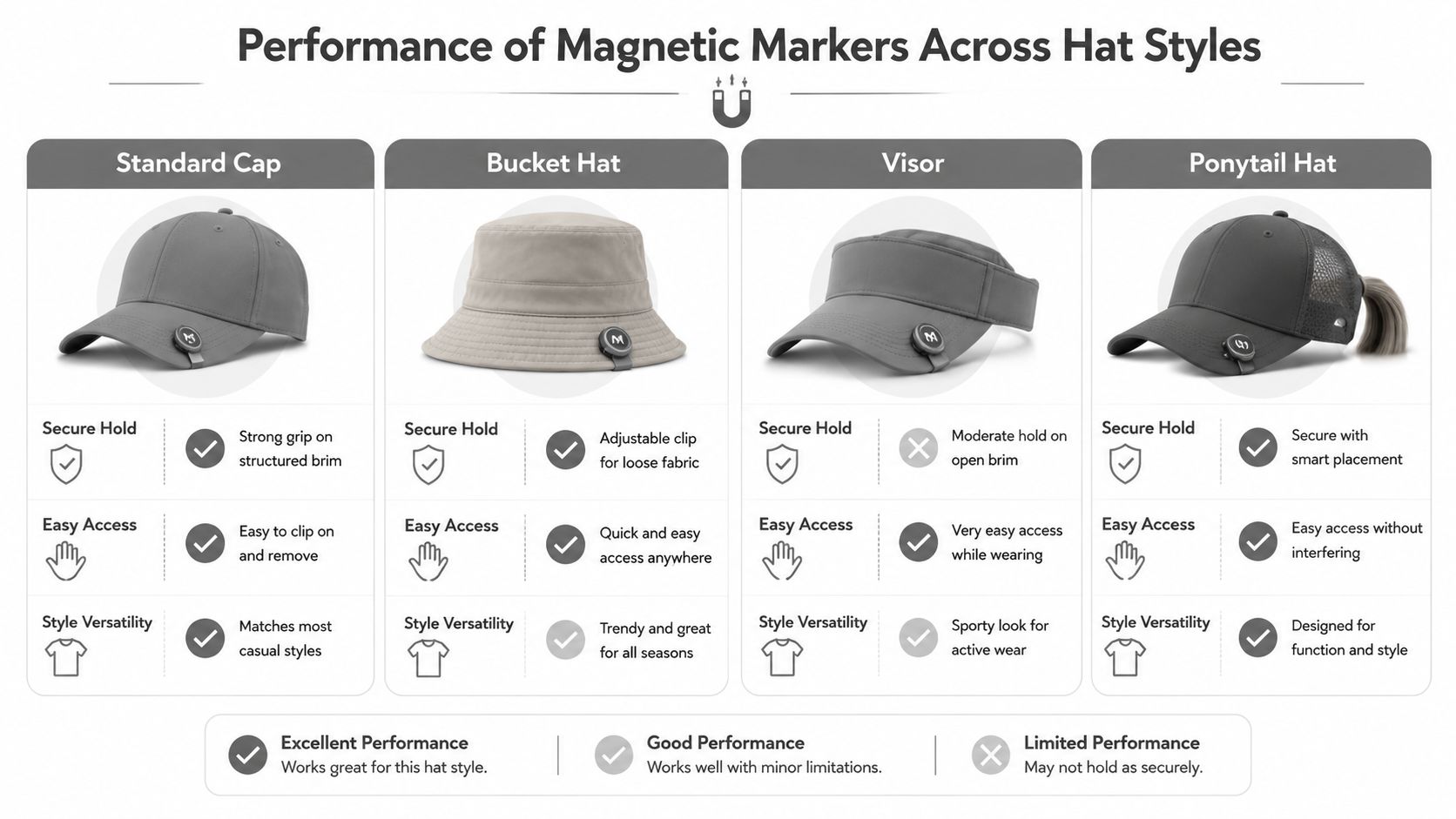
A standard performance cap is the safest pairing because its structured brim resists movement. The clip grips a firm edge, the marker stays visible, and the hat won't usually tilt when you remove it. For most golfers, this is the baseline to beat.
Bucket hats require a real fit test
Bucket hats bring more brim flexibility and more style range, but they're less predictable for clip security. A soft brim can fold under the clip, allowing the marker to rotate or hang lower than expected. Place the clip on a reinforced section if one exists, and avoid attaching it to the loosest part of the edge.
Wind exposes weak designs quickly. A marker with a modest profile creates less drag than a large decorative piece, while a flexible clip can adapt better to fabric movement. If the brim flaps freely, no magnet can compensate for poor mechanical support. Choose a bucket hat with enough structure to support the clip, or use the hat without a marker.
Visors and ponytail hats are more nuanced
Visors often offer excellent marker access because the front brim is open and easy to reach. The drawback is balance. A heavy marker on one side can make a lightweight visor feel uneven, especially if the closure is already loose.
Ponytail-friendly hats introduce another variable. Their rear opening improves hair comfort, but the hat may use a softer, lighter construction. Keep the marker toward the front rather than near the opening, and make sure the clip doesn't catch hair when you remove it. A low-profile system works better than a bulky novelty marker.
Moisture matters across every style. Titleist's Players Ball Marker cap combines 4-way stretch material, a lightweight stretch sweatband, and an internal magnet. That design reflects sound logic. Stretch fabric supports fit, while a sweatband helps limit moisture transfer. Hydrophobic or water-repellent materials and moisture-wicking sweatbands can also reduce slippage when the hat gets damp.
For broader hat selection, compare construction details in performance golf hats rather than relying on a marker description alone. Breathability, brim stiffness, and sweat control determine whether the clip remains comfortable late in the round.
A marker can survive a normal swing if it's mounted correctly, but vigorous movement and wind expose poor fit. Test the hat before play, especially if the brim is thin, flexible, or heavily curved.
Magnetic Hat Markers Versus Traditional Pocketed Options
Pocketed markers still have one undeniable advantage: simplicity. A coin costs nothing extra, doesn't modify your hat, and works with every style from a visor to a wide-brimmed sun hat. If you rarely need to mark a ball or dislike accessories on your clothing, the traditional approach remains perfectly serviceable.
The magnetic option wins on access. You know where the marker is, your hand reaches it without searching, and the marker is less likely to get buried beneath tees, a scorecard, or a glove. That convenience matters most when you're playing in a group that keeps a steady pace.
The trade-off is hardware. A clip can leave an impression on delicate fabric, shift on a loose brim, or pull a lightweight hat sideways. A pocketed marker has no such risk. It also works when you switch between hats during a round, while a hat-mounted marker requires a deliberate transfer.
| Factor | Magnetic Hat Marker | Pocketed Marker |
|---|---|---|
| Pace of play | Fast, immediate access | Can require searching |
| Drop risk | Low when the clip and magnet fit properly | Higher if stored loose |
| Fumble factor | Low, one-handed retrieval | More fumbling in full pockets |
| Clothing wear | Possible clip marks on delicate fabric | No hat wear |
| Hat compatibility | Depends on brim structure and thickness | Works with every hat |
| Weather and movement | Must be tested in wind and during motion | Not affected by hat movement |
| Convenience | Excellent for frequent use | Simple and universally compatible |
The Titleist women's Players Ball Marker cap treats the marker as part of the headwear rather than a separate pocket item. That's the direction I prefer for regular play, provided the hat itself fits well.
A pocketed marker is the reliable fallback. A magnetic marker is the better daily tool when the hat and clip are properly matched.
Fit and Styling Tips for On-Course and 19th-Hole Looks
Start with the hat, not the marker. A magnetic feature can't rescue a cap that pinches, rides up, or traps heat. Choose a secure closure, enough room for your hair, and a brim that sits level without pressing against your eyebrows.
Adjustable closures help fine-tune the fit, but inspect the hardware before attaching a marker. Hook-and-loop closures and square-ring adjustments can leave enough room for a clip on the front or side brim, while a very soft, unstructured hat may need a lighter marker to stay balanced.
Build a rotation around use
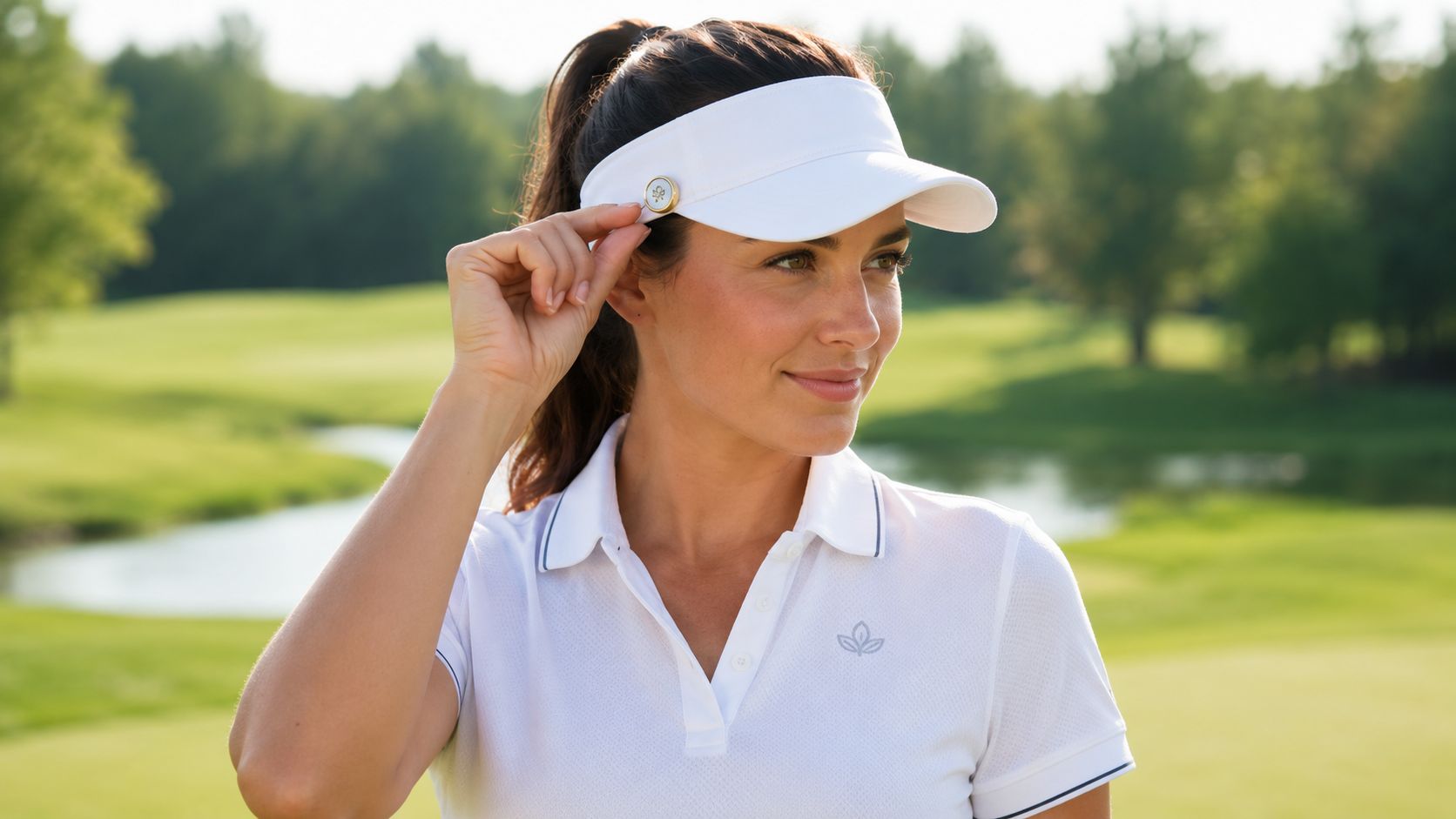
A white or neutral cap works with nearly any golf outfit and lets a metallic or enamel marker act as a controlled accent. Navy, black, and muted earth tones look sharper with understated markers, while brighter apparel can handle a more playful face. Keep the marker's finish consistent with the rest of your accessories if you want the outfit to look intentional.
Athletic outfits pair naturally with stretch caps, curved brims, and moisture-wicking bands. For a more polished look, choose a clean logo, a stable brim, and a marker that doesn't resemble oversized novelty jewelry. The hat should move from tee time to the clubhouse without looking like it belongs only on the practice range.
A ponytail opening should sit comfortably without pulling the hat backward. If the opening changes the hat's tension, mount the marker at the front center or front side rather than near the rear panel. That keeps the accessory away from your hair and reduces imbalance.
For broader wardrobe inspiration, best hats for women offers useful context on matching headwear to face shape, outfit, and occasion. For golf-specific outfit ideas, use golf fashion for women as a reference point, then adapt the suggestions to your course's dress code.
Try the complete look before your round. Put on the hat, attach the marker, bend to read a putt, turn your head, and walk briskly. If the brim shifts or the clip catches your hair, the system needs adjusting before you trust it on the course.
Smart Buying Criteria and Red Flags to Avoid
On a windy hole or late in a full round, a marker system earns its place by staying attached without making the hat uncomfortable. Before buying a women's golf hat with magnetic ball marker, inspect the brim, clip, magnet, fabric, and sun protection in that order.
What deserves your money
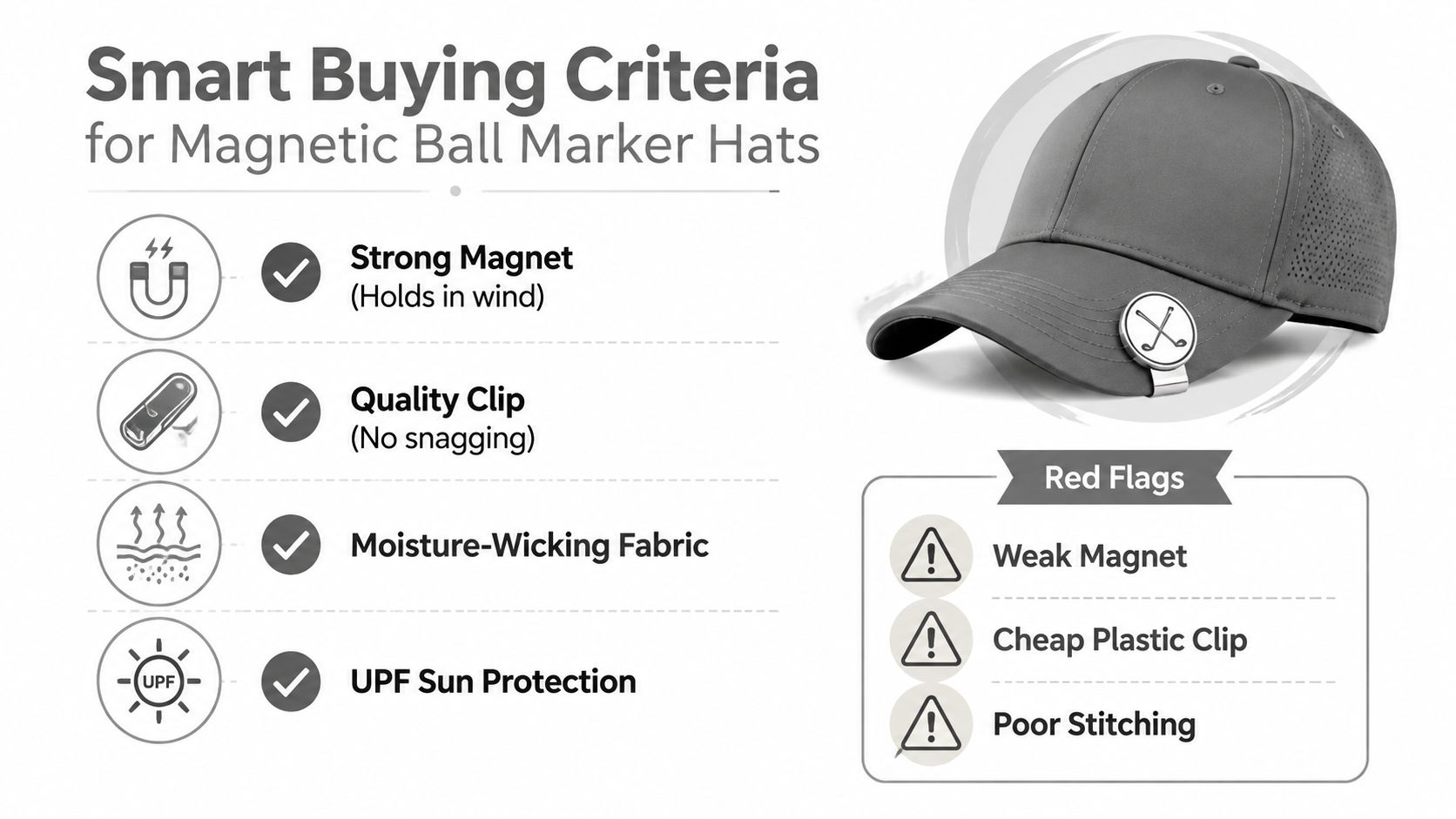
- A secure, controlled magnet: It should hold through walking, bending, and normal swing movement, then release without pulling the brim out of shape. Maximum strength is not the goal.
- A smooth clip: Choose corrosion-resistant metal or soft polymer with rounded edges. The grip must stay firm without snagging fabric or hair.
- Performance fabric: Four-way stretch, moisture-wicking sweatbands, and water-repellent materials matter more than decorative stitching during a damp round.
- Sun-ready construction: Look for a practical brim and clear UV or UPF information. A visor, bucket hat, or ponytail design also needs a marker position that remains reachable without disturbing the fit.
- A compatible brim: Product photos should show exactly how the clip sits. Treat “fits everything” claims without brim guidance as a warning.
Test the attachment for the conditions you play. A clip that works on a stiff cap brim may slip on a soft bucket hat, while a visor can expose the marker to more wind. On a ponytail hat, avoid placing the marker where hair or the opening can catch it. Walk briskly, turn your head, and bend toward a putt before trusting the system for eighteen holes.
Red flags include a magnet that releases during movement, a plastic clip that cracks or loosens, and edges that rub against the fabric. Loose stitching around the brim or sweatband suggests the hat may wear out before the marker.
The women's golf apparel market is expanding, and product quality varies across a crowded field. The women's golf apparel market report estimates the market at USD 1.27 billion in 2025, with hats at about USD 0.19 billion, or roughly 15% of the category. It also reports that nearly 46% of female golfers regularly use caps or visors during play.
Spend more for better fabric, stitching, brim structure, and a replaceable or well-made marker system, not for a logo alone. Sun protection belongs in the same buying decision. Guidance on how to prevent sports eye injuries is relevant when assessing protection for active play.
Care and Maintenance for Long-Lasting Performance
Clean the marker after wet or sweaty rounds. Wipe the face and clip with a soft, damp cloth, then dry both pieces before storing them. Avoid leaving moisture trapped between the clip and brim, especially when the hardware is metal.
Wash the hat according to its care label. A gentle hand wash protects the crown, sweatband, and brim better than aggressive machine cycles. The guide to cleaning golf hats is useful when sweat marks build up around the band.
Store the marker separately if you won't wear the hat soon. That prevents accidental loss and reduces constant pressure on the brim. Keep the hat on a flat surface or a suitable form rather than crushing it beneath clubs or clothing.
Check the attachment point regularly. If the clip begins to loosen, the fabric shows abrasion, or the marker no longer holds reliably, replace the clip or marker if the system allows it. A weakened magnet or corroded surface isn't a minor cosmetic issue. It can turn a convenient accessory into a lost marker during play.
A reliable routine is uncomplicated: dry the hardware, clean the sweatband, inspect the brim, and store the hat without pressure. With those habits, the marker stays useful and the hat remains comfortable enough for repeated rounds.
2ndShotMVP offers golf hats, beanies, and lifestyle apparel for men and women, including designs with adjustable or stretch-focused fit details that can work with course accessories. Visit 2ndShotMVP to find a headwear option for your next round and your post-round plans.

