

You tee off in crisp air, flush the opening drive, and feel perfectly dressed. Then the wind rises, your back tightens, and by the turn you're either sweating under a bulky pullover or shivering between shots. The jacket gets the attention, but the layer touching your skin often decides whether the round feels controlled or uncomfortable.
Golf base layers solve that overlooked problem. They manage warmth, moisture, and movement at the foundation of your outfit, then disappear neatly beneath a polo, quarter-zip, or jacket. The best ones also look good enough to survive the drive home and the 19th hole without making you feel like you're still wearing underwear.
Why Golf Base Layers Are Your Secret Weapon
A base layer is your personal climate-control system. It sits next to your skin, moves moisture away from the body, and helps manage warmth while you alternate between walking, swinging, waiting, and standing in the wind. Golf base layers became a distinct apparel category in the 2000s, when sportswear companies began developing them for performance in cooler conditions. By 2005, Japanese brand Zerofit had already been founded, and later coverage described its products as among the first purpose-built golf base layers on the market. Today's Golfer's history of golf base layers traces how the category moved from niche athletic wear toward mainstream golf clothing.

Skipping that first layer creates familiar problems. Cotton gets damp and stays damp. A loose undershirt bunches under your polo. A thick thermal top adds insulation but interferes with the shoulder turn. You spend the round adjusting clothing instead of reading greens, choosing clubs, and committing to the shot.
The layer closest to your skin matters most
Sweat needs to move off your skin before evaporation can cool you. Fabrics that transport moisture through capillary action and retain less water generally feel better than cotton, which tends to absorb and hold moisture. Golfalot's golf clothing layering guide explains why moisture management matters especially in a stop-start sport, where a golfer can work hard during the swing and then stand still long enough to feel an after-chill.
The practical benefit isn't dramatic warmth for its own sake. It's consistency. A good base layer keeps your torso from becoming clammy, reduces distraction during pauses, and gives your outer layers a drier surface to work over.
On-course rule: Build warmth with thin layers that move, not one heavy garment that fights your swing.
Golfers also spend plenty of time managing physical limitations, especially after years of repetitive swings or an old back issue. If restricted rotation or stiffness affects your game, a resource on sports chiropractic for golfers Utah can help you think about movement alongside clothing. Apparel can't fix a mobility problem, but a correctly chosen base layer won't add another one.
Merino Wool vs Synthetic Fabrics for Golf
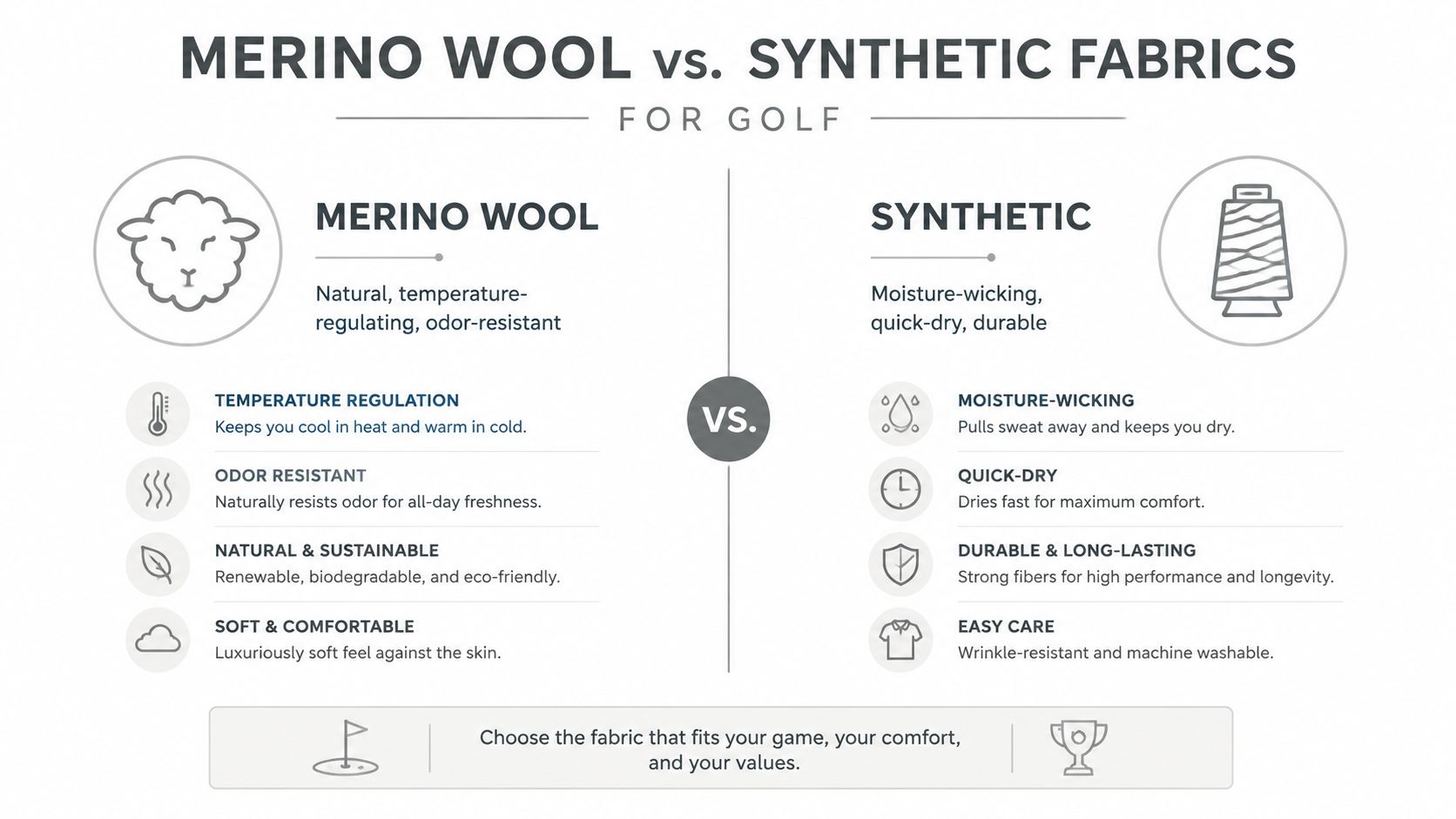
Fabric choice changes the feel of a round more than clever branding does. Merino wool and synthetic fibers, especially polyester, both work well, but they suit different golfers and conditions.
Merino is the better choice when you want broad temperature control and a naturally soft feel. Recent research from a four-year program led by North Carolina State University found that 100% Merino wool base layers delivered superior thermoregulation in stop-go sports including golf. The same research summary reported that wool provided 96% better moisture buffering than polyester, 45% better than cotton, and 26% better than viscose. Textile World's report on the research gives the material a strong case for long rounds in shifting conditions.
Synthetic fabric earns its place through speed and practicality. Polyester dries quickly, feels light, and usually handles repeated washing with less fuss. Independent sports-science literature has also found synthetic base-layer garments more effective than cotton at reducing moisture retention while maintaining skin temperature. If you run warm, sweat heavily, or want a lightweight layer under a summer polo, synthetic is often the straightforward pick.
Choose by playing conditions, not material loyalty
Merino wool feels especially valuable on cool mornings that become mild later. It buffers moisture and manages temperature without the clammy sensation that can follow a damp synthetic garment. Its main drawbacks are price, care requirements, and the possibility that a delicate knit won't tolerate rough handling as well as a durable polyester top.
Synthetic layers make sense for humid weather, high exertion, and golfers who want quick-drying convenience. They're also useful when you need a slim, smooth surface beneath a fitted polo. The tradeoff is that some synthetics can hold odor and feel less comfortable when the fabric is saturated.
For a deeper explanation of how these garments move moisture, consult this guide to moisture-wicking fabric. Then use a simple decision:
- Cool and changeable: Choose Merino or a wool blend for temperature buffering.
- Warm and humid: Choose a lightweight synthetic with strong breathability.
- Mixed conditions: Choose the fabric that feels comfortable when dry and still behaves well after a hard walk.
The best material is the one that matches your sweat pattern, forecast, and laundry habits. Don't buy Merino because it sounds premium, and don't buy polyester because it sounds technical. Buy for the round you play.
Mastering Layering Strategies for Every Season
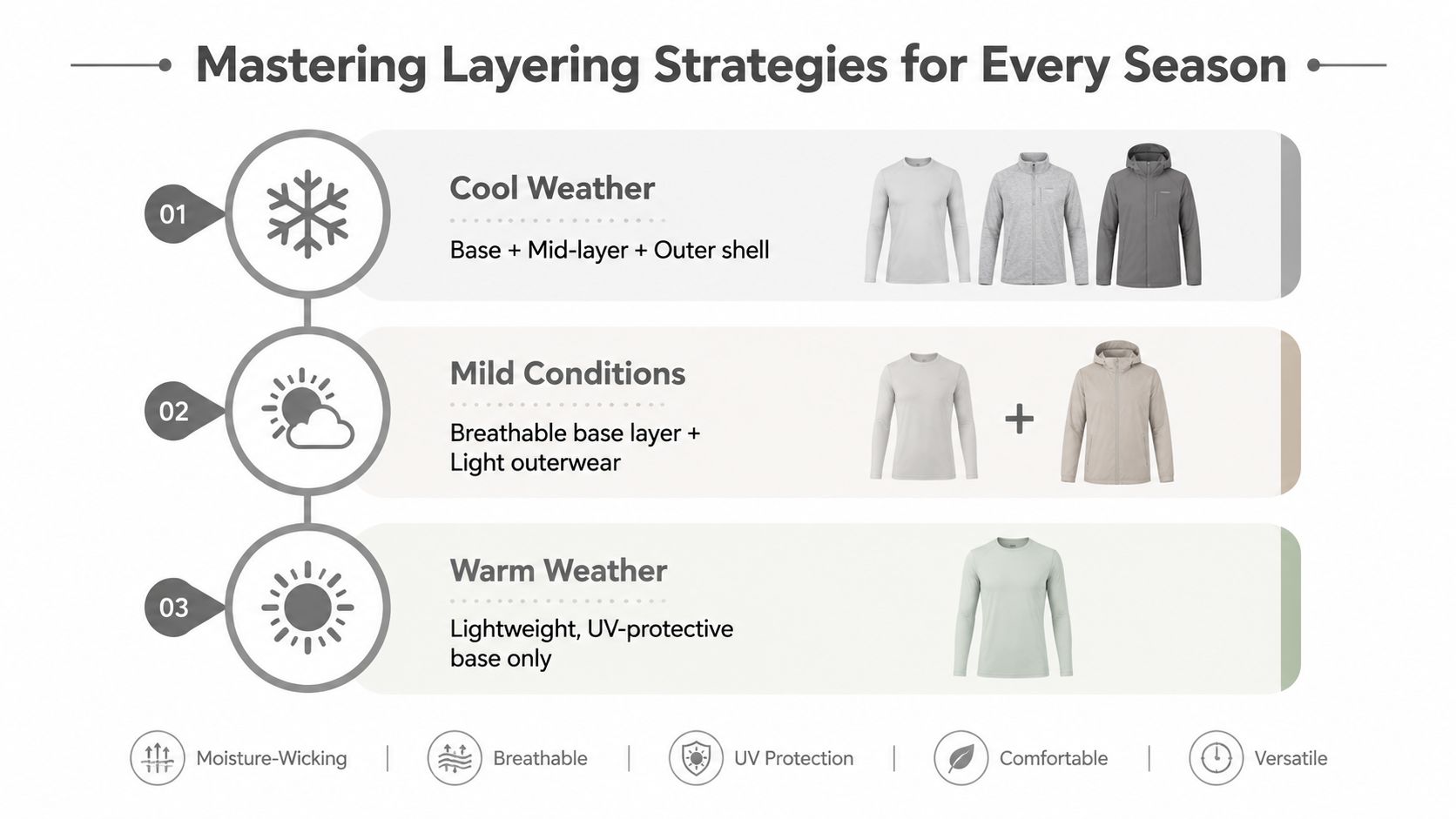
Layering works when each garment has a distinct job. The base layer manages skin comfort. The mid-layer adds insulation. The outer shell blocks wind or rain. Problems start when every piece tries to do everything, creating a thick stack that overheats on the walk and restricts the swing.
Summer needs less fabric, not no strategy
On hot days, use a lightweight, breathable base layer or long-sleeve top when sun coverage and moisture control matter more than insulation. Wear it under a polo only if the combination remains breathable. Otherwise, the base layer can stand alone with shorts or trousers, allowing it to function as performance clothing rather than hidden underwear.
Look for a smooth face, low bulk, and enough stretch for a full shoulder turn. A light, UV-aware long sleeve is particularly useful on cool mornings that warm by the turn, because it can remain visible as part of the outfit instead of becoming a layer you must hide.
Transitional weather rewards easy removal
Spring and fall are where golfers either dress brilliantly or carry half their wardrobe in the golf bag. Start with a light base, add a breathable mid-layer, and keep a wind-resistant outer piece available. Dress for the coldest point of the round, then remove the mid-layer when the temperature rises.
A quarter-zip works well because you can vent the chest without removing the garment. A vest adds warmth around the torso while leaving the arms clear for the swing. For further practical cold-weather ideas, use this guide to cold-weather golf, but keep the central principle intact: every extra layer must justify its weight and bulk.
Winter calls for engineered insulation
Cold-weather golf needs more than a thick shirt. The fabric must trap still air to reduce heat loss while allowing sweat vapor to escape. Recent textile research has described advanced double-layer structures with thermal conductivity as low as 0.039 W/(m·K), moisture permeability above 4000 g/(m²·24h), and a one-way transport index of 1082%. The PubMed-listed research demonstrates that insulation and vapor transport can work together when the fabric uses structures such as gradient pores, lofted inner faces, and balanced hydrophobic and hydrophilic fibers.
Your winter setup should therefore be thin at the skin, warm in the mid-layer, and protective on the outside. Avoid saturating the inner layer. Once wet fabric loses loft, it loses much of its insulating value, particularly when wind reaches you between shots.
Finding the Perfect Fit and Sizing
Fit decides whether a base layer helps your swing or subtly sabotages it. Too loose, and the fabric wrinkles under your polo, shifts during rotation, and bunches at the waist. Too tight, and it can feel restrictive across the chest, shoulders, or upper arms.
Start with your actual measurements, not your usual label. Measure your chest at the fullest point, your waist where the garment will sit, and your sleeve length with your arm relaxed. Compare those measurements with the individual brand's chart because a “medium” can mean a close athletic fit from one company and a relaxed cut from another.
Compression is not automatically better
A compression base layer should feel secure without creating pressure points. The fabric should stay in place as you rotate, reach, and bend, but you shouldn't need to tug it back into position after every shot. If the neckline feels tight, the sleeves pull across the biceps, or the seams dig into your shoulders, size up or choose a regular performance cut.
Regular-fit base layers suit golfers who want comfort, easy layering, and a cleaner transition into casual clothing. Compression fits can work for golfers who like a locked-in feel, but they demand better sizing and careful attention to stretch recovery.
Fit test: Put your arms across your chest, make a slow backswing, and reach toward your toes. If the garment rides up, pinches, or folds beneath the arms, it isn't ready for eighteen holes.
The best fit also supports off-course style. A base layer that lies flat under a polo can become a visible long sleeve beneath a short-sleeve shirt. A refined neckline, restrained branding, and sleeves that finish cleanly at the wrist make the piece look intentional at the bar rather than accidentally exposed.
If you're building a complete outfit around the base layer, compare its collar, hem, and sleeve proportions with modern men's golf shirts. The right base layer should support the silhouette, not compete with it.
Style Meets Function From Tee to 19th Hole
The most useful golf base layer doesn't look like a compromise. It performs during the round, then fits naturally into the rest of your day. That means neutral colors, clean seams, restrained logos, and a shape that works under a polo or beneath a casual overshirt.

A golfer wearing a charcoal base layer beneath a pale polo looks ready for an early tee time. Add a clean quarter-zip for the first few holes, remove it as the day warms, and the base layer remains part of the outfit rather than a disposable thermal hidden underneath. After the round, swap the golf shoes for casual sneakers and add a jacket. The same top can carry the look into lunch or a drink at the clubhouse.
Build around tones that layer easily
Black, grey, navy, cream, and muted blue are forgiving choices. They pair with golf trousers, denim, overshirts, and outerwear without forcing the rest of the wardrobe to match. Tonal layering also creates a sharper appearance than piling contrasting technical fabrics on top of one another.
A visible base layer should have a deliberate neckline and a hem that doesn't flare beneath the shirt above it. If the garment has reflective graphics, loud logos, or racing-style panels, it may still perform well, but it will have fewer off-course uses.
Technical clothing has become more relaxed in styling, and that shift benefits golfers who move between course and social settings. The useful question isn't whether a garment was marketed for golf. Ask whether you'd wear it with chinos, a casual jacket, or a hat after the round.
Here's how that transition looks in practice. Start with a fitted Merino or synthetic long sleeve, add a short-sleeve polo in a complementary tone, and finish with a lightweight quarter-zip. On the course, you can remove the outer layer as conditions change. At the 19th hole, leave the base and polo visible for a clean, layered outfit.
The visual story matters, but performance still comes first. A stylish top that traps sweat or pulls across your back becomes a bad purchase as soon as the round gets demanding.
The video below offers another visual reference for combining golf clothing with a polished, flexible look.
Common Misconceptions About Golf Base Layers
The first myth is that base layers belong only in freezing weather. They don't. A lightweight, breathable long sleeve can help manage moisture and sun exposure during warmer rounds, while a thermal version earns its place on cold mornings. The garment's weight and construction matter more than the label “base layer.”
The second myth is that warmth requires bulk. Modern textile construction proves otherwise. The strongest designs combine insulation with vapor transport, using loft, pore structures, and fiber balances rather than just adding thickness. The result is a thinner system that can protect against chill without turning your torso into a padded tube.
Bulk is a design failure
Six layers are too many if they damage your swing. Recent testing found that dressing a professional golfer in six layers reduced driver ball speed by 6 mph, or 3.7%, as reported by Today's Golfer's winter clothing test. That result doesn't mean golfers should avoid layering. It means every layer must be thin, flexible, and purposeful.
Swing check: If your clothing changes the length of your backswing or makes your trail shoulder feel trapped, remove a layer before you change your swing.
Another misconception says base layers are just thermal underwear and shouldn't be seen. That was true of some old designs, not the best current options. Neutral colors, smooth finishes, and refined cuts allow a base layer to sit visibly beneath a polo or button-down without looking accidental.
Finally, moisture-wicking isn't a magic phrase. A fabric can move sweat away from the skin yet still feel unpleasant if the garment fits poorly, the outer layer blocks evaporation, or the fabric becomes saturated. Treat the entire layering system as one unit. The base layer starts the process, but the mid-layer and shell must let moisture continue outward.
Your Path to Better Golf with the Right Base Layer
The right golf base layer earns its place by solving several problems at once. It keeps the skin more comfortable, supports temperature control, preserves freedom of movement, and gives the rest of your outfit a smoother foundation. That makes it performance equipment, but it also makes it useful wardrobe design.
Start with the conditions you face. If your rounds begin cold and finish mild, choose a versatile Merino or lightweight synthetic layer that can remain comfortable after you remove the quarter-zip. If you play in warm, humid weather, prioritize breathability, low weight, and quick drying. If winter golf is your routine, look for engineered insulation that manages vapor instead of relying on thickness alone.
Make the purchase fit your swing
The garment should stay flat across your back during rotation and avoid bunching beneath the arms. Test the fit in a backswing before you trust the size. Compression can provide a secure feel, but regular performance cuts often offer a better balance of mobility and off-course comfort.
Use the layering system deliberately:
- Start next to the skin: Select Merino, synthetic, or a blend based on sweat, temperature, and drying needs.
- Add warmth in the middle: Use a flexible quarter-zip, light sweater, or vest rather than an oversized thermal top.
- Block the weather outside: Reserve the shell for wind and rain so the inner layers can keep moving vapor outward.
- Plan the 19th hole: Choose a color and silhouette that work with trousers, denim, casual jackets, and your favorite golf hat.
The best base layer isn't necessarily the warmest or most technical garment on the rack. It's the one you forget about during the swing because it stays dry enough, warm enough, flexible enough, and clean enough to wear after the final putt.
A polished golfer's wardrobe now has room for both purposes. The same long sleeve can regulate comfort on the course, sharpen a layered outfit at the clubhouse, and make sense on the drive home. That is the upgrade. You aren't buying another piece to carry. You're choosing the foundation that makes the entire outfit work better.
2ndShotMVP offers premium golf hats, beanies, and lifestyle apparel for men and women, with playful designs made for the course and the 19th hole. Visit 2ndShotMVP to find headwear and apparel that complement your new base-layer system and keep your golf style confident off the course.

