

Most golfers ask the wrong question.
They ask, what is the best golf swing, as if there's a hidden blueprint locked inside a Tour player's finish position. Then they freeze-frame a Rory swing, a Hogan swing, a Scheffler footwork move, and try to paste those pieces onto their own body. That usually creates a swing that looks borrowed and feels uncomfortable.
A better question is this: what swing lets you deliver the club efficiently, repeatedly, and under pressure with your body? That's the swing worth building.
Golf has always tempted players to chase appearances. But a pretty swing isn't the same thing as an effective one. Just like two pitchers can throw hard with very different motions, golfers can move differently and still obey the same laws of speed, sequence, and contact. The body has options. Physics does not.
The Myth of the One Perfect Golf Swing
The idea of one perfect swing is great for highlight reels and terrible for player development.
You can line up a group of elite players and see different backswings, different tempos, different hand heights, different foot action. One player looks compact. Another looks loose and flowing. A third looks almost homemade. Yet they can all strike it beautifully because they solve the same impact problems in their own way.
That's where many dedicated amateurs get stuck. They judge the swing by how it looks halfway back instead of what it produces at the ball.
The real standard is impact
The best swing for you is the one that helps you return the club to the ball in a stable, repeatable way. One coaching perspective argues that the best golf swing isn't a single universal mechanic but the one that maximizes center-face contact for the individual golfer, and that 95% of swing issues resolve when the shaft points at the target line and the club stays in front of the body, from this plane-aligned swing explanation.
That matters because center-face contact is the great truth-teller. You can survive a swing that looks odd. You usually can't survive one that delivers the club inconsistently.
Stop trying to own someone else's swing signature. Build a motion that lets you find the middle of the face again and again.
Why copying pros usually backfires
A Tour swing is shaped by flexibility, strength, timing, practice volume, and years of patterning. If your hips move differently, your spine rotates differently, or your balance pattern is different, copying a pro frame by frame can feel like wearing someone else's shoes in the wrong size.
Focus on principles, not impersonation:
- Repeatable contact: The strike tells you more than the style.
- Match to your body: Height, mobility, and coordination change what feels natural.
- Simple under pressure: If a move disappears on the course, it's not really yours.
- Club in front of you: Many swing fixes become easier when the club and body stay organized together.
The swing isn't an art contest. It's a delivery system.
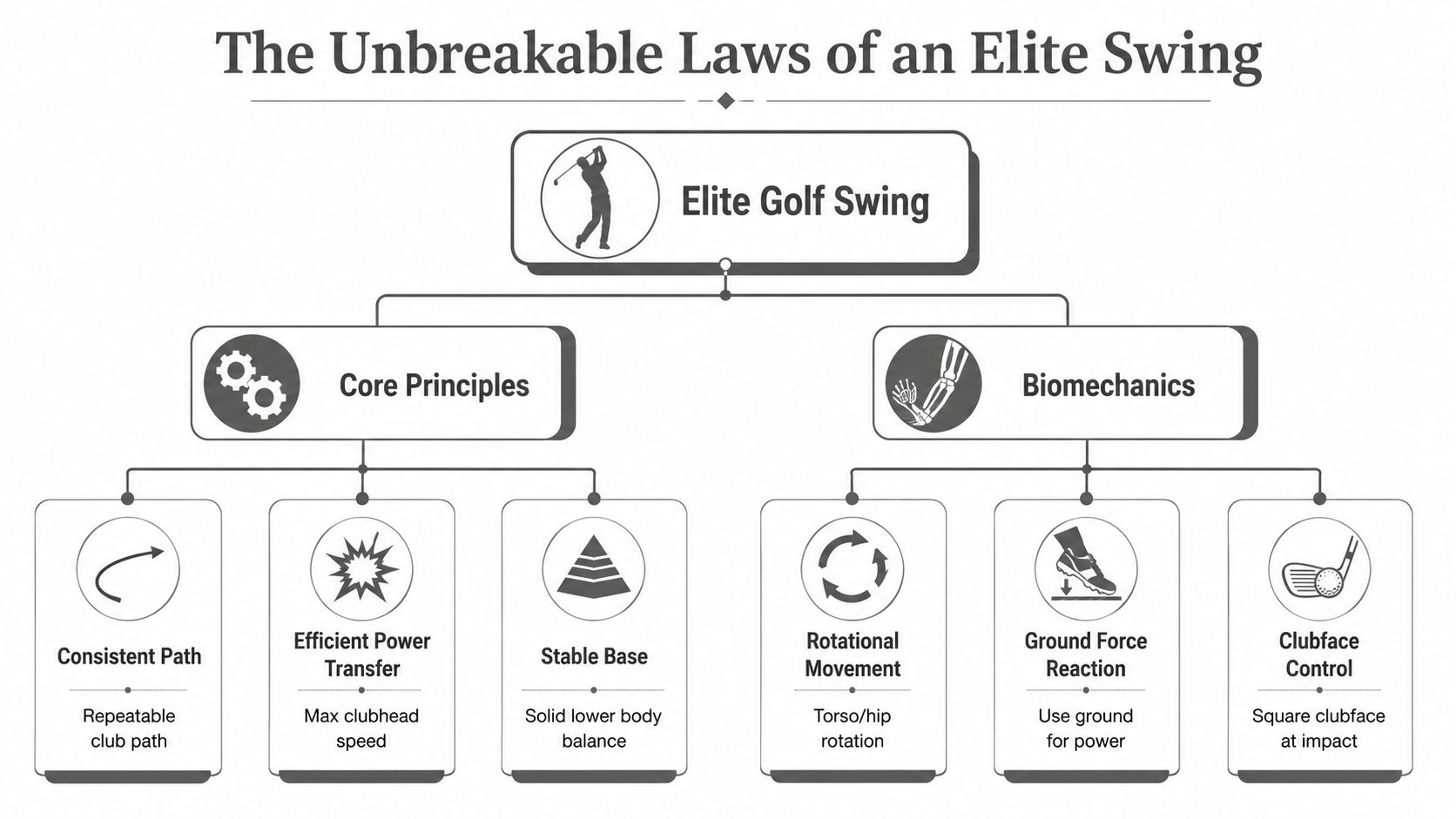
The Unbreakable Laws of an Elite Swing
If you strip away style, elite swings still share a few essential traits. Not cosmetic traits. Biomechanical traits.
Sequence beats effort
Most amateurs try to create speed by swinging their arms harder. That feels powerful, but it often scrambles the order of the swing. Elite players do something different. They build speed through sequence.
A useful way to picture it is cracking a whip. The handle starts first, then energy moves outward. In golf, the body works the same way. The lower body starts the chain, then the torso, then the arms, then the club. When that order is clean, the clubhead gets a free ride from the motion ahead of it.
Research using the Swing Performance Index found that elite professionals had a mean SPI of 100 ± 10, while amateurs averaged 82 ± 4, with a standardized mean difference of 2.12. The index draws from peak pelvic rotational velocity before impact, pelvic rotational velocity at impact, and peak upper torso rotational velocity after impact, and it showed an AUC of 0.97 for classifying pro versus amateur swings in this Frontiers in Sports and Active Living study.
Those numbers give us something coaches have felt for years. Better swings aren't just prettier. They're better organized.
The pelvis is the engine
Your hips don't need to spin wildly. They need to work at the right time.
When golfers hear “rotate more,” many of them overdo it. They slide, stand up, or spin out. Efficient rotation is more like opening a door on good hinges. It moves with purpose, not chaos. The pelvis starts to unwind before impact, and that motion helps pull the rest of the system through.
The torso then reaches its own peak later. That delay matters. It creates stretch, then release. In simple terms, your lower body starts the throw and your upper body cashes it in.
Practical rule: If your arms are trying to manufacture speed on their own, the chain is broken somewhere earlier.
What all great swings have in common
No matter the model, elite motion usually protects these ideas:
- Pressure into the ground: Stable feet help the body rotate without losing balance.
- Ordered rotation: The pelvis leads, the torso follows, the club responds.
- Face control at impact: Speed is useless if the face arrives unpredictable.
- Efficient path: The club doesn't have to be perfect. It has to be repeatable.
A lot of confusion comes from treating the swing like a collection of poses. It's better to think of it as a timed athletic action, more like throwing a ball or swinging an axe. In those motions, nobody asks whether the elbow looked beautiful halfway through. They care whether force arrived in sequence.
The takeaway for serious amateurs
You don't need to swing like a clone of a Tour player. You do need to respect the laws they all obey.
That's the answer to what is the best golf swing. It's the swing that lets your body create organized rotation, deliver the face reliably, and send energy through the club in the right order.
Four Foundational Mechanics You Must Master
Before you chase speed, shallowing, lag, or any of the fun Instagram words, get your foundation under control. Most swing problems start before the club even moves.
Grip and aim
A poor grip is like holding a tennis racket with the wrong hand position. You can still play, but you'll spend the whole day making compensations.
Your grip influences how the clubface behaves through impact. If the face is always fighting to stay square, your body has to rescue the shot on the way down. Start with a grip that lets the clubface return naturally, not one that demands a rescue mission.
Aim is just as sneaky. Plenty of golfers think they have a swing problem when they really have an alignment problem. If your feet, hips, and shoulders are pointed somewhere else, your swing will often invent a path to match.
Stance and posture
Your stance should help you stay athletic, not rigid. Think shortstop, not statue. You want enough balance to move, enough freedom to turn, and enough structure to keep your radius consistent.
A useful benchmark from this golf impact guide is that the optimal swing maintains a consistent spine angle from address through impact, with hands ahead of the ball, while elite players are described as maintaining 0 to 5 degrees of lead wrist extension at impact and generating 90+ mph clubhead speed through coordinated hip rotation and arm extension.
That sounds technical, but the practical lesson is simple. If your posture changes wildly during the swing, low point moves around, face control gets harder, and clean contact disappears.
Good posture doesn't make the swing look better first. It makes impact easier first.
A four-point pre-shot check
Use this before you hit balls on the range:
- Grip pressure: Hold the club securely, not like you're strangling it.
- Body lines: Check that feet, hips, and shoulders match your intended start line.
- Athletic base: Let the knees soften and the feet support you evenly.
- Spine angle: Keep the chest tilted from the hips so your arms can hang naturally.
If mobility limits your setup, don't force a textbook shape. Improve the body where you can. A smart place to start is this guide to golf flexibility training, because a better turn often begins before you ever pick up a club.
One Plane or Two The Great Swing Model Debate
Golf loves camps. One-plane camp. Two-plane camp. Stack-and-tilt camp. Each one has loyal followers who talk as if they've found the final answer.
They haven't. They've found a model.
Different recipes, same kitchen
Swing models are like different throwing styles in baseball. One pitcher is more over the top. Another is more sidearm. If both can command the ball and create force efficiently, both can work. Golf is similar.
The older biomechanical benchmark that has shaped modern instruction says elite swings are defined by a specific order of rotation: the pelvis reaches peak rotational velocity before impact, while the upper torso reaches peak rotational velocity after impact. That pattern, often tied to the X-factor stretch, has remained central in elite training for nearly two decades in this rotational biomechanics paper.
So the question isn't whether one plane or two plane is “right.” The main inquiry is whether your model helps you achieve efficient sequence and reliable impact.
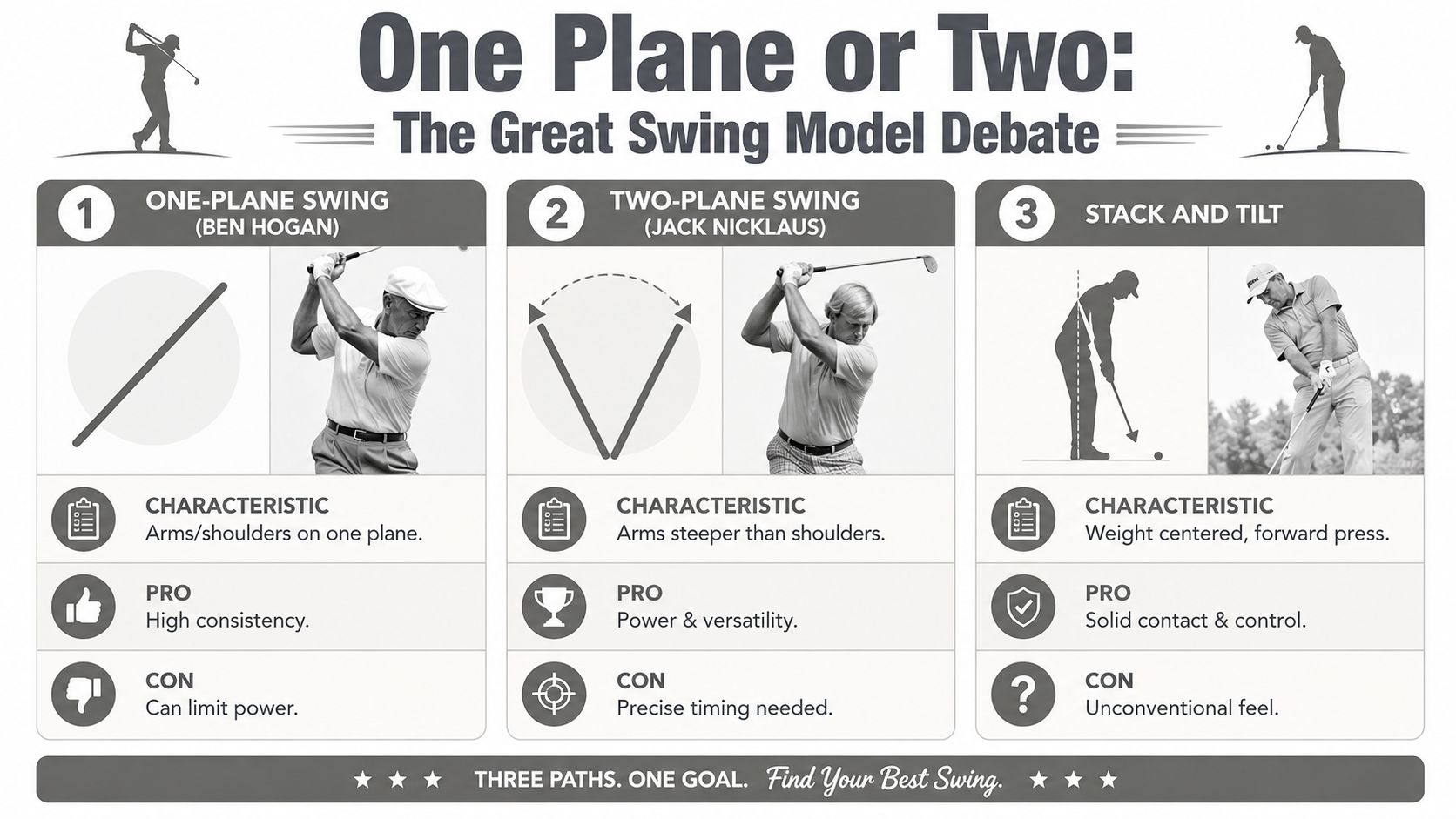
Swing Model Comparison
| Characteristic | One-Plane Swing (e.g., Hogan/Hardy) | Two-Plane Swing (e.g., Nicklaus/Harmon) |
|---|---|---|
| Arm relationship | Arms tend to work more around the body | Arms tend to work steeper relative to shoulder turn |
| General feel | Connected and rotary | More vertical arm swing with turn |
| Common appeal | Golfers who value simplicity and repeatable path | Golfers who like to feel leverage and freedom |
| Possible tradeoff | Can feel restrictive for some players | Often asks for sharper timing |
| Typical miss pattern | Can get too around and trapped | Can get steep or disconnected if rushed |
| Best fit | Players who rotate well and like compact motion | Players who create speed well with arm swing |
Where Stack and Tilt fits
Stack and Tilt is another route, not a rebellion against physics. It tends to organize weight and strike in a very specific way. Some players love the clarity. Others hate the feel.
That's normal. A model is useful only if it helps you solve the ball-flight problem in front of you.
How to choose your model
Try this filter instead of asking what's fashionable:
- Body match: Does the model fit your mobility and balance?
- Contact pattern: Do you hit the center more often with it?
- Pressure test: Does it hold up when you're playing, not just rehearsing?
- Shot shape control: Can you start the ball where you intend?
A swing model is a map. It isn't the destination.
One golfer may need a flatter feel to stay connected. Another may need more vertical arm structure to avoid getting stuck. Neither player wins style points on the scorecard.
How to Film and Analyze Your Own Swing
Your phone can be a terrific coach. It can also lie to you.
Most self-analysis goes wrong before the swing starts because the camera is in the wrong place. Then the player watches a bad angle, sees a fake flaw, and starts fixing a problem that doesn't exist.

A useful teaching point from this golf swing filming guide is that the two key views are down-the-line and face-on, and poor camera placement can create false impressions such as looking over the top when you aren't.
The two views that matter
Down-the-line means the camera sits parallel to the target line at hand height. This view helps you check the club's relationship to your body, your shaft direction, and whether the club stays organized in front of you.
Face-on means the camera is perpendicular to the target line. This view helps you see setup, pressure shift, spine behavior, and impact alignments.
If the camera drifts too far inside, outside, too high, or too low, you're not really studying your swing. You're studying a distortion.
What to look for on video
Don't try to diagnose twenty things at once. Pick a few checkpoints:
- At address: Are you balanced and athletic?
- Takeaway: Does the club move away without immediately getting behind you?
- Top of backswing: Do you still look centered and organized?
- Impact: Are you maintaining posture and delivering the handle with intent?
If you want clearer still frames, tools like frame extraction for content creators can help you pull exact positions from a swing video so you can compare address, top, and impact without scrubbing back and forth.
Build a simple review habit
Film a few swings, not a hundred. Compare your normal shot and your best shot. That contrast teaches you more than doom-scrolling your own flaws.
If you want a deeper tech-assisted breakdown after your basic camera work is solid, this article on AI golf swing analysis is a useful next step.
A short visual walkthrough helps if you're setting this up for the first time:
Essential Drills to Build Your Best Swing
Understanding the swing is satisfying. Owning it takes reps. Good drills turn big ideas into sensations you can trust on the course.

Step drill for sequence
Hit short shots while stepping into your lead side during the transition. The point isn't to look fancy. The point is to teach your body that motion starts from the ground and lower body, not from a frantic throw of the hands.
This drill is excellent for players whose downswing starts with the shoulders. If that's you, the first good rep will feel almost too easy.
Headcover under the trail arm
Place a headcover under your trail arm and make controlled swings. This encourages connection between the arms and torso without making you stiff.
If the headcover drops right away, your arms may be outracing your turn. If you clamp it too hard, you'll get robotic. The sweet spot is connection with freedom.
The best drill is the one that gives you a clear feel for a real problem. Not the one that looks coolest on social media.
Split-hands drill for club delivery
Hold the club with your hands separated on the grip and make half swings. This trains how the club moves through the strike and improves your sense of sequence and face control.
A lot of players instantly notice whether they're yanking from the top or releasing the club too early. It's one of those drills that tells the truth fast.
Feet-together drill for balance
Set your feet close together and make smooth three-quarter swings. This punishes excessive swaying and rewards centered rotation.
Golfers who slide too much often discover they can't stay upright or find the middle of the face with this drill. That's useful feedback, not failure.
Pause-at-the-top drill for tempo
Make a backswing, pause briefly at the top, then swing through. This small pause helps separate backswing from downswing and can clean up rushed transitions.
It also teaches patience. Plenty of players aren't weak or inflexible. They're just in a hurry.
Match drills to your body
Your best swing feel might not match your playing partner's. A taller golfer may need a different posture feel. A less flexible golfer may need a shorter backswing and cleaner sequence. A player with different equipment might respond better to one cue than another.
That's why experimentation matters. Test one drill for a week and judge it by strike pattern and ball flight, not by whether it looks dramatic. If you want more practice ideas built around consistency, this guide on how to improve golf swing gives you more ways to turn good mechanics into reliable habits.
Your Swing Is a Signature Not a Replica
The best swing isn't hiding in somebody else's slow-motion video. It's the motion you can repeat with confidence, control, and enough speed to play the game the way you want.
That's why the smartest answer to what is the best golf swing is personal. Not random. Not anything-goes. Personal within sound principles.
Build your swing around clean setup habits, organized motion, and honest feedback from ball flight and video. Let the body you have shape the pattern. Let biomechanics guide it. Let repetition polish it.
There's also a point where self-coaching stops paying off. If you keep seeing the same miss, can't tell cause from effect, or your feels never match the video, get a trained coach involved. Not because you've failed. Because a skilled set of eyes can shorten the detour.
A good coach doesn't turn you into a copy. A good coach helps you recognize your own signature faster.
If you love golf enough to work on your swing, you probably care how you show up around the game too. 2ndShotMVP makes premium golf hats, beanies, and lifestyle apparel that fit just as well at the range, on the course, or at the 19th hole. If you want gear with personality and clean design, it's worth a look.

