

You're standing on the green with a good look at par. Your ball sits right on a playing partner's line, so you reach into your pocket for a coin. It isn't there. You check the other pocket. Then the pouch on your bag. Now everyone's waiting while you pat yourself down like you've lost your car keys at the airport.
That little scramble is why a golf glove with ball marker has become such a smart piece of kit. It takes a tiny, easy-to-lose tool and puts it in the one place you'll always have access to during a round. For plenty of golfers, that means less fumbling, cleaner routine, and a calmer head before a putt that already asks enough of your nerves.
It also solves a style problem that golfers rarely admit out loud. Loose change in a pressed pair of golf trousers isn't elegant. Digging through a crowded pocket at the club isn't either. If you're the kind of player who goes from boardroom to back nine to the 19th hole, a glove with an integrated marker feels neat, intentional, and a little more polished.
The trick is choosing the right one. Not every marker attachment feels the same. Not every placement works for left-handed golfers. And not every glove that looks sharp on the shelf stays practical in heat, sweat, or a sudden drizzle.
Why a Golf Glove With Ball Marker Matters
A round of golf has a rhythm. Tee the ball. Walk. Assess. Commit. Swing. Then, on the green, slow everything down. Mark. Lift. Clean. Replace. Putt. The smoother that rhythm feels, the more confident you tend to play.
A separate ball marker interrupts that rhythm more often than golfers expect. Coins slide to the bottom of pockets. Flat markers vanish into scorecard holders. Novelty markers look fun until they're mixed with tees, a ball repair tool, and whatever else you tossed into your pocket on the first tee.
The small problem that shows up at the worst time
A golf glove with ball marker fixes a problem that seems tiny until it arrives in a pressure moment. You don't notice the value of easy access on the first hole when everyone's relaxed. You notice it on the back nine when the group behind is close, your putt matters, and you'd rather think about break than pocket inventory.
That's why this glove isn't just a gadget. It's a routine tool.
It's similar to keeping a pencil clipped to a yardage book instead of loose in your bag. Same pencil. Different level of convenience. The tool hasn't changed much. Your ability to use it quickly has.
Practical rule: If a piece of gear removes one repeated annoyance during a round, it often earns its place faster than a flashy club accessory.
It helps both performance and presentation
There's also an etiquette angle. Golf rewards players who look organized and move efficiently without rushing others. Pulling a marker off your glove and getting on with it signals that you know what you're doing. That matters whether you're playing a weekend match, entertaining clients, or joining a member game where first impressions stick.
For executives and style-minded players, there's another appeal. A glove with a marker can look cleaner than carrying a separate branded coin, poker chip, or novelty token. It says you planned ahead. Discreetly.
A good one can also be a conversation piece after the round. Not loud. Not gimmicky. Just one of those thoughtful golf details that people notice when they borrow your pencil, ask about your glove, or wonder why you never seem to be searching for anything.
Where golfers usually get confused
Most confusion starts in three places:
- How the marker attaches: Magnetic clip, pocket, or tab all feel different in use.
- Whether it's legal: Marker size and type matter.
- Whether it fits your hand and habits: Especially if you're left-handed or picky about wrist feel.
That's where golfers often buy the wrong glove. They shop by looks first, then discover the marker sits in an awkward spot, catches their attention at address, or feels annoying every time they adjust the closure.
A smart choice feels invisible until you need it. Then it feels brilliant.
Understanding a Golf Glove With Ball Marker
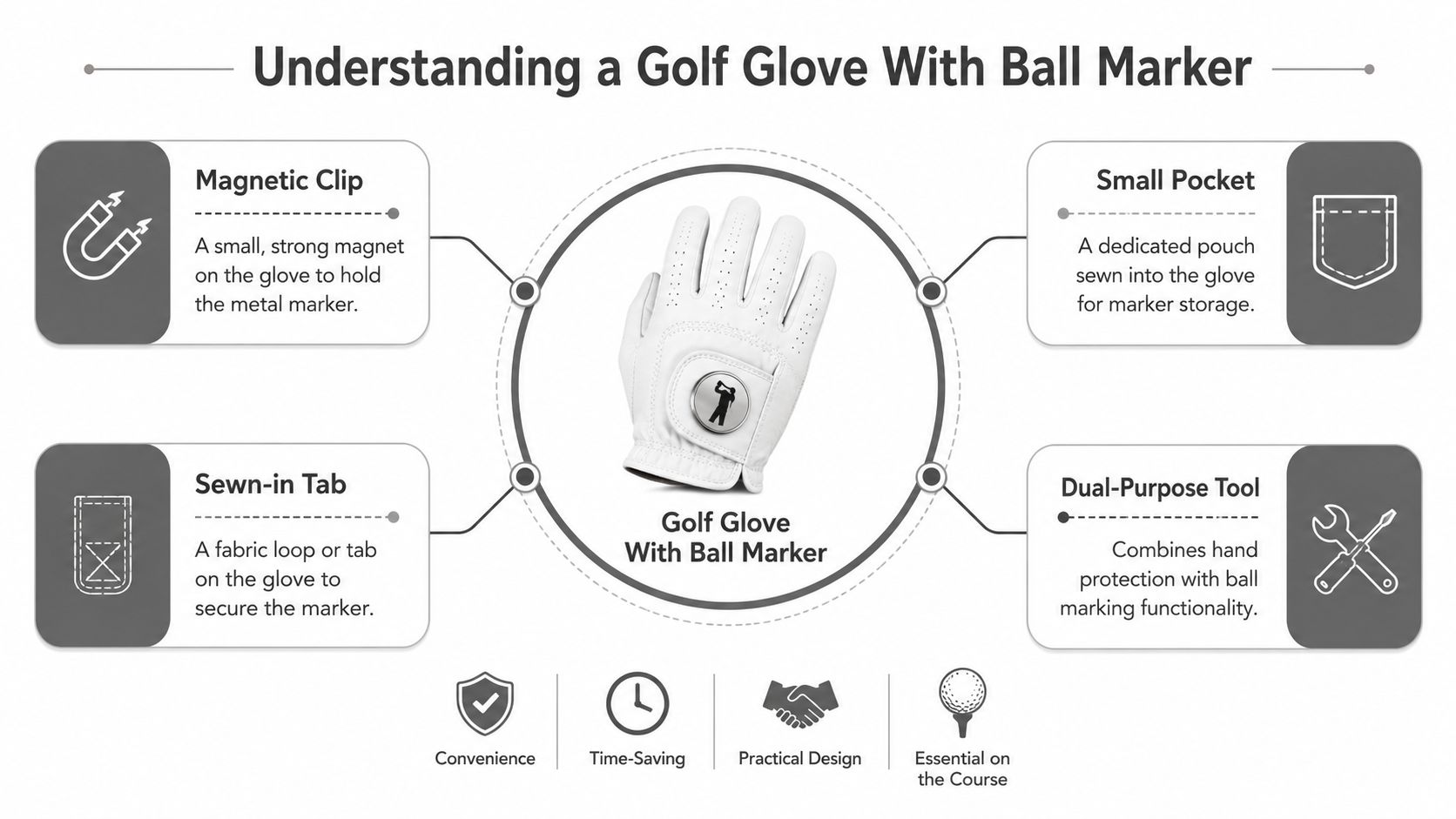
A golf glove with ball marker is exactly what it sounds like. It's a playing glove that includes a built-in way to carry your ball marker, usually on the wrist area, thumb area, or upper part of the glove. Instead of storing the marker in a pocket, the glove stores it for you.
That sounds simple because it is. The value comes from combining two jobs into one item. Your glove already goes with you to every shot. Adding the marker turns it into a dual-purpose tool without forcing you to carry another loose piece of gear.
What makes it different from a standard glove
A standard glove helps with grip, comfort, and hand protection. An integrated-marker glove adds a dedicated storage solution. The most common designs use one of these formats:
- Magnetic clip: A magnet on the glove holds a metal marker in place.
- Small pocket: A stitched compartment stores the marker.
- Sewn-in tab or loop: The marker tucks into a fabric attachment point.
Each design tries to answer the same on-course question. How do you keep a marker handy without making the glove awkward?
That's one reason the category has grown. Golfers already accept gloves as normal equipment. In fact, an estimated 85% of amateur golfers in the United States use a golf glove during play, and integrated marker gloves are among the top three requested premium features, growing by approximately 12% annually, according to golf glove history and feature trend reporting.
How this idea developed
The marker itself wasn't invented by one person. It evolved as golfers began using coins and other small artificial items to mark their ball position. Over time, the Rules of Golf formalized what counts as an acceptable marker, and the equipment world followed by making the process easier and more standardized.
Gloves rose in popularity in the early 20th century, with Sam Snead among the earliest documented professional users in the 1930s. As gloves became ordinary equipment, it made sense for manufacturers to merge glove convenience with ball-marking convenience. That's how the modern glove with integrated marker started to feel normal rather than novel.
A good golf glove with ball marker should feel like you forgot it has a marker until the moment you need one.
Why golfers like the concept so quickly
The appeal isn't hard to understand:
| Feature | What it does on the course |
|---|---|
| Marker stays attached to glove | Reduces pocket searching |
| Wrist-based access | Speeds up green routine |
| One item serving two jobs | Simplifies what you carry |
| Built-in storage location | Makes your setup feel more orderly |
Where people get tripped up is assuming all designs work equally well. They don't. A magnetic model can feel wonderfully fast for one golfer and slightly fussy for another. A pocket design can feel sleek to some and annoying to access to others.
That's why buying one is less about the headline feature and more about how that feature fits your hand, your routine, and your tolerance for anything extra on the glove.
Pros and Cons of Marker Integration
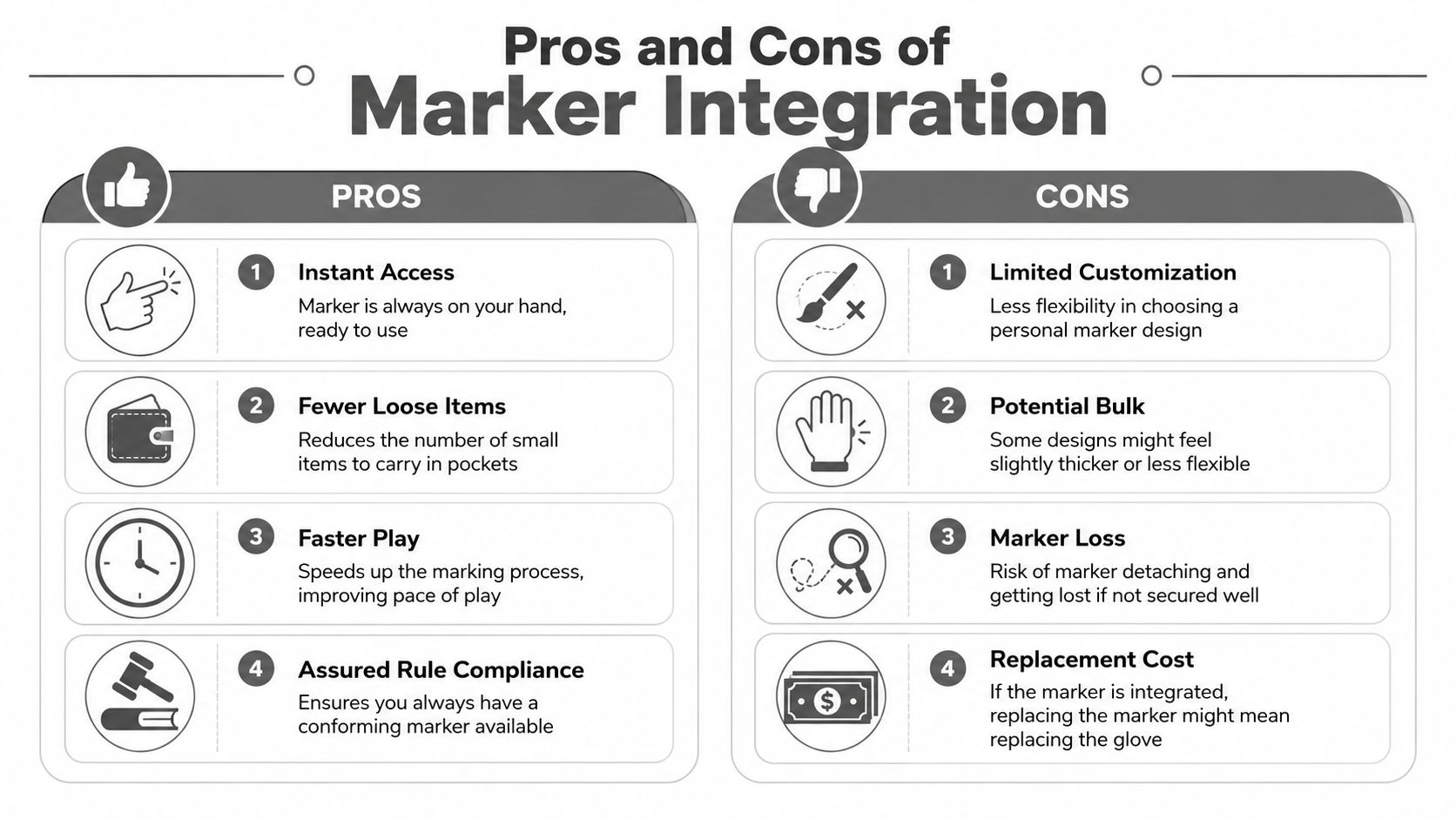
The best thing about marker integration is obvious the first time you use it well. You reach up, remove the marker, mark the ball, and put it back. No digging. No delay. No wondering which pocket it's in.
The catch is that convenience always comes with trade-offs. The same marker that feels efficient to one golfer can feel like wrist clutter to another.
Where integrated markers shine
Most golfers notice the upside on the putting green.
- Instant access: Your marker is already on your hand, which shortens the little pause between arriving at the ball and getting on with play.
- Fewer loose items: One less thing rattling around in a pocket or disappearing into the bottom of a golf bag.
- Cleaner routine: Repeating the same motion each time tends to calm players who like consistency.
- Practical compliance: You're more likely to use a proper marker when one is attached to your glove than when you're improvising with whatever's nearby.
If you play a lot of social golf, this matters more than people admit. Small delays don't ruin a round, but repeated little delays make a group feel disorganized. Good golf habits often look boring from the outside. From the inside, they save time and mental energy.
Where the design can annoy you
The downsides are usually physical rather than theoretical.
A marker on the glove can create slight bulk, especially around the wrist closure. Some golfers never notice it. Others feel it every time they set the club at the top of the grip or adjust the glove between shots.
Then there's personalization. Some players love carrying a marker from a favorite course, event, or club trip. A built-in glove system can limit that freedom, depending on the marker shape and attachment method.
Another concern is loss. If the attachment isn't secure enough, the marker can detach somewhere between tee and green. That risk is one reason some golfers prefer pocket or tab systems over magnets, even if the magnetic style is quicker.
The left-handed golfer problem
This is where many buying guides fall asleep. They assume every golfer experiences marker placement the same way. That's not true.
Industry data reveals that 15% of US golfers are left-handed, yet 0% of integrated-marker glove reviews include left-handed testing or fit-adjustment guidelines, according to reporting on glove review gaps and handedness. That's a real usability issue, not a minor footnote.
For a left-handed player, the marker may sit in a place that's less natural to reach during green play. Even if the glove technically fits, the marker can feel positioned for someone else's habits.
If you're left-handed, don't just ask, “Does this glove fit?” Ask, “Can I remove and replace the marker smoothly without breaking my routine?”
A quick reality check before you buy
Use this simple test in a shop or at home if you can handle the glove before committing:
- Put the glove on fully and fasten it.
- Mimic reaching for the marker while standing upright.
- Mimic the same action while holding a putter.
- Put the marker back without looking too hard.
- Repeat it a few times.
If that sequence feels clumsy in your living room, it won't improve when three people are watching you on a slick green.
Marker Types and Attachment Methods
Not all integrated markers work the same way. Two gloves can look nearly identical on the rack and behave very differently once you're sweating, walking, and trying to mark quickly without dropping anything.
The smartest way to shop is to treat the marker system like you'd treat putter grip shape. There isn't one universal best option. There's the best option for your hand, your patience, and your habits.
The main attachment styles
Magnetic attachment is the fastest to understand. The glove has a magnet, usually near the closure, and the marker snaps onto it. This design feels elegant because access is immediate. Pull it off, use it, click it back into place. The downside is that some golfers become very aware of the hardware on the glove.
Pocket storage hides the marker in a stitched compartment. This can look tidier and feel less metallic on the hand. It's usually slower than a magnet because you have to pinch and retrieve the marker instead of lifting it cleanly away.
Sewn-in tab or loop sits between the two. It's usually simpler than a pocket and less rigid than a magnetic assembly. The marker stays tucked under or through a fabric feature. That can be light and unobtrusive, though not always as slick in wet fingers.
Some golfers also run into adhesive-style add-ons or retrofitted pouches. These are less refined. They can work, but they often feel like a workaround rather than an integrated design.
For golfers who like comparing marker styles more broadly, this guide to golf ball markers and their uses gives helpful context on what different marker designs do on the green.
Comparison of Marker Types and Attachments
| Type | Attachment Method | Pros | Cons |
|---|---|---|---|
| Magnetic marker | Marker attaches to magnet on glove | Fast access, easy one-handed use, clean routine | Can add wrist bulk, may detach if poorly secured |
| Pocket marker | Marker slips into stitched pocket | Neat appearance, less hardware feel | Slower to retrieve, can be fiddly with damp fingers |
| Tab or loop marker | Marker tucks under sewn fabric tab | Lightweight, simple construction | Can feel less secure depending on design |
| Adhesive or retrofit pouch | Added storage attached after manufacture | Useful as a temporary fix | Often less durable, can feel awkward or untidy |
| Alignment-aid style marker | Marker includes visual aid and mounts via magnet or tab | Easy to spot, may help lineup habits | Some golfers dislike added visual fuss |
When each type tends to suit a golfer
A magnetic glove suits players who hate delays and like crisp routines. If you're the sort of golfer who keeps tees lined up and your towel folded the same way every round, magnetic access will probably appeal to you.
A pocket style often suits golfers who care about a more understated look. It can feel a little more traditional. Less gadget, more garment.
Tab systems suit golfers who want a light glove and don't mind a little extra finger work. They're often the choice for players who dislike the idea of a magnet but still want a marker attached somewhere predictable.
What to watch for beyond the headline feature
The marker system shouldn't interfere with three things:
- Closure comfort: If the marker crowds the wrist strap, you'll notice it.
- Putter feel: Some golfers become distracted if the glove feels bulky while putting.
- Storage return: Taking the marker out is only half the job. Putting it back should be easy too.
That last one matters more than buyers think. A glove can feel great in the pro shop when you remove the marker once. It may feel less great on hole twelve when you're trying to reattach it while walking away from the cup.
Choose the system you'll use cleanly, not the one that sounds coolest in product copy.
Using Your Glove on the Course
A golf glove with ball marker only helps if you use it correctly. The good news is that the process is simple. The bad news is that plenty of golfers get casual about it and drift into sloppy habits.
What you want is a repeatable routine that's legal, quick, and polite to the rest of the group.
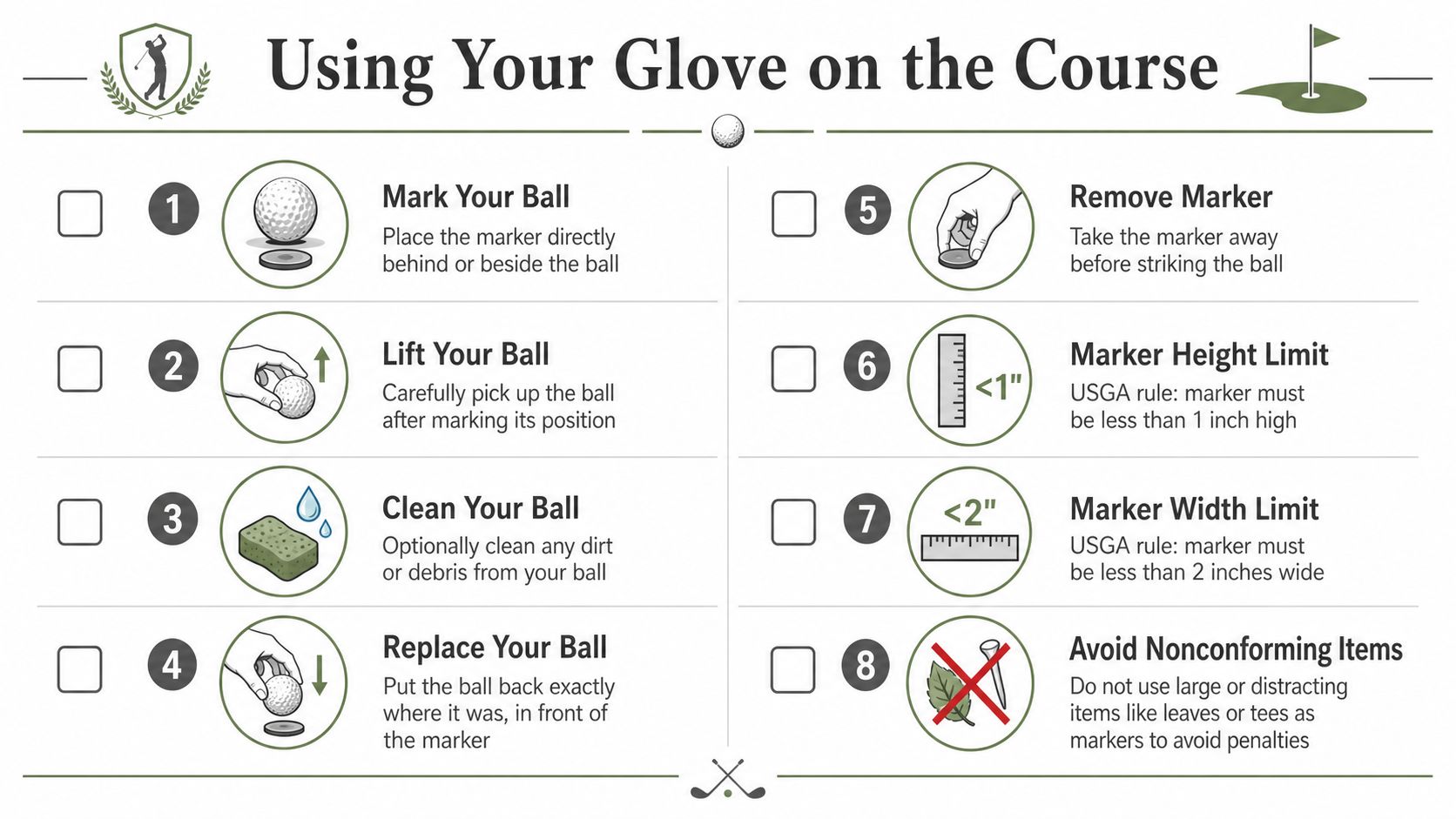
A visual checklist helps lock in the sequence.
The basic routine on the green
Follow this sequence every time and you won't have to think much about it:
- Approach the ball calmly. Don't rush because others are watching.
- Remove the marker from the glove. Use the same hand motion each time.
- Place the marker directly behind or beside the ball. Be precise.
- Lift the ball only after the marker is down.
- Clean the ball if needed.
- Replace the ball in the original spot.
- Remove the marker before you stroke the putt.
- Return the marker to the glove right away.
This routine keeps the green tidy and your head clear. The marker goes from glove to turf to glove again, without wandering into a pocket or onto the edge of the cup.
The rules that matter most
Modern ball markers must be artificial, not natural objects, and they must stay under the size limits recognized in the Rules framework. Specifically, modern ball markers must be under one inch tall and two inches wide, and violating these dimensions brings a General Penalty, which means loss of hole in match play or two strokes in stroke play, according to this history and rules overview of golf ball markers.
That means the cute oversized token your buddy gave you might not be something you want to rely on. It also means a glove marker should be checked for conformity, especially if it has an unusual shape or raised alignment feature.
Keep your marker boring enough to be legal and useful enough to be worth carrying.
Etiquette matters almost as much as legality
The rules tell you what's allowed. Etiquette tells you how not to annoy your group.
- Be accurate: Don't guess at the ball's position.
- Be quick: Mark, lift, replace, and move on.
- Be aware of sight lines: If another player asks you to move your marker, do it without a fuss.
- Be tidy with your gear: Don't leave the marker on the fringe, in your pocket, or on the green after the hole.
If you practice on a home setup or want to understand what makes smooth putting surfaces work so well, resources from professional golf green builders can help you think more carefully about green speed, surface consistency, and why careful marking habits matter.
For a quick visual walk-through, this short video is useful before your next round.
Common mistakes I see from amateur golfers
The first mistake is placing the marker vaguely rather than exactly. On a quiet practice green, that feels harmless. In competition or a money game, it can become a conversation you don't want.
The second is leaving the marker in your hand or pocket after replacing the ball. A glove system helps because it gives the marker a home. Use that home every single time.
The third is choosing novelty over practicality. A marker isn't jewelry. It's a positional reference. If it also looks sharp, fine. But function wins.
Choosing and Caring for Your Golf Glove
Buying the right glove starts with fit, then moves to material, then to the marker system. Most golfers reverse that order. They see the marker feature first, then try to talk themselves into a fit that's only okay.
That's backwards. If the glove doesn't fit your hand well, the clever marker won't rescue it.
Start with fit before anything else
A glove should feel snug without feeling strangled. You want the material to sit close against the palm and fingers so it moves with your hand rather than bunching during the swing.
If you're between sizes, don't guess. Use a proper measuring guide like this golf glove size chart and compare your hand carefully before you buy. A marker glove that's too loose tends to feel even clumsier because the extra movement makes the attachment point shift around more.
Left-handed golfers should be extra picky here. Fit alone isn't enough. Test whether the marker location feels natural to reach and return. A glove can fit beautifully across the fingers and still place the marker in an awkward spot for your routine.
Think about material like a course condition choice
Leather and synthetic gloves feel different on the hand, and that changes how an integrated marker glove behaves.
Leather often feels soft, close-fitting, and refined. It tends to suit players who care about touch and a clean silhouette. Synthetic materials often offer easier maintenance and can tolerate rougher use. Some golfers prefer them for travel, heat, or frequent play.
The right choice depends on what annoys you more. If you hate a glove that feels slightly stiff, you may lean toward softer materials. If you hate babying your gear, you may prefer something that's easier to clean and less precious.
The marker system also plays into that choice. A wrist-mounted magnet on a soft, premium-feel glove may feel luxurious to one golfer and unnecessarily complicated to another.
What matters in magnetic designs
If you choose a magnetic golf glove with ball marker, the attachment needs enough strength to hold during a swing. One verified product specification states that a glove integrating a magnetic marker uses a ferromagnetic steel alloy, typically 304 stainless, with a minimum pull-force rating of 1.2 lbs (0.54 kg) to keep the marker secure during high-speed swings, and the marker itself requires a diameter of 0.5 inches (12.7 mm) for size and visibility requirements in that product context, according to the product specification details for a magnetic ball marker glove.
You don't need to become an engineer when buying a glove. But you do want the attachment to feel confident, not tentative. If the marker seems easy to dislodge by accident, that's a warning sign.
Course-tested habit: Tug lightly on a magnetic marker before you buy. If it comes away too easily in a calm shop, it may not inspire confidence during an actual round.
Caring for the glove without ignoring the marker
Care matters more than golfers think, especially with integrated designs. Industry research shows that 68% of golfers wash gloves weekly, yet 0% of product reviews for magnetic-marker gloves test marker strength after 10+ wash cycles, creating a durability gap, according to reporting on glove washing habits and review blind spots.
That doesn't prove your marker will fail after repeated washing. It does mean buyers often know less than they think about long-term retention.
A sensible care routine looks like this:
- Remove surface dirt early: Wipe down grime before it sets into the glove.
- Dry the glove gently: Let it air dry flat or naturally shaped. Don't roast it with aggressive heat.
- Store it smooth: Don't leave it balled up in a side pocket with tees and snacks.
- Check the marker attachment often: Make sure the magnet, pocket, or tab still feels dependable.
Wet conditions and durability questions
Humidity, sweat, and rain create one of the least discussed issues in this category. The glove material softens, stretches, and absorbs moisture. The marker system still has to hold up through that change.
This is a genuine blind spot in the market. The durability gap in review testing means golfers often buy on first impressions rather than on how the glove behaves after repeated wear and washing. If you play in muggy conditions or perspire heavily, that should make you more cautious, not less.
A practical approach is to treat the first few rounds with a new glove as a trial period. Notice whether the marker feels just as secure at the end of the round as it did on the first green. If it becomes fiddlier when damp, that's useful information.
A simple buying checklist
Before you commit, ask yourself these questions:
| Question | Why it matters |
|---|---|
| Does the glove fit snugly across fingers and palm? | Loose fit makes the marker system feel sloppier |
| Can I access the marker quickly while holding a putter? | Green use should feel natural |
| Does the wrist area feel bulky? | Comfort affects confidence |
| Will this material suit my usual weather? | Heat and moisture change glove behavior |
| Can I care for it consistently? | Good maintenance protects both glove and marker |
Good gear should reduce friction, not introduce a new kind. If you find yourself negotiating with the glove before buying it, keep shopping.
Styling and Gifting Your Glove
Golf style works best when it looks effortless. Not accidental, not costume-like, just put together. A golf glove with ball marker can play a surprisingly useful part in that because it sits right in the visual field. People notice hands, watches, cuffs, gloves, and the little details around them.
That means your glove can either look sharp and intentional or look like an afterthought you grabbed from a bargain bin.
Style on the course and at the 19th hole
For players who care about appearance, the integrated-marker glove has a quiet sophistication. It suggests you've thought about utility without piling on visible gadgets. That's especially useful for executives who want their golf look to feel polished without trying too hard.
The easiest styling move is coordination, not matching. A white or neutral glove with a restrained marker works with almost anything. A more colorful glove can become a statement piece if the rest of the outfit stays calm.
If you like playing with personality, these ideas around colorful golf gloves can help you think through when a bolder glove adds flair and when it starts shouting over the rest of your look.
A few combinations that tend to work well:
- Executive clean: Crisp polo, well-fitting trousers, understated glove, polished shoes.
- Clubhouse casual: Patterned polo, modern quarter-zip, glove with a neat wrist marker, relaxed but still sharp.
- 19th-hole flair: Keep the glove simple if your hat or shirt already carries the personality.
Your glove as a finishing detail
Golfers often obsess over clubs and ignore what sits in plain sight all round. But accessories tell their own story. A glove with a tidy marker system says organized. A glove that's frayed, stained, or paired awkwardly with the rest of the outfit says the opposite.
The glove also lives near other visible gear choices. If you enjoy making your cart and on-course setup feel as considered as your apparel, these ideas on Van Dyke Outdoors' cart enhancements pair well with that same practical-but-stylish mindset.
The best golf style doesn't look expensive first. It looks coherent first.
Why it makes a better gift than most golf accessories
Golf gifts often fail because they're too personal or too random. Clubs are risky. Balls can be too generic. Novelty items get one laugh and then disappear into a drawer.
A golf glove with ball marker sits in the sweet spot. It's practical, visible, and slightly more thoughtful than a sleeve of balls. It says, “I know you play enough to appreciate this.”
It's especially strong as a gift for:
- Client golf outings: Useful without feeling overly intimate.
- Member-guest events: A refined item people will use.
- Birthdays and retirements: Personal enough to feel considered.
- Captain's trip bags or tournament favors: Better than another forgettable trinket.
How to gift one well
Presentation matters. A glove tossed in a plastic bag feels like an errand. A glove wrapped with a note, tucked beside a ball marker tool, or paired with a towel feels intentional.
For a tasteful gift, think about three things:
-
Fit confidence
If you don't know size, ask discreetly or choose a gift format that allows an easy exchange. -
Style personality
Some golfers want classic white only. Others enjoy bold color, logo work, or a marker with a bit more visual character. -
Use case
Is this golfer a weekly walker, a corporate host, or a player who spends as much time on the patio as on the practice green? Buy for that life, not for some imaginary version of their game.
A thoughtful glove gift lands well because it joins form and function. That's rare in golf, where many gifts lean hard toward one side or the other.
Summing Up Your Golf Glove Choice
The best golf glove with ball marker does three jobs well. It fits your hand properly, keeps the marker easy to reach, and stays out of your way when you swing and putt. If one of those three fails, the feature stops feeling helpful.
For many golfers, the winning choice will be simple rather than flashy. A marker that's easy to remove and return. A glove that stays comfortable through the round. A look that feels polished on the course and natural at the 19th hole.
Left-handed golfers should be more demanding than most buying guides suggest. Marker placement isn't a tiny detail if it interrupts every green routine. And style-conscious players, especially executives, should treat the glove like any other visible part of their golf wardrobe. Small accessory. Big signal.
Keep your decision grounded in real use:
- Fit first
- Attachment method second
- Course routine third
- Care and durability fourth
- Style as the finishing layer
If a glove passes those tests, it's more than a convenience item. It becomes one of those pieces of gear you stop thinking about because it works reliably.
If you want golf gear that feels sharp beyond the scorecard, take a look at 2ndShotMVP. Their premium golf hats, beanies, and lifestyle apparel bring the same kind of on-course and off-course confidence that makes a smart glove choice worthwhile.

