

So, you want to build a better golf swing? It really comes down to two things: a rock-solid, repeatable setup and a swing sequence where everything works together. The real secret is to stop chasing all those "quick tips" and start focusing on the fundamentals.
We're talking about grip, posture, and a smooth, connected move from backswing to downswing. Get those right, and you'll unlock a kind of effortless power you probably didn't think you had.
Your Path to a Consistent Golf Swing Starts Here
Forget about the firehose of confusing tips and band-aid fixes that never seem to work when you're actually standing over the ball on the course. This guide is for golfers who are sick of the inconsistency and ready to build a reliable, powerful swing that shows up when it matters.
We’re not trying to create some picture-perfect, robotic swing. The goal is to build your best swing.
We'll dig into the core ideas that truly separate consistent ball-strikers from the weekend hackers. The magic isn't in some secret move; it’s about understanding how a great setup and a connected swing create power without you having to force it. It’s time to ditch the guesswork and build a swing you can finally trust.
Why Quick Fixes Are a Dead End
So many golfers get stuck on a frustrating hamster wheel, trying one-off tips they found on YouTube or got from their buddy on the range. Sure, thinking "keep your head down" might help you pure one shot, but it does absolutely nothing to fix why your head was coming up in the first place.
Lasting improvement comes from understanding the cause, not just treating the symptom.
The goal isn't to hit one lucky shot. It's to build a foundation so solid that even your misses are playable, and your great shots start becoming your normal shots. Getting your head around that idea is the first real step to getting better.
Lots of golfers fall for the easy tip, but the best players know that real progress is built on a solid foundation. Let's look at the difference.
Quick Fixes vs Sustainable Improvements
| Common Quick Fix | Potential Negative Side Effect | Sustainable Improvement |
|---|---|---|
| "Keep your head down!" | Restricts body rotation, kills power. | Learning proper spine angle & posture. |
| "Slow your swing down." | Creates a jerky, powerless swing. | Improving tempo and transition sequence. |
| "Keep your left arm straight." | Causes tension, disconnects the arms. | Building a connected, one-piece takeaway. |
| "Tuck your right elbow." | Can get the club stuck behind you. | Understanding proper swing plane mechanics. |
See the pattern? The quick fix is a command, while the sustainable improvement is about understanding a core concept. That's what we're focused on.
A Foundation for Success
To actually improve, you have to focus on building good habits, not just patching up bad ones. Think of it like building a house—you can't start with the paint and shingles. You have to pour a solid foundation. For your golf swing, that foundation is made of:
- A Consistent Setup: Your grip, aim, and posture pretty much determine everything that can happen—good or bad—in the rest of your swing.
- A Connected Sequence: Getting your body to move in the right order is how you generate power without feeling like you're trying to kill the ball.
- Purposeful Practice: This means getting beyond just mindlessly whacking a bucket of balls and using specific drills that teach your body the right moves.
This guide will walk you through each of these building blocks, giving you the tools to stop tinkering and start building a swing that holds up under pressure.
Building Your Swing From the Ground Up

Before you waste another second agonizing over your takeaway or your transition, let's get to the root of the problem. I've seen it a thousand times: almost every maddening swing flaw—the slice, the hook, the topped shots—starts with a sloppy setup. Your swing is made or broken before the club even moves an inch.
We're going to build a rock-solid foundation by focusing on the G-A-P principle: Grip, Aim, and Posture. Get these three fundamentals right, and a good swing becomes the path of least resistance. It's that simple.
Your Only Connection to the Club: The Grip
Your hands are the only part of your body that touches the golf club. That's it. How you hold it has a direct, non-negotiable impact on where that clubface is pointing when it meets the ball. Think of your grip as the steering wheel; a tiny error here gets magnified into a massive miss 250 yards down the fairway.
There's a reason every great instructor preaches a neutral grip. It gives you the best possible chance to deliver a square clubface at impact without having to perform some last-second, high-speed hand gymnastics.
A "strong" grip, with your right hand slid too far underneath the club, is a classic recipe for a snap hook. A "weak" grip, with that same hand too far on top, is practically an invitation to slice. Finding that neutral sweet spot puts you back in the driver's seat.
Here's how to find it. Let your lead arm hang naturally at your side. Now, place the club in your fingers, not deep in your palm, so the butt end rests just below your heel pad. When you glance down, you should see about two knuckles on your lead hand. That simple checkpoint is your key to a consistent, repeatable grip.
Of course, a good grip is only as good as the glove you're wearing. If your glove is slick and worn out, or if it fits poorly, you'll instinctively squeeze the life out of the club. That tension is a swing-killer. If you need help, you can learn more about finding the perfect fit with a comprehensive golf glove size chart to ensure that connection is secure and tension-free.
The Unsung Hero of Consistency: Aim
I can't tell you how many golfers I've seen on the range with a beautiful swing path who still slice the ball into the next time zone. They spend hours trying to "fix" their swing, but the real issue is that their shoulders were aimed 30 yards left of the target from the get-go. Their "slice" was just their body's athletic intelligence trying desperately to get the ball back toward the flag!
Proper alignment takes all that guesswork and compensation out of the equation. It simplifies everything.
A Dead-Simple Alignment Routine
- Pick an Intermediate Target: Stand behind your ball and find a spot just a few feet in front of it that's on your target line. It could be a discolored blade of grass, an old divot, anything.
- Align the Clubface First: This is the most crucial part. Walk into the shot and set your clubface down aiming squarely at that intermediate target.
- Set Your Body: Once the clubface is locked in, set your feet, hips, and shoulders on a line that runs parallel to your target line. Picture a railroad track: the club and ball are on the right rail, and your body is on the left rail.
This whole process takes maybe five seconds, but it eliminates a massive variable. Now you can swing with confidence, knowing you're pointed in the right direction.
Creating Space for Power: Posture
Your posture is the athletic framework that supports a powerful, rotational swing. If you're too hunched over or standing ramrod straight, you physically block your body's ability to turn. This forces your arms to take over, which is the fast track to weak, inconsistent contact.
A proper golf posture should feel athletic and ready. You should feel like you're about to guard someone in basketball or field a grounder at shortstop.
Key Posture Checkpoints
- Athletic Knee Flex: Your knees should have a soft, slight bend. They shouldn't be locked straight or in a deep squat.
- Hinge from the Hips: The biggest mistake amateurs make is bending from their waist. Instead, tilt forward from your hips, keeping your spine relatively straight. This is what frees up your torso to rotate.
- Arms Hang Naturally: From your hip hinge, just let your arms hang straight down from your shoulders. If you feel like you're reaching for the ball, or if your hands feel jammed into your body, either your posture or your distance from the ball is off.
This balanced, athletic stance creates the room your arms need to swing freely and lets your core do the heavy lifting.
Think about it: your ball position changes with every club. A driver is played way up, off your lead heel, to promote an upward strike. A 9-iron is played in the center of your stance to ensure a downward blow. Your posture has to accommodate all these little changes while maintaining its athletic integrity.
By mastering G-A-P, you're not just patching up flaws. You're building a swing that is powerful and repeatable from the ground up.
Unlocking the Secrets to Effortless Power
Okay, with a rock-solid setup, it's time to fire up the engine. This is where we get into the swing sequence—that beautiful, powerful chain reaction that separates the silky-smooth ball-strikers from the golfers who look like they're trying to chop down a tree.
Forget about memorizing a laundry list of positions. The real secret is learning what a connected, powerful swing actually feels like.
We're going to break this down into four key moments: the takeaway, the backswing, the transition, and the downswing. Mastering the flow between these parts is your ticket to generating that effortless speed you see on TV. Trust me, it’s not about brute strength; it’s all about efficiency.
Start with a Silky Smooth One-Piece Takeaway
The first two feet of your swing set the stage for everything else. Get this wrong, and you're in for a world of hurt.
A jerky, handsy takeaway yanks the club off plane immediately, forcing you to spend the rest of the swing trying to salvage the shot. The goal here is a wide, smooth, "one-piece" takeaway.
Picture the triangle formed by your shoulders and arms at address. Your only job in the takeaway is to move that entire triangle back as one unit. No breaking the wrists, no letting your arms run away from your chest.
When you nail this, the clubhead stays low to the ground and travels straight back, staying outside your hands for the first couple of feet. This creates width, which is a massive source of power. A narrow, snatchy takeaway is a certified power-killer.
Winding Up the Spring: Generating Torque in the Backswing
Once the club is away, the backswing is all about coiling your upper body against a stable lower body. Think of it like winding up a spring—you're storing up all that explosive energy you’re about to unleash.
Your primary focus? A full shoulder turn. For most right-handed golfers, that means getting your left shoulder turned back until it’s pretty much over your right foot. This creates a powerful separation between your hips and shoulders, often called the X-factor.
This separation is where the real magic happens.
Weekend golfers often try to muscle the ball by swaying their hips or lifting their arms straight up. That’s a recipe for disaster. A truly powerful backswing is a rotation. You should feel a good stretch building in your core and back as you turn against a braced back leg.
This coil is the true engine of your swing. Without it, you're just swinging with your arms, which means no power and even less consistency.
"The Magic Move": Nailing the Transition
Ah, the transition. This is it—the single most important, most misunderstood, and most butchered part of the entire golf swing. It's that tiny moment where you shift from back to front, and it's where countless golfers kill their shot before the club even starts down.
The classic amateur mistake is a frantic, aggressive lunge from the top, led by the hands and shoulders. This is the dreaded "over-the-top" move, and it's public enemy number one for slicers everywhere. It throws the club onto a steep, outside path, leading to that weak, glancing blow we all hate.
A powerful, pro-level transition is patient. And it starts from the ground up.
How to Start the Downswing Like a Pro:
- Feel the shift. The very first move down isn’t with your hands. It’s a subtle shift of pressure into your lead foot. It's not a big, dramatic lunge—just a gentle "re-centering" of your weight.
- The hips unwind. As that pressure shifts, your lead hip can start to open up toward the target. The key is that this happens while your shoulders and arms are still finishing the backswing.
- Let the arms drop. This brilliant move from your lower body creates a ton of space, allowing your arms and the club to passively drop down onto a powerful inside path. We call this "dropping it in the slot."
This sequence is what creates that beautiful lag you see the pros have. You aren't pulling the club down; you're letting it fall into position as your body unwinds. It almost feels like a pause at the top, even though it’s an incredibly athletic move. Get this right, and it will change your entire game.
Unleashing the Power Through Impact
If you’ve managed to nail the transition, the downswing is the easy part. It’s almost automatic.
With the club already in the slot, all you have to do is keep rotating your body through the shot. Your hips and torso lead the charge, pulling your arms and the club through the impact zone like a whip.
The feeling you're chasing is one of swinging through the ball, not hitting at it. Your hands should feel relatively quiet, just holding on for the ride as the club releases all that stored energy.
And you know what? All these little mechanical improvements really do add up. The data backs it up. Between 2019 and 2024, the average score dropped from 15.31 to 14.97 over par, and the average handicap dipped from 14.6 to 13.9. Better tech and better information are helping people improve, and you can dive into the numbers yourself in the full statistical breakdown on GolfMonthly.com.
At the moment of truth—impact—your body should be open to the target, with your weight stacked firmly on your lead side. This is a powerful position that lets you compress the golf ball for maximum distance and control.
So, let's recap the secret sauce: a wide takeaway, a full coil, a patient transition, and a powerful release. Focus on that sequence, and you'll be building a swing that’s not just powerful, but one you can count on when the pressure is on.
Drills That Actually Ingrain Good Habits
Knowing the theory behind a great golf swing is one thing, but making your body do it automatically under pressure is a whole different beast. This is where mindless ball-beating gets you nowhere. Smacking 100 balls with the same wonky swing just digs that flaw deeper into your muscle memory. It’s time to start practicing with a purpose.
We’re going to use targeted drills that force your body to learn the right feelings. Think of these as your personal training plan for building a swing that holds up when it counts. Instead of just hoping for a better result, you'll be actively teaching your muscles a new, more efficient way to move the club. The real goal is to turn those clunky swing thoughts into subconscious, repeatable actions.
This visual gives you a great look at the ideal flow of the swing—from a wide takeaway into a patient transition and finally a powerful, sequenced downswing.
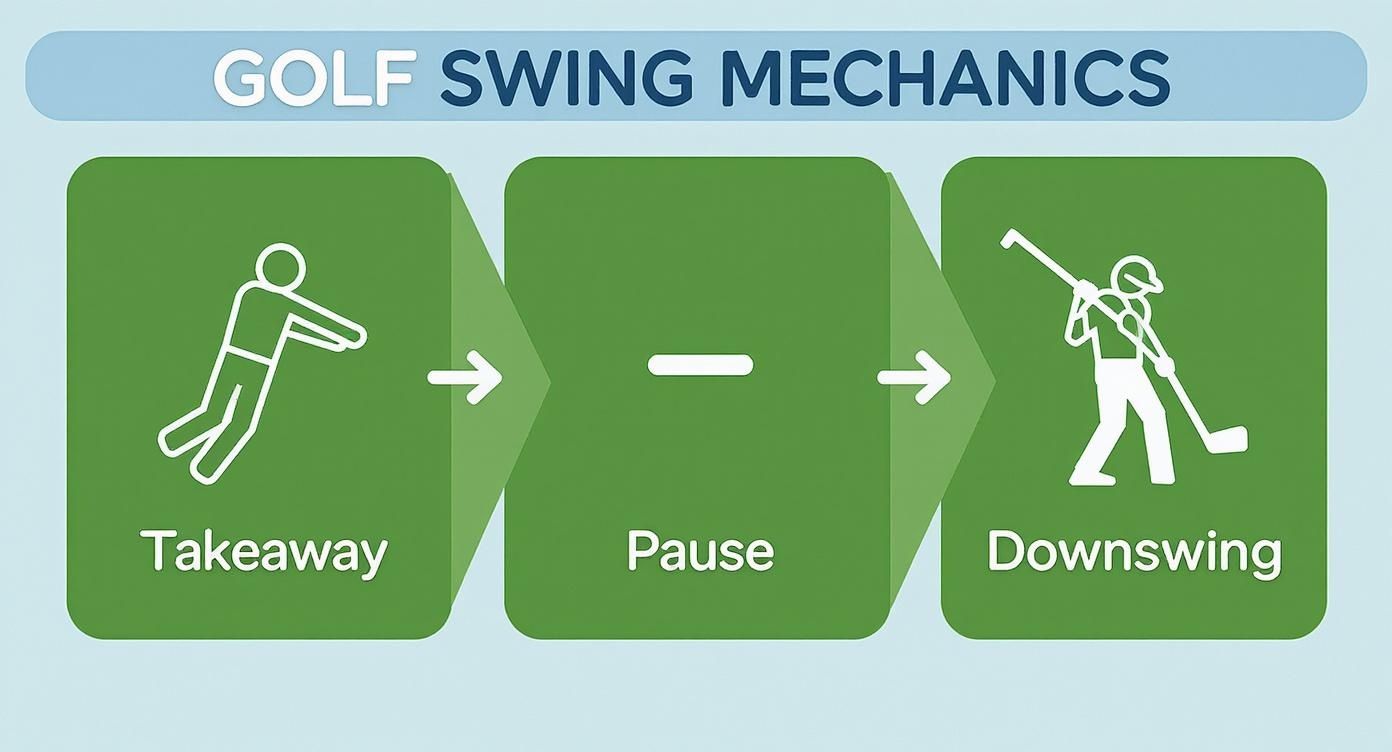
See how each step just builds on the last? That’s the secret sauce—creating a seamless chain reaction that produces what feels like effortless power.
Slay the Slice with the Gate Drill
Ah, the slice. That weak, banana-shaped shot that dies a sad death in the right-hand rough. It's the curse of most amateur golfers, and 99% of the time it’s caused by an "over-the-top" swing path, where your arms and shoulders lunge at the ball from the outside.
The Gate Drill is a classic for a reason: it gives you instant, undeniable feedback.
Grab two headcovers (or towels, or anything soft) and place them on the ground. Put one just outside and behind the ball, and the other just inside and in front of the ball. You've just created a "gate" that your club must swing through.
- Come over the top? You’ll smack the outside headcover.
- Swing way too far from the inside? You’ll clip the inside one.
The only way to miss both is to swing on the correct inside-to-square-to-inside path. This drill forces you to feel the club dropping into "the slot" on the downswing—a non-negotiable part of improving your golf swing for good.
Eliminate Fat and Thin Shots with the Towel Drill
Ever feel like you’re on a contact rollercoaster? One shot is so heavy you dig a trench, and the next is a bladed screamer across the green. This usually points to a total disconnection between your arms and your body. When your arms swing independently from your torso's rotation, all bets are off on where the bottom of your swing will be.
The Towel Drill is the ultimate fix for staying connected.
Simply tuck a small towel under both of your armpits and hit some gentle half-swing shots with a wedge. If that towel falls out, it means your arms have waved goodbye to your body during the swing.
To keep the towel locked in, your arms and chest must rotate back and through together as one cohesive unit. This drill brilliantly teaches you to use your big muscles (your core and torso) to power the swing, not just your flailing arms. It's an incredible feeling once it clicks, and you'll find the bottom of your swing becomes almost boringly consistent.
Find Your Rhythm with the Feet-Together Drill
Tempo is the glue that holds your entire swing together. A rushed, jerky swing throws everything out of sync, absolutely killing both your power and accuracy. If you feel like your swing is a frantic mess of moving parts, the Feet-Together Drill will be a revelation.
Head to the range and hit some balls with a mid-iron, but with your feet touching each other. It sounds simple, but trust me, it’s brutally effective.
Trying to swing hard from this narrow, unstable base is basically impossible—you’ll immediately lose your balance and topple over. The only way to hit a solid shot is to make a smooth, balanced, and perfectly sequenced swing. It forces you to find a rhythm that flows from a gentle takeaway to a patient transition and an unhurried downswing. After hitting a dozen shots like this, go back to your normal stance. You’ll feel incredibly stable, and your tempo will be dramatically smoother.
The right drill can be a shortcut to fixing a persistent problem. Here’s a quick-reference table to match some common swing flaws with a drill that can help get you back on track.
Practice Drills for Common Swing Faults
| Common Fault | Corrective Drill | Primary Benefit |
|---|---|---|
| Slicing / Over-the-Top | Gate Drill | Promotes a proper inside-to-out swing path. |
| Fat / Thin Shots | Towel Drill | Encourages a connected arm-and-body rotation. |
| Poor Tempo / Rushing | Feet-Together Drill | Forces a smooth rhythm and better balance. |
| Early Extension (Humping the Ball) | Chair Drill (butt against a chair) | Maintains spine angle and creates space for the arms. |
| Chicken Wing (Left arm breakdown) | Headcover Under Left Armpit | Keeps the lead arm connected to the chest post-impact. |
These aren't magic bullets, but with consistent, focused practice, they are incredibly effective at retraining your body to move correctly. Pick one that targets your biggest issue and commit to it
Using Technology for Smarter Practice

Welcome to the modern era of golf improvement, where your most brutally honest coach fits right in your pocket. Gone are the days of whacking a bucket of balls and just hoping something clicks. Today, you can get the kind of instant, tour-level feedback that used to require a team of specialists and a million-dollar swing lab.
This isn’t about drowning yourself in data. It’s about using a few key numbers to confirm what you feel is actually happening. This is how you stop guessing and start building a swing you can trust.
Getting Real Numbers on Your Swing
The biggest game-changer for the everyday golfer has to be the explosion of powerful mobile apps. I'm talking about tools like Sportsbox AI, which can take a simple video from your phone and magically turn it into a full 3D breakdown of your swing. All of a sudden, you can see your exact shoulder turn, hip sway, and spine angle—all the stuff that’s completely invisible to the naked eye.
Think about it. Let's say you're trying to keep your head still through impact. You might feel like you're statue-still, but the app can show you that your head actually moved 3.5 inches to the side. Now that’s feedback you can work with. It transforms a vague swing thought into a measurable goal you can actually track.
The Power of Wearable Sensors
Beyond just video, wearable sensors are giving us another layer of incredibly useful data. And no, I'm not talking about your fitness tracker. These are highly specialized gadgets designed to track the tiny, critical movements within your golf swing.
A fantastic example is the HackMotion Golf Wrist Sensor. You strap this little device to your wrist, and it gives you real-time feedback on wrist flexion, extension, and rotation. Since your wrists have total control over the clubface, this information is pure gold for anyone battling a slice or a hook.
Tools like these take the frustrating guesswork completely out of the equation. If you’re trying to flatten your wrist at the top like Dustin Johnson, HackMotion will tell you instantly if you’re actually doing it or just faking it. It's like having a top coach standing over your shoulder for every single rep.
- Feel It in Real-Time: Many of these sensors give you a little buzz or a sound the second you get out of position, so you can correct it on the very next swing.
- Track Your Progress: You can finally see hard evidence that your practice is paying off. Seeing your numbers improve week after week is a massive confidence booster.
- Laser-Focused Practice: These gadgets help you isolate and fix one specific flaw at a time, making your range sessions way more productive.
Making Tech Work for You
The incredible demand for these tools is fueling a massive market. The golf training aids industry is expected to rocket to USD 1,238.1 million by 2030, a huge leap from USD 827.1 million in 2022. This boom is all thanks to regular golfers wanting the same data-driven insights the pros have. You can learn more about the growth of the golf tech market on GrandViewResearch.com.
Of course, all this fancy tech is just one tool in the toolbox. It works best when you combine it with other solid practice gear. Be sure to check out our guide to the best golf accessories to complete your setup. The right gear can make it so much easier to apply what the data is telling you.
Don't get spooked by the tech. Most of these apps and sensors are surprisingly easy to use. The trick is to start small. Pick one thing you want to fix—maybe your tempo or backswing length—and dedicate your practice sessions to improving that single metric. That’s how you turn all this cool data into a genuinely lower score.
Taking Your New Swing to the Golf Course
https://www.youtube.com/embed/dMHxrHOfcR0
So, you’ve put in the hours. Your swing on the range is looking sweet—a well-oiled machine you’ve painstakingly built from the ground up. Then you step onto the first tee, the fairway suddenly shrinks to the size of a shoelace, and that beautiful, fluid motion completely evaporates.
Sound familiar? Welcome to the final boss battle of improving your golf swing: taking it from the friendly confines of the practice mat to the wild, unpredictable world of the golf course. It’s a mental game, pure and simple. And it’s all about trust.
From Range Swing to Course Swing
The biggest trap golfers fall into is trying to "steer" or "guide" their new swing on the course. You get over the ball, and suddenly a mental checklist of 14 different swing thoughts starts scrolling through your brain like the world's worst teleprompter. The result? A tense, restricted, and usually awful jab at the ball.
The secret is to do your thinking before the shot, not during it.
This is where a bulletproof pre-shot routine becomes your best friend. Think of it as a consistent ritual that signals your analytical mind to shut up and lets your athletic instincts take over.
- The Decision: Stand behind the ball. Lock in on your target, choose your club, and really see the shot you want to hit. A little draw? A high fade? Picture it.
- The Rehearsal: Take one or two silky smooth practice swings. This is your last chance for a mechanical thought. Feel the tempo. Feel the balance.
- The Execution: Step in, aim, and pull the trigger. Your only thought now should be your target. Nothing else matters. Trust the work you’ve put in.
This routine is a powerful trigger. It tells your brain, "Okay, we're done with the math. It's go time."
The Mental Game Plan
Look, even with a technically perfect swing, you’re going to hit bad shots. It's golf. That's just part of the deal. The real difference between a good round and a total meltdown is how you react when things go sideways. Don't let one bad shot poison the next one. Acknowledge it, maybe chuckle at how bad it was, and move on.
Your goal on the course isn't perfection; it's damage control. It's about playing the odds, accepting your misses, and having faith that your new-and-improved swing will deliver more good shots than bad ones over 18 holes.
Modern analytics have thrown the curtains back on what really separates the pros from the rest of us. For instance, the groundbreaking SwingTRU Motion Study analyzed 48 different body motions in every swing. It pinpointed huge differentiators like hip sway and shoulder tilt between average Joes and elite players. This kind of data allows for incredibly targeted practice. You can see for yourself how data analytics is changing golf instruction on SportPerformanceAnalysis.com.
Your new swing is an asset, so treat it like one. Trust it. And hey, while you’re at it, give yourself every possible advantage—a great round starts with a good attitude and clean gear. Make sure you know how to clean your golf clubs properly.
Got Questions About Your Golf Swing? We've Got Answers.
Let's be honest, we've all been there. Standing on the range, scratching our heads, wondering why that little white ball refuses to cooperate. Here are a few of the most common questions I hear from golfers trying to get better—and the straight-up answers you need to know.
So, How Long Does This Actually Take?
Ah, the million-dollar question. I wish I could give you a magic number, but the truth is, it's a journey. You'll likely see some quick wins—maybe you'll feel more stable in your setup or start making cleaner contact after just a few practice sessions. That's the good news.
But making a big, lasting change that you can trust on the course, especially under pressure? That often takes a full season of real, dedicated work. Remember, consistent practice beats cramming every time.
Should I Chase More Distance or Fix My Slice First?
Fix the slice. Full stop.
Think about it: adding more speed to a crooked swing just makes the ball slice faster and farther into the trees. It’s a recipe for disaster.
First, learn to control your clubface and get your swing path working for you, not against you. Once you’re hitting the ball relatively straight, then you can start introducing speed and power drills. Build a solid foundation, then add the firepower.
What's the point of an extra 20 yards if it just lands you 20 yards deeper in the woods? Control first, then power.
What's the Single Most Important Part of the Swing?
If you cornered ten different golf pros, you might get ten different answers, but a couple of themes would pop up again and again: the setup and the transition.
Your swing is practically doomed before you even take the club back if your grip, aim, or posture are off. The setup is everything.
Then there’s the transition—that critical moment you change direction from backswing to downswing. It’s where you generate power and drop the club onto the right plane. If you can get those two pieces of the puzzle right, you’ll solve a massive chunk of common swing problems. It’s the perfect place to start.
Ready to look the part while you're dialing in that new swing? 2ndShotMVP has you covered with premium golf hats and apparel that feel as good as a perfectly struck iron. Check out the latest collection.

