

Alright, let's banish that dreaded slice once and for all. The path to straighter shots starts with fixing two key culprits: an open clubface at impact and an out-to-in swing path. We'll get you squaring up that clubface with a stronger grip and grooving a better swing path by tweaking your stance. These are the fundamentals, and they work.
Understanding the Infamous Golf Slice
Welcome to the club nobody wants to join—the Slicer's Society. You know the feeling. You hit what feels like a perfect drive, only to watch it take a hard right turn into the woods, transforming a birdie opportunity into a scramble for bogey. If that’s your reality, don't worry. You’re in good company, and we’re about to stage an intervention.

At its core, a slice isn't some mystical curse; it's just physics. For a right-handed golfer, it happens when your clubface is pointing to the right of your swing path the moment you strike the ball. This creates a glancing blow, putting nasty sidespin on the ball that sends it curving wildly off-target.
Throw in the classic "over-the-top" or out-to-in swing path that so many amateurs struggle with, and you've got the perfect recipe for that banana ball.
Why Your Slice Is Costing You Strokes
This isn't just a minor annoyance; that slice is a certified scorecard-wrecker. For many high-handicappers, it can easily add 15-20 strokes per round between penalty shots, lost balls, and terrible lies. It’s no surprise that a whopping 90% of golfers who score over 100 fight a slice as their main demon. It’s a far more common problem than bad putting, and it's holding you back.
The slice isn't some complex curse you're doomed to live with. It's a symptom of a few specific setup and swing flaws. Once you understand the 'why,' the 'how' to fix it becomes much clearer.
Your Roadmap to a Straighter Ball Flight
The good news? Fixing your slice isn’t about blowing up your entire swing and starting from scratch. It’s about making a few small, deliberate adjustments that lead to massive results. We’re going to walk you through a clear roadmap to straighten out that ball flight for good.
We’ll focus on actionable changes you can make right now to your:
- Grip: This is your only connection to the clubface. Let's make it count.
- Stance and Alignment: The foundation of your swing. Get this right, and a good swing path becomes much easier.
- Swing Mechanics: We'll retrain your body to swing from the inside, not "over the top."
This isn't a total overhaul. Think of it as making smart tweaks. For new players, building these habits early is a game-changer, and you can find more great foundational advice in our guide covering the best golf tips for beginners.
Ready to finally ditch that slice and start finding the fairway with confidence? Let’s get to it.
Here's a quick overview of the three main culprits behind your slice and the core principle to fix each one. This gives you an immediate, actionable summary.
Your Slice-Fixing Cheat Sheet
| Problem Area | What Causes the Slice | The Core Fix Principle |
|---|---|---|
| The Grip | A "weak" grip allows the clubface to open at impact. | Strengthen your grip to encourage the clubface to naturally close or square up through the hitting zone. |
| The Setup | Open alignment (shoulders pointing left of target) promotes an out-to-in swing path. | Close your stance slightly to create an inside track for the club to approach the ball from. |
| The Swing Path | An "over-the-top" move brings the club from outside the target line to inside, cutting across the ball. | Practice drills that force you to swing "in-to-out," attacking the ball from the inside to promote a draw. |
This table boils it all down. Master these three principles, and you'll be well on your way to hitting powerful, straight shots.
Your Grip: The Only Thing Connecting You to the Clubface
Think of your hands as the steering wheel for your golf club. Seriously. They're your one and only connection to that clubface, and if your grip is sending the wrong signals, you might as well be aiming for the trees on the right. For the vast majority of golfers battling a slice, the problem starts right here, in your hands, before you even take the club back.
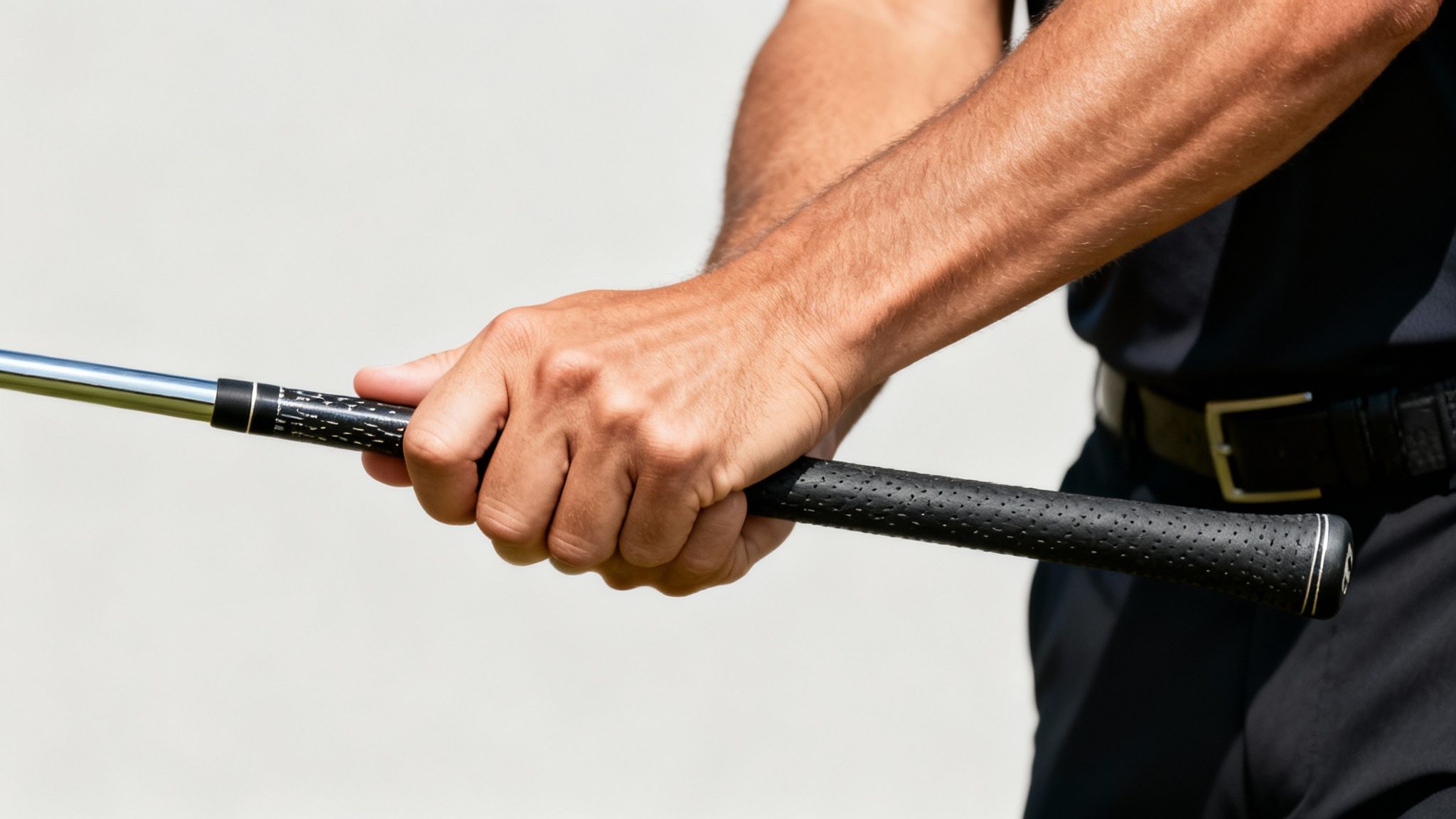
Let's ditch the confusing old-school talk of "weak" versus "strong" grips for a minute. That stuff just muddies the waters. Instead, let's focus on one dead-simple visual checkpoint that tells you everything you need to know to set up for a straighter ball flight.
The Slicer's Kryptonite: The Two-Knuckle Rule
Go ahead and grip your club. Now, look down at your lead hand (that’s your left hand if you're a righty). How many knuckles can you see on the back of your hand?
If you see just one knuckle—or worse, none at all—that's the smoking gun. Your hands are twisted too far over to the left on the grip, putting you in a classic "weak" position that all but guarantees an open clubface when you make contact.
The fix? You must see at least two knuckles on your lead hand.
To get there, just rotate both of your hands slightly to the right on the grip. We're not talking about a death grip or a massive change here. It’s a subtle shift that presets your hands to naturally square up—or even slightly close—the clubface as you swing through impact.
It’s a frustratingly common story: you step up to the tee, feeling good, only to watch your ball banana-slice into the next fairway. This plagues something like 90% of triple-digit golfers. The good news is, the fix starts with this simple rotation. Turning your hands to the right by just 3-5 degrees can be enough to counteract the 3-5 degrees the clubface is typically open at impact for slicers. The folks over at GOLFTEC.com have some great insights on this very topic.
A proper grip doesn't feel "powerful" or contorted; it just feels athletic and ready. The whole point is to let your hands return the club to a square position automatically, without you having to consciously flip or manipulate it during your swing.
Build the Feeling, Even Off the Course
You don't need a bucket of balls to make this new grip feel natural. In fact, you can build the right muscle memory just about anywhere with a simple drill.
Try The Forearm Rotation Drill:
- Grab a club and hold it out in front of you, parallel to the ground, using only your lead hand.
- Take your other hand (your trail hand) and gently hold your lead forearm to keep it steady.
- Now, slowly rotate just your lead hand, making the clubface go from wide open (toe pointing to the sky) to completely closed (toe pointing to the ground).
- Do this 10-15 times.
This little exercise isolates the exact feeling of your forearm rotating to square the clubface. It teaches your body what it feels like to deliver a square face to the ball—a massive piece of the puzzle when you're figuring out how to fix a slice in golf. By locking in this small but mighty grip adjustment, you’re laying the foundation for much straighter, and frankly, much more satisfying golf shots.
Setting Up Your Stance to Swing from the Inside
Ever feel like your slice is baked into your swing before you even move the club? You're probably right. So many golfers I see fighting that dreaded banana ball are setting up with an "open" stance—feet, hips, and shoulders all pointing way left of the target.
It's a classic mistake. It feels powerful, like you're clearing the way for a big swing. But what you're really doing is paving a one-way street for an over-the-top, outside-in swing path. If your whole body is aimed left, where else can your arms go but across the ball? You’ve basically pre-programmed the slice right there on the tee box.
The fix? We need to get your body aimed correctly to give your arms a clear runway to attack the ball from the inside.
Your Two-Second Alignment Check
Forget the high-tech gadgets for a moment. You can audit your alignment in seconds with something you already have in your bag.
Grab two alignment sticks (or just two extra clubs). Here's the drill:
- Lay one stick on the ground, pointing right at your target. This is your ball-to-target line.
- Now, place the second stick parallel to the first, right along the tips of your toes. This is your body line.
Take your stance. Your feet, hips, and shoulders should all be running parallel to that target line, not pointing away from it. This simple "railroad track" setup is the foundation for an inside swing path. Suddenly, your arms have a path.
This image shows you exactly what a solid, square setup looks like. This is one of the most fundamental parts of learning how to fix a slice in golf.
See how the golfer's shoulders and hips are square to the target line? That's what creates the space to drop the club into the "slot" and swing from the inside-out.
The Pro Move: A Tiny Hip Bump
Alright, once you're squared up, here's a little secret weapon. Just before you take the club back, give your lead hip a tiny bump—seriously, just an inch or two—toward the target.
This tiny, almost imperceptible move does something magical. It pre-sets your body to come into the ball on a shallower, more powerful angle. It encourages the club to drop naturally into that perfect inside position on the downswing without you even having to force it. It’s a "feel" that promotes the kind of swing path you see on TV every Sunday.
A square stance isn't a stiff stance. You're not a statue. The goal here is to feel athletic and balanced, ready to uncoil. We're just building a solid foundation that allows your body to rotate properly and deliver the club from the inside out.
This is true even when you're on a funky lie. If the ball is below your feet, for instance, you'll naturally aim a bit left, but your body's relationship to your intended swing path should still feel square. Get the setup right, and you've already won half the battle against the slice.
Retraining Your Swing to Attack from the Inside
Alright, let's get to the real meat and potatoes—the engine that powers nearly every slice you've ever hit. It's that ugly, scorecard-wrecking move golfers call the "over-the-top" swing.
For a moment, let's ditch the confusing technical jargon. We're going to fix this with feelings and pictures in your head, completely rewiring your swing path from the ground up.
A slice is born the moment your club attacks the ball from an out-to-in path. Picture a straight line from your target, through your ball, and extending behind you. Slicers start their downswing by throwing the club outside of that line and then cutting across it as they hit the ball. Our mission is to flip that sequence on its head.
The "Swing to Right Field" Feeling
This is one of the oldest and most effective swing thoughts in the book for a simple reason: it just works. If you're a right-handed golfer, imagine you're standing at home plate in a baseball stadium. But instead of trying to hit a home run to center field, your goal is to smack a line drive over the second baseman's head.
That one simple image forces you to keep your back to the target a fraction of a second longer. It lets your arms and club drop down "into the slot" behind you, creating that magical in-to-out swing path we're chasing. It’s a powerful mental cue that helps you physically feel the right move, and it's a cornerstone of what we discuss when we look at how to improve golf swing mechanics.
https://2ndshotmvp.com/blogs/news/how-to-improve-golf-swing
Don't feel bad if this is you; it's an incredibly common flaw. Studies show a staggering 85% of amateur golfers slice their driver, with that over-the-top move being the prime suspect. This bad habit turns potential 250-yard bombs into weak 210-yard pop-ups, bleeding distance on every tee shot. I've seen chronic slicers completely transform their game just by committing to this "swing to right field" idea. You can dive deeper into the data behind this on MyGolfSpy.com.
The goal isn't to actually blast the ball way out to the right. It's to create the feeling of a swing that moves from inside the target line to outside the target line through impact. When you combine this path with the stronger grip we talked about earlier, the ball will start right and draw back toward your target. Magic.
A Practical Drill to Groove the Path
Mental images are fantastic, but sometimes your body needs a more forceful reminder. This next drill gives you unmissable feedback that practically forces you to swing from the inside.
All you need is an extra headcover, a water bottle, or even an empty range basket.
- Take your normal setup to a ball on the driving range.
- Place your headcover on the ground about six inches outside your golf ball and just a little bit in front of it.
- Your mission is simple: hit the ball without hitting the headcover.
If you make your usual over-the-top slice swing, you’re going to clobber that headcover. There’s no way around it. The only way to miss it and make clean contact is to drop the club on an inside path. This drill provides instant, undeniable feedback on every single swing—no coach required.
Of course, to build a truly consistent and powerful swing, a strong foundation is key. You need to be able to control your rotation. A great way to do that is to improve your core stability for a better swing.
When you first try this drill, start with slow, half-swings. Just focus on missing the obstacle. As you get the hang of it, you'll be training your body to find a new, slice-free path to the ball.
Let's Hit the Range: The 15-Minute Slice-Killer Routine
Alright, enough talk. Theory is one thing, but the real work—and the real fun—happens on the driving range. This is where we're going to bake that slice right out of your swing.
I've put together a super-focused, 15-minute routine that zeros in on the root causes of a slice. We'll use three simple but incredibly powerful drills. You'll get a feel for how your hands should work, retrain your swing path, and finally start grooving that solid, compressed impact position. The key is to start slow and small, focusing on half-swings before you even think about unleashing the driver at full speed.
This little diagram gives you a great visual of what we're aiming for. It's all about correcting that swing path, which leads to a square clubface at impact and a proper weight shift. Get those three things working together, and you're on the fast track to hitting a draw.
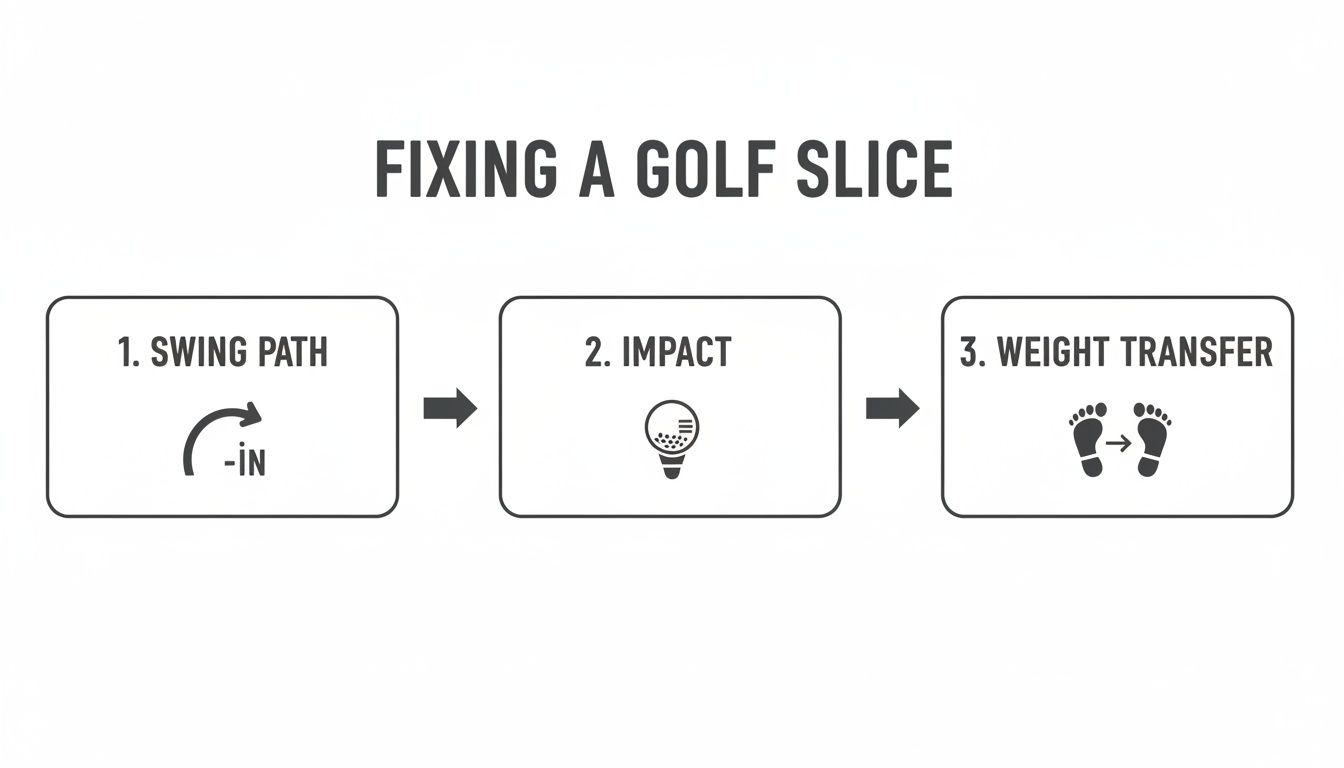
Ready? Let's get to it.
Drill 1: The Split-Hand Drill for Hand Awareness
First up, we need to get your hands reacquainted with what they're supposed to be doing. The split-hand drill is perfect for this because it isolates your hand and forearm rotation, letting you feel the clubface squaring up through the hitting zone.
Grab a short iron or a wedge. Instead of your normal grip, separate your hands on the club. Now, just make some slow, easy half-swings.
Pay close attention to the sensation of the clubface closing as you swing through. When you get it right, you'll see a much tighter ball flight, maybe even a little draw. Say goodbye to that nasty slice spin.
What you'll need:
- A short iron or wedge
- Your phone's camera (or a mirror) for a quick visual check
- A patient mindset—don't rush this!
Even after just a few swings, you'll feel a huge difference. I've seen students cut their slice spin by 75% with this drill alone. It’s all about waking up that lead hand.
Drill 2: The Gate Drill to Fix Your Path
Now for that dreaded over-the-top swing path. The gate drill is my go-to for fixing this because it gives you instant, undeniable feedback.
Take two alignment sticks and place them on the ground to create a "gate" or a tunnel for your clubhead, just wide enough to fit it through. The ball should be right in the middle of this gate.
Your only job is to swing through the gate without clobbering the sticks. This little visual trick naturally forces your club onto a more inside-out path, which is exactly what we need.
- Start by setting the sticks parallel to your target line.
- Make some slow, controlled swings, focusing only on getting through the tunnel cleanly.
- Once you're comfortable, gradually ramp up the speed to a full swing, but always keep that inside path.
Having a clear physical barrier like this is priceless. You don't have to guess if you're coming over the top—the sticks will tell you immediately.
Drill 3: Half-Swing Punches for Solid Impact
The final piece of the puzzle is impact. We need to lock in that powerful, hands-ahead position. Half-swing punches are the answer.
Think of it like hitting a low, punchy shot. You'll make a half-swing, but the real focus is on keeping your hands ahead of the clubhead through impact and finishing with your weight on your front foot.
As you do this, concentrate on keeping that left wrist firm and flat. You’ll see the ball fly lower and straighter. That's the feeling of pure compression.
- Focus on forward shaft lean at impact. This is non-negotiable for a solid strike.
- Keep your wrists firm! No flipping or scooping at the ball.
- Feel your hips rotating toward the target to power the movement.
If you're looking for more simple routines like this, check out our guide to beginner golf drills that are designed to build consistency without overwhelming you.
Combine these three drills into a quick 15-minute range session. If you can do this just twice a week, you'll be amazed at how quickly you can rewire that muscle memory and kick that slice to the curb for good.
Getting the Most Out of Your Practice Time
A little intention goes a long way. To really maximize your progress, try these tips:
- Always warm up. A few dynamic stretches will get your body ready to swing properly.
- Track your progress. If you have access to a launch monitor, use it! Seeing the numbers change is a huge motivator.
- Keep a practice journal. Jot down a few notes after each session about what you felt and how the ball flew. It helps connect the dots.
- Be patient. Rome wasn't built in a day, and neither is a perfect golf swing. Enjoy the process of getting better.
Answering Your Nagging Slice Questions
Alright, let's talk about those questions that pop into your head mid-swing. You’ve been grinding on your grip, your stance, and your swing path, but fixing a slice is a journey, not a destination. It's totally normal to have a few "what the heck is happening now?" moments.
Think of me as your buddy who’s seen it all. I’m here to tackle those lingering questions and make sure you stay on the straight and narrow.
"I Strengthened My Grip and Now I'm Hooking It! What Gives?"
First of all... congratulations! Seriously, this is the best problem you can possibly have. It means you've successfully taught yourself how to close the clubface through impact. That's a huge milestone. A hook is just a minor overcorrection, and trust me, it’s a million times easier to dial back than a slice.
What this new shot shape tells us is that your swing path is probably still a little out-to-in. Now, you can finally stop worrying about the clubface and just pour all your focus into that "swing out to right field" feeling we discussed earlier. This will neutralize your path. You can also try easing up on the grip just a smidge—maybe go from seeing three knuckles down to two and a half.
Welcome to the club, my friend. You're officially learning how to shape the ball.
"So, How Long Until This Slice is Gone for Good?"
You can absolutely see a different ball flight in a single practice session. But let's be real—turning that quick fix into a permanent, "don't-have-to-think-about-it" swing takes time and repetition. You're literally re-wiring your brain and building new muscle memory.
If you can dedicate just 15-20 minutes to your anti-slice drills, maybe two or three times a week, you can build a fundamentally sound swing in about a month. The whole point is to make the correct move feel so natural that you aren't standing over the ball with a mental checklist. Don't get bummed out by a bad day at the range; even the pros are constantly grinding on their fundamentals.
A slice is just a habit, and bad habits take a little time to kick. Be patient with yourself. The payoff is a swing you can trust under pressure, not just a band-aid fix.
"Could It Be My Equipment? Is This Driver Out to Get Me?"
This is the age-old question. The honest-to-goodness truth? Probably not, but your gear can absolutely make a bad problem worse. Your swing is the root cause about 90% of the time. But playing with the wrong clubs can feel like you're trying to run a marathon in ski boots.
For example, a driver with too little loft for your swing or a shaft that's way too stiff makes it incredibly difficult to get the clubface square at impact. If you've put in the work on your swing and that banana ball is still showing up, getting a proper club fitting is one of the best investments you can make in your game. Plus, modern adjustable drivers can be set with a "draw" bias, which is like having a little built-in slice insurance.
"Why Do I Only Slice My Driver and Not My Irons?"
Ah, the great mystery that haunts golfers everywhere. This is incredibly common, so don't feel like you're alone on this one. It all comes down to two things: length and loft. Your driver is the longest club in the bag and has the least amount of loft, a brutal combination that magnifies every tiny flaw in your swing.
Your swing path might be a little out-to-in with all your clubs. With your irons, the higher loft creates more backspin, which helps stabilize the ball and minimizes that nasty sidespin. It often turns what would be a slice into a playable fade.
But with the driver? There's nowhere for that flaw to hide. The low loft lets the sidespin completely take over, sending your ball on a one-way trip to the next fairway over. Fixing the root cause—that out-to-in path—is the key to unlocking consistency with every single club in your bag.
Ready to look as good as your new swing feels? At 2ndShotMVP, we've got you covered with premium golf hats and apparel that bring style and personality to your game. Ditch that slice and step onto the first tee with confidence. Check out our latest collections at https://2ndshotmvp.com.

