

Welcome to the most rewarding, frustrating, and endlessly addicting game on the planet. As a newcomer to golf, you're probably being bombarded with advice: keep your head down, left arm straight, rotate your hips, and don't forget to breathe. It’s enough to make anyone want to head straight for the 19th hole and skip the first 18. What if you could cut through the noise and focus on what actually works?
This guide is your fast track. We've distilled the game down to the 10 absolute best golf tips for beginners, designed to deliver real, measurable results right away. Forget trying to piece together a perfect swing from a hundred different YouTube videos. Here, we'll cover the essentials that pros build their entire careers on, from a flawless grip to the on-course strategy that saves strokes and sanity.
These aren't just vague suggestions; they are actionable steps to build a solid foundation. You'll learn how to practice with purpose, choose the right equipment, and manage your way around the course like you’ve been playing for years. Let’s bypass the early frustration and get you on the path to playing with confidence, enjoying the game, and maybe even impressing your foursome.
1. Get Proper Golf Grip
Before you even think about swinging for the fences, let’s talk about your hands. Your grip is your only connection to the golf club, making it the undeniable foundation of your entire swing. Get it wrong, and you’re basically trying to drive a Ferrari with bicycle handlebars. A proper grip is one of the best golf tips for beginners because it directly influences clubface control, power, and consistency.
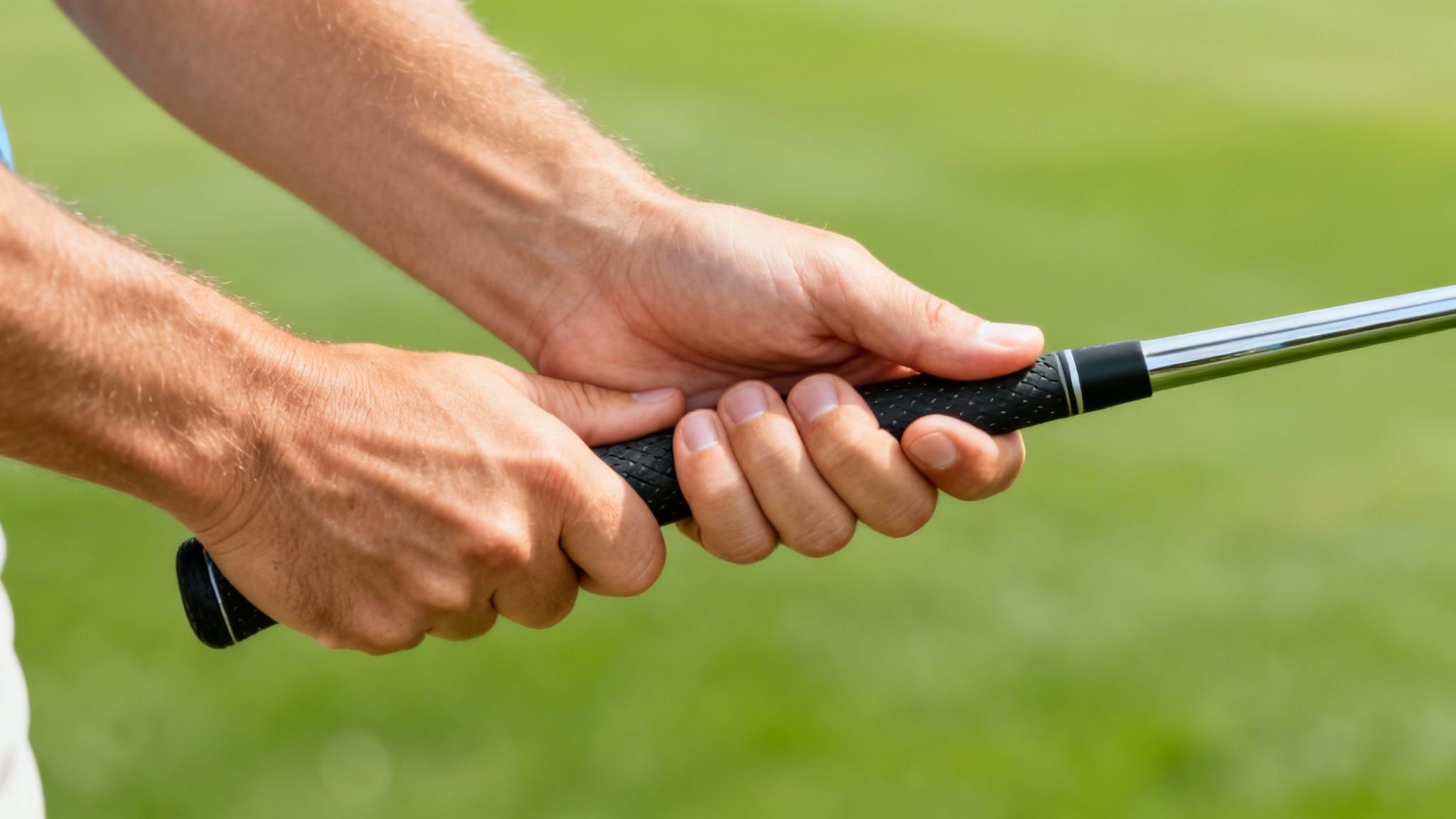
Most instructors will point you toward either the overlapping (Vardon) or interlocking grip. With the overlap, the pinky finger of your trail hand rests on top of the space between your lead hand's index and middle fingers. The interlocking grip, well, it interlocks those same two fingers. Both are designed to make your hands work together as a single, cohesive unit.
How to Master Your Grip
Your goal is to achieve what’s called a “neutral” grip. An easy way to check this is to look down after taking your grip. You should see two knuckles on your lead hand. If you see more, your grip is too strong; if you see fewer, it’s too weak.
Pro Tip: Imagine you're holding a small bird. Your grip pressure should be firm enough that it can't fly away, but gentle enough that you don't hurt it. A death grip creates tension and kills your swing speed.
Here are a few actionable steps to make a perfect grip second nature:
- Daily Practice: Spend 10 minutes each day just holding the club. Do it while watching TV. The goal is to build muscle memory until it feels completely natural.
- Use Training Aids: A molded grip trainer can be a fantastic tool to physically guide your hands into the correct position every time.
- Check Your Gloves: A worn-out glove or one that doesn't fit properly can sabotage your hold. Ensuring you have the right size is crucial for maintaining a secure, consistent connection to the club. If you need help, exploring a golf glove size chart can make all the difference.
2. Maintain Proper Posture and Stance
If your grip is the foundation, your posture and stance are the framing of your golf swing house. Without a solid, athletic setup, you’re trying to generate power from a wobbly base, which is about as effective as shooting a cannon from a canoe. A proper athletic stance is one of the most critical golf tips for beginners because it sets the stage for balance, power, and a repeatable swing path.

Think of legendary players like Tiger Woods or Jack Nicklaus; their pre-shot routine is a masterclass in establishing a perfect athletic posture. The goal is to create a stable platform that allows your body to rotate powerfully around your spine. This involves a slight knee flex, tilting from your hips (not your waist), and letting your arms hang naturally. An improper stance, like standing too upright or slouching over the ball, immediately restricts your body’s ability to move correctly.
How to Master Your Posture
Your setup should feel balanced and ready for action, similar to how a shortstop stands before a pitch. Your feet should be about shoulder-width apart for mid-irons, with your weight distributed evenly. The key is to maintain your spine angle from address all the way through impact.
Pro Tip: Imagine a straight line running from your shoulders down through your knees to the balls of your feet. This helps you achieve proper balance and avoid sitting back on your heels or leaning too far forward.
Here are a few actionable steps to dial in your setup:
- Use a Mirror: Stand side-on to a mirror to check your spine angle and knee flex. You want to see a straight back, not a rounded or C-shaped posture.
- Video Yourself: Record your setup from down the line and face-on. Compare your posture to that of a professional. This visual feedback is invaluable for seeing what you’re actually doing versus what you think you're doing.
- The Wall Drill: Stand with your back against a wall. Take a small step forward, then get into your golf posture, trying to touch the wall with your backside. This teaches you to hinge from your hips properly.
3. Learn to Swing at Your Own Pace
When you first step onto the range, the urge to smash the ball into next week is almost irresistible. But trying to swing out of your shoes is a classic beginner mistake that leads to wild shots and frustration. A smooth, controlled tempo is far more valuable than raw power, making this one of the best golf tips for beginners. Think of players like Ernie Els or Adam Scott; their swings look effortless yet generate incredible distance. That’s the power of rhythm.
Tempo is the total time of your swing, and most pros maintain a consistent 3:1 ratio, meaning their backswing takes three times longer than their downswing. It’s about creating a fluid, repeatable motion, not a violent lurch at the ball. Rushing the swing, especially the transition from backswing to downswing, is where everything falls apart. A good tempo ensures all the parts of your swing sequence correctly, leading to purer strikes and better accuracy.
How to Find Your Rhythm
Your goal is to find a tempo that feels natural and repeatable under pressure. It shouldn't feel rushed or forced. A balanced, smooth swing will always outperform a fast, jerky one.
Pro Tip: Don't confuse swing tempo with swing speed. You can have a fast swing speed with a slow, deliberate tempo. The key is the smoothness of the motion, not the overall speed.
Here are a few actionable steps to develop a consistent tempo:
- Use a Metronome: Download a metronome app and set it to around 80 beats per minute. Start your backswing on the first beat and begin your downswing on the second. This drill helps internalize a steady rhythm.
- Count It Out: A simple mental trick is to count "one" on the backswing and "two" on the downswing as you swing. This prevents you from rushing the crucial transition at the top.
- Practice in Slow Motion: Take swings at 50% speed, focusing entirely on the sequence and feel. This helps build muscle memory without the pressure of hitting the ball perfectly.
- Prioritize Tempo Over Distance: On the practice range, make it your goal to have the same tempo for every single swing, from your wedge to your driver. Never sacrifice your rhythm for a few extra yards.
4. Focus on the Short Game First
It’s tempting to head straight to the driving range and unleash your inner Tiger Woods, trying to smash the ball 300 yards. But here’s a reality check: the long drive is for show, but the short game is for dough. Roughly 60% of your shots happen within 100 yards of the hole. Neglecting your chipping, pitching, and putting is like baking a cake and forgetting the frosting; you’ve done the hard work but messed up the finish.

This is one of the best golf tips for beginners because it offers the fastest path to lowering your scores. A great drive followed by three clumsy chips and two putts still results in a double bogey. Mastering the delicate shots around the green builds confidence and saves strokes far more effectively than adding ten yards to your drive. Just look at pros like Phil Mickelson, whose legendary career was built on a magical touch around the greens.
How to Master Your Short Game
Your goal is to turn three shots into two whenever possible. This means getting your chip or pitch close enough for a simple one-putt. It’s about precision and feel, not brute force.
Pro Tip: Think "least air, most ground." If you can putt it, putt it. If you can't putt, chip it. If you can't chip, pitch it. Using the simplest, lowest-risk shot available will dramatically improve your consistency around the green.
Here are a few actionable steps to make your short game your secret weapon:
- Split Your Practice: Dedicate at least 60% of your practice time to shots inside 100 yards. For every bucket of balls you hit on the range, spend an equal amount of time on the putting and chipping greens.
- Play Chipping Games: Set up targets at various distances (e.g., 10, 15, and 20 yards) around the practice green. See how many out of 10 balls you can get within a three-foot circle of the hole. This makes practice fun and goal-oriented.
- Focus on Lag Putting: On the putting green, spend more time on long putts (20+ feet). The goal isn’t to make them all, but to get your first putt close enough for an easy tap-in. This skill alone will eliminate frustrating three-putts from your scorecard.
5. Use Golf Clubs Suited to Your Swing Speed
Swinging a golf club that’s wrong for you is like trying to win a drag race in a minivan. You might get to the finish line, but it won’t be fast, pretty, or efficient. Many beginners grab a hand-me-down set or buy what the pros use, not realizing the club's specifications are fighting against their natural swing. Using clubs matched to your abilities is one of the best golf tips for beginners because it makes the game easier and way more fun.
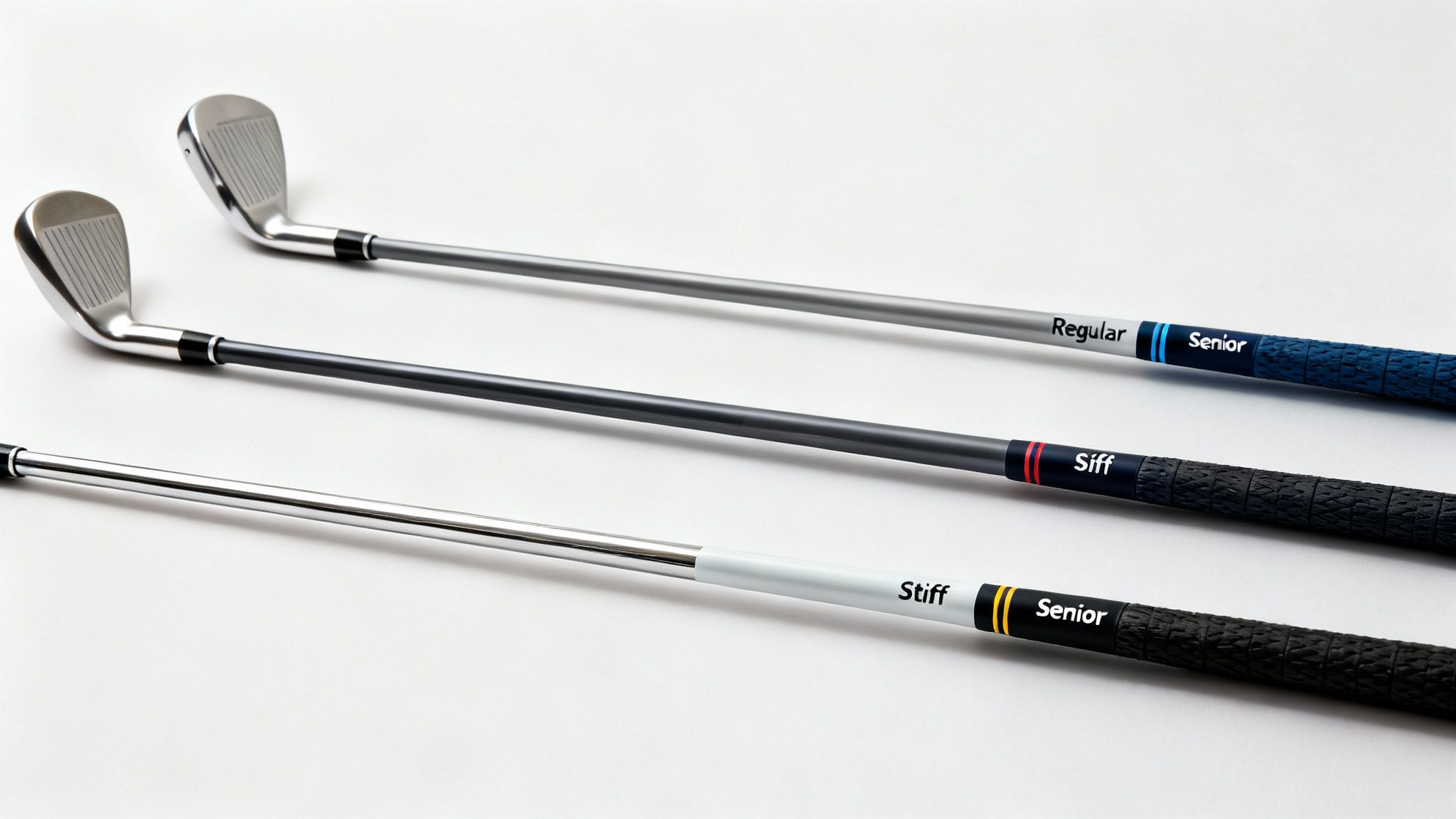
The key factors are shaft flex, club weight, and head design. A player with a slower swing speed needs a more flexible, lighter shaft to help generate power and launch the ball higher. Conversely, a stronger player with a faster swing needs a stiffer shaft to maintain control and prevent the ball from ballooning. It's all about matching the equipment to the athlete.
How to Find the Right Clubs
Your mission is to find clubs that complement your swing, not complicate it. Forget about brand names and focus on performance. Getting this right can dramatically cut down your score and reduce frustration.
Pro Tip: Don't assume you need "stiff" flex shafts just because you're strong. Swing speed, not just raw strength, dictates the ideal flex. Many amateur men play shafts that are far too stiff for them.
Here are a few actionable steps to ensure your clubs are helping, not hurting:
- Get Professionally Fitted: This is non-negotiable. A session with a certified club fitter at a PGA facility or major golf retailer uses a launch monitor to measure your swing speed, attack angle, and other data points to find the perfect club specs for you.
- Start with "Game Improvement" Irons: These clubs are designed with larger sweet spots and perimeter weighting, making them much more forgiving on off-center hits. They are a beginner's best friend.
- Test Before You Buy: Never purchase clubs without hitting them first. Most pro shops and golf stores have demo days or hitting bays where you can test different models to see what feels best.
6. Practice with Purpose and Tracking
Mindlessly whacking a large bucket of balls at the driving range might feel productive, but it's the golfing equivalent of running on a treadmill with no destination. Purposeful practice is about having a plan, not just showing up. This approach transforms your range sessions from a workout into a strategic training exercise, making it one of the best golf tips for beginners looking for real, measurable improvement.
The concept is simple: instead of hitting 100 random shots, you dedicate your practice to specific goals and track your progress. This means focusing on a particular club, a specific shot shape, or a key metric like fairways hit. Studies show that structured practice with clear objectives is vastly more effective than unstructured, random hitting. It's the difference between building a house with a blueprint versus just piling up bricks and hoping for the best.
How to Practice with a Plan
Your goal is to make every shot count, even in practice. Start by identifying the weakest parts of your game during a round and designing your next range session around fixing them. Did you miss every green from 100 yards out? Your next practice should focus almost entirely on your wedges.
Pro Tip: Don't just hit shots at the big, open range. Pick specific targets for every swing. Imagine you're playing a real hole: hit a driver to a "fairway," then an iron to a specific "green" (like a yardage marker). This simulates on-course pressure and makes your practice more effective.
Here are a few actionable steps to make your practice sessions count:
- Write It Down: Before you go to the range, create a simple written plan. For example: 10 warm-up swings, 20 shots with a 7-iron focusing on alignment, and 20 drives aiming for a narrow fairway.
- Track Your Stats: Use an app like 18Birdies or a simple notebook to track 3-5 key metrics during your rounds. Focus on fairways hit, greens in regulation (GIR), and putts per round. This data tells you exactly what to work on.
- Use Training Aids: Incorporating specific tools can elevate your sessions. You can find some of the best golf accessories for practice to help with alignment, swing plane, and putting.
- Film Your Swing: Once a month, take a slow-motion video of your swing from a few different angles. You don’t need fancy equipment, your phone will do. Comparing videos over time is a powerful way to see what's changing, for better or worse.
7. Understand Basic Golf Etiquette and Rules
Golf is more than just hitting a ball; it’s a game of honor, respect, and tradition. The unwritten (and written) rules are just as important as your swing. Understanding basic golf etiquette is one of the best golf tips for beginners because it ensures you, and everyone around you, have an enjoyable time on the course. Get it wrong, and you might not get invited back.
Proper conduct shows respect for the game, the course, and your fellow players. It’s about being a good steward of the turf and a considerate playing partner. From keeping pace to staying quiet during a swing, these customs are the bedrock of the sport and help maintain the integrity and flow of play for all.
How to Master Golf Etiquette
Your goal is to be the kind of golfer everyone wants to play with. This means being mindful of your actions from the moment you arrive until you leave the 19th hole. The core principles are simple: be safe, be quick, and take care of the course.
Pro Tip: Think of the golf course as a library on grass. Keep your voice down, silence your phone, and never move or make noise when someone else is "reading" their putt or preparing to swing.
Here are a few actionable steps to ensure you're a great playing partner:
- Keep Pace: A round of 18 holes should take about 4 to 4.5 hours. Be ready to hit when it's your turn and limit your ball search to a maximum of three minutes.
- Care for the Course: Always repair your ball marks on the green, rake the bunker after you hit out of it, and fill your divots with the provided sand.
- Dress the Part: Most courses have a dress code. Showing up in the right gear is the first sign of respect. If you are unsure what to wear, a quick guide on what is proper golf attire can prevent any awkward conversations in the pro shop.
8. Get Golf Lessons from a Qualified Instructor
Trying to learn golf from YouTube videos alone is like trying to learn surgery from watching "Grey's Anatomy." You might get the general idea, but the execution will be messy. Investing in a few lessons from a PGA or LPGA professional is one of the single best golf tips for beginners because it provides a personalized roadmap and stops bad habits before they become permanent swing scars. Self-teaching often leads to frustrating plateaus, while an instructor can spot flaws you’d never see yourself.
A qualified instructor doesn't just give you a cookie-cutter swing. They analyze your unique physical characteristics, flexibility, and learning style to build a swing that works for you. Studies even show that beginners who take lessons improve 30-40% faster than their self-taught counterparts. Think of it as hiring a guide to get you through a dense forest versus wandering around hoping you find the path.
How to Get the Most Out of Lessons
A single lesson can be helpful, but a series of 3-5 is where the real progress happens. This allows your pro to build a progressive curriculum, check in on your practice, and make adjustments as you develop. It creates accountability and structure, accelerating your improvement significantly.
Pro Tip: Don't be afraid to "interview" potential instructors. Ask about their teaching philosophy, experience with beginners, and if they use technology like video analysis. Finding a pro you connect with is just as important as their credentials.
Here are a few actionable steps to find the right coach:
- Commit to a Package: Book a series of 3-5 lessons upfront. This shows commitment and allows the instructor to create a long-term plan for your development.
- Look for Certifications: Prioritize PGA or LPGA certified professionals. This certification ensures they have met rigorous standards for teaching and understanding the golf swing.
- Ask About Technology: Inquire if they use tools like launch monitors or video analysis. Seeing your swing on camera provides instant, undeniable feedback that words alone can't replicate.
- Discuss Your Goals: Be clear about what you want to achieve. Whether it's just making contact consistently or breaking 100, a good instructor will tailor the lessons to your specific ambitions.
9. Play on the Correct Tees for Your Level
Nothing can ruin a round of golf faster than feeling like you’re trying to climb Mount Everest with a putter. Many beginners make the mistake of playing from the same tee boxes as their more experienced friends, turning a fun challenge into an impossible slog. This is one of the most overlooked but best golf tips for beginners because it directly impacts your score, pace of play, and overall enjoyment of the game.
Tee boxes aren't just about color; they represent different total yardages for the course. Playing from the tips (the furthest tees) adds hundreds of yards, making par-4s unreachable in two shots for most new players. Choosing the forward tees shortens the course to a manageable distance, giving you a legitimate chance to hit greens in regulation and make pars.
How to Choose the Right Tees
Your goal is to select a tee box that matches your current skill and average driving distance. The USGA recommends that beginners start on courses between 4,800 and 5,400 yards for 18 holes. This often corresponds to the forward or senior tees. Don't let your ego choose your tee box; let your ability guide you.
Pro Tip: Your score is your score, no matter which tees you play from. A 95 from the forward tees is far more fun and encouraging than a 115 from the back tees where you never had a chance.
Here are a few actionable steps to ensure you're starting from the right spot:
- Ask the Pro Shop: When you check in, simply ask the staff for their recommendation based on your beginner status. They know the course better than anyone.
- Start Forward: As a rule of thumb, choose the tees that are one or two boxes forward of where your playing partners are. You can always move back as you improve.
- Focus on Fun: Remember, the goal is to enjoy the game. Playing from the correct tees makes golf less of a punishment and more of a pleasure, which is key to sticking with it.
10. Develop Mental Game and Course Management Skills
You can have a picture-perfect swing, but if your mind unravels after one bad shot, your scorecard will look like a disaster zone. Golf is played on the six-inch course between your ears just as much as it is on the green fairways. Neglecting your mental game is like building a skyscraper on a foundation of sand; it’s bound to crumble under pressure. Learning to manage your thoughts and the course itself is one of the most crucial golf tips for beginners to break through scoring plateaus.
A strong mental game isn't about never feeling angry or nervous; it's about having the tools to manage those feelings so they don't derail your entire round. It’s the difference between a frustrating 105 and a respectable 95, even when your swing feels exactly the same. Good course management means playing smart, not just hard, by knowing when to attack a pin and when to play it safe.
How to Master Your Mental Game
Your goal is to become a strategic thinker, not just a ball-hitter. This starts with accepting that bad shots are an inevitable part of golf and learning to move past them quickly. A consistent pre-shot routine is your best friend here, as it provides a comforting, repeatable process to ground you before every single swing.
Pro Tip: Embrace a "one shot at a time" mentality. The only shot that matters is the one you are about to hit. Don't dwell on the slice from the last hole or worry about the tough par 3 coming up. Stay present.
Here are a few actionable steps to build mental resilience:
- Create a Pre-Shot Routine: Make it simple and consistent. It could be two practice swings, picking a target, and taking a deep breath. A routine of 30-45 seconds is perfect for calming nerves.
- Practice Box Breathing: When you feel the pressure mounting, inhale for 4 seconds, hold for 4, exhale for 4, and hold for 4. This simple technique can lower your heart rate and clear your mind.
- Know Your 'Safe' Shot: On every hole, identify the conservative play. Sometimes, laying up short of a hazard instead of trying a heroic shot over it is the smartest way to save strokes and avoid a big number.
Top 10 Beginner Golf Tips Comparison
| Item | Complexity 🔄 | Resources ⚡ | Expected Outcome 📊 | Ideal Use Cases 💡 | Key Advantage ⭐ |
|---|---|---|---|---|---|
| Get Proper Golf Grip | Low — basic motor pattern to learn | Minimal — club; grip trainer optional | High — improved accuracy & consistency | All levels, essential for beginners | Controls clubface; reduces hooks/slices ⭐ |
| Maintain Proper Posture and Stance | Moderate — requires body awareness & feedback | Low — mirror/video or coach recommended | High — better balance, power, consistency | All levels; critical for repeatable swing | Enhances weight transfer and reduces injury ⭐ |
| Learn to Swing at Your Own Pace | Moderate — tempo retraining and patience | Low — metronome/app, video recording | High — fewer mishits; repeatable contact | Players rushing swings or lacking consistency | Produces reliable rhythm under pressure ⭐ |
| Focus on the Short Game First | Low — simple drills but needs repetition | Moderate — wedges, practice green, time | Very High — fastest route to lower scores | Beginners prioritizing score improvement | Largest scoring impact within 100 yards ⭐ |
| Use Golf Clubs Suited to Your Swing Speed | Moderate — fitting process and adjustments | Moderate–High — fitting fees; possible new clubs | High — immediate gains in distance & accuracy | Novices using ill-fitted clubs | Customized fit improves performance & confidence ⭐ |
| Practice with Purpose and Tracking | Moderate–High — planning, tracking, analysis | Moderate — apps, notebooks, optional launch monitor | High — measurable, faster improvement | Committed learners wanting efficient progress | Targets weaknesses; accelerates improvement ⭐ |
| Understand Basic Golf Etiquette and Rules | Low — learnable behavioral and rule set | Minimal — rule guides, course info | Moderate — smoother rounds; better group play | All beginners playing public or private courses | Promotes respect, access, and better group dynamics ⭐ |
| Get Golf Lessons from a Qualified Instructor | Low–Moderate — follow structured instruction | High — lesson costs, travel, time commitment | Very High — accelerated learning (30–40% faster) | Beginners who want rapid improvement | Personalized feedback prevents bad habits ⭐ |
| Play on the Correct Tees for Your Level | Low — simple selection decision | Minimal — course tee availability | Moderate–High — improved enjoyment and scoring | High-handicap/beginner golfers | Makes course appropriate and boosts confidence ⭐ |
| Develop Mental Game & Course Management | High — ongoing practice and self-reflection | Low–Moderate — coaching, books, practice | High — fewer costly mistakes; better pressure play | Players plateauing or competing | Improves decision-making and resilience ⭐ |
Your Journey to Better Golf Starts Now
And there you have it, the ultimate cheat sheet to kickstarting your love affair with golf. We've navigated the tricky terrain from the fundamental handshake of your grip to the zen-like focus required for course management. It might feel like drinking from a firehose right now, but remember, every single golfer, from the weekend warrior to the green-jacketed champion, started exactly where you are: at the beginning.
The journey to breaking 100, and then 90, isn't about a single, magical swing thought. It's about layering small, consistent improvements over time. Think of it like building a house. Your grip and stance are the concrete foundation. Your short game is the sturdy framework. Your course management and mental resilience are the roof that protects you from the inevitable storms of bad shots and tough lies. You can’t build it all in one day.
Turning Tips into Triumph
The real secret sauce isn't just knowing these best golf tips for beginners; it's applying them with intention. Don't overwhelm yourself by trying to fix everything at once. That's a one-way ticket to frustration and a golf bag collecting dust in the garage. Instead, adopt a "one-thing-at-a-time" philosophy.
Here’s your action plan for the next month:
- Week 1: The Foundation. Dedicate your practice sessions solely to your grip, posture, and stance. Use an alignment stick. Check your setup in a mirror. Don't even worry about where the ball goes; just focus on feeling balanced and comfortable before every swing.
- Week 2: The Money Zone. Shift your focus to the short game. Spend 70% of your practice time on the putting and chipping greens. Master that 50-yards-and-in game, and you'll see your scores drop faster than a poorly struck drive into a water hazard.
- Week 3: Find Your Rhythm. Head to the driving range with a clear purpose. Work on swinging at your own pace, not like you're trying to win a long-drive competition. Focus on making solid contact and finding a repeatable tempo.
- Week 4: Take it to the Course. Now, put it all together. Play from the forward tees, celebrate the good shots, and learn from the bad ones. Pay attention to your decisions and how you react to a less-than-perfect outcome.
Mastering these concepts is about more than just lowering your handicap. It’s about unlocking a lifetime of enjoyment. It’s about the satisfaction of a perfectly flushed iron shot, the camaraderie of the 19th hole, and the personal challenge of competing against yourself and the course. Golf is a game of continuous improvement, and your journey has officially begun. Embrace the process, laugh at the shanks, and never forget that your next best shot is just one swing away.
Ready to look the part while you master the game? A confident golfer is a better golfer, and nothing says "I belong here" like premium golf apparel. Check out the stylish and comfortable hats, polos, and gear from 2ndShotMVP to elevate your on-course presence. Visit 2ndShotMVP and find the perfect look for your new journey.

