

You're probably reading this because you've had at least one bad visor moment. The sun sits right at eye level on the back nine. Sweat starts creeping down your forehead. Your visor either pinches your temples, slides during the swing, or makes your hair do something unforgivable by the turn.
That's exactly why golf visors for women deserve more respect than they usually get.
A good one isn't just a cute add-on. It's part sun shield, part performance gear, part finishing touch that can pull your whole look together. The right visor keeps your eyes relaxed, your face cooler, and your outfit sharper. The wrong one becomes a distraction you fight all round.
If you've been treating visors like an afterthought, stop. This is one of those pieces that can effortlessly upgrade your comfort and your confidence at the same time.
Beyond the Ponytail Portal
On the 14th hole, the wrong visor exposes itself fast.
You settle over the ball, the sun is coming in sideways, and suddenly every annoying detail starts shouting. The brim throws weak shade. The band feels damp and heavy. The back closure jams into your ponytail or fights your clip. By the end of the round, your hair looks confused and your forehead has the imprint to prove it.
That is exactly why women's golf visors deserve a more selective approach. The good ones are built for real rounds, real heat, and real hairstyles. They also do something a lot of caps do not. They let your look keep its shape.

Why visors still win
A strong golf visor handles three jobs at once, and it does all three without making you feel overdone.
- Cuts glare where you need it: You get shade over the eyes without trapping heat over your whole head.
- Plays nicer with hair: Low ponytail, high ponytail, braid, bun, claw clip, loose waves. A well-designed visor gives you options instead of forcing one hairstyle.
- Frames your face better than a lot of caps: The right brim looks polished on the course and still works for a drink after the round.
That last point gets overlooked. A visor is one of the few golf accessories that can read sporty, relaxed, or country-club sharp depending on the shape, color, and how you wear your hair.
A visor should disappear once you put it on. If you keep adjusting it, leave it in the cart.
This is also where personality comes in. A competitive golfer usually wants a cleaner silhouette, firmer brim, and a secure fit that stays quiet through every swing. A casual weekend player can get away with a softer, lighter style that feels easy from the first tee to the patio. If your round ends at the 19th hole, pick a visor that still looks intentional with a braid, a sleek low bun, or hair worn down.
The best visor is never just about sun protection. It should match how you play, how you dress, and how you wear your hair. That is the difference between a visor you tolerate and one you reach for every single round.
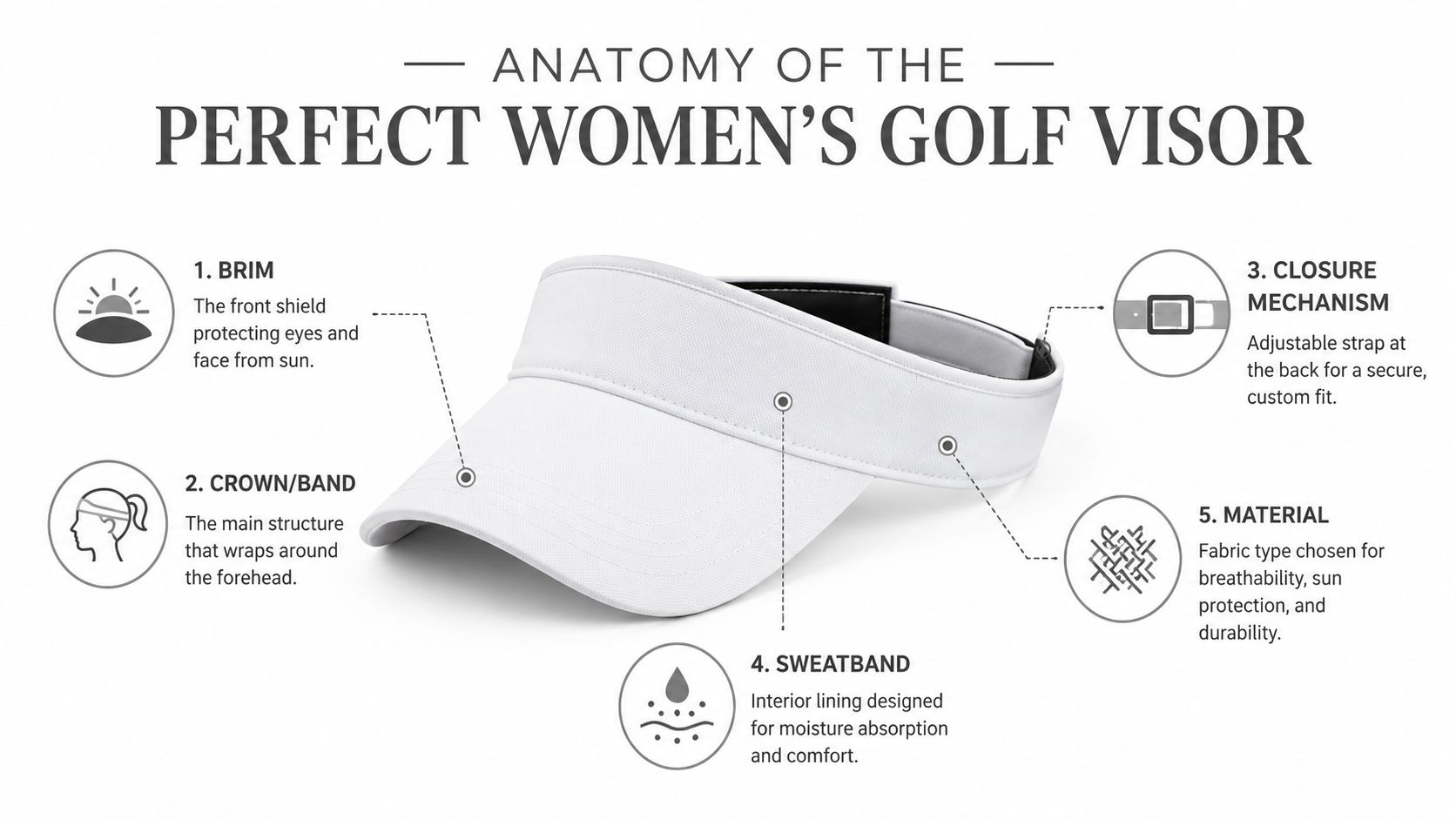
Anatomy of the Perfect Golf Visor
If you want a visor that performs, start being picky about the parts. Tiny design details change everything once you're two hours into a sunny round.
The brim decides whether you squint all day
The brim is the whole point. If it's too shallow, glare sneaks underneath and you'll feel it right away. If it's too oversized or stiff in the wrong way, it can look costume-y and throw off your proportions.
The sweet spot for high-performance women's golf visors is a 2.5 to 3 inch brim depth, paired with a shape that controls glare without feeling bulky. Verified product-performance data also notes that visors with a 360° ventilation channel and that brim depth can deliver 15 to 20% higher airflow velocity over the crown, with a 3 to 5°C lower perceived head temperature under direct midday sun.
That's not a throwaway feature. That's comfort you can feel.
The band is where comfort lives or dies
If the band is scratchy, absorbent in the wrong way, or too rigid, the whole visor becomes annoying fast. The best bands feel smooth on the forehead and don't hang onto sweat.
Women's golf visors built for play often use polyester or nylon blends with a hydrophobic finish, and verified benchmark data notes that this kind of finish can reduce sweat absorption by up to 40% compared with untreated cotton. Less absorbed sweat means less heaviness, less slip, and fewer mid-round adjustments.
Look for a band that feels athletic, not decorative.
Practical rule: If a visor feels “fine” indoors but a little snug, it'll feel worse on the course.
The closure should respect your hair
At this point, a lot of brands get lazy.
Here's the quick breakdown:
- Velcro: Easy to adjust, but it can grab loose hair and lose polish over time.
- Buckle: Cleaner look, better hold, usually the best choice if you want a premium finish.
- Elastic: Comfortable at first, but less precise if you like a locked-in fit.
Verified fit data shows that visors with a structured adjustable plastic or metal buckle system can maintain a consistent 58 to 60 cm head circumference fit across 90% of female users, which is exactly why buckle styles tend to feel more stable during full swings.
My blunt buying advice
Skip visors that are only cute on a shelf. Choose one with:
- A defined brim
- A true sweatband
- A secure back closure
- Fabric that feels sporty, not flimsy
Pretty matters. Construction matters more.
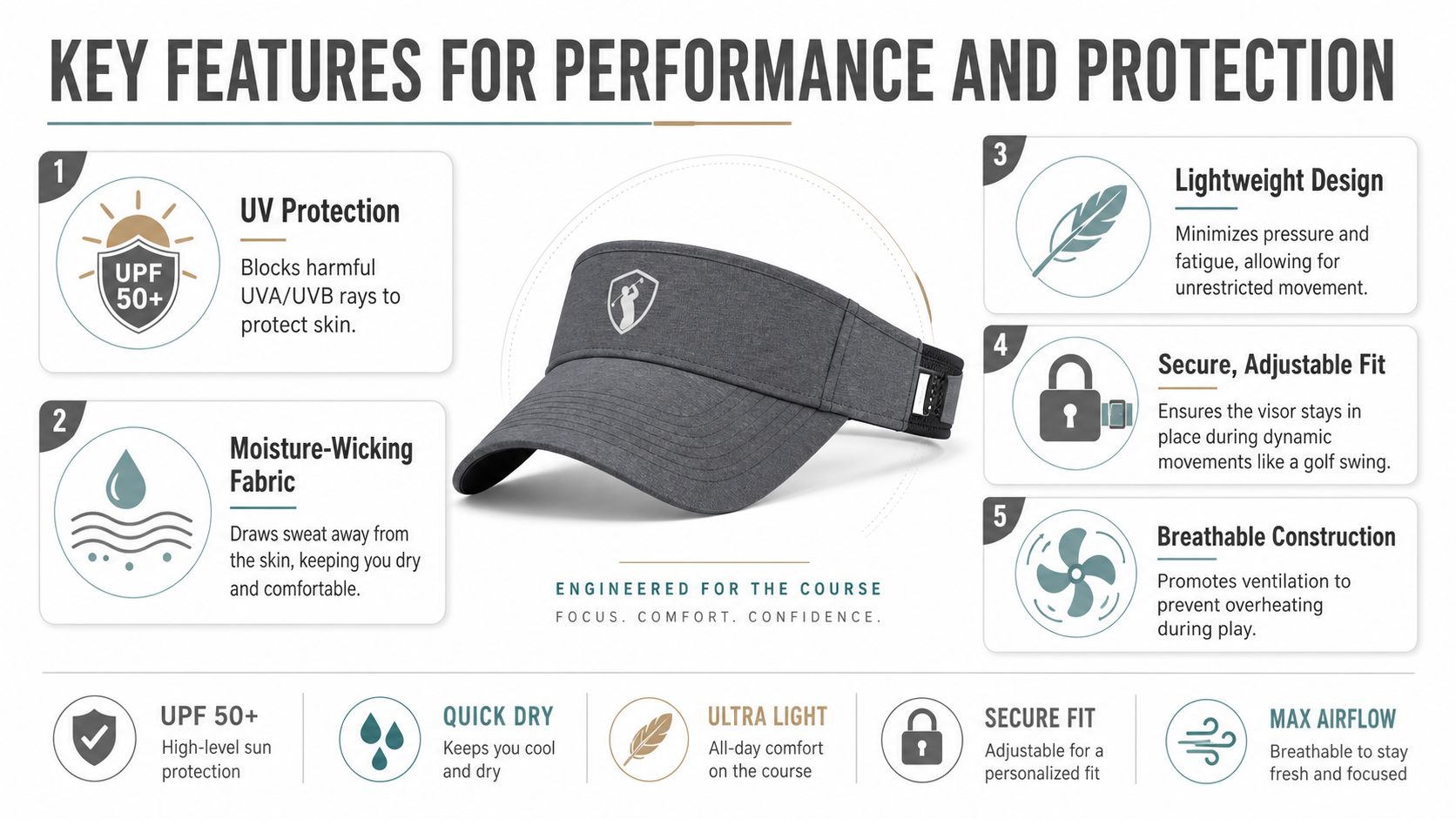
Key Features for Performance and Protection
Golf visors for women separate into two camps. One camp looks good in a product photo. The other survives heat, sun, sweat, and eighteen holes without becoming irritating.
UPF isn't optional
Your forehead and brow line take a beating on the course. If your visor isn't helping protect that area, it's underperforming.
According to verified ASTM benchmark data, premium women's golf visors should hit UPF 50+, which blocks over 98% of UVA and UVB radiation. That's the standard worth caring about. Anything vague like “sun-ready” or “great for outdoor wear” without a real UPF callout doesn't impress me.
If you're already serious about eye comfort and visibility in bright conditions, this broader guide to eye protection for athletes is worth reading too. Your visor handles part of the problem. Your eyewear handles the rest.
Moisture management is what keeps a visor wearable
Sweat is where many cute visors fail.
A proper moisture-wicking fabric doesn't just soak up sweat and sit there. It moves moisture away from your skin so the band stays more comfortable and the visor keeps its shape better through the round. That matters when you're walking, playing in humidity, or dealing with a hot practice session before a tee time.
Here's what to prioritize:
- Polyester or nylon blends: They're the safer choice when you want athletic performance.
- Hydrophobic finishing: Better for reducing that soggy, heavy feeling.
- Interior sweatband: Non-negotiable if you play in heat.
For a broader look at headwear options built around sun coverage, this golf hat sun protection guide is a useful companion read.
Breathability versus coverage is the real trade-off
Most shopping guides get this wrong because they act like more shade automatically means better choice. Not always.
Verified industry commentary notes that existing content rarely addresses the trade-off between sun protection and breathability for women playing mid-morning rounds in hot climates, even though visors offer maximum breathability while caps provide deeper forward shade for sunrise plays. That's a useful distinction because tee time changes the answer.
If you mainly play later in the morning, I'd choose a visor over a cap almost every time. The open top helps heat escape, and that comfort difference adds up over a long round.
More fabric isn't always smarter. Sometimes it just means hotter.
What to scan for in product descriptions
Use this as your filter:
- UPF 50+ if the brand provides a sun-protection rating
- Moisture-wicking fabric instead of basic cotton-heavy construction
- Ventilation details if you play in heat
- Adjustable closure that won't loosen after nine holes
- Structured brim that holds shape
Ignore fluffy copy. Buy the visor that solves actual on-course problems.
Finding Your Flawless Fit and Hairstyle Harmony
For many women, visors become a beloved accessory or are quickly discarded. Fit and hair are the whole game. If either one is wrong, the visor gets blamed, even when the underlying problem is that the style doesn't match how you wear your hair.
Match the brim to your face
You do not need a complicated beauty chart. You need balance.
- Oval face: Lucky you. Most visor shapes work. Choose based on vibe, not correction.
- Round face: Go for a slightly longer, cleaner brim that adds structure.
- Square face: A gently curved brim softens stronger angles.
- Heart-shaped face: Skip anything too oversized. A medium brim usually looks cleaner and more proportional.
If you're guessing on size, measure first instead of hoping for the best. A quick head measurement guide for hats saves a lot of return-label energy.
Ponytails, buns, braids, and short hair
A visor should work with your hairstyle, not force you into one.
For high ponytails, position the visor slightly lower on the forehead than you think you need, then secure the ponytail so it sits above the closure instead of colliding with it. For low ponytails, buckle-back visors usually behave better because the strap sits cleaner against the base of the head.
For messy buns, choose a visor with enough structure in the band that it doesn't flare away from the face. Soft, floppy bands can look cute in a mirror and chaotic on the course.
For braids, especially one long braid or double braids, a visor is one of the easiest headwear choices because there's less bulk fighting the back closure. For short hair or bobs, the key is brim proportion. Keep it sleek and avoid super-wide styles that can overpower your face.
If you want a stylist's-eye view on creating cleaner ponytail finishes, these ponytail extension techniques for stylists give surprisingly useful ideas for smoothing and wrapping hair around a tie. The same neatness translates well on the course.
If your visor only works with one hairstyle, it's too high-maintenance.
Choose by tee time, not just outfit
This is the part women get almost no useful guidance on.
For hot, bright mid-morning rounds, a visor is often the better pick because breathability matters more. Verified commentary on women's golf headwear points out that visors offer maximum breathability, while caps give deeper forward shade for sunrise play. So if you're the golfer chasing early tee times and low-angle sun, a cap may still win that narrow battle. If you're stepping onto the course when heat starts building, the visor often feels better.
My easiest fit checklist
Before you keep a visor, test these:
- Bend test: Shake your head. If the brim bounces or shifts, pass.
- Hair test: Try it with the hairstyle you wear on the course.
- Temple test: Wear it long enough to notice pressure.
- Sightline test: Address an imaginary ball and make sure the brim doesn't distract your peripheral view.
The perfect visor feels custom without trying too hard.
Styling Your Visor On and Off the Course
You finish a humid back nine, grab an iced tea, and head straight to the patio. Your visor should still look sharp in that second setting. If it only works during the round, it is not a great buy.
Golf style has shifted. Women want pieces that play well, flatter the face, and still make sense after the 18th hole. A good visor does all three, especially when you match it to your personal style and your hair instead of treating it like generic sun gear.

On-course formulas that actually look pulled together
Start with the woman wearing it.
- Competitive and polished: Crisp white or black visor, well-fitting polo, clean skort, small studs, nothing distracting. Keep hair smooth and controlled.
- Casual weekend player: Soft neutral visor, sleeveless top, easy skirt or shorts, relaxed pony or low braid. This look should feel fresh, not fussy.
- 19th-hole social golfer: Visor with a refined trim, fitted dress or matching set, nicer sunglasses, hair with a bit more shape. Here, a visor can look chic instead of purely athletic.
Color matters, but restraint matters more. If the visor is bright, keep the rest of the outfit clean. If the outfit has print or contrast piping, choose a visor that repeats one color and stops there.
If you like stronger personality in your outfits, this example of bold women's golf wear shows how a visor can anchor a louder look without turning the outfit messy.
Off-course styling works best with the right visor personality
The visors that transition well are simple, structured, and intentional. Pair one with a knit tank, polished shorts, a quarter-zip, or a clean monochrome travel outfit. White sneakers help. So do gold hoops, a neat braid, or a low bun that keeps the whole look crisp.
Skip anything too corporate or too precious. A golf visor with heavy tailoring usually looks off. A golf visor with sporty basics, resort pieces, or refined athleisure looks smart.
Your hairstyle decides a lot here. Loose waves with a sporty visor can look great for errands or post-round lunch, but only if the brim is sleek and the band sits flat. A high pony reads athletic. A low bun reads polished. A braid feels effortless and stays neat longer in wind and heat.
The best off-course visor outfit looks chosen on purpose, not like you forgot to change.
Keep the logo restrained, the brim clean, and the rest of the outfit edited. That is how a visor looks expensive and flattering instead of random.
Which Visor Matches Your Golfer Persona
Not every woman wants the same thing from a visor, and that's exactly why generic buying advice is useless. Your best visor depends on how you play, where you play, and who you are between the first tee and the 19th hole.
That matters even more because younger women are shaping what golf style looks like now. In the women's golf apparel market, the 18 to 35 age group holds a 39.6% share, according to Cognitive Market Research on women's golf apparel. They're not buying one-note gear. They want pieces that perform and still feel like them.
The three personas that actually matter
| Golfer Persona | Primary Need | Key Features to Look For |
|---|---|---|
| Competitive Player | Zero distraction during play | Structured brim, moisture-wicking band, secure buckle closure, minimal bulk |
| Casual Weekender | Comfort and easy styling | Soft athletic fabric, flattering brim, simple adjustability, versatile color |
| 19th-Hole Social Golfer | Polished look that lasts past the round | Premium finish, clean silhouette, hair-friendly closure, elevated branding |
The Competitive Player
She doesn't care whether the visor is trendy if it shifts during the swing.
Choose a visor with a secure closure, real sweat control, and no extra fuss. This is the golfer who should prioritize function first. Clean white, black, navy, or a crisp neutral usually works best because it goes with everything and doesn't feel distracting.
Best match: a structured athletic visor with a buckle closure and performance fabric.
The Casual Weekender
She wants to play well, but she's also there to enjoy the day. Her visor needs to be comfortable, cute, and easy. Nothing too technical-looking, nothing too precious.
This golfer should look for medium brims, soft but stable bands, and shades that pair with most of her wardrobe. Think soft white, sand, muted pink, or classic black.
Best match: a balanced visor that feels sporty but still feminine.
The 19th-Hole Social Golfer
She wants the visor to survive the scorecard, the patio lunch, and the post-round photos.
She should look for refined finishes, a polished closure, and a silhouette that flatters the face. For these elements, texture, trim, and shape matter as much as pure performance. If the visor looks cheap up close, she'll notice.
Best match: a premium-looking visor with a sleek brim and enough structure to hold its style all day.
Your persona isn't fluff. It's the fastest way to stop buying gear that looks right online and feels wrong in real life.
Keeping Your Visor in Top Shape
Once you find a visor you love, don't destroy it with lazy care.
Clean it without ruining the shape
Hand-wash it. Use cool water, a small amount of mild soap, and a soft cloth or gentle brush on the sweatband. Rinse lightly, reshape the brim with your hands, and let it air dry.
Never twist it dry. Never flatten the brim under something heavy. And yes, putting it in the dishwasher is a terrible idea.
If you want a more detailed method, this guide on how to clean golf hats covers the basics well.
Store it like you plan to wear it again
Don't shove it into the bottom of a packed tote under sunscreen, balls, and snack wrappers. Keep it on a shelf, hook, or in a spot where the brim won't get crushed.
A quality visor earns that courtesy.
My final advice
Buy the visor that fits your real golf life. Not your fantasy golf life. If you play in heat, choose breathability. If you care about polished style, choose structure. If your hair is always in a high ponytail, stop buying closures that fight it.
The right golf visor for women should protect your face, keep you comfortable, and make you feel pulled together the second you put it on. That's not asking too much. That's the standard.
If you want headwear that feels sharp on the course and still looks right long after the final putt, take a look at 2ndShotMVP. Their premium golf hats, beanies, and lifestyle pieces are built for golfers who care about quality, personality, and wearing their gear with confidence on and off the course.

