

XXL isn't a standard hat size, and most brands get it wrong. If your head measures 62 to 64 cm (24.4 to 25.2 inches), that's the number to shop for, not some fuzzy “XXL” label that means one thing on one site and something completely different on the next.
You're probably here because you've already done the dance. You ordered the “big size.” It arrived. You put it on. It perched on your head like a teacup on a fire hydrant, pinched your temples, and somehow still threatened to fly off in the first decent breeze.
That's especially maddening if you want a bucket hat for golf, not for a mirror selfie. On the course, a bad fit isn't a minor annoyance. It distracts you over the ball, rides up when you swing, and turns sun protection into wishful thinking. A proper XXL bucket hat should fit cleanly, stay put, and still look sharp enough for a post-round drink without giving off “borrowed from the bait shop” energy.
The good news is the right one exists. You just need to ignore the marketing fluff, measure your head correctly, and look for the numbers that matter. Start at 62 cm and up if you're shopping in true XXL territory.
Welcome to the Big Head Club
You know the moment. The hat says “Large/XL,” the product page says “roomy fit,” and within ten minutes your forehead feels like it's being slowly tightened by a ratchet strap. That isn't a style problem. That's a sizing problem disguised as optimism.
Plenty of golfers put up with this nonsense longer than they should. They settle for caps that sit too high, bucket hats that never come down far enough, or “one-size” models that fit everybody except the people who need the sizing chart to mean something. Then they wonder why the hat feels wrong all round.
The bucket hat grew up
The bucket hat isn't just a passing fashion gag anymore. Industry trend analysis from Alibaba notes that bucket hat searches peaked in mid-2022, then shifted from viral trend status into a transitional accessory and functional staple. Good. That means you can wear one now without looking like you lost a bet.
For golfers, that shift matters. A bucket hat gives you shade around the face and ears, works with modern golf apparel, and has enough personality to avoid the country-club-uniform look. When it fits properly, it looks intentional. When it doesn't, it looks like surrender.
Big-head golfers don't need more “style inspiration.” They need a hat that stops squeezing their skull and stops lifting on the downswing.
You're not the problem
If you've spent years thinking, “Maybe hats just aren't for me,” toss that idea in the nearest bunker. The issue isn't your head. The issue is lazy sizing and generic product design.
That's why guides built for average shoppers usually miss the point. Golfers with larger head sizes need a different standard. They need real measurements, useful crown depth, and enough structure to survive a round without becoming an airborne napkin. If that sounds familiar, the folks looking for big head golf hats are dealing with the exact same headache.
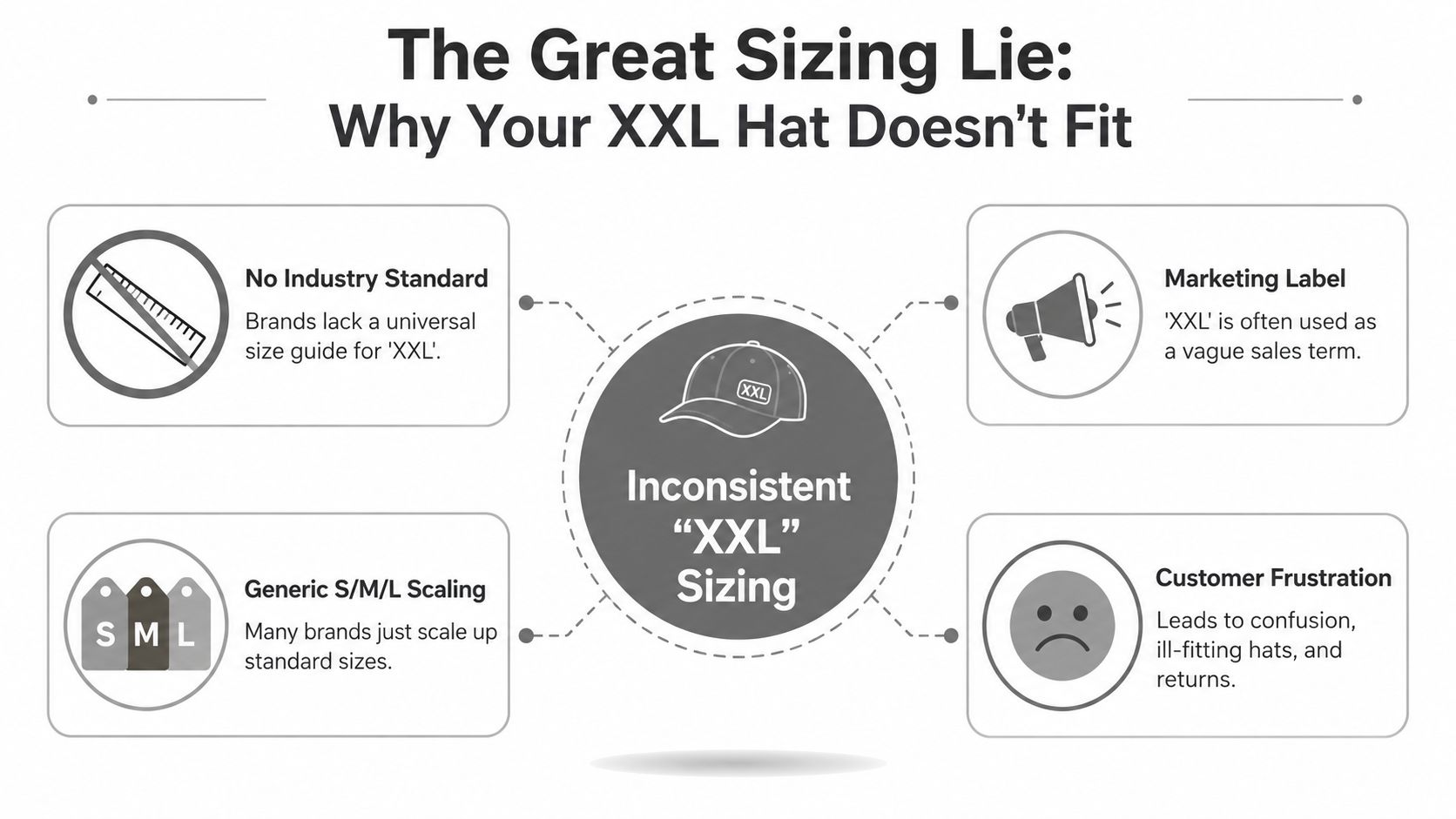
The Great Sizing Lie Why Most XXL Hats Dont Fit
“XXL” sounds precise. It isn't. It's a marketing label wearing a fake mustache.
Most shoppers assume hat sizing works like decent shoe sizing. If you know your size, you buy your size, and life moves along. But bucket hats often don't work that way. One brand's XXL is another brand's optimistic XL with better copywriting.
What XXL usually means, and why that's useless
The core problem is simple. The Painted Cupcake's sizing overview explains that XL is typically 60 to 62 cm, while XXL has no standardized definition and can vary wildly, leaving buyers with heads larger than 25 inches without a reliable way to verify fit before purchase.
That last part is the killer. Without an actual centimeter measurement, “XXL” tells you almost nothing.
Why golfers feel the problem more than casual wearers
A sloppy fit is annoying at brunch. On a golf course, it becomes a performance issue.
A too-small hat clamps down and sits too high. A too-shallow crown won't settle properly. A brim that's already under tension from being stretched over a larger head won't behave the way the designer intended. It can warp, tilt, or lose the shape that helps with coverage and stability.
Here's the clean way to understand it:
| Label on tag | What you should care about | Why it matters |
|---|---|---|
| XXL | Actual head circumference in cm | Labels vary too much |
| “Relaxed fit” | Crown depth and brim structure | Marketing language means nothing without dimensions |
| “One size” | Move along | It's rarely built for genuinely large heads |
Ignore the label and read the numbers
Treat hat shopping like buying a suit off measurements, not off hope. If a product page doesn't tell you the circumference range, be skeptical. If it doesn't mention crown depth or any real construction details, be more skeptical.
Buying rule: never trust “XXL” by itself. Trust the centimeter range.
That one shift will save you money, time, and the indignity of returning another hat that looked promising until it met your forehead.
Measure Once Buy with Confidence
If you can measure your grip size, you can measure your head. This part isn't complicated, but it does need to be done properly. Sloppy measuring gives you the same bad result as sloppy setup at address. Start crooked, finish annoyed.
How to measure your head correctly
Use a flexible tape measure if you have one. If you don't, use a string, then lay it flat against a ruler.
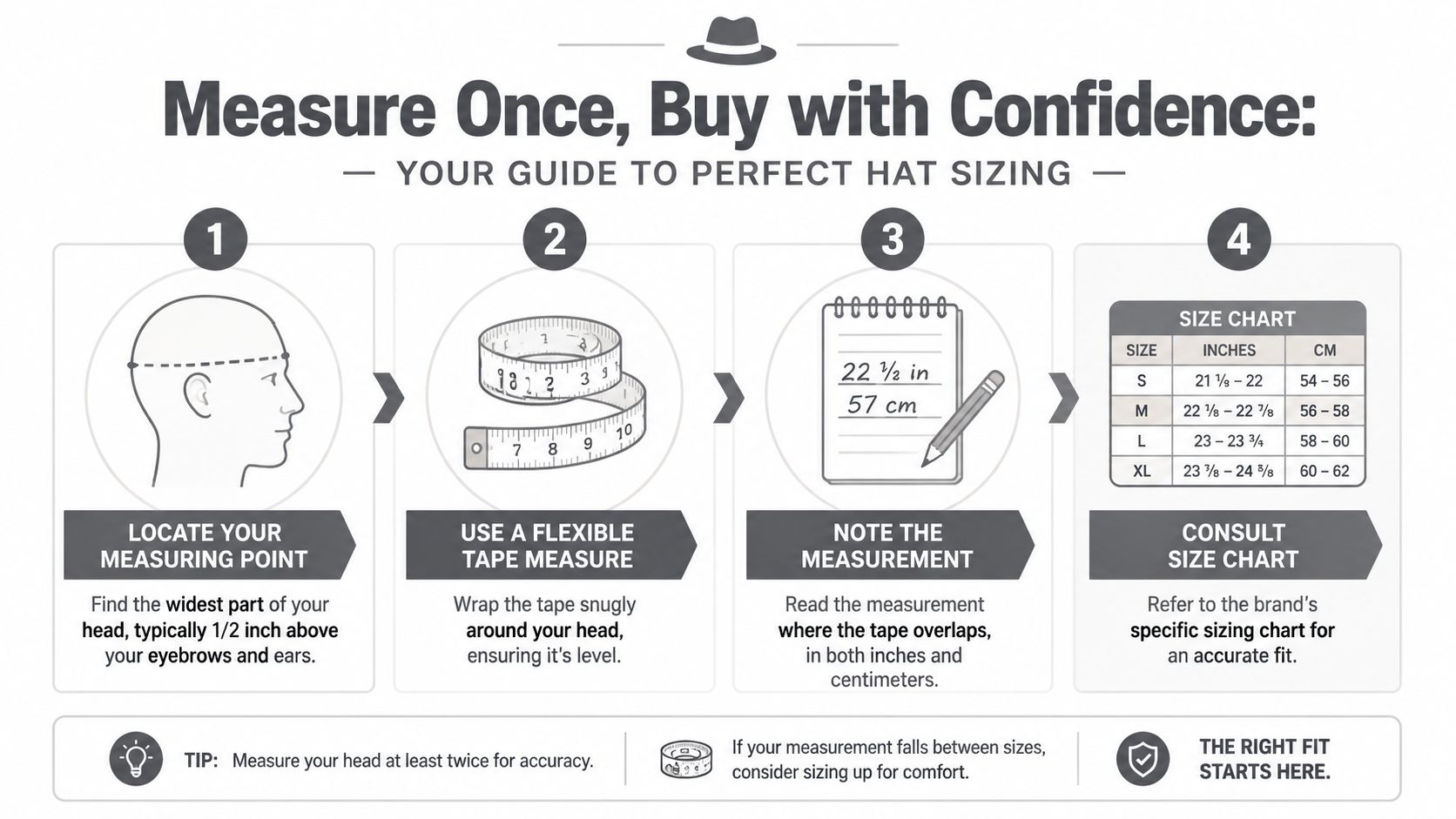
Do this in four clean steps:
-
Find the right line
Measure around the widest part of your head. That usually means across the forehead and just above the ears. -
Keep the tape level
Don't let it drift upward in back or sag in front. If the tape isn't level, the number is junk. -
Pull it snug, not tight
You want the fit you'd wear. Not loose enough to spin, not tight enough to leave a trench across your forehead. -
Write down both cm and inches
Brands bounce between the two. Having both numbers keeps you from making dumb conversion mistakes at checkout.
For a visual walkthrough, this head measuring guide for hats is worth a look.
A short video can help if you want to double-check your measuring technique:
The number that matters
Nury's hat size guide states that a true XXL bucket hat should correspond to 62 to 64 cm (24.4 to 25.2 inches). It also notes that putting a smaller hat on a larger head creates tension that deforms the brim and reduces UV protection as the hat rides up.
If you measure 63 cm, shop for a hat specifically built for 63 to 64 cm. Don't “size down and hope.”
That's the whole ballgame.
What to do with your measurement
Once you have your number, shop like this:
- If you're at 62 cm, look for true XXL or a listed range that begins at 62 cm.
- If you're at 63 cm, skip anything that tops out at 62 cm, even if the brand swears it runs large.
- If you're at 64 cm, you need explicit confirmation in the size chart. No chart, no sale.
The big mistake is buying by category instead of measurement. “Men's XXL.” “Oversized fit.” “Big head friendly.” That language belongs in the recycling bin unless it's backed by dimensions.
Anatomy of a Perfect Golf Bucket Hat
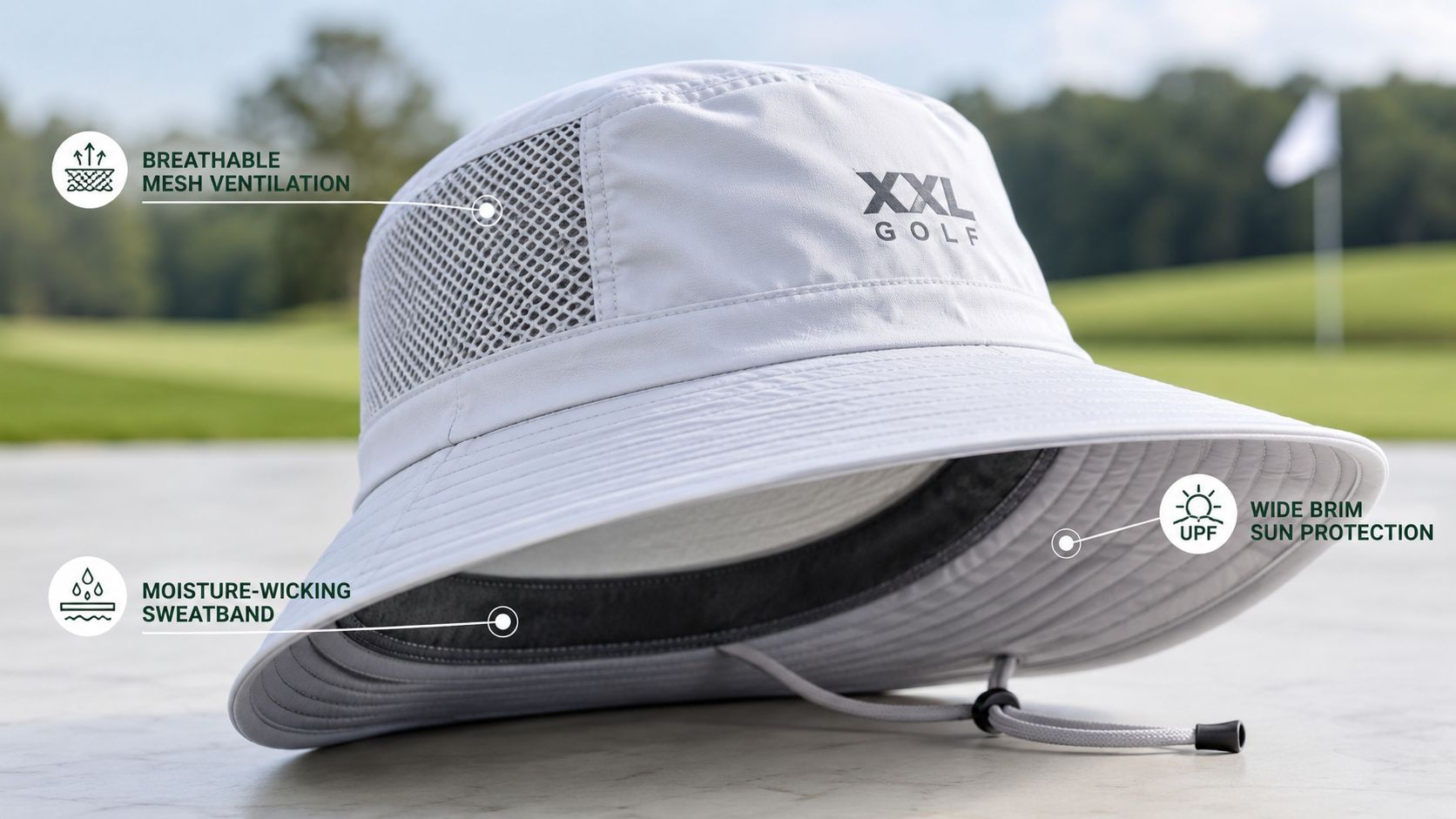
A real golf bucket hat isn't just bigger. It's engineered differently. That matters because golf adds movement, sweat, wind, and long sun exposure. A fashion bucket hat can get away with being flimsy. A golf hat can't.
Crown depth decides whether the hat settles or perches
For golf-specific use, an XXL bucket hat needs a crown depth of 14 to 15 cm and a brim width of 8 to 10 cm to maintain stability during a swing. Those dimensions aren't decorative. They're functional.
A shallow crown sits high and unstable. That's when you get the dreaded mushroom effect. The hat looks undersized because it is undersized in the one way that matters most: it never settles onto the head.
A proper depth lets the hat sit lower and more securely. That gives you a cleaner profile and a steadier feel through the swing.
Brim width isn't just about shade
An undersized brim misses the point. You want enough width to cover, but not a floppy pancake that catches every gust on the property.
Here's the practical breakdown:
-
Around the face
A brim in the proper range helps shade the forehead, cheeks, and ears without looking theatrical. -
During the swing
Good width paired with proper structure helps the hat stay composed instead of lifting and wobbling. -
Off the course
The right brim still looks polished with a quarter-zip or a clean polo. Too narrow looks cheap. Too wide looks costume.
If you're comparing designs, this overview of the golf bucket hat category shows the sort of style direction that works on the course without drifting into novelty territory.
Fabric decides whether the hat holds its shape
Material is where a lot of bucket hats go to die. They look good in product photos, then collapse after heat, sweat, and humidity get involved.
For golf, performance materials should have tensile strength of at least 35 MPa and water absorption under 5% over 24 hours to maintain structural integrity in humid outdoor conditions. In plain English, you want fabric that doesn't stretch out, sag, or turn limp when the weather acts up.
On-course standard: if the material can't keep its shape in heat and humidity, it isn't a golf hat. It's a souvenir.
What a good golf hat should include
You don't need a science lab. You need a few obvious signs of quality:
| Feature | What to look for | Why you care |
|---|---|---|
| Crown | Deep enough to sit down on the head | Better stability and cleaner fit |
| Brim | Structured, moderate width | Shade without flopping |
| Sweatband | Soft, secure, moisture-managing feel | Better comfort through a full round |
| Fabric | Holds shape in humid conditions | Less droop, better appearance |
| Stitching | Even and reinforced feel | Better long-term durability |
Golfers with larger heads shouldn't accept generic fashion geometry and call it good enough. The hat has a job to do.
Styling Your Hat for the Course and the Clubhouse
A good XXL bucket hat should solve two problems at once. It should fit properly, and it should make you look like you know what you're doing. One without the other is half a win.
The nice part is you're shopping at the right moment. Fortune Business Insights reports that the global bucket hat market is valued at $400 million in 2025 and projected to grow to $660 million by 2034, with a 5.93% CAGR over that forecast period. The same analysis notes that bucket hats have moved from fleeting trend status into an enduring functional accessory. Translation: you're not forcing it. You're wearing a piece that has earned its place.
The course-ready look
Start with the hat in a clean neutral. White, navy, black, stone. Then build the outfit like an adult.
Pair it with:
- A modern polo that fits the shoulders and sleeves properly
- Well-fitting golf trousers or refined shorts with some structure
- A belt and shoes that look intentional, not pulled from three different decades
The point is balance. The bucket hat has more visual presence than a standard cap, so the rest of the outfit should be understated. If your shirt is loud, your shorts are louder, and your hat is trying to be the headline too, you'll look like a pro shop clearance rack gained consciousness.
The 19th hole version
After the round, keep the hat on if the rest of the outfit deserves it. Swap the golf-energy look for something sharper.
A crisp knit polo works. A quality quarter-zip works. A linen blend shirt on a warm day works beautifully. What doesn't work is keeping the same wrinkled shirt, sweat-stamped hat, and beat-up shoes, then pretending it's all “relaxed.”
The best-dressed golfer in the clubhouse rarely wears the loudest outfit. He wears the one that fits.
Style rules for bigger hats
Larger hats need proportion. That's where a lot of men get sideways.
-
Keep the crown clean
Don't overload the hat with giant logos or chaotic patterns. Big headwear already makes a statement. -
Choose structure over slouch
A little shape looks deliberate. Too much collapse looks tired. -
Dress to the hat's size
Slightly roomier polos, straight trousers, and clean outer layers usually pair better than ultra-skinny silhouettes.
A proper XXL bucket hat can look elegant, sporty, and relaxed at the same time. That's a useful trick in golf, where you want technical performance without dressing like a lost caddie.
Your Final Checklist for Buying the Right XXL Hat
If you remember nothing else, remember this: buy the measurement, not the label. That one decision filters out most of the junk.
The non-negotiables
Run through this list before you buy:
-
Actual size range in centimeters
If the product page doesn't tell you the head circumference it fits, skip it. -
True XXL territory
If your measurement falls into the larger-head category covered earlier, shop for that exact range. Don't talk yourself into “close enough.” -
Deep crown
You want a hat that sits on your head, not on your hopes. -
Structured brim
Enough shape to keep coverage and composure on the course. -
Performance-minded fabric
Material should resist sagging, soaking, and losing form in warm, humid conditions.
The quality checks people forget
A few details separate a keeper from a return label:
| Check | Good sign | Red flag |
|---|---|---|
| Stitching | Even, tidy, firm seams | Loose threads and wavy lines |
| Sweatband | Comfortable and secure feel | Scratchy band that shifts |
| Shape | Balanced crown and brim | Twisted or uneven silhouette |
| Product info | Clear dimensions | Vague buzzwords only |
Care that keeps the hat looking expensive
You don't need to baby the thing, but don't treat it like a gym towel either.
- Let it dry properly after hot rounds. Don't crush it into the trunk.
- Store it with the crown supported so the shape holds.
- Clean it gently according to the fabric type instead of blasting it with whatever soap is nearest the sink.
- Reshape the brim by hand while it's drying if it starts to lose its line.
Buy one that fits, maintain the shape, and you'll wear it for years instead of replacing cheap mistakes every season.
The right XXL bucket hat should disappear while you're playing and get compliments when you're done. That's the standard. Comfort first. Stability second. Style close behind.
If you're done gambling on vague sizing and flimsy brims, take a look at 2ndShotMVP for premium golf headwear built for confidence on and off the course. Good hats should fit, perform, and look sharp enough to carry from the first tee to the 19th hole without apology.

