

You're on the back nine, the sun has moved across the fairway, and the visor that felt perfect on the first tee is suddenly letting light hit the bridge of your nose. Your scalp is hot, your ponytail keeps slipping, and you're thinking about your hat instead of the par putt in front of you.
That's the problem with treating a women's golf hat as a cute extra. Over a long round, the right hat manages glare, sweat, hair, and sun exposure while staying quiet on your head. The wrong one shifts during every downswing, traps heat, or leaves your ears and neck uncovered. For women shopping for golf hat ladies styles, function has to come first. The hat should support your game, then look good enough to survive the 19th hole.
Why the Right Golf Hat Matters on the Course
A reliable hat removes small distractions before they become round-long annoyances. A stable brim helps control harsh light when you're reading a putt or tracking a high shot. A sweatband keeps perspiration from running into your eyes. A secure crown keeps loose hair away from your face and stops you from reaching up to adjust the hat after every swing.
That comfort matters because golf exposes you to the same conditions for hours. The history of women's golf attire shows that headwear began as part of formal women's clothing, not as a specialized performance product. In 1811, when the first known women's golf tournament was held, long skirts and hats were still standard, and golf clothing closely followed everyday dress. By the 1920s, women's golf fashion had become more flexible and better suited to movement.
A hat should disappear during the swing
The best golf hat is the one you stop noticing by the third hole. It doesn't pinch above your ears, float above your forehead, or drop into your line of sight when you look down. Its brim sits firmly enough to manage glare, while its crown and sweatband let air move around your head.
A poor fit creates a steady stream of tiny interruptions:
- Glare: Light reaches your eyes during setup or putting.
- Sweat: Moisture collects along the forehead and causes constant wiping.
- Hair movement: A loose ponytail or crushed bun becomes part of your swing thought.
- Instability: The hat shifts when you bend, turn, or walk into wind.
Women's golf participation has also made headwear more relevant across the sport. One industry source reported approximately 5.8 million women golfers in 2017, while another reported that women represented 25% of golfers in 2021, up from 19% a decade earlier (golf participation and women's professional golf history). More women playing means more reason to choose a hat designed around real movement, comfort, and coverage rather than borrowing a men's cap.
The Main Hat Styles Women Actually Wear
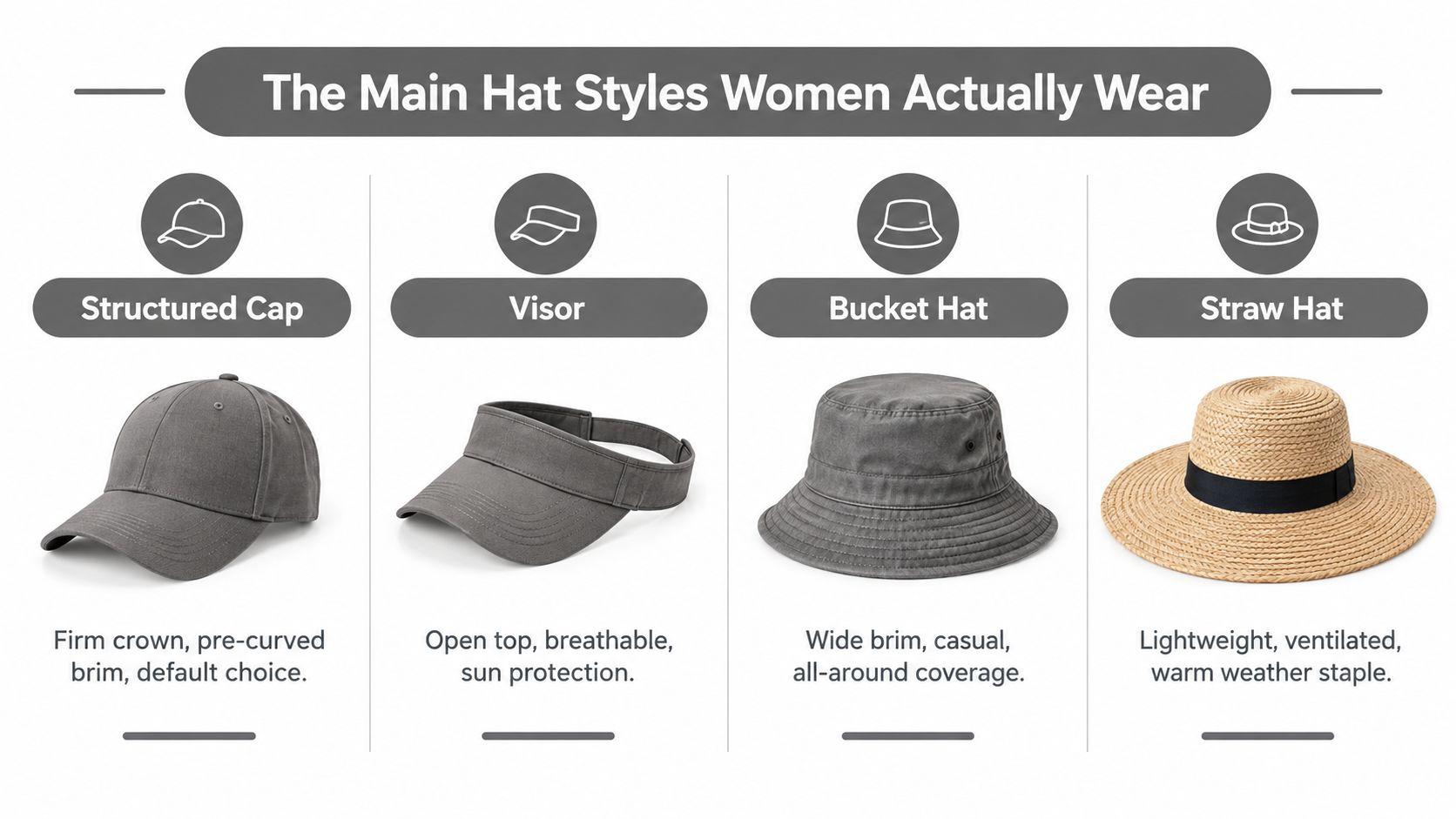
Walk past a tee box and you'll see four practical categories. Each has a distinct shape, and each solves a different problem. Don't choose by logo first. Choose by the amount of airflow, coverage, and hair freedom you need.
Structured caps
A structured cap has a firm front panel, a shaped crown, and a curved brim. The back usually closes with a snap, hook-and-loop strap, buckle, or elastic section. You can spot one immediately because the front holds its shape even when the hat isn't on a head.
This is the safest default for golfers who want hair contained and a familiar fit. It works particularly well with a low ponytail, sunglasses, and a push cart. Look for a crown that has enough height to avoid crushing your hair, but not so much that the hat looks oversized.
Visors
A visor has a brim and sweatband but no crown. That open top gives you the most airflow and leaves room for a high ponytail or fuller hair. It's also easy to adjust during a hot round because the exposed crown doesn't trap as much heat.
The trade-off is obvious. A visor protects the eyes and forehead while leaving the scalp, upper ears, and much of the hair exposed. Wear sunscreen on those areas, or choose a visor only when you're comfortable with the reduced coverage.
Bucket and floppy hats
Bucket hats have a soft crown and a brim that drops around the head. Floppy hats use a similar idea but often have a wider, less structured brim. Their visual cue is simple: the brim moves easily when you handle it, and the silhouette extends beyond the face rather than stopping at the forehead.
They're strong choices for open resort layouts, walking rounds, and players who want more cheek, ear, and neck coverage. A softer brim can also feel less restrictive than a structured cap, though wind can turn it into a nuisance if the fit isn't secure.
Headbands and bandanas
Headbands and bandanas cover the least area, but they're useful when you hate a crown on your head. They control sweat and help hold hair back without pressing down on curls, braids, or a top knot.
For shape advice beyond golf, this hats for face shape guide can help you compare crown height and brim proportions. On the course, though, your first filter should remain coverage and stability.
Sun Protection, Sweat, and Breathability
A hat earns its place in your golf bag by managing heat, glare, and exposure, not by looking technical on the product page. Start with the UPF rating. UPF 50+ fabric blocks about 98% of UV radiation, allowing roughly 1/50th of UV to reach the skin, according to golf hat sun-protection guidance. That level of coverage matters during a long round, especially when the hat also has a broad brim.
UPF 30+ and UPF 50+ are useful benchmarks, yet the fabric still matters. A tightly woven or dense material usually provides more dependable coverage than a loose decorative weave. A visor may carry a high UPF rating across its brim while leaving the scalp and ears exposed, because the rating applies to the fabric, not every part of your head.
Read the brim like gear
Brim design decides where the shade falls. A narrow brim can protect your eyes while leaving your cheeks and ears in direct sunlight. A wider brim reaches farther around the face and toward the neck, which helps on exposed fairways and under a high sun.
Use this golf hat brim guide to compare curved, flat, short, and wide profiles. Choose based on performance, not shape alone. Tilt your head down as if reading a putt and check whether the brim still blocks light. Then take your address position and confirm it stays outside your sightline.
Ventilation earns its place
Breathability comes from construction, not sporty graphics. Look for laser-cut vents, mesh inserts, side grommets, and a sweatband that manages moisture. These details release trapped heat and move perspiration away from your forehead during extended play, as reflected in women's golf hat product guidance.
Your hair and scalp need coverage too. Healtsy's UV shielding for hair guide provides broader context on sun exposure. Use that information alongside the hat's fit, fabric, and coverage rather than judging protection by face shade alone.
| Feature | What to Look For | On Course Benefit |
|---|---|---|
| UPF fabric | UPF 30+ to UPF 50+ with a tight weave | Limits UV exposure through the material |
| Brim | Firm, stable shape with useful side coverage | Reduces glare and shades the face |
| Underbill | Matte or anti-glare finish | Cuts reflected light into the eyes |
| Crown ventilation | Mesh panels, laser cuts, or grommets | Helps release trapped heat |
| Sweatband | Moisture-control fabric with a soft finish | Keeps sweat away from the eyes |
| Adjustable fit | Strap, buckle, snap, or hook-and-loop closure | Prevents movement while walking and swinging |
Golf-hat guidance also highlights anti-glare underbills, wider brims, and breathable materials for heat, glare, and extended exposure (women's golf hat reviews). My rule is simple: a decorative panel must improve coverage, airflow, or stability. If it only adds weight, leave it behind. That standard lets the same hat work from the first tee through the 19th hole without sacrificing comfort or polish.
Getting the Fit Right the First Time
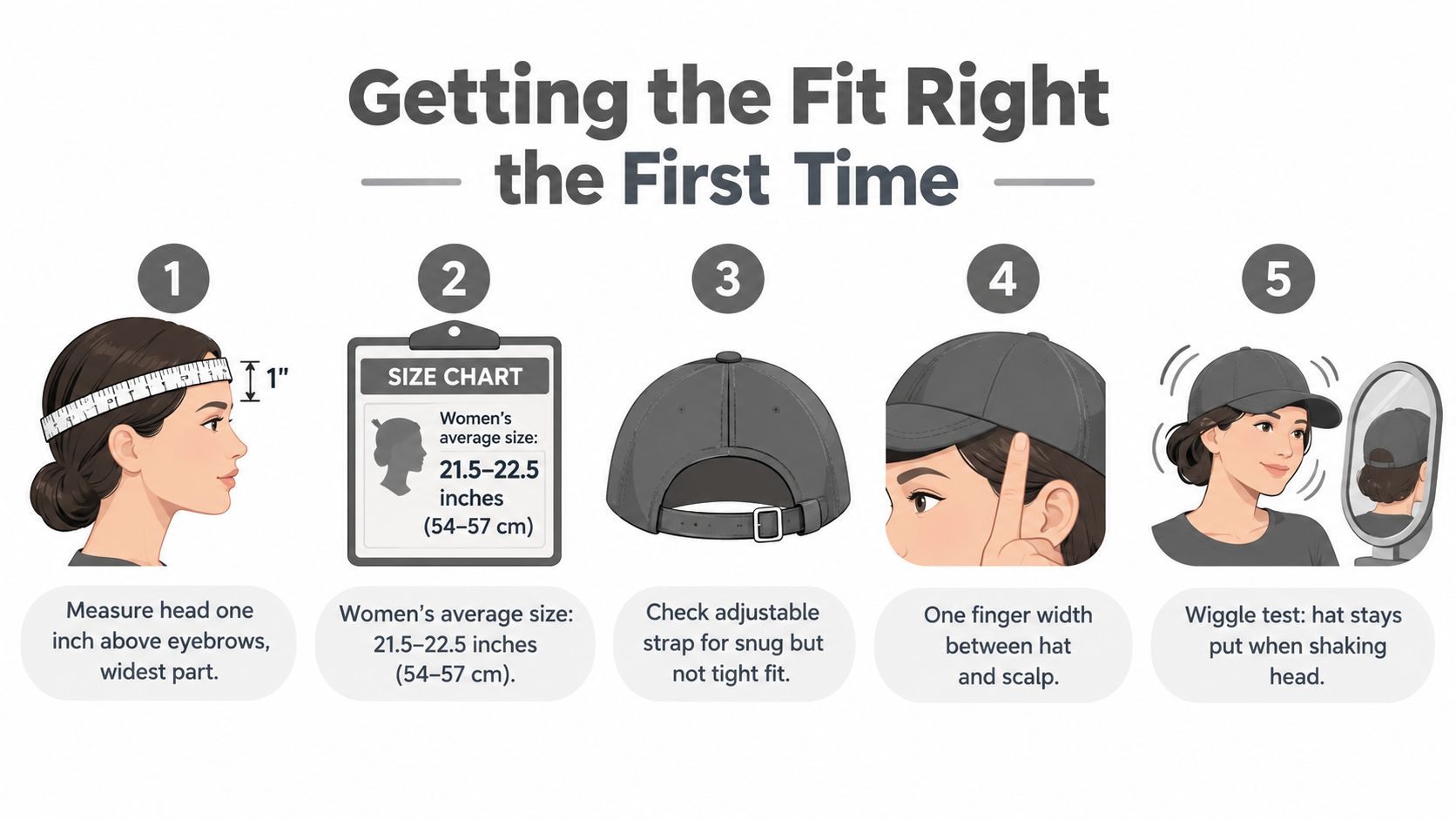
A hat should feel secure without squeezing. Start with a soft tape measure held about an inch above your eyebrows, running across the widest part of your head. Measure without pulling the tape tight, then compare that result with the brand's own size chart because “one size” and “women's medium” aren't consistent across manufacturers.
Choose the closure around your hair
Ponytail players should inspect the back before buying. A rear opening, low ponytail cutout, or stretch back gives hair somewhere to go without forcing it into a bun. A low-profile crown can look sleek online but press awkwardly against a ponytail once you start moving.
Adjustable closures are the most forgiving. A snap, metal buckle, or hook-and-loop strap lets you fine-tune tension when your hair is braided, loose, or tucked under a layer. Stretch-fit styles can work well too, provided the elastic sweatband hugs your head instead of clamping it.
Use this guide to measuring your head for a golf hat before ordering online. Five minutes with a tape measure is cheaper than discovering a pressure point halfway through a round.
Test the hat, not just the label
Try the hat with your normal golf hairstyle and sunglasses. Bend over as if you're reading a putt, turn your head quickly, and make a slow practice swing. The brim shouldn't dip into your vision, and the crown shouldn't slide backward.
Watch for these warning signs:
- Pressure points: Pain around the temples or behind the ears appears quickly.
- A red ring: The sweatband leaves a deep mark after brief wear.
- A floating visor: The front sits away from the forehead and fails to shade it.
- A loose brim: The hat moves when you look up or turn into wind.
- A cramped crown: Your ponytail, braid, or curls get pushed into an uncomfortable shape.
Fit rule: If you're thinking about the hat before you reach the green, the fit is already wrong.
Matching the Hat to the Round
A hat that works at the range can fail by the back nine. Choose it for the forecast, the walking you'll do, and how much skin you want covered. Treat the hat as course equipment first, then judge whether it still looks right after the round.
| Hat Style | Best For | Watch Out For |
|---|---|---|
| Structured cap | Secure everyday wear, sunglasses, push-cart rounds | A rigid crown can crush fuller hair |
| Visor | Maximum airflow and high ponytails | Scalp, ears, and hair need separate protection |
| Bucket hat | Broad face and neck coverage on open courses | Soft brims can move in wind |
| Floppy hat | Resort play and relaxed outfits | Shape may collapse during storage |
| Headband or bandana | Sweat and hair control without a crown | Minimal shade for eyes, face, and scalp |
A structured cap earns its place on calm days and steady walking rounds. It stays close to the head, works with most golf clothes, and leaves room for sunglasses. Choose a visor for hot conditions when airflow matters more than coverage, and be ready to protect the exposed scalp, ears, and hair separately.
Let coverage follow the sun
Open courses and long stretches without shade call for a wider brim. Bucket and floppy styles shield more of the face and ears than a traditional cap. A firm underbill can also cut reflected brightness while you look across a pale fairway.
Compare brim shapes before shopping, then trust your own sightline over a product-page measurement. Stand before a mirror, lower your chin, and check that the brim shades your eyes without hiding the ball. If it blocks your putting view, it belongs off the golf course, regardless of how polished it looks.
Let the material follow the climate
Airy synthetic fabric, mesh, and paper braid suit humid summer rounds because they release heat. Brushed cotton and wool blends feel better in cooler shoulder-season weather, though they can turn heavy as sweat builds. Pack the material that matches the forecast, not the one that photographs best.
Headbands and bandanas solve a different problem. They control sweat and hair without adding a crown, making them useful for hot rounds or under a hoodie at an early tee time. They provide little shade, so pair them with sunscreen and other coverage when direct light is unavoidable. Pick by the holes you'll play and the conditions you'll face, not by whatever silhouette is trending in the clubhouse. A functional choice should carry you from the first tee to the 19th hole without needing a costume change.
Styling a Golf Hat from Tee to 19th Hole
The easiest way to make a golf hat work after the round is to choose one that doesn't look overly technical in the first place. Stone, navy, olive, black, and ecru sit comfortably beside casual clothing, while washed cotton and soft poly blends transition more naturally than neon panels or oversized performance logos.

A crisp visor looks polished with a knit polo, shorts, and low-profile sneakers. A muted structured cap works with linen trousers and a tucked ribbed tee once you leave the cart path. Bucket hats in canvas feel relaxed and weekend-ready, while a floppy straw silhouette pairs naturally with a sundress or midi skirt.
Build around the hat's strongest feature
Keep the rest of the outfit clean. If the hat has a strong brim or a visible logo, skip oversized earrings and busy necklines that compete with it. A simple watch, small hoops, or a slim bracelet is enough for the clubhouse.
For broader wardrobe inspiration, this curated list of timeless accessories is a useful reminder that versatile pieces usually outperform novelty items. The same logic applies to golf headwear. Pick a finish and color you'll wear with more than one outfit.
A hat that moves from course to clubhouse also needs sensible handling. Carry it in a tote or place it crown-up on a shelf. Don't crush it against a steering wheel or wedge it under a towel in the car, because a misshapen brim makes even a good outfit look accidental.
This video offers another visual reference for pairing golf pieces with an off-course look:
One hat can cover all eighteen holes and still belong at the bar afterward. That's the standard worth shopping for.
Care Tips That Keep a Hat Looking New
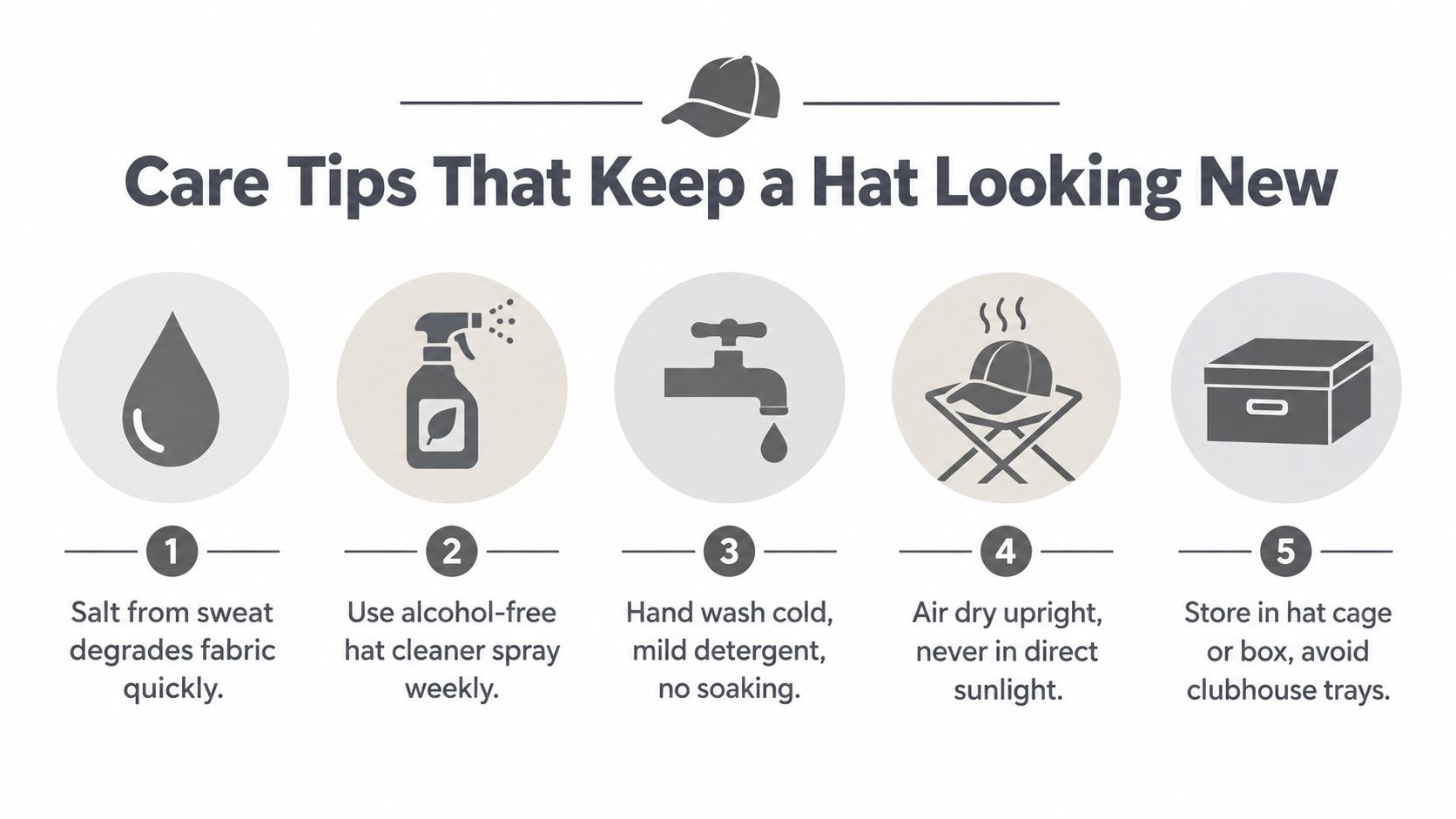
Golf hats age quickly because they absorb sweat, sunscreen, dust, and repeated handling. Salt from perspiration can stiffen fabric and break down the sweatband, while sunscreen residue can leave pale marks or oily patches. Compression inside a golf bag or a crowded car adds another problem, especially for structured crowns and shaped brims.
Start a post-round routine before the hat gets forgotten. Brush away loose dirt with a soft clothing brush, then inspect the sweatband and underbill. If you see a mark, dab it with a mild soap solution and a clean cloth. Don't soak the hat unless the care label specifically allows it.
Clean by silhouette
A structured cap usually tolerates gentle hand cleaning, but aggressive scrubbing can distort the front panel. A visor can be treated similarly, with extra attention to the sweatband because it sits directly against the forehead. Packable floppy and bucket hats should get spot treatment whenever possible, since soaking can destroy the shape you bought them for.
For a more detailed routine, use this guide on how to clean golf hats. The important rule is restraint. Cold water, mild detergent, and patient dabbing beat hot water and a hard brush.
Dry and store it properly
Reshape the brim while the hat is damp, then air-dry it upright on a clean surface. Keep it out of direct heat and don't leave it crushed under golf towels in the trunk. A hook, shelf, hat cage, or box in your gear closet protects the crown and makes the hat easy to grab before the next tee time.
Storage rule: A hat shouldn't spend the night under a towel, inside a hot car, or at the bottom of a golf bag.
Rotate hats by season. Use lighter, ventilated materials in hot weather and denser fabrics when the air cools. Replace a hat when the brim loses its useful stiffness, the crown won't recover its shape, or the sweatband visibly breaks down. A worn hat can still look nostalgic, but it no longer performs its main job.
2ndShotMVP offers premium golf hats, beanies, and lifestyle apparel for men and women, with designs made to work on and off the course. Visit 2ndShotMVP to find a headwear option that keeps your fit comfortable through the round and still looks right at the 19th hole.
