

Think of your golf grip as the handshake that starts every great shot. It’s your one and only connection to the club, making it the command center for everything that follows. Mastering it is all about getting your lead hand on first, then your trail hand, and linking them up in a way that feels right—usually with an overlap, interlock, or 10-finger style.
This simple connection dictates power, accuracy, and control more than any other part of your setup.
Why Your Grip Is the Foundation of Your Entire Golf Swing
Forget about complex swing planes and perfect hip rotation for a minute. Let's get back to basics. The way you hold the club is the steering wheel for your entire swing. A tiny tweak here can send your ball from the middle of the fairway into the trees. It’s that important.
This is where so many golfers stumble right out of the gate. They either strangle the club with a "death grip," creating a ton of tension that absolutely kills clubhead speed, or they hold it so loosely in their palms that they might as well be swinging a wet noodle. We're looking for that sweet spot: a grip that feels secure but also athletic and ready for action.
The Three Foundational Grips
First things first, let's look at the three most common ways to connect your hands on the club. There’s no single "right" way to do it. The best choice for you really depends on things like your hand size, your strength, and frankly, what just feels natural.
- The Overlap (Vardon) Grip: The pinky finger of your trail hand rests snugly in the gap between the index and middle fingers of your lead hand.
- The Interlock Grip: Here, the pinky finger of your trail hand actually links together with the index finger of your lead hand.
- The 10-Finger (Baseball) Grip: Just like it sounds. All ten fingers are on the club, with your hands touching but not overlapping or interlocking at all.
The right grip makes a square clubface at impact feel like second nature. It’s not about finding a textbook-perfect hold, but discovering what allows your hands to work together seamlessly without you having to think about it.
It's a common misconception that there's one "pro" grip. A survey from the PGA Tour showed that nearly 90% of professionals prefer the Vardon Overlap for its amazing control. But then you have legends like Tiger Woods and Jack Nicklaus who built their careers using an interlocking grip. This just proves that personal comfort and what actually works for you will always beat what the book says.
Of course, finding the right grip goes hand-in-hand with having the right gear. A grip that’s too thick or too thin for your hands can cause all sorts of problems, and so can a glove that doesn't fit properly. A perfect fit lets you apply the right pressure without any strain. If you're unsure, you can learn more by checking out our guide on finding your golf glove size.
Your lead hand is the captain of this ship, so let's get its position right first.
Choosing Your Grip Style: Overlap, Interlock, Or 10-Finger
Okay, let's get your hands on the club. I'm going to let you in on a little secret: there is no single "best" way to hold a golf club. It just doesn't exist. The real goal is to find the grip that feels right for your hands and your swing.
Think of it like finding the right pair of running shoes—what works for a world-class sprinter might be terrible for a weekend jogger. We're going to walk through the big three grip styles: the Overlap, the Interlock, and the 10-Finger. One of them is going to feel like it was made for you, giving you that perfect mix of control and comfort.
The Vardon Overlap Grip
Walk down the range at any PGA Tour event, and you'll see this one everywhere. The Vardon grip, or Overlap, is the undisputed king of the professional ranks. An estimated 90% of pros use it, and for good reason. It just works.
To get the feel for it, simply rest the pinky finger of your trail hand (your right hand, for righties) in the little channel created between the index and middle finger of your lead hand. That's it. This simple move encourages your hands to work as a single unit, preventing one from overpowering the other.
This grip is an absolute gem for golfers with average-to-large hands. It promotes a smooth, connected takeaway and a swing that’s powered by your bigger muscles, not just a flippy, handsy motion.
The Interlock Grip
If the Overlap feels a little clumsy or you feel like your hands are slipping, give the Interlock a shot. This one has some serious star power behind it—it was the preferred grip of both Jack Nicklaus and Tiger Woods. If it's good enough for them, it's definitely worth trying.
Instead of resting your pinky on top, you're going to actually link it with the index finger of your lead hand. This creates an incredibly secure connection, almost like your hands are locked together. For golfers with smaller hands or shorter fingers, this can be a total game-changer.
Many players who make the switch to an interlock grip immediately notice more control over the clubface. It physically keeps your hands from shifting around during the swing, giving you a massive boost in confidence.
The 10-Finger (Baseball) Grip
Don't let anyone tell you the 10-Finger grip is "wrong." While it might look simple, it can be wildly effective. As the name suggests, you just place all ten fingers on the club, with your hands nestled snugly together.
There's no overlapping or interlocking here. This is the most natural-feeling grip of the bunch, which makes it a fantastic starting point for total beginners, juniors, or any player who struggles with arthritis or a lack of hand strength. It's the best way to get maximum leverage from both hands.
The Bottom Line: Your goal isn't to force a grip that doesn't feel right. It's to find the one that lets your hands work together as a team. The best grip for you is the one that feels secure, comfortable, and powerful all at once.
This visual guide breaks down the core process, from setting your lead hand to connecting your trail hand and finalizing your chosen grip style.
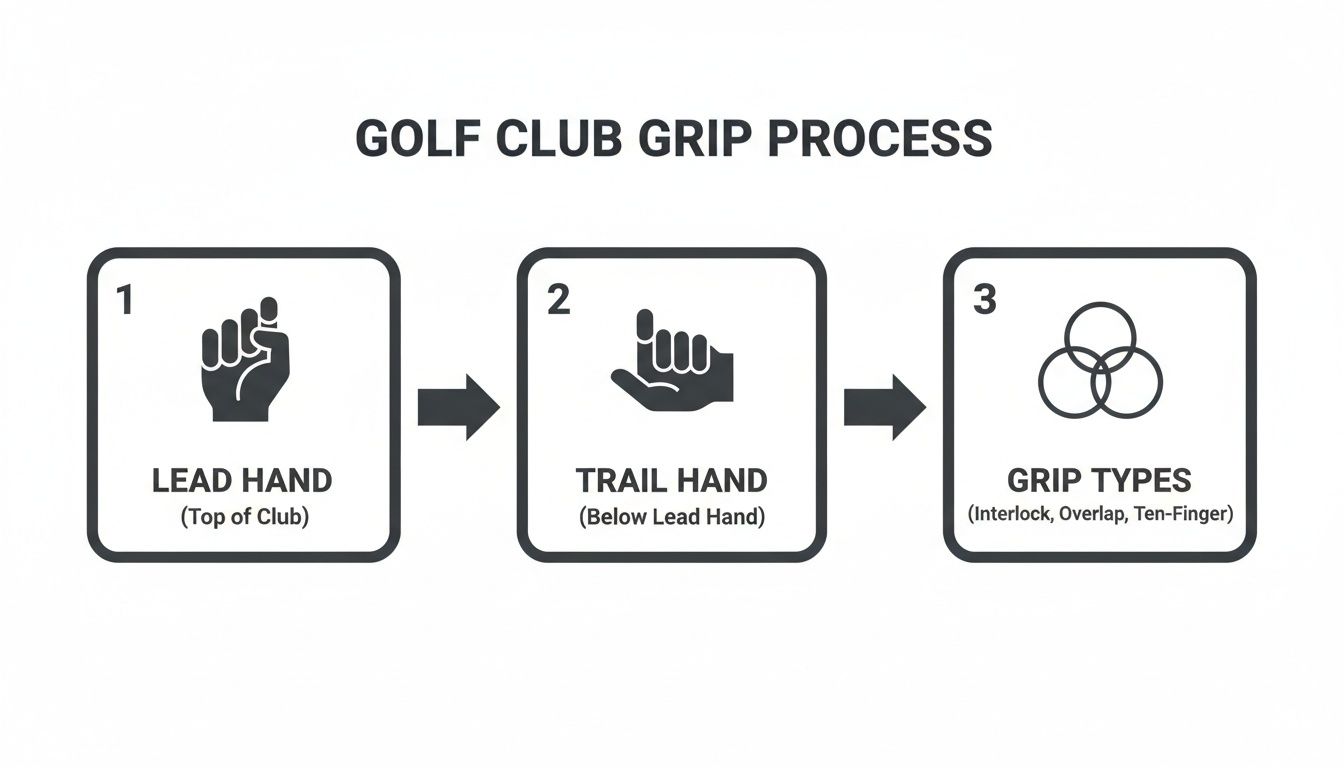
You can see how each step builds on the last to create a solid connection between you and the club—the foundation of every good golf swing.
The Most Important Detail: Fingers, Not Palms
No matter which of the three styles you land on, there's one golden rule you absolutely cannot ignore: the club belongs in your fingers, not in your palm.
This is, without a doubt, the most common mistake I see from amateurs. They jam the club deep into the lifeline of their lead hand, and in doing so, they completely kill their ability to hinge their wrists properly. That wrist hinge is a massive source of power and clubhead speed!
A proper grip runs diagonally across the fingers of your lead hand, starting at the base of your pinky and running up to the middle joint of your index finger. This position frees up your wrists to hinge naturally, storing power on the way back so you can release it through the ball. It’s the secret behind that effortless snap you see the pros make.
Finding the Right Amount of Grip Pressure
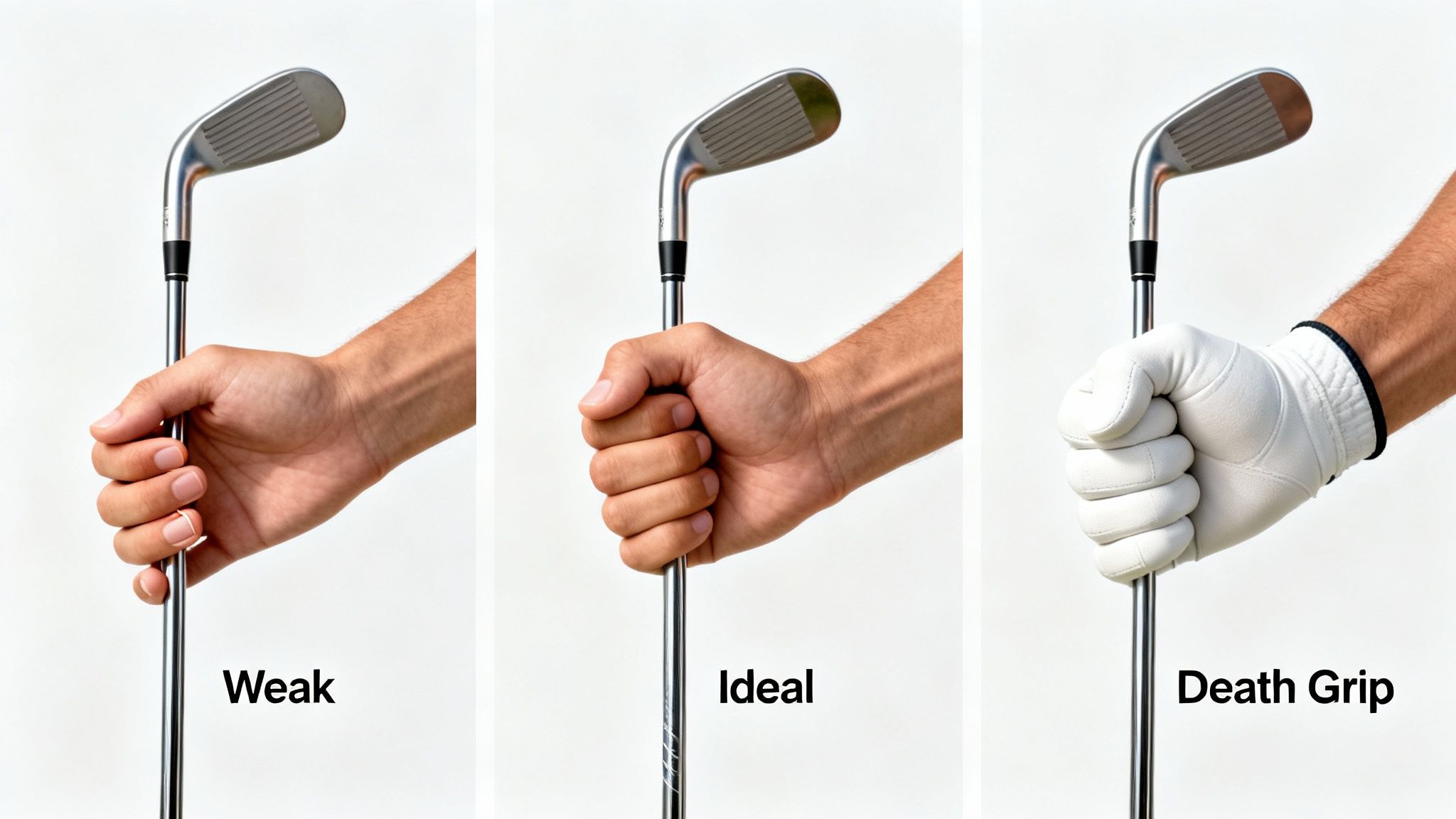
Let's get one thing straight right away. If you've ever been told to hold a golf club like you're holding a delicate little bird, do me a favor and forget you ever heard it. That well-meaning but awful piece of advice has probably created more tense, powerless, and wildly inconsistent swings than any other tip in golf history.
The truth is, grip pressure isn't about being gentle—it's about being smart. The real magic happens when you figure out how to manage and distribute that pressure correctly between your hands. This creates a stable connection that frees you up to swing with incredible speed. It’s the difference between a controlled, powerful strike and a flailing disaster.
The Misunderstood Art of Squeezing
Most weekend golfers get grip pressure completely backward. They’ll often start with a light, almost limp grip at address, only to clench down with a white-knuckle death grip as they start their downswing. That sudden tensing is a certified speed killer. It locks up your arms and wrists, destroying any chance of generating natural lag and releasing the club properly.
Think of it this way: your body's rotation is the engine of your swing, but your arms and hands are the whip. If you stiffen the whip, it can't crack. The goal is to find a pressure that’s firm enough to control the clubface but light enough to let your wrists hinge and release like they’re meant to. A firm, confident handshake is a much better analogy than the fragile bird.
A hallmark of a great ball-striker is consistent grip pressure from start to finish. You want to set your pressure at address and maintain it throughout the entire swing, letting your big muscles do all the heavy lifting.
This isn’t just my opinion; the data backs it up. A fascinating Golf Lab study revealed that professional golfers maintain incredibly consistent pressure, changing it the least from setup to impact—a stark contrast to amateurs who fluctuate all over the place. In that analysis, pros squeezed nearly twice as hard at address with their lead hand, starting at almost 65% pressure. You can dive into the full study on grip pressure data yourself to see the charts.
Finding Your Perfect Number
So, how hard should you actually hold on? Using a 1-to-10 scale is a fantastic way to feel this out.
- 1 is barely holding the club, so loose it feels like it might fly out of your hands.
- 10 is the tightest you can possibly squeeze, with your knuckles turning white.
Most elite players and coaches will tell you that a grip pressure of around a 5 or 6 out of 10 is the sweet spot. It’s a pressure that says, "I'm in control," without screaming it. You should feel most of that pressure in the last three fingers of your lead hand (pinky, ring, middle) and the two middle fingers of your trail hand.
Try this simple drill on the range:
- Grip your club at a "10" and make a few practice swings. Feel all that tension creep into your forearms and shoulders. Yuck.
- Now, drop down to a "1." Notice how sloppy and out of control the clubhead feels.
- Finally, settle into that "5." You should feel connected and secure, but still able to hinge your wrists effortlessly. That’s the money spot.
Lead Hand vs. Trail Hand
Understanding the role each hand plays is a game-changer. Your lead hand (left hand for righties) is the rudder; it’s mainly responsible for controlling the clubface angle and the swing's path. Your trail hand is more like the accelerator, providing support and injecting speed at just the right moment.
The most common amateur mistake is letting the trail hand get too bossy, especially in the downswing. When that right hand takes over, it tends to squeeze harder and push the club "over the top," which is the classic cause of that dreaded slice. Your lead hand should be the dominant partner in this relationship, maintaining control from start to finish.
Of course, maintaining this delicate balance is a lot harder if your equipment is working against you. A slick, worn-out grip forces you to squeeze way too hard just to keep the club from twisting. This is why it’s so important to learn how to clean your golf clubs properly and make sure your grips have the tackiness you need for a confident, tension-free hold.
How Your Grip Controls Ball Flight
Is your golf ball consistently making an unscheduled trip into the right-hand trees? Or maybe it’s diving left like it’s got a mind of its own? Before you blow up your entire swing and start blaming your hips, shoulders, or that hot dog you had at the turn, let’s talk about your hands.
Your grip is the number one suspect in almost every recurring ball flight mystery. It's the director of the clubface, telling it exactly where to point at that critical moment of impact. Think of it as the steering wheel for your golf club. Even a tiny turn before you start the engine (your swing) will send the car veering off course.
Getting a handle on this relationship is the secret to becoming your own swing detective and finally kicking that pesky slice or hook to the curb.
Diagnosing Your Grip: The Knuckle Test
The easiest way to figure out what your grip is doing is with a quick visual check. It’s called the "knuckle test," and you can do it right now, no range required. Just get into your address position and glance down at your lead hand (that’s your left hand if you're a righty).
So, how many knuckles can you see?
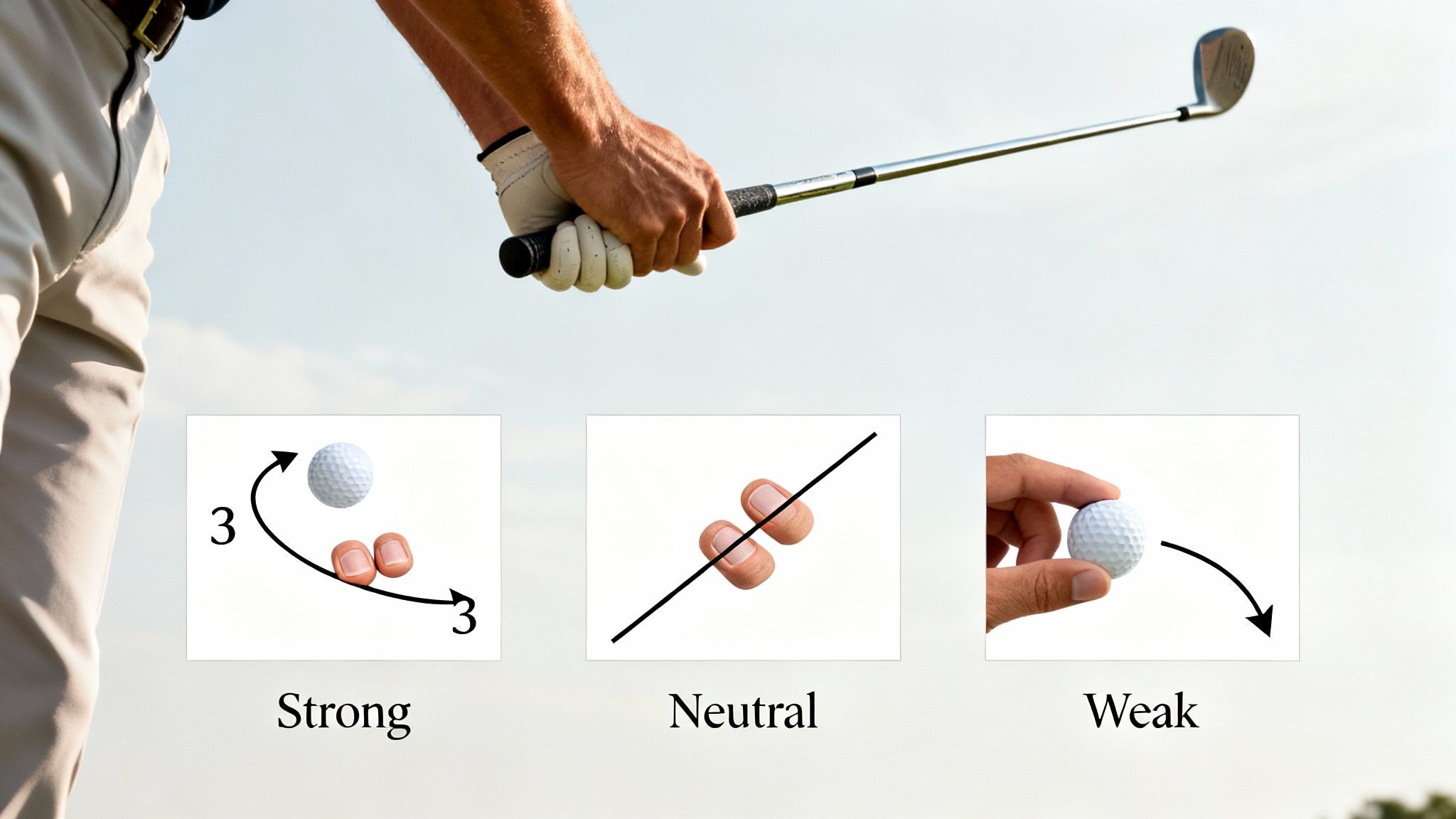
- 1 Knuckle (or even less): You’ve got a weak grip. This means your hand is rotated too far toward the target.
- 2 to 2.5 Knuckles: Bingo. This is considered a neutral grip, the gold standard for delivering a square clubface at impact.
- 3 to 4 Knuckles: This is a strong grip. Your hand is rotated too far away from the target.
This simple checkpoint reveals the clubface's natural bias before you even take the club back. It's the first clue in solving your ball flight puzzle.
The Strong Grip: Your Slice Antidote
For the vast majority of us amateur golfers, the slice is the monster hiding under the bed. It's that high, powerless shot that peels off dramatically to the right. The culprit? An open clubface at impact, plain and simple.
This is where a strong grip can feel like pure magic. By rotating your hands slightly away from the target so you see 3 or more knuckles, you’re essentially pre-setting the club to close more easily on the downswing. It gives your hands a head start, encouraging a natural release that squares up the face.
For chronic slicers, this small adjustment is often the "aha!" moment that finally gets the ball flying straight, or even with a touch of a beautiful, pro-style draw.
A quick heads-up: A "strong" grip has nothing to do with pressure. It's all about the position of your hands. You can have a light-as-a-feather strong grip or a death-grip weak grip.
The Weak Grip: Taming the Nasty Hook
On the flip side, we have the hook—that low, screaming shot that dives hard to the left. This happens when an overactive clubface slams shut too quickly through the hitting zone, often because of hands that are a little too eager to take over.
The perfect medicine for a hook is a weak grip. By rotating your hands more toward the target at address (seeing only 1 knuckle), you make it much tougher for your hands to roll over and shut the face down.
This grip position quiets the hands and encourages more of a "body release," where your bigger muscles do the work of rotating the club. It forces your core and torso to be the engine of the swing, which is a massive key to consistency and power. While it's a minor tweak, a weaker grip can dramatically improve your golf swing by promoting better mechanics.
Ultimately, the goal isn’t to force your hands into some textbook position, but to find your personal neutral. It’s about discovering the grip that helps you deliver a square clubface time and again without even thinking about it. Get to the range, play around with it, and see how a small rotation can turn your biggest miss into your most reliable shot.
Fixing Common Grip Mistakes
Every single golfer, from a weekend hacker to a tour pro, has wrestled with a grip flaw that threatened to blow up their entire swing. It’s the silent killer of consistency. Think of this as your troubleshooting guide for the most common gremlins that sneak into how you hold the club.
We're going to tackle the bad habits that pump tension into your arms, kill your speed, and send your ball on an unscheduled vacation into the trees. By learning to spot and fix these issues, you can finally build a grip that holds up under pressure and delivers the goods.
The White-Knuckle Death Grip
This is, without a doubt, the most common and destructive mistake in golf. You get a little nervous over a tough shot, so you squeeze the life out of the club, thinking more pressure means more control. The exact opposite is true.
This "death grip" creates a wave of tension that travels from your hands, up your forearms, and right into your shoulders. All that tension completely locks up the fluid, athletic motion your swing needs, basically slamming the brakes on your clubhead speed. It’s like trying to crack a whip that’s been frozen solid.
To fix it, give the "pump drill" a try.
- Take your normal setup and squeeze the club as hard as you can—a 10 out of 10 on the pressure scale.
- Now, completely relax your hands until you're barely holding on, maybe a 1 out of 10.
- Pump it back and forth a few times, then settle into a pressure of about 5 out of 10. This little exercise is fantastic for recalibrating your feel and reminding you what a tension-free, ready-to-go grip is supposed to feel like.
Holding the Club in Your Palms
Here's another classic error I see all the time: placing the club deep in the palm of the lead hand, running it straight up the lifeline. I get it, it feels secure, but it absolutely strangles your ability to hinge your wrists properly.
Your wrist hinge is a massive speed generator. Holding the club in your palm is like putting a cast on your wrist—it simply can't move freely, and you're leaving a ton of power on the table.
The Fix is in the Fingers: A proper golf grip runs diagonally across the fingers of your lead hand. It should sit at the base of your pinky and run out toward the middle joint of your index finger. This simple adjustment unlocks your wrists and lets you generate effortless power.
Check your grip right now. If that handle is buried in your palm, you’re sacrificing a serious amount of yardage. Moving it into your fingers might feel weird at first, but the jump in clubhead speed and feel is almost immediate.
The Long and Unruly Lead Thumb
Where you put your lead thumb has a surprisingly huge impact on your control at the top of the swing. A lot of golfers let their thumb stretch way down the shaft, creating what we call a "long thumb."
This creates a little gap between your thumb and the club, making the club feel loose and unstable right when you need control the most—at the top of your backswing. From this wobbly position, it's incredibly easy for the club to fall off-plane, which often leads to that dreaded over-the-top move on the way down.
The solution is the "short thumb." Just pull your lead thumb back a bit, so it feels more bunched up against your index finger. This creates a much more compact and stable connection, giving you far better control of the clubface from start to finish.
An Overactive Trail Hand
For all you slicers out there, your trail hand (the right hand for a righty) is often public enemy number one. The data is clear: golfers who slice the ball almost always apply too much pressure with their trail hand, especially as they start the downswing.
When that trail hand gets too bossy, it wants to push the club from the top, throwing it "over the top" and outside the correct swing path. This forces that classic outside-in swing that produces a weak, glancing blow and that ugly slice.
To fight back, focus on feeling the pressure in the last three fingers of your lead hand. That's your primary point of control. Your trail hand is just a supporter, not the one in charge. Imagine your trail hand is just along for the ride, letting your body's rotation and a firm lead hand guide the club down to the ball. This one simple thought can be a genuine game-changer for curing your slice.
Your Top Golf Grip Questions, Answered
Alright, let's tackle some of the most common questions I hear about the golf grip. Think of this as your personal cheat sheet. We'll cut through the noise and get straight to the answers you need to start seeing real improvement on the course.
How Do I Know If My Grip Is Too Strong Or Too Weak?
This is a classic. The quickest and easiest way to check your grip is the good old "knuckle test." Just get into your normal setup position and glance down at your lead hand (that's your left hand if you're a righty).
- See 3 or even 4 knuckles? That's what we call a "strong" grip. Your hands are rotated a bit away from the target, which naturally encourages the clubface to close on its way down. If you're fighting a nasty slice, this could be your new best friend.
- Only see 1 knuckle? You've likely got a "weak" grip. Here, your hands are rotated more towards the target, which can help stop the clubface from shutting too fast. For players who battle a hook, this simple tweak can be a game-changer.
- Spotting 2 to 2.5 knuckles? Bingo. That's the "neutral" grip—the sweet spot we're all aiming for. It gives you the best chance of delivering a square clubface at impact, which is the cornerstone of consistency.
Quick tip: A "strong" grip has zero to do with how hard you're squeezing the club! It’s all about the rotational position of your hands. You can, and should, have a strong grip with light, athletic pressure.
Should I Go With The Overlap Or The Interlock?
Ah, the great debate. The truth is, this one boils down to personal comfort and what gives you the best sense of control. There's no single right answer, and you'll find tour pros in both camps.
The Vardon Overlap is the king of the PGA Tour for a reason. It's fantastic for golfers with average-to-large hands, as it really helps your hands feel like they're working together as one solid unit.
On the other hand, the Interlock grip—made famous by guys like Tiger Woods and Jack Nicklaus—creates an incredibly secure connection. This style often feels more natural for players with smaller hands, as it helps prevent any slipping or shifting during the swing. My advice? Hit a bucket of balls with each and just go with what feels more stable and powerful to you.
How Hard Should I Actually Squeeze The Club?
Forget that old saying about holding a bird. It’s a little too delicate for golf.
If you imagine a pressure scale from 1 (about to drop the club) to 10 (a white-knuckle death grip), you want to be right around a 5 or 6.
You're looking for a firm, confident hold that gives you total control but doesn't create tension up into your forearms and shoulders. Tension is the ultimate swing killer. Interestingly, studies have shown that pros actually grip the club significantly firmer than most amateurs do at address, especially with their lead hand, to create a stable foundation.
The biggest mistake I see amateurs make is starting too loose and then instinctively strangling the club on the downswing. You want to do the exact opposite. Set a consistent, athletic pressure from the start and hold it all the way through your swing.
Ready to look as good as your new grip feels? At 2ndShotMVP, we create premium hats, beanies, and apparel that bring style and personality to your game. Check out our unique designs and find your new favorite headwear at https://2ndshotmvp.com.

