

The most popular advice about his & hers T-shirts is also the least useful: buy two identical shirts, preferably with a giant slogan, and call the outfit finished. That works for one staged photo. It usually fails at brunch, on a golf-club patio, and every time you open the drawer afterward.
The smarter approach is coordinated contrast. Choose related colors, compatible graphics, and silhouettes that suit each person instead of forcing two bodies into the same template. You'll still look connected, but the shirts will feel like clothes rather than costumes. That distinction matters if you want repeat wear, decent photographs, and a couple look that survives beyond one weekend.
Why Matching Couple Tees Are Out and Subtle Coordination Is In
Matching doesn't mean identical. A men's tee in deep forest green and a women's tee in soft stone can look far more intentional than two shirts shouting “King” and “Queen” across a restaurant.
Recent fashion coverage describes this move from exact “twining” toward cohesive contrast and harmonious coordination, with complementary palettes and minimalist, slogan-led designs replacing obvious duplicates (fashion coverage on coordinated couple dressing). The change makes sense in real life. At Saturday brunch, two related neutrals look relaxed. At a country-club dinner, the same pair can sit under a cardigan, quarter-zip, or lightweight jacket without announcing that you bought a novelty set.
The test is repeat wear
A loud matching print has a narrow job. It might suit an anniversary trip, a tournament weekend, or a social post, but it becomes awkward when the occasion disappears. A restrained emblem, tonal graphic, or shared color story has more range. One partner can wear the tee with fitted shorts, while the other pairs it with jeans, a tennis skirt, or relaxed trousers.
Subtle coordination also photographs better because the eye sees a relationship rather than a duplicate. The outfits feel considered, and each person remains visually distinct. That matters in group photos, where identical slogans can dominate the frame and make the couple look like they're wearing uniforms.
Practical rule: Match one visible element, then let the rest belong to each person.
Use a shared accent color, related golf reference, or complementary phrase. Avoid matching every detail. The sections ahead focus on the decisions that make this approach work, including the T-shirt's unisex history, measurement logic, silhouette, fabric, print durability, golf styling, and gifting. The central recommendation stays simple: buy shirts that signal connection without demanding that either partner dress out of character.
A Quick History of How T Shirts Became a Couples Wardrobe
The T-shirt did not begin as a couples' fashion statement. In the 19th century, it developed from men's undergarments and belonged mainly to the male wardrobe. By the early 20th century, manufacturers had turned it into a mass-market basic, with Fruit of the Loom marketing T-shirts at scale in the 1910s (history of the T-shirt).
That commercial shift made the garment easier to produce, buy, and wear casually. The T-shirt could move out from under a shirt and stand on its own. Printed graphics and informal dress then gave its simple shape new jobs, from representing sports teams and brands to displaying slogans and personal identity.
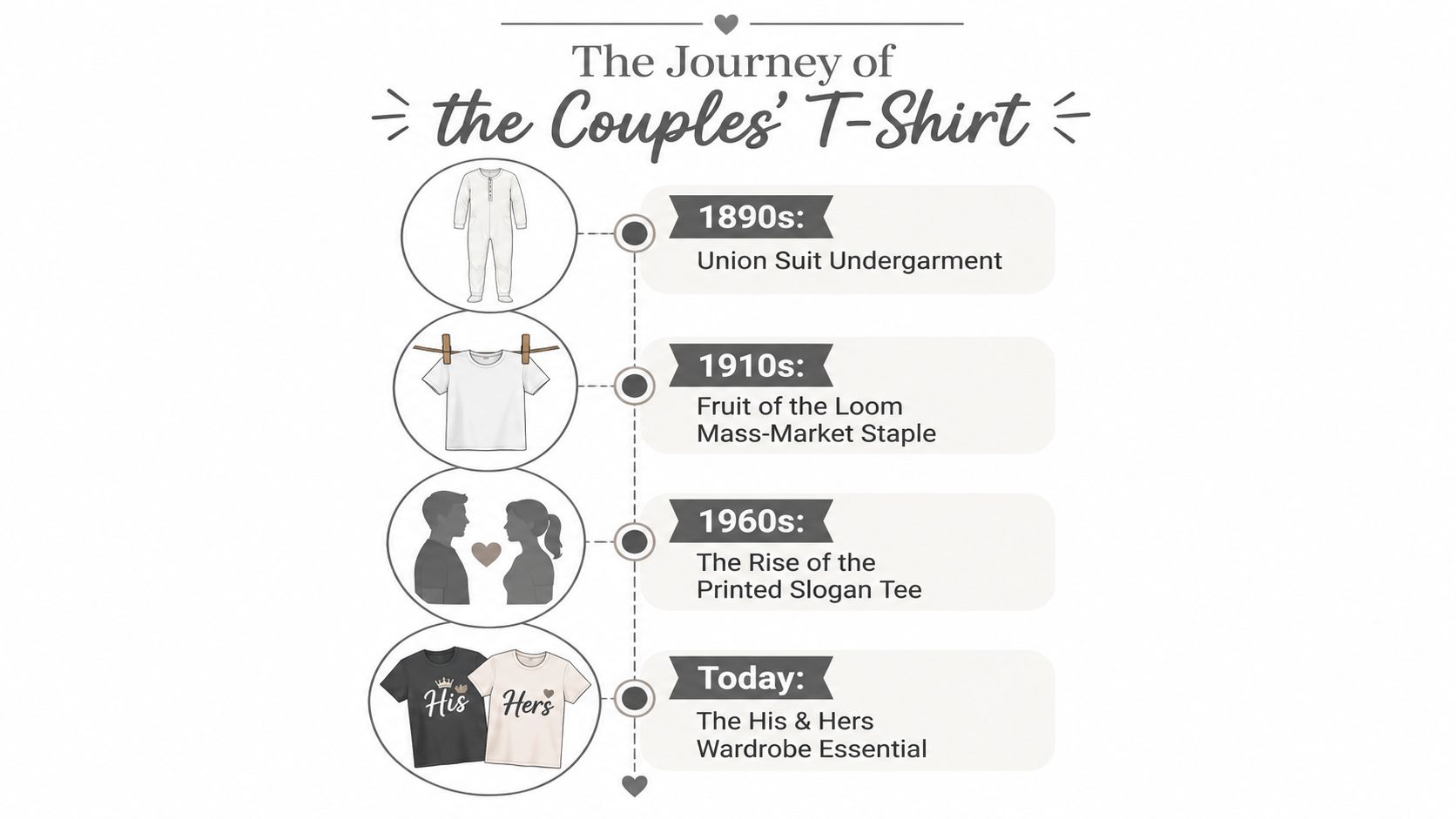
From unisex basics to shared signals
By the 1970s, the T-shirt was widely regarded as a true unisex garment. That shift gave couples a practical way to share a clothing category while choosing different proportions, colors, and styling. It also supports the approach that works best now: coordinate around a restrained color, golf reference, or small emblem rather than wear identical, loud prints.
Paired clothing had already appeared during the wider unisex fashion era. A 2015 Smithsonian account describes department stores and catalogs advertising “his'n'her” clothing during the 1965 to 1975 period, including coordinated items such as ponchos (Smithsonian history of his-and-her unisex fashion). His & hers T-shirts are therefore not a social-media invention. They continue a retail idea built around a garment that gradually moved from gendered underwear to shared casualwear.
The history also explains why a good pair should avoid costume energy. A T-shirt already has a flexible, democratic identity. Use that flexibility: choose related colors or a quiet shared detail, then let each person select a cut and styling that works for repeat wear, golf-course rules, the 19th hole, and ordinary weekends. The strongest couple tees signal connection without turning either partner into a walking slogan.
How T Shirts Are Actually Sized and Why Couples Need Different Logic
Couples often make one sizing mistake: they treat matching as evidence that both shirts should follow the same size logic. They shouldn't. A men's, women's, or unisex size label is only useful when you know the garment's actual chest, length, and sleeve measurements.
Basic apparel grading usually increases chest width by about 1.5 to 2 inches per size, body length by about 1 inch, and sleeve length by about 0.75 inch (apparel size grading rules). Width grows faster than length because the pattern must accommodate circumference without creating an excessively long body.
A practical producer size chart shows the same principle. Chest width can move from 18.5 inches at SM to 25.5 inches at 2XL, while body length moves from 27.5 inches to 31.5 inches over that range (T-shirt sizing measurements). Those figures describe a controlled measurement ladder, not a universal promise, so always check the specific brand's chart.
Common T-shirt Size Progression
| Size | Chest Width (in) | Body Length (in) | Sleeve Length (in) |
|---|---|---|---|
| SM | 18.5 | 27.5 | Varies by grade |
| 2XL | 25.5 | 31.5 | Varies by grade |
The available reference chart provides the chest and body-length endpoints, but not a complete sleeve progression. Don't fill in missing measurements by guessing. Use the manufacturer's sleeve measurement when it's listed.
Measure a shirt you already like
Lay a favorite tee flat without stretching it. Measure straight across the chest from armpit seam to armpit seam, then compare that number with the new shirt's chest-width measurement. Measure from the highest shoulder point beside the collar to the bottom hem for body length.
For couples, this method prevents a common mismatch. One partner might prefer a close, shorter women's cut, while the other needs more shoulder room and a longer men's body. Use garment measurements, not the assumption that both people should order the same letter. A practical size chart and fit recommendations can help you interpret measurements when the retailer uses unfamiliar sizing terms.
Sizing rule: Match the visual idea, not the numerical label.
If one partner wants a relaxed fit, size for the intended drape rather than forcing both shirts into equivalent labels. Check fabric shrinkage, return terms, and whether measurements describe the garment laid flat or the body. Those details decide whether the pair looks coordinated or whether one shirt fits and the other swims.
Men's, Women's, and Unisex Cuts Compared
The cut changes the couple look more than the artwork does. Two identical unisex tees can make both partners look swallowed by fabric, while a men's cut paired with a women's cut can create an easy visual rhythm.
A men's cut generally gives more room through the shoulders and torso, with a straighter body and a standard sleeve. A women's cut usually narrows at the shoulder, tapers through the waist, and shortens the sleeve. A unisex cut sits between those ideas, often using a relaxed body and a moderately dropped shoulder.
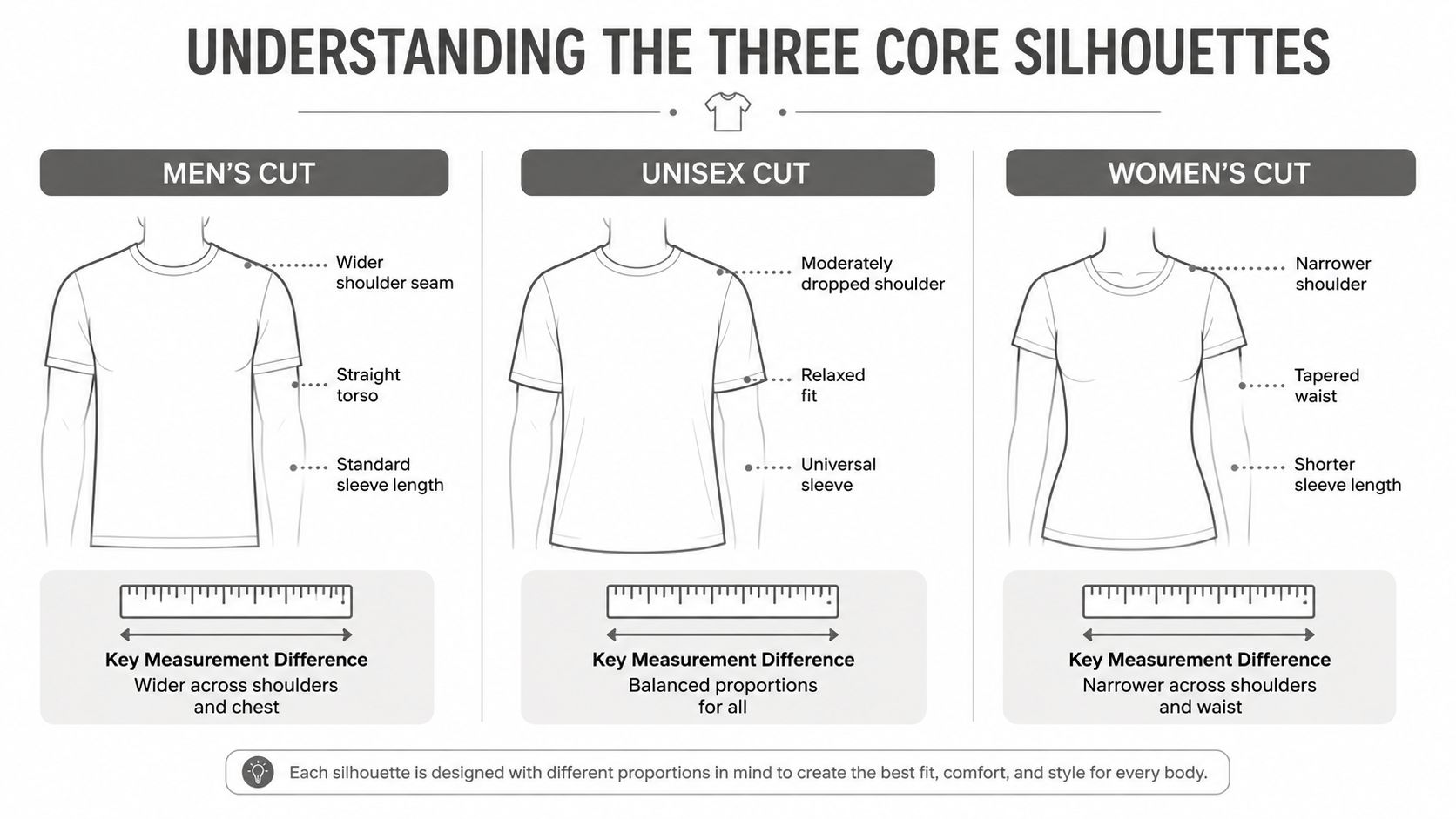
Pick the silhouette before the print
| Cut | Shoulder and sleeve | Body shape | Usually suits |
|---|---|---|---|
| Men's | Wider shoulder, standard sleeve | Straight and roomier | Broad shoulders, athletic builds, or relaxed styling |
| Unisex | Moderately dropped shoulder, universal sleeve | Relaxed and adaptable | Partners who want an easy shared shape |
| Women's | Narrower shoulder, shorter sleeve | Tapered through the waist | Petite frames or a more defined outline |
A tall partner often benefits from a longer men's or unisex body, especially when the shirt will be tucked or layered. A petite partner may prefer a women's cut so the shoulder seam and hem don't overwhelm the frame. Athletic builds need enough room across the chest without excess fabric at the waist. Broader frames should prioritize shoulder and chest measurements first, then choose length based on how the shirt will be worn.
The strongest pairing is often mixed. One partner wears a clean men's cut with a straight hem, while the other chooses a shaped women's tee in the same palette. The outfits connect through color or graphic language, but the proportions tell the viewer that two individuals are wearing them.
Golf styling follows the same principle. A coordinated tee has to work with layers and accessories, not just stand alone. For context on the broader menswear side of that equation, this guide to men's golf shirts is useful when you're building outfits around course-appropriate layers.
Fabric Weight, Print Quality, and Construction Cues That Matter
A couple tee is a repeat-wear item, so judge it like one. The shirt needs a fabric that hangs well, a print that stays readable, and seams that don't twist after washing.
Fabric weight gives you a useful starting point. Lightweight tees around 140 GSM feel airy and can work in hot weather or under layers. Mid-weight cotton offers a more stable drape for everyday use. Premium weights around 220 GSM and above feel denser and more structured, but they can run warmer and look less natural under a quarter-zip.
For most couples, a mid-weight cotton tee is the sensible choice. It photographs cleanly, layers without excessive bulk, and feels substantial without turning a casual outfit into heavy streetwear.
Read the print and the seams
Plastisol prints usually sit visibly on top of the fabric and can deliver strong color, but poor application may crack or feel stiff. Water-based ink absorbs more into the fibers and often creates a softer hand. Direct-to-garment printing can reproduce detailed artwork, but the finished result depends heavily on the garment and printer.
Look for construction details that reduce premature wear:
- Taped neck seams: These stabilize the collar and make the neckline feel cleaner.
- Side-seamed bodies: These help preserve shape and reduce the tubular, twisting feel of cheaper blanks.
- Double-needle hems: Reinforced stitching gives the sleeve and bottom hem a more finished edge.
- Even graphic placement: A design should sit level with the garment, not drift toward one side.
Don't confuse a high price with quality. A cheaper blank can outperform a premium tee if the print, cotton, and stitching are better chosen. If you're comparing apparel suppliers or planning coordinated accessories, resources such as bulk custom hats from Dirt Cheap Headwear can help you think about headwear and T-shirt decoration as one visual system.
Moisture management matters more for active settings than a standard cotton tee. If you're layering for a range session or warm-weather walk, this explanation of moisture-wicking fabric clarifies why performance materials behave differently from cotton. For a lifestyle couple tee, though, comfort and wash resilience should lead the decision.
Golf Course and 19th Hole Styling That Actually Works
His & hers tees fit golf best around the round, not automatically during it. Many clubs expect collared shirts on the course, so a T-shirt may belong at the practice range, clubhouse patio, casual resort setting, or post-round drinks rather than the fairway.
That limitation makes the styling more interesting. Instead of forcing a novelty tee into a dress code that rejects it, build a coordinated outfit that moves naturally through the relaxed parts of a golf day.
Three formulas that earn repeat wear
For a cool morning tee time, use a muted tee under a quarter-zip. Keep the men's shirt in a tonal shade such as charcoal, navy, or forest, then give the women's tee a softer variation from the same family. The shared color reads as deliberate once the outer layers come off.
For the turn or a casual resort lunch, pair coordinated tees with well-fitting shorts. Let one shirt carry a small chest graphic while the other uses a related but quieter mark. Keep the shorts neutral so the shirts don't compete with belts, shoes, or golf bags.
For the 19th hole, go tonal from head to hem. A tee, well-fitted trouser or short, and matching hat can create the connection without duplicate graphics. A 2ndShotMVP hat is one option for tying a golf-lifestyle palette together, since the brand offers golf hats, beanies, and lifestyle apparel for men and women.
The hat often does more coordinating work than a second slogan.
Choose one accessory as the shared signal. It might be a hat color, embroidered emblem, or matching trim. Keep the rest individual. This is especially useful when one partner prefers a shaped tee and the other favors a relaxed cut.
For more outfit combinations built around this setting, use these couples' golf outfit ideas as a reference point. The goal isn't to make both players look cloned. It's to make the pair look comfortable, polished, and connected from the first coffee through the final drink.
Buying His and Hers Tees as Gifts That Don't Feel Gimmicky
Couple tees make strong gifts when the occasion gives them a reason to exist. Anniversary trips, tournament weekends, destination birthdays, and resort getaways all provide context. Without that context, a loud matching design can feel like a joke the recipient has to perform.
Start with the recipient's actual wardrobe. Check the shoulder width and body length of a favorite tee, then compare those measurements with the seller's chart. If you need to keep the purchase secret, photograph the size label and measure a shirt while it's flat. Don't rely on remembered letter sizes, especially if the two shirts come from different brands.
Match the design to the event
A private joke or bold graphic can work for a destination weekend where the shirts will be worn once or twice. For an anniversary gift with longer life, choose coordinated colors, small embroidery, or complementary artwork. A tee paired with a 2ndShotMVP hat or beanie can feel like a complete golf-lifestyle gift rather than two random garments.
If apparel isn't right for the couple, consider a related experience or accessory. Barware gift sets for couples offer another way to mark a shared occasion without asking both people to wear the same thing.
The care note matters. Tell the recipient to wash the shirts cold, turn printed garments inside out, dry them gently, and keep direct heat away from iron-on graphics. Follow the garment label first, especially when the shirt uses a blend or specialty finish. Good care won't turn a weak print into a durable one, but it can prevent avoidable fading, cracking, and shrinkage.
Treat his and hers tees as event or seasonal pieces, not automatic daily uniforms. That expectation keeps the gift fun. The couple can wear the shirts for the intended moment, then fold them into a broader wardrobe where the colors and cuts still work separately.
Your Couple Tee Checklist Before You Hit Buy
Before checkout, make the decision mechanical. Emotional appeal can sell a matching set, but five practical checks determine whether it survives beyond the first photograph.
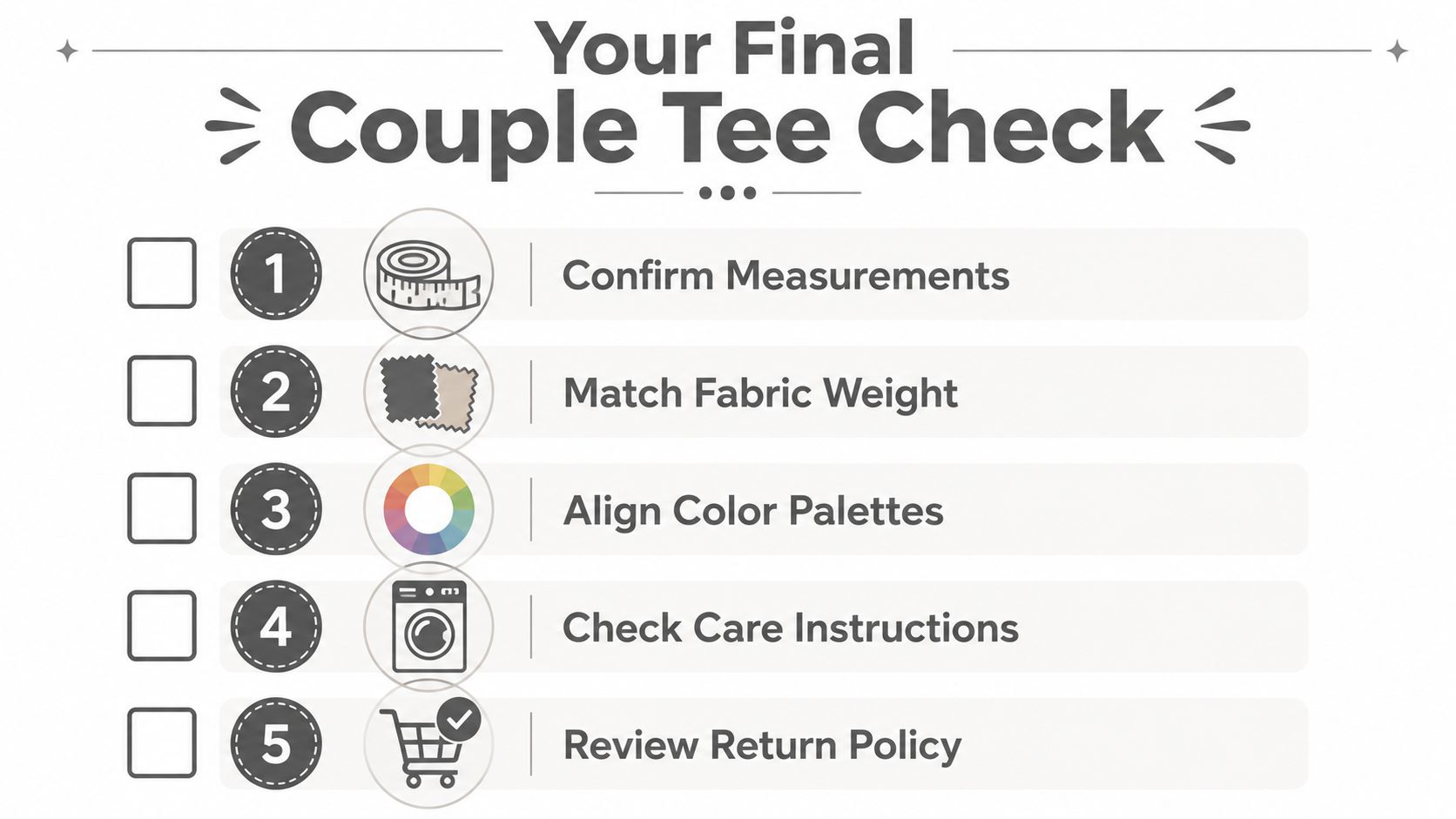
- Confirm measurements. Compare chest width and body length with a shirt each partner already wears comfortably. Ignore the temptation to order equivalent letter sizes.
- Choose complementary cuts. A men's cut and women's cut often look more intentional than two identical unisex silhouettes. Pick the shape each person will want to wear.
- Check fabric weight and construction. Mid-weight cotton is usually the most versatile choice for casual repeat wear. Look for taped neck seams, side seams, and double-needle hems.
- Inspect the print method. Consider whether the graphic feels soft, whether the color sits evenly, and whether the decoration suits repeated washing. A design that looks impressive online can feel stiff in person.
- Match the design to the occasion. Buy the loud slogan for a deliberately playful event. Choose tonal graphics or shared colors for travel, golf weekends, brunch, and everyday layering. Review care instructions and the return policy before removing tags.
The best pair tells a story without taking over the outfit. One tee can carry the shared reference, while the other responds through color, placement, or a quieter graphic. Add a coordinated hat when you want the connection to read clearly without duplicating the shirts.
The final test is simple: would both of you happily repost the photo later, and would each of you wear the shirt separately afterward? If the answer is no, skip the gimmick and choose a more flexible pair.
2ndShotMVP offers golf hats, beanies, and lifestyle apparel for men and women, including T-shirts that can support a restrained his & hers look. Visit 2ndShotMVP to pair a golf-lifestyle tee with headwear that works at the range, around the 19th hole, and away from the course.

