

Ever finish a round of golf and feel like you need a Ph.D. in applied mathematics just to figure out your score? Yeah, we’ve all been there. This is your crash course in golf scoring for beginners, and I promise we’ll skip the confusing jargon and get right to what matters.
Your Friendly Guide to Understanding Golf Scores
Think of every hole on the golf course as a little puzzle. The puzzle has a target score, and we call that target ‘Par’. Your final score is just the story of how you did against that target. Did you need more shots? Fewer? That's really the heart of it.
Knowing your score is about more than just numbers on a card. It’s how you measure improvement, celebrate those little wins (like finally conquering that one tricky hole), and genuinely have more fun out there. Let’s get you from feeling intimidated by the scorecard to owning it.
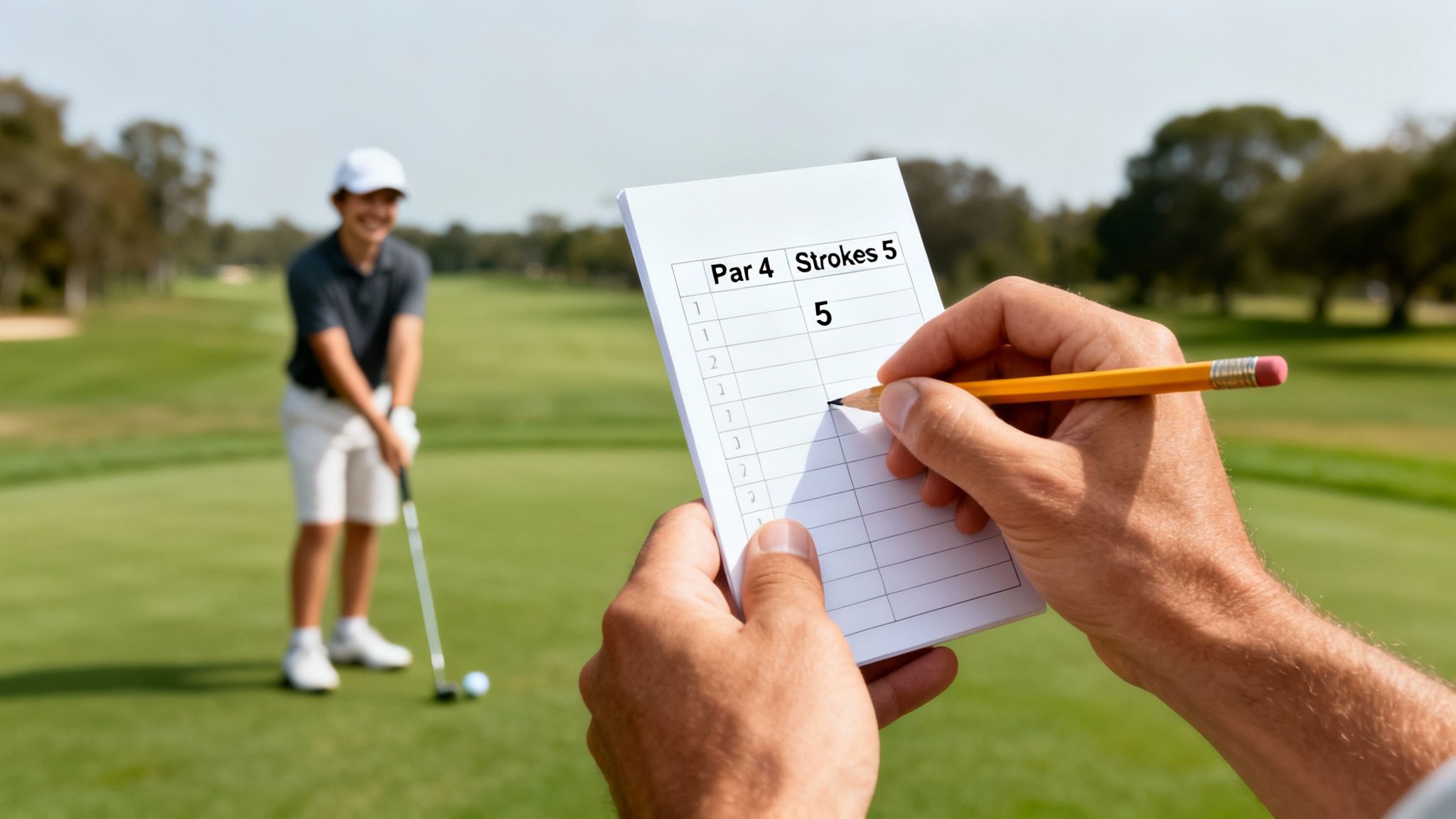
The Core Concept of Par
Par is the magic number in golf. It’s the number of strokes an expert golfer is expected to take to sink the ball in the hole. It's the benchmark you're always measuring yourself against. Each hole has its own par, almost always a 3, 4, or 5, which is mostly determined by its length.
Here's how that usually breaks down:
- Par 3: These are the short ones. The goal is one shot to get on the green, then two putts to get it in the cup.
- Par 4: The most common holes. You're expected to take two shots to reach the green, followed by two putts.
- Par 5: The big dogs. These are the longest holes where you get three shots to land on the green, plus the standard two putts.
So, if you're on a Par 4 and you take four shots... you made "Par." Simple! But if it takes you five shots, you're "one over par."
Everything in golf scoring boils down to this simple idea of being 'over' or 'under' par. Once you get this, the rest is easy. By the time you're done here, you’ll be able to confidently read any scorecard and know exactly the story it’s telling about your game.
Alright, let's get you talking like you've been on the links for years. Golf has its own language, but don't let that intimidate you. It's actually pretty simple once you get the hang of one key concept: Par.
Think of Par as the target score for a hole. It's the number of shots a skilled golfer is expected to take to get the ball in the cup. Once you know the par, everything else just falls into place.
It’s a bit like getting a grade in school. Making Par is the solid, expected result. Do better than that, and you get a special name. Do worse... well, that gets a name too.
Birdies, Eagles, and Other Triumphs (Scores Better Than Par)
This is the fun stuff. When you finish a hole using fewer shots than the par, you've officially done something awesome. These are the scores that bring on the high-fives, and for some quirky historical reason, they're mostly named after birds.
- Birdie: You took one less stroke than par. Sinking your ball in 3 shots on a Par 4? That's a birdie, my friend. Feel free to do a little fist pump.
- Eagle: Even better! An eagle is when you score two strokes under par. A prime example is finishing a Par 5 in just 3 shots. That’s a major achievement.
- Albatross (or Double Eagle): Now you're just showing off. This is the holy grail of golf scores—a ridiculously rare three strokes under par. Think of getting a 2 on a Par 5. Most golfers go their whole lives without one, but hey, it's good to have goals!
The Not-So-Great Stuff (Scores Worse Than Par)
Okay, let's talk about the other side of the coin. Taking more shots than the par is where most of us live, especially when we're starting out. And that's totally fine! Learning these terms is just as important.
A Bogey is simply one stroke over par. If you took 5 shots to finish that Par 4, you just made a bogey. Don't sweat it; even the pros make them all the time.
From there, the pattern is pretty easy to follow. A "Double Bogey" is two over par (a 6 on a Par 4), and a "Triple Bogey" is three over. It can be frustrating to write these down on your scorecard, but tracking them honestly is the only way you’ll see how much you're improving over time.
To make it even easier, here’s a quick-glance table for the most common scoring names.
Common Golf Scoring Terms at a Glance
This little cheat sheet will help you instantly connect the lingo with the numbers on your scorecard.
| Score Name | Strokes Relative to Par | Example on a Par 4 |
|---|---|---|
| Albatross | -3 | 1 (Hole-in-one!) |
| Eagle | -2 | 2 |
| Birdie | -1 | 3 |
| Par | 0 | 4 |
| Bogey | +1 | 5 |
| Double Bogey | +2 | 6 |
| Triple Bogey | +3 | 7 |
Just remember, at the end of the day, it's all about counting your strokes. These names just make the counting a lot more fun.
How to Read and Use Your Golf Scorecard
That little slip of paper they hand you in the pro shop? It might look like a cryptic spreadsheet at first, but your golf scorecard is really the storybook of your round. It’s where your triumphs (and, let’s be honest, your occasional disasters) get recorded. Learning to read it is a rite of passage for every golfer.
Look at the top of the card. You'll see the basics for each hole: its number, how long it is in yards, its Par, and a number labeled "Handicap" (or HDCP). Don't let that last one throw you. The handicap simply ranks the holes on the course from 1 (the toughest) to 18 (the easiest). For now, you can pretty much ignore it and just focus on the Par.
Breaking Down the Grid
The main part of the card is a big grid. You’ve got rows for each player and columns for each of the 18 holes. The card is usually split into two halves: the "Front 9" (holes 1-9) and the "Back 9" (holes 10-18).
Your job is simple. After you putt out on each hole, just write down the total number of swings you took in the box for that hole.
At the halfway point, there's a box often marked "Out" where you’ll tally up your score for the first nine holes. You’ll do the same thing for the back nine in the "In" box. Finally, the grand finale: add your "Out" and "In" scores together in the "Total" box to get your final score for the round.
Friendly Game Tip: To keep things moving and avoid arguments, it's super common for one person in the group to keep score for everyone. Just be sure to give it a once-over at the end of the round. A little friendly rivalry never hurt, but bad math can!
The whole point of scoring is to see how you did against the hole's par. This is the heart and soul of golf scoring.
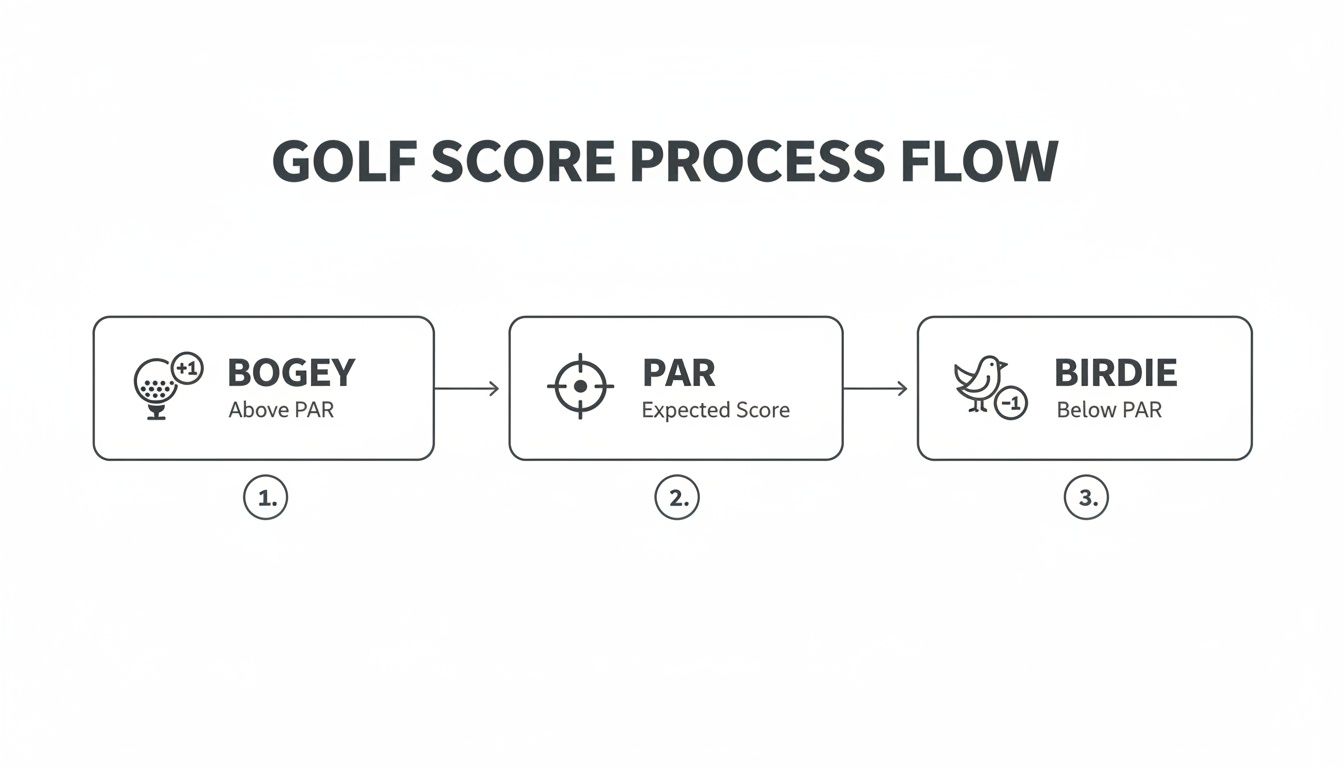
As you can see, a Bogey is one over par, a Par is hitting the target right on the nose, and a Birdie is one under. The only way to get better is to be honest with your count. Every stroke matters because it's the only way you’ll see those scores start to drop.
What Is a Good Golf Score for a Beginner?
Alright, you've survived 18 holes, added up all those little pencil marks on your scorecard, and now you’re staring at a final number. So, you have to ask the question every single new golfer asks: "Is this any good?"
Let’s get one thing straight right off the bat: comparing your score to what you see on TV is the fastest way to get discouraged. A "good" score when you're just starting out is simply one that's better than your last one. Golf is a game you play against yourself.
The real goal is progress, not perfection. It's a journey of small wins. Did you pure one drive right down the middle? Did you finally get out of a bunker in one shot? Those are the moments to celebrate! That's what keeps you coming back.
Setting a Realistic Benchmark
Okay, I get it. You still want a number to shoot for. It’s only human.
Most beginners are going to shoot somewhere around 108 for their first full 18-hole round. Here’s a little perspective: only about 38% of all golfers ever consistently break 100. So, if you’re north of that number, you are in very good company. You can see a full explanation of how average golf scores break down on devereuxgolf.com.
Your mission, should you choose to accept it, isn't to break the course record. It's to have fun, learn something new, and enjoy the walk. The real win is wanting to tee it up again next weekend.
The Magic Number: 100
In the amateur golf universe, breaking 100 is a legendary milestone. It’s like a rite of passage, the moment you officially level up from "beginner" to "golfer."
Shooting a 99 means you averaged about 5.5 strokes per hole on a par-72 course. That's a huge achievement and a sign that you're starting to build some real consistency in your game.
Instead of staring at that triple-digit number on your card and getting frustrated, focus on the little things. We've got a whole guide with some of the best golf tips for beginners that will help you chip away at that score.
At the end of the day, a good score is any score you had a blast earning.
Common Scoring Blunders Every Beginner Makes
Look, everyone butchers their scorecard at some point. It’s practically a rite of passage in golf. Learning to keep an honest and accurate score isn't about being hard on yourself; it's about getting a real, unfiltered snapshot of your game so you know where to improve.
The most common rookie mistake? Forgetting to count those pesky penalty strokes. If your ball decides to go for a swim in a pond or sails out of bounds, you have to add a stroke to your score for that hole. Yep, even though you didn't actually swing.
Another classic is the "whiff." You swing for the fences with every ounce of your being... and connect with nothing but air. It's embarrassing, but hey, it happens. And yes, it absolutely counts as a stroke. We’ve all been there.
How to Keep Your Score Honest
It’s tempting, I know. That little "mulligan" off the first tee or "forgetting" that chili-dipped chip shot feels harmless. But you're only cheating yourself out of tracking your actual progress. For any beginner, honest scoring is the bedrock of getting better.
Here are a few situations where strokes can mysteriously disappear if you're not careful:
- Whoops, I Bumped It: If you accidentally move your ball on the green before you've marked it, that's a one-stroke penalty. It stings, but it’s the rule.
- The "Breakfast Ball": Taking a do-over on your first tee shot is fine for a super-casual round with friends (if everyone agrees!), but it's a no-go for official scoring. Your first shot is the one that counts.
- Forgetting the Short Ones: A three-foot putt counts the exact same as a 300-yard drive. Don't forget to count every single tap-in! The green is where scores often balloon, so sharpening your game with some golf putting practice drills is a huge help.
A fantastic first goal for new golfers is to break 60 on nine holes. Once you get that down, you can start aiming for "bogey golf," which means shooting around 45 (or one over par on each hole). Being honest with that little pencil and paper is the fastest way to get there. You can get more perspective on what average golf scores look like on vesselgolf.com.
Fun Scoring Formats Beyond Stroke Play
Counting every single swing, or Stroke Play, is the old-school way to keep score. It's the gold standard for pros, but let's be honest—it can be a real pressure cooker, especially when you're just starting out. The good news? It’s not the only game in town!
There are a bunch of other formats that can make your time on the course less of a grind and a whole lot more fun. Think of them as the "party mode" of golf. They're perfect for a laid-back round with friends, shifting the focus from agonizing over every duffed chip to just enjoying the day.

Beginner-Friendly Game Formats
Ready to mix it up? Two of the most popular and newbie-friendly formats out there are the Scramble and Stableford.
- Scramble: This is the ultimate team game. Everyone on the team tees off, you all walk up to the best drive, and everyone hits their second shot from that spot. You repeat this all the way to the hole. It’s fantastic for groups with a mix of ringers and rookies because one great shot can carry the whole team. No more feeling like your one bad shot is sinking the ship!
- Stableford: Instead of counting strokes, you’re chasing points. In this format, your score on a hole earns you points based on how you did against par. A bogey might get you 1 point, a par 2 points, and a glorious birdie 3 points. The beauty of Stableford is that one blow-up hole can't tank your entire round—you just get zero points for that hole and move on to the next one with a clean slate.
Here's a little perspective: only about 38% of golfers ever break 100. A bogey golfer, who averages one over par on each hole, still shoots a 90 on a par-72 course. These other formats let you celebrate the awesome shots without getting bogged down by the not-so-awesome ones.
Once you get the hang of these, you can dive into a complete guide to golf tournament scoring to see what other wild formats are out there. After all, a little friendly competition, maybe with some Birdies Only fun MVP gear on the line, can make any round unforgettable.
Alright, let's clear up a few of the head-scratchers that trip up every new golfer. Don't worry, we've all been there. Getting a handle on these will make you feel like you actually know what you're doing out there.
What's This "Handicap" Thing All About?
Ever wonder how your buddy who golfs every weekend can have a fair match against you, a total beginner? That's the magic of the handicap.
Think of it as golf's great equalizer. It’s a number that reflects your potential playing ability and, in short, it levels the playing field. A lower handicap means you're a better golfer. As you get better, your goal is to see that number shrink.
Does a Total Whiff Count as a Stroke?
Ah, the classic swing-and-a-miss. We’ve all done it. And yes, I'm sorry to say, it absolutely counts.
If you took a mighty swing with the intention of hitting the ball, that whiff officially goes on the scorecard as a stroke. It's a painful one, but it's part of the game.
Now, the key word here is "intention." Those little practice wiggles you take beside the ball to get a feel for the shot? Those are totally fine and don't add to your score. So, warm up all you want!
My Ball Went for a Swim... Now What?
So, you found the water. It happens to the best of us! When your ball takes an unscheduled dip into a water hazard, you're looking at a penalty.
Typically, you'll add one penalty stroke to your score for that hole. Then, you'll take a "drop," which means you play a new ball from a designated spot near where your original shot met its watery demise.
Ready to look the part while you're figuring out the scorecard? Check out the awesome, course-ready headwear from 2ndShotMVP. Find your new favorite hat over at their official site.

