

Forget that shiny new driver. If you're serious about slashing your handicap, the real magic happens on the putting surface. The secret to dropping strokes isn't chasing 300-yard bombs; it's the quiet confidence you build by mastering the art of how to read greens in golf. This one skill will transform frustrating three-putts into routine tap-ins faster than anything else.
Why Reading Greens Is Your Secret Weapon

We've all been there. You stripe a drive down the middle, stick your iron shot on the dance floor, and then... disaster strikes. A clumsy three-putt erases all that great work in a matter of moments. It's a soul-crushing experience that plays out on scorecards every single weekend.
The truth is, the chasm between a good round and a great one is almost always on the green.
This is where green reading becomes your superpower. It’s not some mystical dark art; it's a repeatable process that replaces pure guesswork with a solid, actionable plan. Once you learn to see the subtle breaks, feel the slope through your feet, and properly judge the speed, you’re no longer just hoping the ball finds the cup. You’re giving it a roadmap to get there.
From Guesswork to Conviction
I’ll never forget a club match I nearly choked away on the 17th hole. I was facing a 15-footer for birdie, and my brain completely tuned out a subtle ridge running right through my line. I saw a dead-straight putt, gave it a firm rap, and watched in horror as it veered a good six feet left of the hole. My opponent calmly two-putted for par, and I was left with a gut-wrenching three-putt.
That moment was a painful lesson: the green was telling me a story, and I simply wasn't listening.
This guide is built to prevent those moments. We're skipping the abstract theories and jumping straight into practical techniques you can use on your very next round. This isn't just about what to look for; it’s about understanding why it matters and how to piece it all together.
The goal is to build a reliable routine that gives you conviction over every putt. When you trust your read, you can make a confident stroke, which is half the battle.
Just look at the pros. According to PGA Tour data, the average tour player hits about 12 greens in regulation per round. Contrast that with the typical 15-handicapper, who hits only 4. The pros aren't just better ball-strikers; they are masters at converting those opportunities because they expertly navigate the greens.
What You'll Gain from Mastering the Green
Dedicating time to your green-reading skills pays massive dividends on the scorecard. Here’s what you can look forward to:
- Slash Your Three-Putts: When you can accurately judge speed and break, you’ll leave yourself tap-ins instead of testers.
- Boost Your Confidence: Walking up to a putt with a clear plan melts away doubt and frees you up to make a smooth, committed stroke.
- Smarter Course Management: Understanding green contours helps you plan your approach shots, leaving yourself with much easier putts.
- A Deeper Love for the Game: You'll start to see the course through the architect's eyes, appreciating the subtle challenges they designed. For more tips to sharpen your game, check out our guide on the https://2ndshotmvp.com/blogs/news/best-golf-tips-for-beginners.
At the end of the day, reading greens is a mental skill just as much as a physical one. To truly turn it into your secret weapon, it helps to understand the principles of golf sport psychology to sharpen your focus and build a rock-solid mental game on the course.
Let's get started.
Your First Read Starts from the Fairway
Most golfers don't start reading the green until they're standing over their ball, putter in hand. Big mistake. If you wait that long, you're already playing catch-up. The best putters I know start gathering intel way before their spikes even touch the putting surface. Your first—and arguably most important—read begins the moment you start your walk up the fairway.
Think of yourself as a detective arriving at a crime scene. You don't just zoom in on the first piece of evidence you see. You take a step back and survey the entire area to get the lay of the land. It’s the same on the golf course. You need to look for the big, unmissable clues that will dictate everything about your putt.
See the Big Picture First
As you approach the green, take your eyes off your ball for a second and look at the world around it. The course architect didn't just plop that green down in the middle of nowhere; it's designed to be part of the landscape. And that landscape gives you massive clues.
Is there a giant pond guarding the left side? Water always finds the lowest point, so you can bet the farm that the green is designed to drain right toward it. Are you playing in the mountains? The overall tilt of the land will almost always influence the green. Gravity is a powerful, predictable force, and the surrounding terrain tells you exactly which way it's pulling.
Every green has a story, and the surrounding terrain writes the first chapter. Pay attention to major features like water, bunkers, and hills—they dictate the green's overall drainage and primary slope.
Understanding these macro-level forces gives you an instant baseline. You'll know the general direction of the break before you even set foot on the green. It’s the foundation you’ll build everything else on.
Your Mental Checklist from 30 Yards Out
Once you get within 30-40 yards, you can start to zero in a bit more, but you’re still in full-on intelligence-gathering mode. This is the perfect time for a quick mental checklist to form an initial theory. The goal here is to step onto the green with a solid idea of what to expect, not get ambushed by a slope you never saw coming.
From this distance, try to lock onto two key spots:
- The Highest Point: Scan the entire green and find its peak. This is the summit where everything begins to fall away.
- The Lowest Point: Now, find the main collection area. This is where a rainstorm would send all the water.
Got them? Good. Now, picture someone dumping a huge bucket of water right on that high point. Which way would it all run? Visualizing that simple flow of water can reveal the green's dominant break in a heartbeat.
As you get closer, keep your eyes peeled on your playing partners' shots. How did their ball react when it hit the green? Did it stop on a dime, or did it release and roll out forever? Maybe their shot looked perfect but trickled off to the right. These are free, invaluable pieces of the puzzle that either confirm or challenge your read. You've already packed your physical tools, but this kind of information is just as critical. In fact, reviewing a list of golf bag essentials is smart for the physical game, but this mental checklist is what prepares you for the strategic battle on the greens.
By the time you finally reach your ball, you’re not starting from scratch. You’ve already got a solid theory on the break and a feel for the speed. This proactive work saves you time and, more importantly, prevents those head-slapping mistakes that cost you strokes. You've already done your homework, so the final exam standing over the ball feels a whole lot easier.
Using Your Feet and Eyes to Decode the Break
Okay, so you've done your homework from the fairway. You've got a decent theory about the green's master slope, but now it's time to get up close and personal. This is where the real magic happens, where you turn a broad hypothesis into a concrete, putt-sinking plan. And to do it, you'll need the two best green-reading tools you'll ever own: your eyes and your feet.
So many golfers make the classic mistake of only reading a putt from one spot—standing right behind the ball. That’s like trying to judge a car's design by only looking at the front bumper. You’re missing the whole picture! To really understand what that ball is going to do, you need to collect intel from a few different angles.
This quick flowchart shows how your read should evolve from that big-picture view into a detailed, ground-level analysis as you walk onto the green.
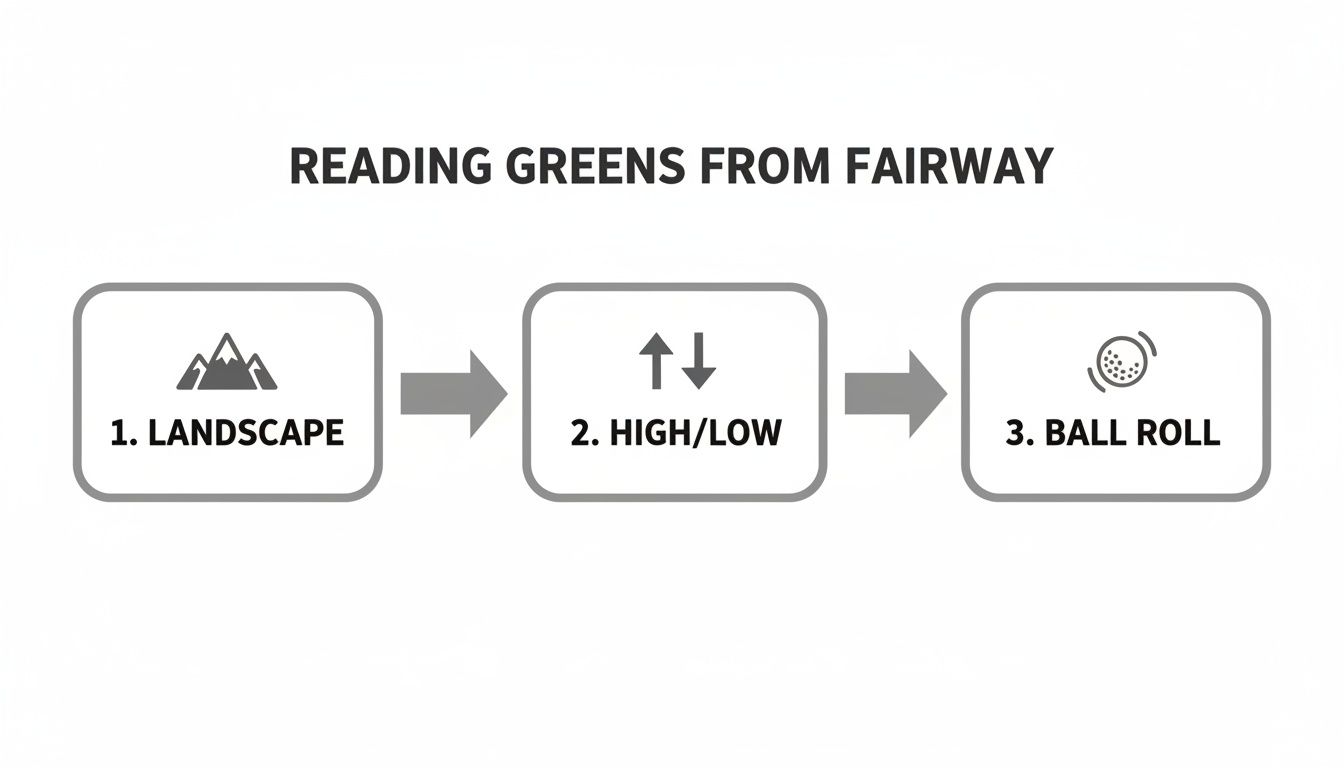
As you can see, that final piece of the puzzle—how the ball will actually roll—demands a close-up investigation.
Trust Your Feet to Feel the Slope
Your eyes can play tricks on you. Optical illusions are everywhere on a golf course, created by dramatic backdrops, mowing patterns, or subtle contouring you can't quite see. But your feet? They don’t lie. Your internal gyroscope gives you raw, honest feedback about the slope you're standing on.
As you stroll from your ball to the hole, pay attention to the subtle pressure changes in your feet. If it's an uphill putt, you’ll feel more weight on the balls of your feet. Going downhill, that pressure shifts to your heels. For a putt that breaks right-to-left, you’ll feel a little more weight on the inside of your right foot and the outside of your left. It’s a faint signal, but it’s pure gold.
Here's a trick the pros use: Walk the line of your putt for a few steps with your eyes closed (just make sure no one is waiting!). It's a fantastic way to mute all the visual distractions and force yourself to listen to what your feet are telling you. You'll be amazed at the subtle tilts you suddenly notice.
This physical feedback is often your most trustworthy source of information. It will either confirm what your eyes are telling you or, more importantly, expose a hidden break you might have missed completely.
Find the Putt's True Story From Every Angle
After you’ve walked the line, get low. I mean, really low. Crouch down behind your ball until your eyes are just inches off the turf. This grass-level view totally exaggerates the green’s contours, making even the most delicate breaks pop. From down here, you aren't just looking for a vague slope; you're tracing the entire rollercoaster ride your ball is about to take.
This low vantage point helps you visualize the ball's complete journey. Are there little humps and hollows you couldn’t see while standing? Is there a tiny ridge that will nudge your ball offline? These are the details that separate a good guess from a great read.
To get the full story, you need to gather intel from three critical viewpoints. Each one gives you a different piece of the puzzle.
Three Key Green Reading Perspectives
| Perspective | What to Look For | Primary Goal |
|---|---|---|
| Behind the Ball | The initial line and the putt’s overall curve from start to finish. | To establish your primary read and see the big picture. |
| Behind the Hole | How the ball will break in the final few feet as it's losing speed. | To confirm your read and see how the ball will die into the cup. |
| Mid-Point (Low Side) | The highest point of the break, what golfers call the apex. | To pinpoint the peak of the curve and find your true aiming point. |
By combining these three perspectives, you're building a complete, three-dimensional map of the putt in your mind. No more guessing.
Ditch the Vague Aim and Pick a Tiny Target
One of the costliest mistakes I see amateurs make is aiming vaguely at some general "area" outside the hole. This kind of fuzzy target just breeds doubt and encourages a weak, tentative stroke. The best putters in the world, by contrast, pick a hyper-specific, tiny target for their start line.
Instead of staring at the hole, find something just a foot or two in front of your ball that sits perfectly on your intended starting line. This is your intermediate target.
- It could be a slightly discolored blade of grass.
- Maybe it’s an old, repaired ball mark.
- It might even just be a different shade of green.
Whatever you choose, lock onto it. Your only job now is to roll the ball directly over that spot with the right speed. This trick simplifies the entire task. Hitting a target two feet away is so much easier mentally than trying to perfectly execute a 15-foot curve. It’s a game-changer.
You’ve already done the hard work of reading the green. This technique just boils it all down to making a simple, straight putt to a spot right in front of you.
Real-World Example: A Tricky Downhill Slider
Let’s walk through a scenario. You’ve got a tricky 20-footer that slides hard from right-to-left and runs downhill. It’s the kind of putt that can easily turn into a three-putt.
- Macro Read: As you walked up to the green, you noticed the whole thing tilts away from a big bunker on the right side. Your first thought is a healthy right-to-left break.
- Feel the Slope: You walk the line. Instantly, you feel more pressure on the inside of your right foot—confirming the side-slope—and on your heels, confirming it’s downhill. Your feet just validated your initial theory.
- Get Low: Crouching behind the ball, you can see the break isn't consistent; it looks like it gets sharper in the middle third of the putt. Then, walking behind the hole and looking back, you notice the last few feet are flatter. That means the ball will lose speed and really dive left at the very end.
- Find the Apex: From the low side of the putt, you pinpoint the apex—the highest point of the curve—and see it's about four feet out to the right of the hole.
- Pick Your Target: You don't aim at that apex 4 feet away. Instead, you find a tiny brown spot on the green, just two feet in front of your ball, that is on the perfect line to get the ball rolling out towards the apex.
- Commit and Roll: You take your stance, your eyes laser-focused on nothing but that little brown spot. You make a smooth stroke. You’ve just replaced fear and guesswork with a confident, repeatable process.
The Hidden Influence of Grass and Grain

So, you've done everything right. You spotted the big-picture slope from the fairway, felt the subtle break under your feet, and locked onto a perfect target just a few feet in front of your ball. You pull the trigger, and the putt looks absolutely pure... until it mysteriously grinds to a halt or veers offline at the last second.
What just happened? Welcome to the invisible, often maddening world of grass grain.
Grain is simply the direction the blades of grass are growing. Think of it like petting a cat—smooth one way, rough and resistant the other. This sneaky little force can mess with your putt's speed and break, turning a great read into a "what-the-heck-was-that" miss. Most amateurs completely ignore it, but learning to spot it is one of the biggest secrets to understanding how to read greens in golf.
Once you know what to look for, it's actually pretty easy to see. It’s all about the way the grass plays with the light.
Decoding the Sheen and the Shade
The simplest trick is to look for changes in the color and texture of the grass as you circle your putt. This isn't some Jedi mind trick; it's a quick visual check that gives you a massive leg up.
- Shiny and Silvery (Down-Grain): When the grass looks bright, almost silvery with a distinct sheen, the blades are leaning away from you. This is what we call putting down-grain.
- Dark and Dull (Into-the-Grain): If a patch of grass looks dark, dull, or even a little bruised, the blades are growing toward you. You’re about to putt into-the-grain.
A putt rolling down-grain will be way faster and break less than you expect; the grass is literally helping it along. Conversely, an into-the-grain putt will be sluggish and break more because the grass acts like tiny little brakes, grabbing at the ball and amplifying the effect of the slope.
When your putt is rolling across the grain, the grass will nudge your ball in the direction it's growing. If the grain is pulling from right-to-left, it's going to add extra oomph to a right-to-left putt but will fight a left-to-right putt, holding it up against the slope.
Finding Grain's Natural Compass
Grass is a plant, and like any good plant, it grows toward what it needs (sun, water) and away from what it doesn't. If the light isn't helping you out, you can fall back on a few golden rules that course superintendents have known for a century.
- Follow the Sun: Grass loves a good sunbathing session. It will almost always try to grow in the direction of the setting sun, which usually means westward.
- Head for Water: Greens are built to drain. The grain will nearly always follow the flow of water toward the nearest runoff area, whether that's a pond, a creek, or just the low point of the fairway.
- Mountain Magnetism: Playing a mountain course? The grain will typically grow away from the big peaks and down toward the valleys, following the natural drainage.
These environmental clues are your cheat sheet. If you see a lake sitting off the left side of the green, you can bet the grain is pulling that way, even if you can't see a strong sheen. It’s about being a detective and using every piece of evidence.
The Ultimate Tell: The Edge of the Cup
Okay, if you want the absolute, no-doubt-about-it confirmation, get down on your hands and knees and look at the edge of the hole itself. This is the dead giveaway the pros live by.
The cup is cut fresh every morning, and that process always leaves a tiny bit of stressed grass on one side of the rim.
Take a close look. One side of the hole will look sharp and pristine. The opposite side will look a bit ragged, brown, or frayed. The grain always grows away from the ugly, ragged side and toward the clean-cut side. It’s the most reliable indicator you’ll find anywhere on the green.
By adding these little observations to your routine, you can turn grain from a frustrating mystery into a predictable part of your green-reading arsenal. It's that final layer of detail that separates good putters from great ones.
Why Speed Control Is More Important Than Line
Let's get one thing straight: you can find the perfect line, a beautiful, sweeping curve that would make a painter proud. But if your speed is off, that masterpiece of a read is completely worthless. The ball has exactly zero chance of dropping into the hole.
This is the simple, brutal truth of putting: pace is king.
While reading the break gets all the glory, speed control is the unsung hero that actually gets the ball in the cup. A putt hit with the wrong pace won’t just miss; it’ll miss badly, often leaving you a treacherous follow-up. Nail the speed, however, and even a slightly misread line can cozy up just inches from the hole.
Think about it this way: the hole is most generous to a ball that’s just running out of steam as it arrives. A ball dying at the hole can use the entire 4.25-inch diameter, plus a little extra help from gravity's gentle pull. A putt smashed at the cup has a much smaller effective target—it can easily lip out or catch only the back edge and power right through.
Calibrating Your Feel Before the First Tee
Your feel for speed isn’t some fixed setting you can just turn on. It changes daily based on the course, the weather, and even your own internal rhythm. That’s why walking straight to the first tee without hitting the practice green is a recipe for three-putts. You’ve got to get calibrated.
A fantastic pre-round warmup is the classic ladder drill. No special gadgets needed, just a few balls and a bit of space.
- Drop three balls and putt to a spot you figure is about 15 feet away.
- Walk up to those balls and putt them back toward where you started.
- Now, find a new target about 30 feet away and do it again.
- Finish with some short 5-footers to dial in your stroke on the ones you absolutely have to make.
This simple routine forces your brain to connect the length of your putting stroke to the distance the ball actually rolls, building a reliable internal speedometer for the day. For more great ways to sharpen your putting, you should explore these essential golf putting practice drills that can make a huge difference.
Your goal isn't just to get the ball to the hole; it's to have it arrive with the perfect "dying speed." This means if the ball were to miss, it would roll no more than 12-18 inches past the cup. This pace gives you the absolute best chance of the ball tumbling in on its last roll.
Adapting Your Speed to Changing Conditions
Of course, not all putts are created equal. The speed you need for a flat 20-footer on the practice green is a world away from what’s required out on the course.
That lightning-fast downhill putt? It requires a delicate touch and a much shorter backstroke, almost like you’re just nudging the ball to get it started. On the flip side, a slow, uphill putt grinding into the grain on a wet morning needs a firm, aggressive stroke. You have to consciously adjust the length and tempo of your stroke to match the challenge right in front of you. This is a critical skill in learning how to read greens in golf.
This is where the pros truly separate themselves. The short game and green reading are now measurable stats, and they reveal how proximity to the hole directly impacts scoring. PGA Tour short game leaders have scrambling rates over 68% and display accuracy metrics that showcase their elite ability to judge speed from anywhere.
Aggressive vs. Delicate: The Strategy of Pace
So, when should you die the ball into the hole versus hitting it firmly into the back of the cup? The classic golfer's answer: it depends.
For most putts, especially those with significant break, letting the ball die at the hole is the superior strategy. It allows you to use the high side of the cup and lets gravity do the work, which gives you a much bigger margin for error.
However, on those short, straight, uphill putts (inside 6 feet), a more aggressive, firm pace can be your best friend. Hitting the ball firmly helps it hold its line, powering right through any minor bumps or imperfections on the green. This strategy takes a lot of the break out of the putt and, frankly, shows some serious conviction.
Ultimately, mastering speed gives you control. It’s the engine that drives your putting, turning good reads into made putts and saving you strokes even when your line is less than perfect.
Your Biggest Green Reading Head-Scratchers, Solved
Even after you've got a system, some putts just feel like a cruel joke. Every golfer I know, from pros to guys just starting out, gets stumped by the same few situations on the greens. Let's break down those common putting puzzles so you have a go-to answer next time you're standing over one.
This is your cheat sheet for when the green throws you a curveball.
"How Much Break Should I Really Play?"
Ah, the million-dollar question. The honest, and most frustrating, answer is: it all comes down to speed. A putt that's hammered at the hole is barely going to wiggle, while one that’s just dying into the cup will fall off a cliff. There's no secret formula.
Here’s a hard truth: most amateurs I play with chronically under-read the break. A fantastic drill is to go to the practice green and force yourself to play twice as much break as you think you see. You'll be amazed how often that "crazy" read is the one that drops.
Instead of just guessing, try to pinpoint the apex—the highest point of the putt's curve. The real game isn't aiming "two feet out"; it's rolling your ball over a specific spot on its journey.
Stop aiming at nothing. Find a discolored blade of grass on your intended line, commit to rolling the ball right over it with perfect speed, and let gravity handle the rest. This takes the guesswork out and builds massive confidence.
"What's the Secret to a Double-Breaking Putt?"
These slithery, S-shaped putts are the ultimate test. The trick to taming these monsters is knowing which break is the real boss. Because the ball is moving slowest as it gets to the hole, the break in the last few feet has way more say in the final outcome.
Think of it as two separate putts.
- Part One: Figure out the line and speed you need just to get the ball to the "inflection point," which is that spot where the slope flips.
- Part Two: From there, picture how that second, more powerful break will take over and guide the ball home.
Your main job is to nail the speed for that first section. Get that right, and the second half is surprisingly predictable. Botch the pace on the first part, and you've got zero chance of managing the second break.
"How Do I Trust My Read When I'm Standing Over the Ball?"
This is a war fought entirely between your ears. Second-guessing yourself is the number one killer of good putting strokes. The only way to win this mental battle is to have a rock-solid routine you never, ever break.
Do all of your detective work before you even think about taking your stance. Walk the line, feel the slope with your feet, get low, pick your spot—do it all. But the second you step up to that ball, the thinking is done. Your only job is to pull the trigger.
Take one last look at your intermediate target (that blade of grass we talked about), a final peek at the hole, and make a committed stroke. Any hesitation just creates tension, and tension leads to that weak, decelerating jab we all hate.
A confident stroke on a so-so read will beat a timid, hesitant stroke on the "perfect" line almost every single time. Trust the work you did and let the chips fall.
"Do Greens Really Change Throughout the Day?"
You better believe it. Greens aren't static carpets; they're living things that change dramatically from sunrise to sunset. If you're trying to putt on a 4:00 PM green the same way you did at 8:00 AM, you're just throwing shots away.
- Morning Greens: Early in the day, greens are usually slick with dew. That moisture acts like a set of brakes, making putts noticeably slower. You've got to give them a little extra oomph.
- Afternoon Greens: As the sun beats down, the greens dry out and get quick. Really quick. The grain of the grass also starts to play a much bigger role, especially if you're on Bermuda.
- Late Afternoon Greens: By the end of the day, it's a war zone. You're not just reading slope and grain anymore; you're dodging footprints and old ball marks right around the cup that can send a perfect putt careening offline.
Pay attention to the conditions. A great green reader is, first and foremost, a great observer who is always adjusting for speed and break as the day wears on.
At 2ndShotMVP, we believe confidence on the course starts with looking and feeling your best. While you're dialing in your green reading, make sure you've got the gear to match. Check out our premium golf hats and apparel designed for both style and performance. See the latest drops at https://2ndshotmvp.com and find your new go-to look.

