

A good golf rain hat is one of those non-negotiable pieces of gear. It’s what separates a miserable, soggy slog from a focused, comfortable round. We’ve all been there—trying to swing with blurred vision as a standard baseball cap drips water right into our eyes. The right hat is your first, and best, line of defense against whatever the sky throws at you.
Why Your Baseball Cap Is Your Worst Enemy in the Rain

Let me paint a picture for you. You’re on the 16th, neck and neck in the club championship. The heavens open up, and that trusty cotton baseball cap you love suddenly turns into a sponge. Water soaks through, gets cold, and starts funneling a steady stream right down your face as you're trying to line up that must-make putt.
That’s not just a run of bad luck. That's a classic case of gear failure. Your everyday baseball cap is fantastic on a sunny day, but it becomes a massive liability the second it starts raining. It's just not built for the job, and it creates way more problems than it solves.
The Downfall of Cotton and Short Brims
Most of our go-to golf caps are made from cotton or poly-blends that are basically designed to absorb water. Once they're saturated, the hat gets heavy, cold, and just plain miserable to wear. Even worse, the short, front-facing brim offers next to no real protection, channeling water directly into your line of sight and breaking your concentration at the worst possible moment.
It's no surprise that serious golfers are demanding better. The golf rain gear market, which includes specialized golf rain hats, was already worth around USD 2.52 billion in 2024 and is expected to balloon to USD 4.09 billion by 2032. You can read more about the growing demand for quality golf gear from IntelMarketResearch. That kind of growth shows just how seriously players are taking their all-weather equipment.
Performance Gear for Unpredictable Weather
Choosing the right hat for a rainy day is just as strategic as picking the right club for a tricky shot. A purpose-built golf rain hat is engineered from the ground up to bead water away, keep your vision completely clear, and let you stay comfortable and focused on your game.
Think of it this way: you wouldn't wear sneakers to play on a wet, slippery course, so why would you rely on a fair-weather cap in a downpour? A proper rain hat gives you the same kind of performance edge as a good pair of golf spikes.
In the end, it all comes down to control. A great rain hat gives you back control over your comfort and your focus, letting you play your best game no matter what the forecast says.
Breaking Down the Tech That Keeps You Dry
Ever wonder what kind of wizardry goes into a golf hat that can laugh off a downpour? It's not magic, but it’s some seriously clever science. A top-notch rain hat is a tiny fortress for your head, built from advanced materials and smart design choices that work together to defy the weather.
First, let's get one thing straight: water-resistant and waterproof are not the same thing. Not even close.
A water-resistant hat can handle a light drizzle or the spray from a sprinkler. It's designed to shrug off a little bit of moisture. But a waterproof hat? That's a different beast entirely. It’s built to withstand a relentless, course-soaking storm, keeping you bone-dry when everyone else is running for cover. For a serious golfer, knowing that difference is key.
The Fabric Fortress: Membranes and Coatings
The real MVP of any waterproof hat is the fabric, specifically the high-tech membrane bonded to it. You’ve probably heard of Gore-Tex, the undisputed champion in this arena. This stuff is a marvel of material science.
Imagine a fabric filled with billions of microscopic pores. These pores are about 20,000 times smaller than a single drop of water, making it physically impossible for rain to sneak through. But here’s the genius part: those same pores are 700 times larger than a molecule of sweat vapor. This means while rain can't get in, all that steamy moisture from your head can get out. It’s the secret to staying dry without feeling like you’re wearing a plastic bag.
Of course, a great membrane is only part of the story. Two other critical features turn a good hat into a great one:
- Durable Water Repellent (DWR) Coating: This is a special finish applied to the hat's outer surface. It’s the reason you see water bead up and roll right off. Think of it as the hat's first line of defense.
- Seam Sealing: A hat is stitched together, and every single one of those stitch holes is a potential leak. To combat this, manufacturers fuse waterproof tape over all the internal seams, completely sealing them off. No gaps, no leaks.
A waterproof hat without sealed seams is like a boat with a hole in it. It might look the part, but eventually, you're going to get wet. Every single detail matters.
Before we dive deeper, let's look at how these materials stack up against each other.
Waterproof vs Water-Resistant Materials Showdown
Choosing the right hat often comes down to the material it's made from. This table breaks down the common options to help you decide what’s best for your game.
| Material Type | Waterproof Level | Breathability | Best For |
|---|---|---|---|
| Gore-Tex | Excellent | Excellent | Serious all-weather golfers who need top performance in heavy rain. |
| Proprietary Membranes | Very Good | Good to Excellent | Golfers looking for brand-specific tech that offers a balance of price and performance. |
| Coated Nylon/Polyester | Good | Fair to Good | Casual golfers facing light to moderate rain who prioritize affordability. |
| Waxed Cotton | Fair (Resistant) | Fair | Golfers who prefer a classic, traditional look for misty or drizzly days. |
As you can see, you get what you pay for. A material like Gore-Tex offers the ultimate protection and comfort, while other options provide solid performance for less demanding conditions.
Understanding these components helps you see the incredible engineering that goes into quality headwear. For a closer look at what separates the best from the rest, check out our guide on premium golf hats. In the end, this technology isn’t just about comfort—it's about giving you the confidence to focus on your shot, no matter what the sky is doing.
The Must-Have Design Features for Serious Golfers
Alright, let's talk about what separates a decent rain hat from a game-changing piece of gear. It’s not just about the fancy waterproof fabrics; it's the little, golfer-specific details that really count when the skies open up. These features are the secret sauce that turns a simple hat into your most reliable all-weather ally.
First up, the brim. Think of a 360-degree brim as your personal gutter system. Its entire job is to channel rain away from your face, off your neck, and down your back, keeping your line of sight crystal clear. Nothing’s worse than a drip of cold water sliding down your nose right as you're lining up a crucial putt. You want a brim that's sturdy enough to stand up to a gust of wind but not so rigid it feels like you're wearing a helmet.
Function Over Fashion Every Time
Look, we all want to look good on the course, but when it's pouring, performance has to be the top priority. A couple of classic designs have proven their worth time and time again for golfers who won't let a little rain ruin their round.
- Bucket Hats: These are the undisputed champs. They offer full, 360-degree protection, making them the gold standard for staying dry.
- Wide-Brim Caps: A great hybrid option. You get that fantastic forward-facing protection like a baseball cap, but with an extended brim to keep the weather off your face and neck without as much material in the back.
So, what makes these designs actually work? It's a combination of smart technology.
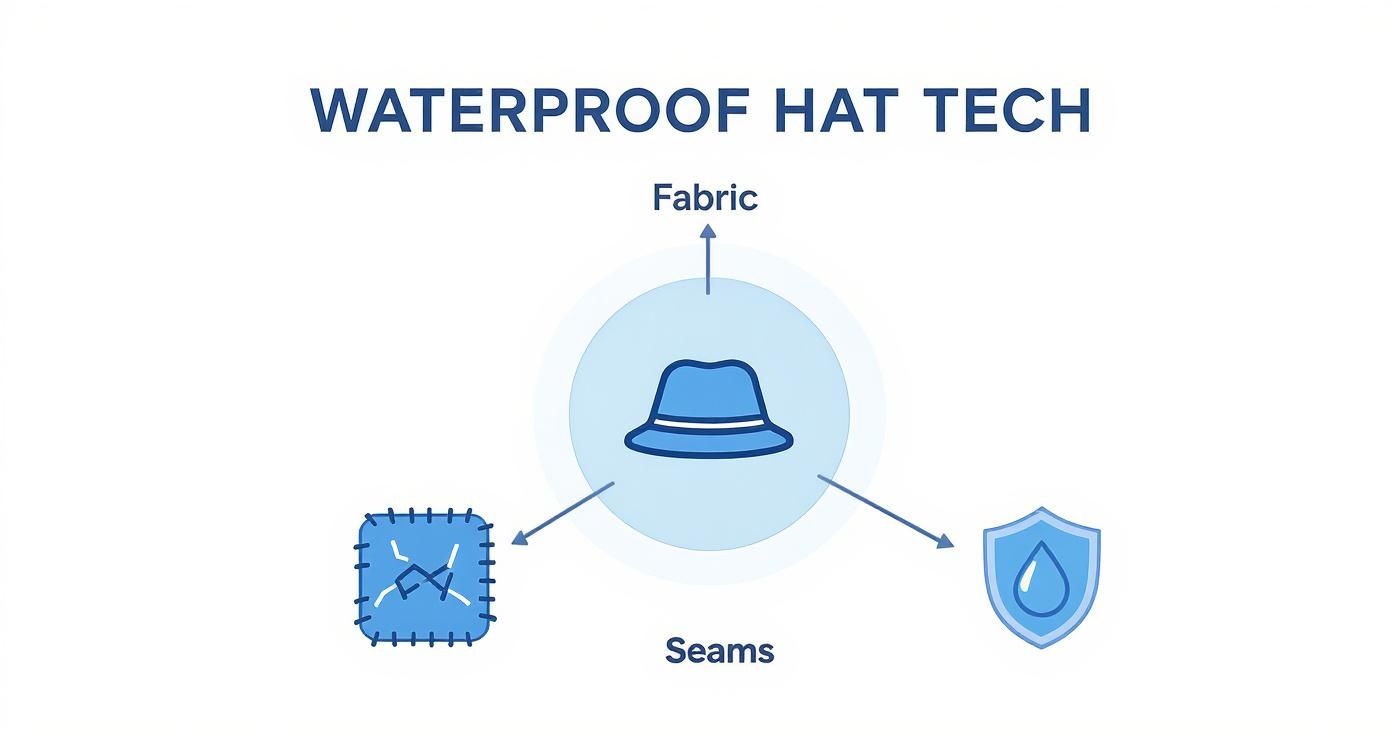
As you can see, keeping you dry is a team effort between the outer fabric, how the seams are sealed, and any protective coatings.
The Little Details That Make a Big Difference
Beyond the overall shape, a few other small features can make a huge impact. An adjustable chin strap might feel a bit old-school, but on a blustery day, it's an absolute lifesaver. It keeps your hat planted on your head so you're not chasing it down the fairway mid-swing.
Inside the hat, a good moisture-wicking sweatband is non-negotiable. It pulls sweat away from your forehead, keeping you dry from the inside while the hat keeps you dry from the outside. Comfort is key.
Finally, think about packability. The best rain hats can be squashed, rolled, and stuffed into a side pocket of your golf bag, popping back into shape when you need them. They’re the perfect "just in case" accessory. This kind of specialized gear is exactly why the global golf hat market, valued at a cool USD 1.5 billion in 2024, is projected to climb to USD 2.9 billion by 2033. If you're curious, you can dig into more stats about the booming golf apparel market from DataHorizzon Research.
A great rain hat is like a trusted caddie—it quietly does its job in the background, letting you focus entirely on your next shot without distraction.
When you start looking for these key features, you're not just buying a hat. You're investing in a piece of performance equipment that’s purpose-built to help you play your best, no matter what the weather throws at you.
How to Find a Rain Hat That Fits Perfectly
A rain hat that doesn't fit right isn't just a minor inconvenience; it's a certified round-wrecker. Too tight, and you're staring down a tension headache by the third hole. Too loose, and a single gust of wind sends it sailing down the fairway, turning your pre-shot routine into a slapstick chase scene.
The goal is to find that perfect sweet spot where the hat is secure, yet so comfortable you completely forget it’s even there. It should feel like a natural part of your gear, not some annoying distraction you're constantly fiddling with.
Getting Your Measurements Right
Look, you can guess your size, but why risk it? Taking literally thirty seconds to measure your head will save you the headache of returns and, more importantly, the misery of a bad fit on the course.
It couldn't be simpler:
- Grab a flexible measuring tape. A soft tailor's tape is ideal, but a piece of string and a ruler will do the trick in a pinch.
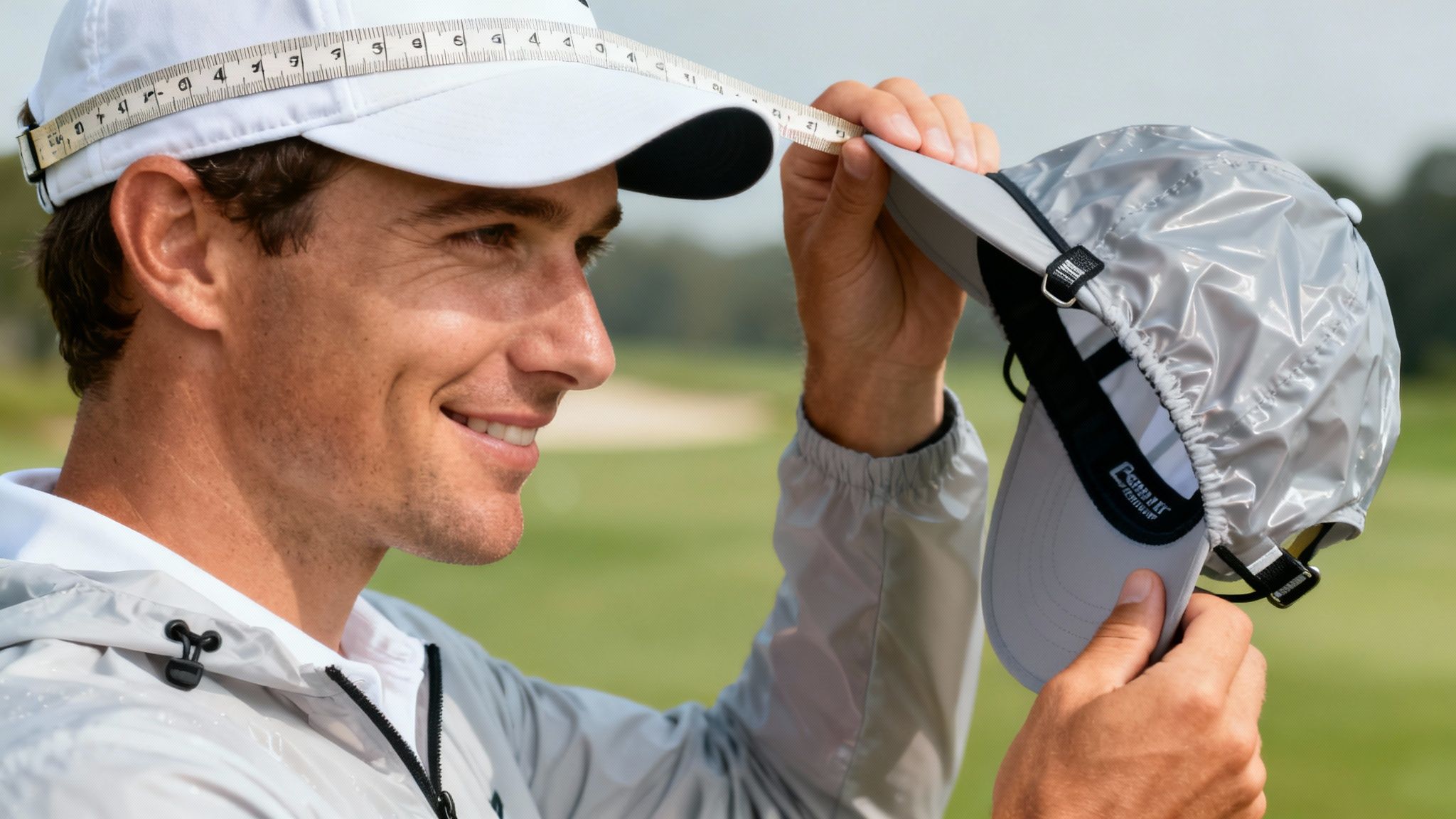
- Wrap it around your head. You want to place the tape about an eighth of an inch above your eyebrows and ears, keeping it nice and level all the way around.
- Don’t yank it tight. The tape should feel snug and comfortable—exactly how you’d want your hat to feel.
- Jot down the number. Use that measurement, whether in inches or centimeters, to compare against the brand’s sizing chart.
Once you have that magic number, you can shop for golf rain hats with total confidence, knowing your new lid will be ready for action right out of the box.
One Size Does Not Fit All
When you're shopping, you’ll see a few different sizing systems. Which one is best for you really comes down to personal preference for a precise fit versus a bit more flexibility.
- Sized Hats (S, M, L, XL): These are your best bet for a truly accurate fit, especially if your measurement falls neatly into one of the standard sizes.
- Adjustable Hats: These usually have a toggle or strap at the back. This is fantastic for fine-tuning the fit or for making a little extra room for a winter beanie underneath.
- One-Size-Fits-Most: Honestly, these can be a bit of a gamble. They tend to work best for people with what's considered an "average" head size, but they can be hit or miss.
The ultimate goal is to find a hat so lightweight and perfectly fitted that it disappears from your consciousness, letting you stay completely dialed into your shot-making.
Don’t forget about the little things, either. Your hairstyle or whether you wear glasses can slightly change how a hat sits on your head. Taking that extra moment to find your perfect fit is a tiny investment for a huge payoff in distraction-free comfort on the course.
Keeping Your Gear in Top Shape for the Long Haul
You've dropped good money on a serious piece of equipment, so let's make sure it goes the distance. Taking care of your golf rain hat isn't just about keeping it looking sharp; it’s about protecting the high-tech waterproof magic that lets you play through a downpour.
Think of the hat's waterproof membrane like your skin—it needs to breathe. When dirt, sweat, and oil build up, they clog the microscopic pores. That clogs the works, killing breathability and, eventually, its ability to keep water out. A quick, gentle clean after a muddy round can make all the difference.
The Right Way to Wash and Dry
First thing's first: always check the care label inside the hat. Every hat is a little different, but most high-performance waterproof gear needs a gentle touch. Your best bet is usually hand washing in lukewarm water with a mild soap that's free of harsh detergents. Why? Those heavy-duty detergents can strip off the hat's original water-repellent coating.
For a complete walkthrough, our guide on how to clean golf hats breaks down the process step-by-step. Once it’s clean, gently reshape it and let it air dry. Keep it away from direct heat like a radiator or, heaven forbid, a clothes dryer—that's a fast track to ruining the waterproof membrane and seam seals.
Bringing Back That "Fresh Out of the Box" Water Repellency
Remember how water used to bead up and roll right off your hat? Over time, that effect fades as the Durable Water Repellent (DWR) coating wears down. But don't toss the hat! You can easily revive it.
Restoring the DWR is a lot like waxing your car. The car itself is already waterproof, but that layer of wax makes the rain slide off effortlessly instead of pooling up. A fresh DWR treatment does the exact same thing for your hat's outer fabric.
After you've cleaned and dried your hat, grab a DWR restoration spray. Just follow the instructions on the can, and you'll recharge its water-shedding power, making it perform like new again.
This focus on long-lasting performance is a big deal for manufacturers, too. We're seeing innovations like Adidas's EcoDrive Golf Hat, which is made from 100% recycled polyester, blending sustainability with durability. It's part of a larger trend toward advanced, resilient materials, as detailed in the evolution of functional features in golf hats on Business Research Insights. A few minutes of simple maintenance ensures your gear will be ready to go when the clouds roll in.
Styling Your Rain Gear Like a Pro
Let's face it, while performance is everything on the course, nobody wants to look like they’re wrestling with a rogue tarp in a downpour. Looking the part matters. Thankfully, modern golf rain hats and apparel have come a long way, meaning you don't have to sacrifice style for staying dry.
The days of baggy, crinkly rain suits in depressing shades of beige are long gone. Today’s gear features athletic cuts and sharp color palettes that make putting together a rain-ready outfit a breeze. The secret is to treat your rain gear—hat, jacket, and pants—as a complete, intentional outfit, not just a random assortment of things you grabbed from the trunk.
Building a Cohesive On-Course Look
The easiest way to look dialed-in is to go with a matching set from the same brand. A navy rain jacket, navy pants, and a navy bucket hat to top it off? That creates a clean, seamless look that says you came prepared. It’s a no-brainer for looking sharp when the skies open up.
But you don’t have to go full matchy-matchy. A monochromatic look is another killer option. Think about a charcoal gray hat with a slightly lighter gray jacket and black rain pants. The subtle tonal shifts create a sophisticated, minimalist vibe that's always in style.
A well-coordinated rain outfit does more than just keep you dry; it boosts your confidence. When you feel good about how you look, it's one less distraction, allowing you to focus entirely on your game.
Coordinating Colors and Styles
If you're more of a mix-and-match player, a few simple guidelines will keep you looking sharp. I always recommend keeping your big pieces—the jacket and pants—in classic neutral colors like black, navy, or gray. This gives you a solid foundation and lets your golf rain hat either blend in seamlessly or pop as a statement piece.
Here are a few combinations that always look great:
- The Classic Pro: You can't go wrong with a black bucket hat and a matching black rain suit. It's timeless, powerful, and exudes a quiet confidence.
- The Modern Minimalist: A crisp white waterproof cap paired with a gray jacket and navy pants feels clean, fresh, and totally contemporary.
- The Subtle Statement: Try a deep green or rich burgundy rain hat to add a sophisticated splash of color against an all-black or all-navy outfit.
The whole point is to look like you meant to wear what you're wearing. For a deeper dive into crafting sharp on-course looks, our complete guide on how to dress for golf has you covered. At the end of the day, a well-styled rain kit shows you’re a serious golfer who’s ready for anything—and looks damn good doing it.
Clearing Up Your Burning Questions About Golf Rain Hats
Alright, even after breaking down all the tech and fancy features, you've probably still got a few questions rattling around. That's great! It means you're thinking like a golfer who's serious about their gear. Let's dive into the most common questions we get about golf rain hats.
Think of this as the 19th hole for gear talk—a place for straight, honest answers. Getting these details right can be the difference between a miserable, soggy day and a surprisingly comfortable round in the wet stuff.
Can't I Just Wear My Hiking Hat?
We hear this all the time. Sure, a waterproof hiking hat beats a soggy cotton cap any day of the week, but it’s just not built for the golf course. The reason is simple: your swing.
Most hiking hats have wide, floppy brims. That's fantastic for keeping the sun off your neck on a trail, but it's a disaster on the tee box. A floppy brim can catch on your shoulder during your backswing or, even worse, droop into your line of sight right as you're about to make contact. Golf rain hats, on the other hand, have stiffer, more intelligently designed brims that stay put, giving you a clear, unobstructed view from setup to finish. It’s a small detail that makes a world of difference.
How Do I Know When It's Time to Re-Waterproof My Hat?
Look for the tell-tale sign: when water stops beading up and rolling off and starts soaking into the outer fabric. This is called "wetting out," and it means the factory DWR (Durable Water Repellent) finish has called it quits.
Procrastinating on re-waterproofing is like playing with worn-out grips. The hat's inner membrane might still be keeping your head dry, but the outer layer gets waterlogged, making it feel heavy, clammy, and far less breathable.
The good news? It's an easy fix. A quick cleaning followed by a spray-on DWR treatment will have it shedding water like a duck's back again. This one simple step can dramatically extend the life and performance of your favorite rain hat.
What's the Ultimate Hat for Nasty, Windy, Rainy Days?
When the wind is howling and the rain is coming in sideways, you need a hat that’s absolutely locked down. In this battle, there's one undisputed champion: the bucket hat with an adjustable chin strap.
The 360-degree brim gives you complete protection, keeping rain from running down your face and the back of your neck. But the real MVP is that chin strap. It anchors the hat to your head, so you can swing for the fences without ever worrying about it taking off like a kite down the fairway. It might not win any fashion awards, but when the weather turns truly ugly, you'll be glad you have one. Function over fashion, my friend.
Ready to find a hat that laughs in the face of bad weather? 2ndShotMVP offers a collection of premium golf headwear designed for comfort, style, and durability, ensuring you stay focused on your game, not the forecast. Check out our unique designs at https://2ndshotmvp.com and find your perfect on-course companion.

