

Let's get one thing straight: if you want to slash strokes off your score right now, forget about trying to hit monster drives. The secret sauce, the fastest way to drop your handicap, is mastering the shots around the green. Seriously. A solid chipping game is your golden ticket.
Why Chipping Will Save Your Scorecard
We've all been there. You smoke a drive right down the middle of the fairway. You're feeling like a pro. Then you get up to your ball, just a few yards off the green, and the nightmare begins. You either chunk it, leaving a crater the size of a small mammal, or you blade it, sending the ball screaming across the green and into the bunker on the other side.
It's a soul-crushing experience that turns a surefire par into a "how did that happen?" double bogey.
But here’s the good news: you can completely flip that script. The real magic in golf isn't about raw power; it’s about having a deft touch from 50 yards and in. This is where you'll make or break your round, every single time.
The Numbers Don't Lie
This isn't just a hunch; the stats back it up. Focusing your practice time on the short game pays off big time. Improving your chipping by a mere 10% can carve almost five full strokes off your score. To get that same improvement with your driver, you'd need a Herculean effort that just isn't realistic for most of us.
Think about it. By building a simple, reliable chipping motion, you're essentially creating a safety net for your entire game. You gain a powerful tool that can erase earlier mistakes and put you in a position to score, not just salvage the hole.
A great chip is your get-out-of-jail-free card. Your drive found the rough? Doesn't matter. Your approach shot missed the green? Who cares. A confident chip gives you a fighting chance to save par from anywhere.
That’s exactly what this guide is all about. We’re going to ditch the complicated, pro-level jargon and stick to the simple, actionable fundamentals. These are the building blocks for a dependable short game that will stop you from bleeding strokes around the green. If you're looking for a broader look at the game, you can check out our general best golf tips for beginners.
Nailing Your Setup for Incredibly Crisp Contact
Before you even think about swinging the club, we need to dial in your setup. I see it all the time with new golfers: a wonky setup is the number one reason for those soul-crushing chunks and skulls around the green. Getting your stance and posture right from the get-go is the secret to building a repeatable, confident chipping stroke.
Think of it this way: a solid setup puts you in a position to win before you even start the swing. It makes hitting a good chip almost automatic. We're just going to make a few small tweaks to get physics working for you, not against you.
This little diagram says it all. Bad scores are often a direct result of a shaky short game. Fix the chipping, and the scores plummet. It’s that simple.
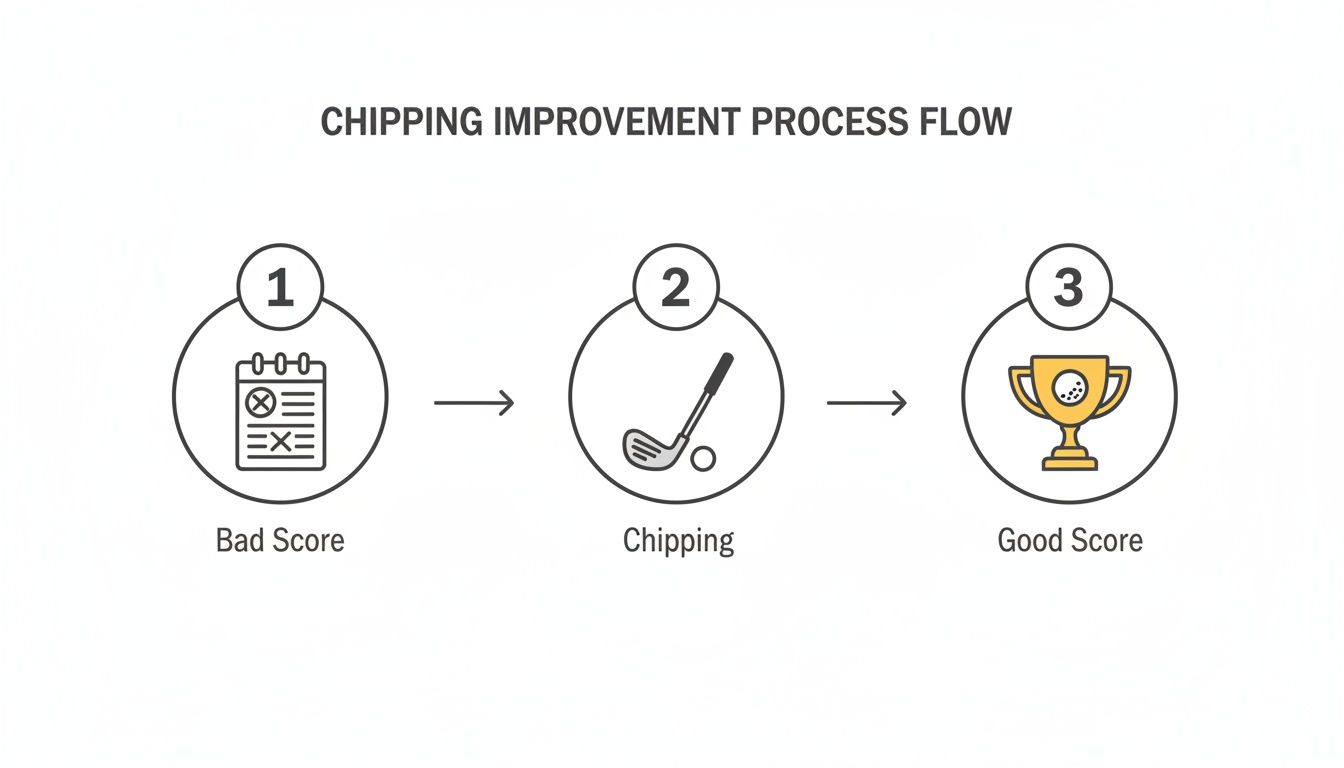
The message here is loud and clear: if you want to shave strokes off your handicap fast, dedicate some serious time to your chipping.
The Chipping Stance Checklist
First things first, throw your driver stance out the window. This isn't about bombing it down the fairway; it's a touch-and-feel shot. Your body needs to reflect that.
- Get Your Feet Closer: Bring your feet in so they're only about a club-width apart. A wide base is for power and invites your body to sway. A narrow stance quiets the lower body and lets your shoulders do all the rocking. Simple.
- Flare That Front Foot: Point the toes of your lead foot (the left one for righties) a little bit toward the target. It’s a subtle move, but it opens up your hips and makes it so much easier to rotate through the shot without getting stuck.
- Move the Ball Back: This is a game-changer. Position the golf ball so it's in line with the heel of your back foot. This is the magic ingredient that helps you hit down on the ball, guaranteeing you make ball-first contact. That's how you get that crisp, "pinched" feel.
The entire point of a great chipping setup is to preset a downward strike. By putting your weight and hands forward, you’re basically telling the club, "Hey, hit the little white ball first, then brush the grass."
Lock In Your Weight and Hand Position
Okay, your feet and the ball are in the right spot. The last piece of the puzzle is getting your weight and hands sorted. No need to get weird with this; just feel athletic.
You'll want to feel about 60-70% of your weight on your front foot. This lean is crucial because it stops you from falling backward during the swing—a classic mistake that leads to thin, bladed shots screaming across the green.
Next, press your hands slightly forward, just ahead of the golf ball. Your arms and the club shaft should create a small lowercase "y" shape. This "forward press" takes your wrists out of the shot and kills any temptation to scoop or flip at the ball.
Keeping this solid setup also helps keep your clubface from getting gunked up, but you should always know how to clean your golf clubs properly to make sure your grooves are working for you. Master this simple, stable stance, and you’ve just unlocked the door to reliable, stress-free chipping.
Mastering The Simple 'Pendulum' Swing Motion
Let's clear the air right now. Forget the big, powerful golf swing you see on TV. When you're just off the green, trying to replicate that is the fastest way to ruin your chip shot and your scorecard. Most beginners get into trouble because they take a tiny, violent, wristy hack at the ball. The result? Total chaos.
It's time to simplify. We're going for a much more reliable motion: the pendulum swing.
This isn't about raw power; it's all about rhythm. Picture a grandfather clock's heavy pendulum, just rocking back and forth, nice and easy. That’s the exact feeling we're chasing. Your arms, shoulders, and chest need to move together as one solid unit. This creates a stable triangle that just rocks away from the ball and then smoothly back through it.

This "one-piece takeaway" is the secret sauce for great chipping. By keeping your arms connected to your chest, you get rid of that flippy, handsy motion that causes those dreadful chunks and thins. The clubhead should feel like it's staying right in front of your body the whole time.
The Feeling You're After
The best way I can describe this motion is that it feels less like a golf swing and more like a gentle, underhand toss. Seriously. If you were going to toss a ball to a friend standing a few feet away, you wouldn't break your wrist and flick it, right? Of course not. You'd use a simple, smooth arm swing—and that's the pendulum motion in a nutshell.
This single idea is a cornerstone of any good collection of golf chipping tips for beginners because it’s so easy to learn and, more importantly, repeat when the pressure is on.
Want to really ingrain this feeling? Try this classic drill:
- Tuck a Towel: Grab a small towel or even a headcover and tuck it under your lead armpit (that's the left one for right-handed golfers).
- Make Practice Swings: Your only goal is to make small chipping motions without letting that towel drop to the ground.
- Feel the Connection: This little trick forces your arm and chest to rotate together. You'll instantly get the feeling of a connected, one-piece pendulum swing.
If you can keep that towel in place, you’re preventing your arms from flying off on their own little adventure and forcing your bigger, more reliable muscles to control the shot.
This connected 'pendulum' motion is your golden ticket to consistency. When your big muscles are in charge, the small, twitchy muscles in your hands and wrists can't sabotage the shot. You'll hit it solid way more often.
Control Your Distance By Changing Your Swing Length
Now for the magic. Once you get this simple rocking motion down, controlling how far your chip shots go becomes ridiculously easy. You don't need to swing harder or faster for longer shots. That just invites disaster.
Instead, you just make the pendulum swing longer.
- Short Chip (5-10 yards): Think "knee to knee." The clubhead goes back to about your back knee, and your follow-through finishes pointing at your front knee.
- Medium Chip (15-20 yards): Think "hip to hip." A slightly longer backswing up to your back hip, followed by a matching follow-through to your front hip.
Notice what doesn't change? The tempo. The rhythm. It's the same smooth pace for every single shot. All you're doing is adjusting the size of the arc. This takes all the guesswork out of it and gives you a simple, repeatable system for dialing in your distances.
5 Practical Drills To Build Unshakeable Confidence
Alright, theory is great, but getting your hands dirty on the practice green is where you forge a short game you can actually trust. Reading about the perfect pendulum swing is one thing; feeling it is another.
These aren't your typical, mind-numbing exercises. I've hand-picked drills that are engaging, give you instant feedback, and build that crucial muscle memory that takes over under pressure.

Let's dive in and turn practice into productive play. You'll be amazed at how a little focused effort here pays massive dividends on the course.
The Towel Drill For Landing Zone Mastery
This one’s a classic for a reason—it flat-out works. The goal here is brutally simple: learn to land the ball exactly where you intend to. Most amateurs stare at the hole, but great chippers are obsessed with their landing spot.
Grab a small hand towel and lay it on the practice green about a third of the way to your target. Now, your only job is to chip a bucket of balls and make them land on that towel. That's it. This drill forces you to stop fixating on the final result and dial in the part you can actually control.
A huge part of chipping is visualizing the shot. This drill trains your brain to see the small shot (the carry) that sets up the big result (the roll to the hole). It’s a complete mental shift.
Once you’re consistently peppering the towel, start moving it to different distances and see how you do. This single exercise will do more for your distance control than just about anything else.
The Gate Drill For A Perfect Path
Ever feel like your club path is a bit… creative? This drill cleans that up in a hurry. It gives you no choice but to swing the club straight back and straight through, which is the secret to eliminating those ugly pushes and pulls.
Here’s the setup:
- Place your ball on the green like you're about to chip.
- Set up two tees (or even two golf balls) on either side of your clubhead, creating a narrow "gate" just wide enough for the club to pass through.
- Now, place another two tees about a foot in front of the ball, creating a second gate right on your target line.
Your mission, should you choose to accept it, is to swing the club through both gates without clobbering any of the tees. If you take the club too far inside or swing over the top, you’ll immediately know. It's instant, undeniable feedback that grooves a perfect, on-plane chipping motion.
The Distance Ladder Drill
This drill is an absolute gem for developing feel and calibrating your internal yardage-o-meter. It's all about building a mental library of how much swing is needed for different distances.
A great way to do this is to lay out a measuring tape and mark spots with alignment sticks at 5, 10, 15, and 20 yards. Your goal is to hit one ball to each marker in succession, starting with the closest and working your way out. You'll quickly get a feel for the different "gears" in your chipping stroke.
For those just starting out, there are tons of simple exercises that can build a strong foundation. You can find a great collection of the best golf drills for beginners to complement your chipping practice. The key is to make your practice purposeful, not just banging balls aimlessly.
Common Chipping Mistakes And How To Fix Them Fast
Every beginner, and I mean every beginner, makes the same few mistakes around the greens. It's a rite of passage! The good news is these aren't some deep, dark swing flaws that require a total rebuild. They're almost always just a simple misunderstanding of how the club is supposed to work with the ball and the ground.
Think of this as your greenside emergency kit. When one of these classic blunders rears its ugly head, you’ll have a quick-fix thought ready to deploy. Let's tackle the three biggest culprits that are likely stealing strokes from your game and banish them for good.
The Chunk: Hitting the Ground Before the Ball
You know the one. The dreaded chunk. You set up, you take a nice, smooth practice swing, and then… THUD. The club digs into the turf like it’s trying to plant a garden, and the ball meekly pops up a few feet in front of you. It’s a soul-crushing shot.
Nine times out of ten, the cause is simple: your swing is bottoming out too early. This almost always happens when your weight hangs back on your trail foot, or you get "flippy" with your wrists, trying to scoop the ball into the air. That solid setup we covered earlier? It’s specifically designed to prevent this very problem.
The Instant Fix:
- The "Forward Button" Thought: Picture a big red button on the front of your lead hip. Your only mission during the chip is to turn and press that button toward the target. This one simple thought keeps your weight forward and guarantees the club makes contact with the ball before the turf.
Most chipping errors come from one place: a subconscious desire to help the ball get into the air. You have to trust the loft on your club. Your job isn't to lift it. Your job is to strike down on it, and the club’s design will do the lifting for you.
The Thin: Hitting the Ball's Equator
Just as frustrating, and maybe even more dangerous, is the "thin" shot. You might hear it called a "skull" or a "blade." The leading edge of the club catches the ball right around its equator, sending a low-flying missile screaming across the green and, often, into the bunker on the other side. It feels awful and can turn an easy up-and-down into a double bogey in the blink of an eye.
This is the polar opposite of the chunk. It happens when the low point of your swing actually rises up right before impact. And the number one reason for this? You peeked! Lifting your head and chest to watch the shot before you've even finished hitting it is the classic cause.
The Instant Fix:
- The "Count to Two" Drill: This couldn't be simpler. After you strike the ball, force yourself to keep your eyes glued to the exact spot where the ball used to be. Silently count in your head, "one-one-thousand, two-one-thousand," then you can look up. It feels a little weird at first, but this little trick keeps your entire body stable through the impact zone and ensures a crisp, clean strike.
The Decel: Slowing Down Through Impact
This one is sneaky. Your setup feels perfect, your swing thought is clear, but the ball still comes off the face with no energy and dies halfway to the hole. Welcome to the "decel"—short for deceleration. It’s that tentative, hesitant swing where the club actually slows down as it approaches the ball.
This is a mistake born from fear. You’re so worried about hitting the ball too hard and flying it over the green that you instinctively pump the brakes. The problem is, this completely wrecks your rhythm and almost always leads to poor contact. A good chip requires you to accelerate through the ball.
The Instant Fix:
- "Click and Finish": Instead of worrying about the backswing, put all your focus on making your follow-through at least as long as your backswing. Listen for the "click" of the ball on the clubface, and make sure your club keeps swinging smoothly and continuously past that point. A committed swing that accelerates will always beat a timid one that decelerates.
Your Top Chipping Questions Answered
Alright, so you've got the basics down, but a few questions are probably rattling around in your head. That's totally normal. Let's clear the air and tackle some of the most common head-scratchers that trip up golfers around the green.
Getting these little details sorted is what turns a hopeful poke into a confident, predictable shot. Soon enough, you'll be sizing up these shots with a clear plan instead of just crossing your fingers.
What Is The Difference Between A Chip And A Pitch?
This is a classic, and for good reason—it confuses a ton of new golfers!
Here’s the simplest way I can put it: a chip shot spends most of its time on the ground, and a pitch shot spends most of its time in the air. Think of it as roll vs. flight.
- Chipping: You're close to the green with a clear path. The goal is a small hop onto the putting surface and letting it roll out like a putt. It's a low-risk, simple pendulum motion.
- Pitching: You need to fly the ball over something—like a bunker or a patch of rough—and get it to stop relatively quickly. This requires a bigger swing and more loft.
For any beginner, mastering the chip is priority number one. It’s simpler, safer, and will save you more strokes, period.
Should I Use The Same Club For Every Chip Shot?
Short answer: Nope. Long answer: Absolutely not!
While practicing with just one club (like your pitching wedge) is an awesome way to build a reliable feel, that's a practice drill, not a course strategy. Think of your wedges and short irons as a toolkit. Each one has a specific job.
Got a ton of green to work with? Grab a lower-lofted club like an 8-iron. It will come out low and trundle across the green, saving you from a tricky long-distance putt.
Barely any green between you and the pin? That’s when you pull out the sand wedge. It'll pop the ball up high and put the brakes on fast.
Pro Tip: The secret to consistency is picking a landing spot and flying the ball to that same spot every time. Let the club's loft dictate the roll. This is infinitely easier than trying to force one club to do everything by changing your swing.
How Do I Chip From The Rough?
Ah, the dreaded fluffy stuff. Chipping from the rough is a different beast entirely because that grass is out to get you. It will grab your clubhead and kill your momentum in a heartbeat.
You have to make a few key adjustments:
- Get Aggressive: This is no time to be timid. You must accelerate through the ball. Decelerating is the cardinal sin of chipping from the rough.
- Get Steep: To cut through the grass, you need a steeper angle of attack. Put a little extra weight on your front foot and open the clubface just a touch. This helps the club dig down and pop the ball out.
- Plan for a Pop-and-Stop: The ball will come out higher with less roll than it would from the fairway. A sand wedge is usually your best friend here. Your main goal isn't to get cute—it's to make solid contact and get that ball onto the putting surface.
As beginners get more into the game, they often start exploring gear that can add a little extra something. For those with a taste for golf tech, checking out accessories like Marq Golfer watch bands can be a fun part of embracing the sport.
Why Do I Keep Hitting My Chip Shots Thin?
Ugh, the "skull." The shot that screams across the green and into the bunker on the other side. It’s infuriating, but it's almost always caused by one of two things.
The most common culprit is lifting your head and chest up too early. As soon as your upper body rises, the bottom of your swing arc rises with it. The club's leading edge then catches the ball's equator—thwack—and it's gone. To fix this, really focus on keeping your chest pointing down at where the ball was, even after you've hit it.
The other major cause is trying to "scoop" or "lift" the ball into the air with your wrists. Bad habit! Remember the pendulum. Your hands need to lead the clubhead through impact. A great drill is to lay a towel a foot behind your ball. If you scoop at it, you'll hit the towel on your backswing. It's instant, undeniable feedback.
At 2ndShotMVP, we believe that looking good and feeling good go hand-in-hand with playing good. Our premium golf hats and apparel are designed for golfers who love the game and want to express their style with confidence. Check out our latest collections and find your new favorite hat at 2ndshotmvp.com.

