

Welcome to the golf rabbit hole! It's a world of incredible highs, baffling lows, and the unending quest for that one perfect shot. Before you can hit those jaw-dropping drives or sink that clutch putt, you need to build a solid foundation. Forget spending hours aimlessly whacking buckets of balls at the range; the secret to rapid improvement isn't about hitting more, it's about hitting with purpose.
That’s precisely where targeted practice comes in, and we've compiled the ultimate cheat sheet for your journey. We’ve cut through the noise to bring you the 8 best golf drills for beginners, each one designed to fix a specific flaw and build rock-solid muscle memory. These aren't just abstract concepts. They are actionable, repeatable exercises used by pros and top coaches to create consistent, confident golfers.
From mastering your grip while watching TV to building a tour-level putting stroke in your living room, this list is your roadmap to playing better golf, faster. We'll show you exactly how to transform your practice sessions from frustrating flailing into focused skill-building. So grab your clubs, and let's get to work on shaving those strokes off your scorecard.
1. The Grip Drill
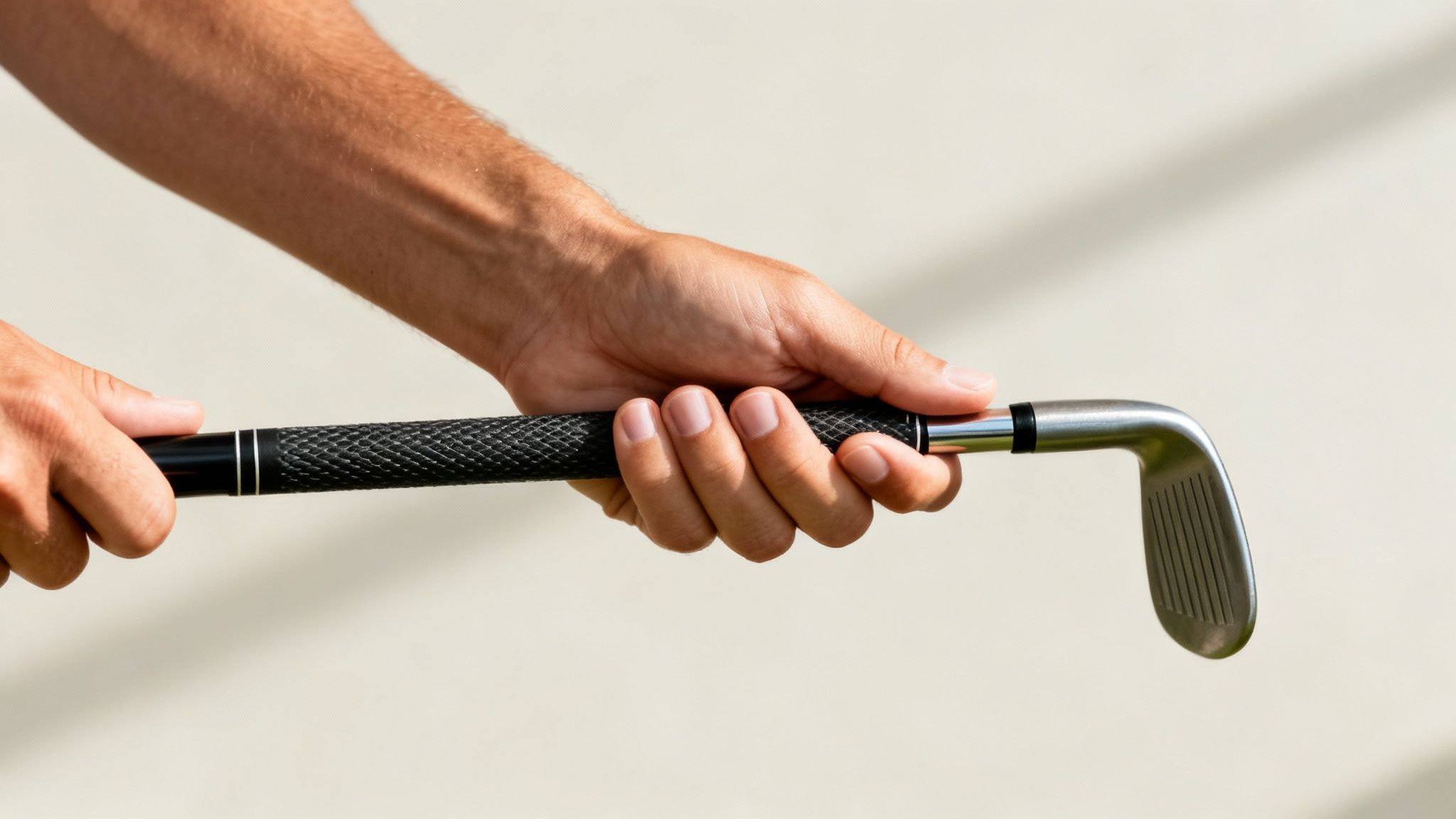
If your golf swing were a skyscraper, the grip would be its entire foundation. Mess it up, and the whole thing comes crashing down. The Grip Drill is the quintessential starting point for any beginner, and it’s one of the best golf drills for beginners because it influences every single shot you will ever hit. This drill isn't about power or fancy techniques; it's about creating a stable, repeatable connection to the club.
Think of it this way: your hands are the only part of your body that touches the club. They are your steering wheel, your throttle, and your brakes. A proper grip gives you control over the clubface, which dictates where the ball goes. A bad grip is like trying to drive a car with your feet – you might move, but you're not going where you want.
How to Master The Grip
The goal is to place your hands on the club in a neutral, athletic position that promotes a square clubface at impact. The legendary Ben Hogan famously spent countless hours perfecting his grip, and so should you.
Start by placing the club diagonally across the fingers of your lead hand (left hand for right-handed players). Close your hand, and you should see two knuckles when you look down. Next, place your trail hand on the club, with the lifeline in your palm covering the thumb of your lead hand. You can use an interlocking, overlapping, or ten-finger grip – experiment to see what feels most natural.
Pro Tip: Your grip pressure should feel like you're holding a tube of toothpaste without squeezing any out. On a scale of 1 to 10, aim for a 4 or 5. A death grip creates tension and kills your swing speed.
Actionable Tips for a Perfect Hold
- TV Time is Grip Time: Keep a club in your living room. During commercial breaks, practice setting and re-setting your grip. Repetition builds muscle memory.
- Mirror, Mirror on the Wall: Use a mirror to check your hand placement against photos or videos of a correct grip. Are your "V's" (the lines formed by your thumb and forefinger) pointing toward your trail shoulder?
- Get a Second Opinion: Ask a teaching pro or an experienced golfer to look at your grip. A quick two-minute check can save you months of frustration.
- Feel the Fit: A proper grip starts with a well-fitting glove. If your hand is sliding around, you'll never feel secure. A snug glove provides the tackiness and confidence needed to relax your grip pressure. For more information, you can find a golf glove size chart to ensure you have the perfect fit.
2. The Alignment Stick Drill
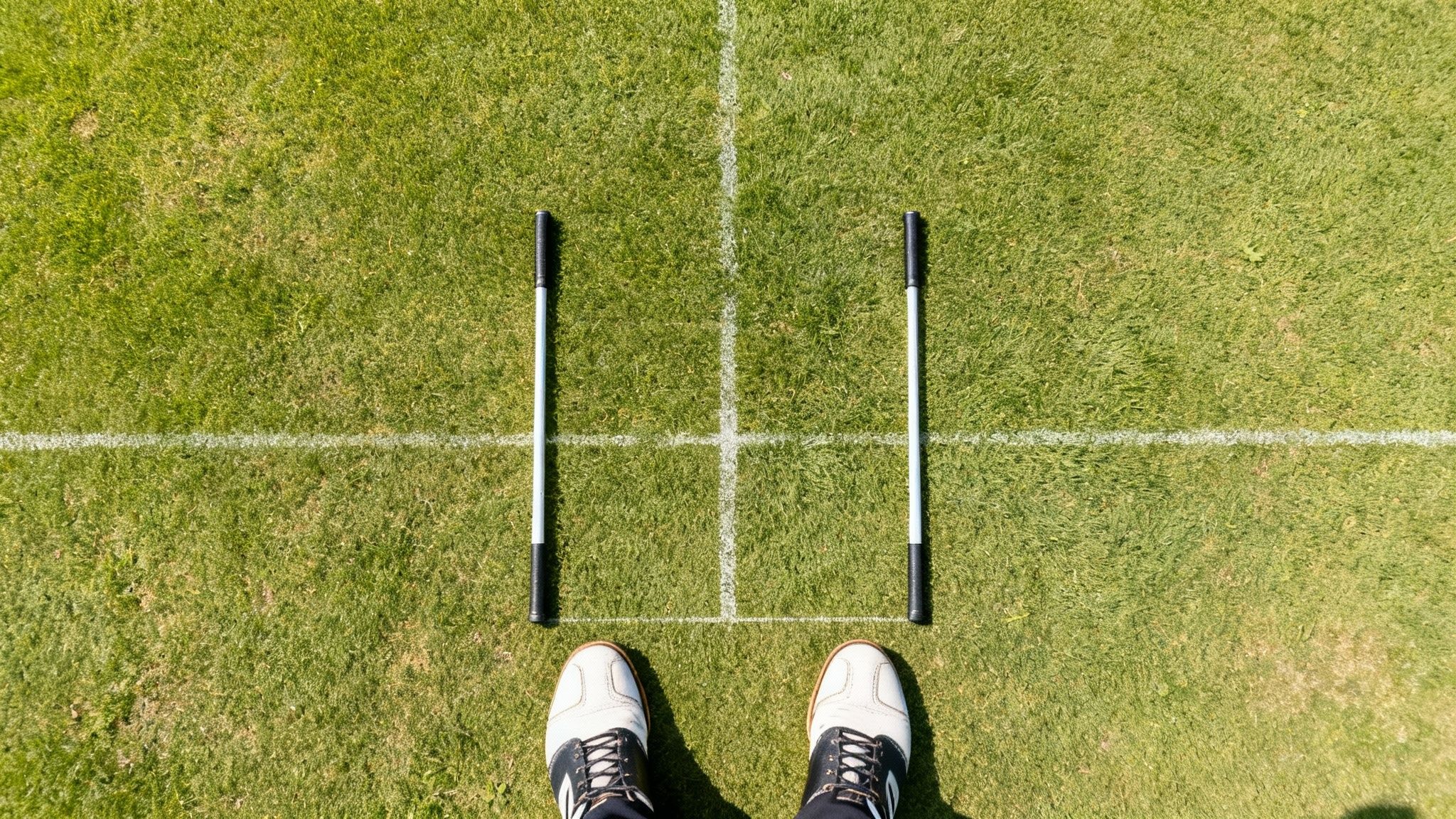
If aiming in golf were as easy as pointing, we'd all be professionals. Unfortunately, what feels straight to a beginner is often wildly off-target. This is where The Alignment Stick Drill comes in, acting as your personal on-course GPS. It’s one of the best golf drills for beginners because it provides instant, undeniable visual feedback on where your body is aimed, which is the root cause of slices and hooks for most new players.
Think of it like the painted lines on a runway. A pilot needs those lines to land safely, and you need alignment sticks to ensure your swing is taking off in the right direction. Without them, you're just guessing, and in golf, guessing leads to frustration and lost balls. This drill trains your eyes and body to recognize what a square setup actually feels like, building a repeatable pre-shot routine.
How to Master Your Aim
The objective is to create a set of "railroad tracks" that guide your setup. The outer track points to your target, while the inner track guides your body. This simple visual aid, popularized by top coaches like Butch Harmon, is a staple in the warm-up routines of nearly every PGA Tour player for a reason: it works.
Lay one stick on the ground pointing directly at your target (the target line). Place the second stick parallel to the first, just inside the ball, creating a line for your feet, hips, and shoulders. Your body should be square to this second stick, not to the target itself. This parallel-left alignment is a concept that trips up many beginners.
Pro Tip: Your brain can trick you. After hitting a few shots, step away and then re-address the ball without the sticks. Have a friend check your alignment. You'll likely be surprised at how quickly your old, incorrect habits try to creep back in.
Actionable Tips for a Perfect Setup
- Start Small: Begin with short irons, like a pitching wedge or 9-iron. The shorter clubs are easier to control and will help you build confidence in your new alignment.
- Routine Reps: Before you even hit a ball, practice stepping into your "station" 5-10 times. This helps ingrain the feeling of a square setup into your muscle memory.
- Don't Forget the Short Game: Use this drill for chipping, too. Proper alignment is just as critical for shots around the green as it is for a 300-yard drive.
- Get the Gear: Alignment sticks are inexpensive and incredibly useful. They are one of the most essential tools you can own, and you can explore more of the best golf accessories to fill out your practice kit.
3. The Short Game Distance Control Drill (Target Pitching)
If you’ve heard the phrase "drive for show, putt for dough," this drill is the key to cashing in. The Short Game Distance Control Drill focuses on what truly lowers scores: mastering the shots from inside 100 yards. It's one of the best golf drills for beginners because it trains your hands, mind, and body to develop a feel for distance, which is a skill, not a guess.
Think of it like being a quarterback throwing a screen pass. It’s not about slinging it 60 yards downfield; it's about hitting your receiver in stride with the perfect touch. This drill builds that finesse, turning dreaded in-between distances into genuine scoring opportunities. Mastering this will save you more strokes than adding 10 yards to your drive ever will.
How to Master Distance Control
The goal is to calibrate your swing length to specific yardages, creating a reliable system for your wedges. Short game gurus like Dave Pelz and Phil Mickelson have built careers on this principle. They don't guess how hard to hit a 40-yard pitch; they know exactly what swing produces that result.
Start by placing targets at set distances like 20, 30, and 40 yards. You can use towels, alignment sticks, or buckets. Using just one club (like your sand wedge), practice hitting shots to the 20-yard target. Your focus isn't on perfect contact at first, but on how big the swing needs to be to send the ball that far. Once you have a feel for it, move to the 30-yard target, and so on.
Pro Tip: Your short game practice should make up at least 60% of your total practice time. Why? Because nearly two-thirds of your shots in a typical round occur within 100 yards of the hole.
Actionable Tips for a Precise Short Game
- Clock System Practice: Imagine your body is a clock face. A swing from 7 o'clock to 5 o'clock might go 20 yards, while a swing from 9 o'clock to 3 o'clock goes 50 yards. Experiment with different "times" to dial in your distances.
- Keep a Logbook: After each practice session, write down your findings. For example: "Pitching Wedge, 9-to-3 swing = 45 yards." This data becomes your on-course yardage guide.
- Vary the Lie: Don't just practice from perfect fairway grass. Hit shots from the rough, from hardpan, and from uphill and downhill lies. The same swing will produce different results, and you need to learn those adjustments.
- Make it a Game: Create a points system for yourself. Give yourself 3 points if the ball lands within one club length of the target, 1 point if it's within three club lengths. This adds pressure and makes practice more engaging.
4. The Impact Position Drill (Mirror or Video Analysis)
If the golf swing is a story, the impact position is the climax. It's the moment of truth where all your setup, takeaway, and downswing efforts either pay off or fall apart. The Impact Position Drill is one of the best golf drills for beginners because it freezes this critical moment, allowing you to see exactly what you’re doing right and wrong.
Think of it like being a detective at a crime scene. You wouldn't just glance and guess what happened; you’d dust for prints and analyze the evidence. By using a mirror or video, you stop guessing what a good impact feels like and start building what a good impact looks like. This drill trains your body to find the correct, powerful position instinctively.
How to Master the Moment of Truth
The goal is to train your body to reach a dynamic impact position: weight shifted to your lead foot, hips open to the target, and hands ahead of the clubhead. This position creates the "lag" and forward shaft lean that you see every Tour pro demonstrate, which is the secret to compressing the golf ball for pure, powerful shots.
Famed instructor David Leadbetter popularized video analysis, and modern technology like TrackMan has made understanding impact more accessible than ever. You can start with just your smartphone. Set it up to record your swing and slowly rehearse moving from your setup to the impact position, holding it for a few seconds.
Pro Tip: Your impact position is not your address position. At impact, your weight should be about 80% on your lead foot, and your belt buckle should be pointing slightly ahead of the golf ball, not directly at it.
Actionable Tips for a Perfect Impact
- Two Angles are Better Than One: Record yourself from two perspectives: "face-on" (directly in front of you) and "down-the-line" (behind you, looking toward the target). This gives you a complete 3D picture of your mechanics.
- Use Slow-Mo: Your phone's slow-motion video feature is your best friend. It allows you to pause the frame precisely at impact to see where your hands, hips, and head are.
- Compare to the Pros: Find a video of a professional golfer's swing and put it side-by-side with your own. You don't need to be an exact copy, but look for the key similarities in weight shift and hand position.
- The Living Room Rehearsal: You don’t even need a ball. Stand in front of a full-length mirror and slowly rehearse your swing, pausing at the impact position. Check your reflection to ensure your hands are ahead of the clubhead and your hips have started to clear.
5. The Ladder Drill (Progressive Distance Hitting)
Imagine trying to sprint before you've learned to walk. That’s what many beginners do on the driving range, grabbing a driver and swinging for the fences. The Ladder Drill is the antidote to this chaos, providing a structured, methodical approach to mastering your distances. It's one of the best golf drills for beginners because it forces you to focus on control and consistency before chasing power.
This drill is all about building a solid foundation, one club at a time. Instead of randomly hitting balls, you create a "ladder" of targets at increasing distances. This process teaches you how your swing changes for a 50-yard shot versus a 150-yard shot and builds immense confidence in every single iron in your bag. It’s a favorite warm-up routine for Tour players and a core tenet of golf academies worldwide for a reason: it works.
How to Climb the Ladder
The goal is to establish a repeatable swing and consistent contact for each club, starting from your shortest wedges and working up to your longer irons. Think of it as building a house brick by brick, not just throwing up the walls and hoping they stick.
Start with a short wedge, like your sand wedge or pitching wedge, and aim for a target just 50 yards away. Hit several balls, focusing only on solid contact and accuracy. Once you feel dialed in at that distance, take your next club (or a slightly fuller swing) and aim for a 75-yard target. You’ll progressively move up in distance, "climbing the ladder" until you've worked through most of your irons.
Pro Tip: Don't obsess over hitting the flagstick. Focus on your "dispersion circle" – the area where your shots consistently land. A tight grouping 10 feet right of the target is far better than one great shot and four wild misses.
Actionable Tips for a Perfect Climb
- Set Clear Rungs: Use the yardage markers on the driving range to create your ladder. Start at 50 yards, then move to 75, 100, 125, and 150.
- Quality Over Quantity: Hit 3-5 high-quality shots to each target before advancing to the next "rung." If you struggle, stay at that distance until you feel confident.
- Know Your Numbers: Keep a small notebook or use a notes app on your phone to record which club you used for each distance. This is the first step to knowing your exact yardages.
- Pack the Right Tools: To properly execute this drill, you need the right clubs. Ensuring you have the correct wedges, irons, and hybrids is crucial, so take a look at these golf bag essentials to make sure you're fully equipped for success.
6. The Putting Gate Drill
If the full swing is a cannon, putting is a sniper rifle. It requires precision, a steady hand, and an unwavering path. For beginners, controlling the putter face and starting the ball on the intended line is a massive challenge. The Putting Gate Drill is one of the best golf drills for beginners because it provides instant, undeniable feedback on your stroke path and clubface control.
Think of it as learning to drive by staying perfectly between the lines on the road. This drill forces you to swing the putter head on a straight path through impact, eliminating the wobbly, inconsistent strokes that lead to missed three-footers. It's so effective that PGA Tour pros and their caddies are seen setting up gate drills on the practice green every single week.

How to Master The Putting Gate
The goal is to train your body to produce a consistent, straight-back-and-through putting stroke. This drill, popularized by putting gurus like Dave Stockton, isolates the most critical part of the putt: the first few inches of the ball’s journey.
Set two alignment sticks, tees, or even chalk marks on the green about a foot in front of your ball. The space between them, the "gate," should be just slightly wider than your putter head. Your objective is simple but demanding: hit the putt so the ball rolls cleanly through the gate without touching either side. If the ball hits a side, you know your clubface wasn't square or your path was off.
Pro Tip: Your focus should be on a smooth, rhythmic tempo, not on hitting the ball hard. A good putting stroke is a pendulum, not a punch. Let the putter do the work and concentrate on maintaining a steady rhythm back and through.
Actionable Tips for a Perfect Roll
- Start Small: Begin from just three feet away from the gate. The initial goal is consistency, not distance. Once you can roll 10 consecutive putts through the gate, you can move back.
- Narrow the Target: Start with a gate that is about six inches wide. As you get more consistent, challenge yourself by narrowing it to just four inches. This will sharpen your precision even more.
- Shadow Strokes: Before hitting any balls, make several practice strokes through the gate without a ball. This helps you feel the correct path and build muscle memory without the pressure of the result.
- Combine and Conquer: Once you feel confident with your stroke path, combine this drill with distance control practice. After rolling a ball through the gate, pay attention to how far it travels to develop a complete putting game.
7. The Tempo Training Drill (Metronome Practice)
If you've ever watched a pro golfer swing, you'll notice a smooth, almost poetic rhythm. They never look rushed or jerky. That's tempo, and it’s the secret sauce that separates a tense, inconsistent beginner from a fluid, confident player. The Tempo Training Drill is one of the best golf drills for beginners because it trains this crucial element of the swing using a simple tool: a metronome.
Think of your swing as a dance. Without a beat, your movements are chaotic and out of sync. A metronome provides that steady beat, helping you coordinate your backswing, transition, and downswing into one seamless motion. It eliminates the beginner's urge to rush from the top, which is a major cause of slices, hooks, and general misery on the course.
How to Master Swing Rhythm
The goal here is to internalize a consistent rhythm so you can repeat it under pressure, whether you’re on the range or facing a tough tee shot. Legendary instructor Butch Harmon has used tempo training for years to help his students find their "swing speed," not just raw power.
Start with a metronome app on your phone set to a slow beat, around 60 beats per minute (BPM). The idea is to create a three-beat swing: "one" for the takeaway, "two" for the top of the backswing, and "three" for impact. As you get comfortable, you can gradually increase the tempo to find what works for you, usually somewhere between 60 and 80 BPM.
Pro Tip: Your backswing should generally be three times slower than your downswing. A common tour-pro ratio is 3:1. For a 3-beat metronome, this would mean taking two beats to go back and one beat to swing through impact.
Actionable Tips for a Perfect Tempo
- Start Without a Ball: Begin by just making practice swings in your yard, syncing your movement to the metronome's ticks. This builds the feeling without the pressure of hitting the ball.
- Use Headphones: On a busy driving range, it can be hard to hear the metronome. Use headphones to block out distractions and focus solely on the beat.
- Feel the "Pause": Use the metronome to train a slight, unhurried pause at the top of your backswing. As one beat ends and the next begins, that’s your cue to start the downswing smoothly.
- Hum Your Tune: Once you find a rhythm you like, try humming it to yourself on the course. This internal metronome can be a powerful tool to calm your nerves and keep your swing from getting too quick.
8. The Ball Position Drill (Zone Awareness)
If your setup is the launch sequence for a rocket, ball position is the precise coordinate you’re aiming for. Get it slightly wrong, and your shot will end up in a different galaxy, or more likely, the woods. The Ball Position Drill is one of the best golf drills for beginners because it hardwires a fundamental that changes with every single club in your bag.
Think of it like this: you wouldn't stand in the same spot to hit a baseball pitched at your knees as one at your chest. Similarly, a driver requires a different ball position than a wedge. This drill isn't about hitting the ball harder; it's about hitting it correctly by creating a consistent, repeatable setup that leads to pure contact and predictable ball flight.
How to Master Zone Awareness
The goal here is to understand where the ball should be relative to your stance for different clubs. For your longest clubs, like the driver, the ball should be positioned off your lead heel. As the clubs get shorter, the ball position gradually moves back toward the center of your stance, with your wedges and short irons played from the middle.
To practice, lay an alignment stick on the ground pointing at your target. Place another stick perpendicular to it, forming a "T." This cross-point is your center. Now, place balls at the different "zones": one just inside your lead heel (driver), one a few inches back (mid-irons), and one in the dead center (wedges).
Pro Tip: Your stance width also changes. It should be widest with the driver (shoulder-width or slightly more) and narrowest with your wedges. A stable base is crucial for every shot.
Actionable Tips for a Perfect Setup
- Create Your Zones: Use tees, coins, or even different colored ball markers on the range mat to designate your driver, iron, and wedge positions.
- Step Into the Shot: Practice setting your feet first, then placing the club behind the ball. This trains you to build your stance around the correct ball position, not the other way around.
- Film Yourself: Take a short video from a "down-the-line" and "face-on" view. You might be surprised to see that where you think the ball is and where it actually is are two different things.
- The Nicklaus Method: The great Jack Nicklaus famously kept his ball position consistent relative to his front foot and simply adjusted the width of his back foot. For beginners, this is a simple and brilliant way to stay consistent.
8-Drill Comparison: Best Golf Drills for Beginners
| Item | 🔄 Implementation Complexity | ⚡ Resource Requirements | 📊 Expected Outcomes | 💡 Ideal Use Cases | ⭐ Key Advantages |
|---|---|---|---|---|---|
| The Grip Drill | Low — simple, repetitive hand placement | Minimal — a club, mirror or trainer optional | High — faster clubface control & muscle memory | Beginners, pre-round checks, indoor practice | Prevents bad habits, portable, quick corrections |
| The Alignment Stick Drill | Low–Medium — set‑up and positioning practice | Low — alignment sticks or clubs, space to lay out | High — improved body alignment and consistent strikes | Range warm-ups, alignment checks, lessons | Clear visual feedback, habit formation, immediate fixes |
| Short Game Distance Control (Target Pitching) | Medium — measured practice and repetition | Moderate — wedges, markers/cones, practice area | Very High — direct scoring improvement and feel | Scoring practice, short-game sessions, competitions | Improves touch, club selection by distance, engaging |
| Impact Position Drill (Mirror/Video) | Medium — requires correct camera/mirror angles | Low–Moderate — mirror or smartphone, optional launch monitor | High — better contact consistency; identifies faults | Indoor technique work, video analysis sessions | Immediate visual feedback, repeatable without balls |
| The Ladder Drill (Progressive Distance) | Medium–High — structured progression and tracking | Moderate — range with yardage markers, balls, time | High — consistent distances across clubs; measurable gains | Full‑swing practice, warm-ups, club‑gapping | Organized progression, builds confidence, measurable |
| The Putting Gate Drill | Low — quick setup and repeatable strokes | Minimal — alignment sticks/tape, putter, ball | High for stroke path — improves short‑range accuracy | Putting practice indoors/outdoors, stroke mechanics | Immediate success/failure feedback, inexpensive |
| Tempo Training Drill (Metronome) | Low–Medium — requires disciplined timing practice | Low — metronome app or device, headphones optional | High — steadier rhythm, reduced rushing and tension | Any practice session, pre-shot routine, rehab | Internalized rhythm, improves consistency across shots |
| Ball Position Drill (Zone Awareness) | Low — simple visual setup and repetition | Minimal — tees, chalk/markers, alignment aid optional | High — better contact quality and shot direction | Setup routines, pre‑shot checks, fundamentals lessons | Simple, immediate improvements, reinforces setup consistency |
Your Journey to a Better Game Starts Now
There you have it, the ultimate cheat sheet of the best golf drills for beginners. We've just handed you the keys to unlock a more consistent, confident, and frankly, a much more enjoyable golf game. The journey from a tentative newcomer to a fairway-strutting regular isn't about finding some magical swing secret. It's about building a solid foundation, brick by brick, with focused and intentional practice.
Think of these drills as your personal coaching staff. The Alignment Stick Drill is your strategist, ensuring you're always aimed at success. The Putting Gate Drill is your cool-headed closer, teaching you to sink those crucial putts under pressure. And the Tempo Training Drill? That's your swing's rhythm section, ensuring every movement is smooth, synchronized, and powerful. You are no longer just aimlessly hitting balls at the range; you're building muscle memory and refining specific skills that translate directly to lower scores on the course.
The Power of Purposeful Practice
The real magic happens when you stop simply "practicing" and start "training." The difference is monumental. Hitting a hundred balls with a driver might feel productive, but dedicating 20 minutes to the Ladder Drill, methodically working through your wedges, will do infinitely more for your scoring potential. This is the core takeaway: quality over quantity, every single time.
Don't feel overwhelmed by the list. Your mission, should you choose to accept it, is to start small.
- This week's goal: Pick just one drill. Maybe it's the Grip Drill while you watch TV, or the Impact Position Drill in front of a mirror for five minutes each morning.
- Next week's goal: Master that one drill and add another. Perhaps it's taking the Short Game Distance Control Drill to the practice green.
- Your new routine: Integrate these small, focused sessions into your life. Soon, they become second nature, and the fundamentals become ingrained in your swing DNA.
Remember, every single pro you admire on TV started right where you are, fumbling with their grip and struggling with alignment. They didn't become great by accident; they became great by relentlessly drilling the basics. This curated list of the best golf drills for beginners is your roadmap. Now, it's time to put the car in drive. Your journey to breaking 100, and then 90, starts not with a wish, but with a single, perfectly executed practice swing. Go get it.
Ready to see how all this practice pays off on the course? Track your progress, analyze your stats, and compete with friends using the innovative scoring formats from 2ndShotMVP. It’s the perfect way to measure your improvement and make every round more exciting. Check out what you're missing at 2ndShotMVP.

