

You're standing 85 yards from the pin, looking at a green protected by a shallow bunker. Your pitching wedge flies too far when you make a comfortable swing, but your sand wedge leaves you trying to manufacture speed. The shot feels like a choice between an awkward half-swing and a predictable mistake.
That uncomfortable distance usually isn't a technique problem alone. It can be a wedge gapping problem, made worse when modern iron sets carry stronger pitching-wedge lofts than older sets. Understanding the different types of golf wedges gives every club a job, from full-swing approaches to bunker escapes and delicate shots over trouble. The useful questions aren't “Which wedge is popular?” or “Should I buy a 60-degree wedge?” They're How far does it carry, how does its sole interact with the ground, and can I trust it under pressure?
Why Your Wedge Setup Matters More Than You Think
A golfer with the wrong wedge setup spends the round negotiating with the bag. The pitching wedge is pulled for a controlled approach, then returned after the player realizes the swing has become too delicate. The sand wedge comes out next, but its higher flight and shorter carry create a different problem. By the time the ball reaches the green, the golfer has spent more attention managing equipment than choosing a target.
Wedges are precision tools, not spare irons. The pitching wedge generally bridges the iron set and the scoring clubs. The gap wedge handles the distance left between a stronger pitching wedge and a sand wedge. The sand wedge earns its name through its sole and bounce, while the lob wedge specializes in height and soft landings. Those roles overlap around the edges, but they aren't interchangeable.
Practical rule: If two wedges produce the same carry distance with the same stock motion, one of them may be taking up valuable space without adding a useful shot.
Loft provides the starting point. Historically, pitching wedges commonly sat around 48 to 50 degrees, sand wedges around 54 to 56 degrees, gap wedges between 50 and 54 degrees, and lob wedges at 58 degrees and higher, according to the USGTF history of wedges. Modern sets have changed that relationship by strengthening iron lofts, which is why a club labeled “pitching wedge” can now need help from an additional wedge before you reach the traditional sand-wedge range.
The real scoring question
Don't begin with the name stamped on the sole. Begin with the shots you face repeatedly.
- From a full approach distance, you need a wedge that carries naturally without steering the club.
- From a bunker, you need a sole that slides rather than digs.
- From a tight lie, you need a leading edge and grind that let you strike the ball cleanly.
- Over a bunker or short-sided, you may need extra loft, but only if you can deliver it with confidence.
The rest of your setup should make those decisions easier. Once loft, bounce, grind, and carry gaps work together, the 85-yard shot stops being a negotiation. You pick the club, make the swing you practice, and accept a predictable result.
The Four Main Types of Golf Wedges
Wedge categories are useful shorthand, but loft is more reliable than the label. Manufacturers don't all assign the same loft to a pitching, gap, sand, or lob wedge, so check the specifications for your actual clubs.
Pitching wedge
A pitching wedge usually occupies the lower end of the wedge family, commonly around 48 to 50 degrees historically, with many modern sets using stronger lofts, as documented by the USGTW wedge history guide. It's the natural bridge from your irons and often the easiest wedge to hit with a full motion.
Use it for a controlled approach, a longer pitch, or a bump-and-run when you have plenty of green. Its lower loft creates a flatter flight and more rollout than a sand or lob wedge. For example, from the front of a green with the flag at the back, a pitching wedge may let the ball land short and release toward the target.
Gap or approach wedge
The gap wedge, also called an approach wedge, fills the space between the pitching wedge and sand wedge. Its common range is roughly 50 to 54 degrees, although a strong pitching wedge may require a gap wedge at the lower end of that range.
This is often the most valuable club for full and three-quarter approaches. If your pitching wedge flies too far and your sand wedge flies too short, the gap wedge gives you a club that can carry the uncomfortable middle distance with a normal motion. Around the green, it also produces a useful middle trajectory, less run than a pitching wedge and less height than a lob wedge.
For a deeper look at the traditional sand-wedge specification, see this guide to what angle a sand wedge uses.
Sand wedge
The sand wedge usually falls around 54 to 56 degrees, though modern options extend across a wider higher-loft range. Its defining feature isn't just loft. Bounce, sole width, and grind help the club slide through sand and resist digging.
That makes it the natural bunker specialist, but it's also useful for pitches from grass when you need a higher launch and a softer landing. From a greenside bunker, the sole should enter the sand behind the ball and keep moving through the shot. From a fairway, the same bounce can help a player who tends to strike the ground steeply, although a very wide sole may be less comfortable from a tight lie.
Lob wedge
A lob wedge generally starts around 58 degrees and higher. It's the scalpel of the wedge set, designed for shots that need rapid height and limited rollout.
Use it when a bunker, slope, or short-sided pin makes a lower shot impractical. An open-face shot over a bunker is the classic example. The trade-off is that higher loft magnifies delivery errors, so a lob wedge shouldn't automatically be your default club around the green. If a sand wedge can clear the obstacle and release predictably, it may be the smarter choice.
| Wedge Type | Loft Range | Avg Carry (yds) | Primary Uses |
|---|---|---|---|
| Pitching wedge | Commonly 48°–50° historically, often stronger in modern sets | Personal to the golfer | Full approaches, longer pitches, bump-and-runs |
| Gap or approach wedge | 50°–54° | Personal to the golfer | Distance gaps, controlled approaches, predictable chips |
| Sand wedge | 54°–56° commonly | Personal to the golfer | Bunkers, soft lies, high pitches |
| Lob wedge | 58° and higher | Personal to the golfer | Flop shots, short-sided shots, high soft landings |
A professional survey summarized by wedge loft and bounce usage data shows how widely modern players distribute lofts. The important lesson isn't copying a Tour setup. It's recognizing that wedge roles have become differentiated by loft, bounce, and sole interaction rather than one universal standard.
How Modern Iron Sets Changed Wedge Gapping
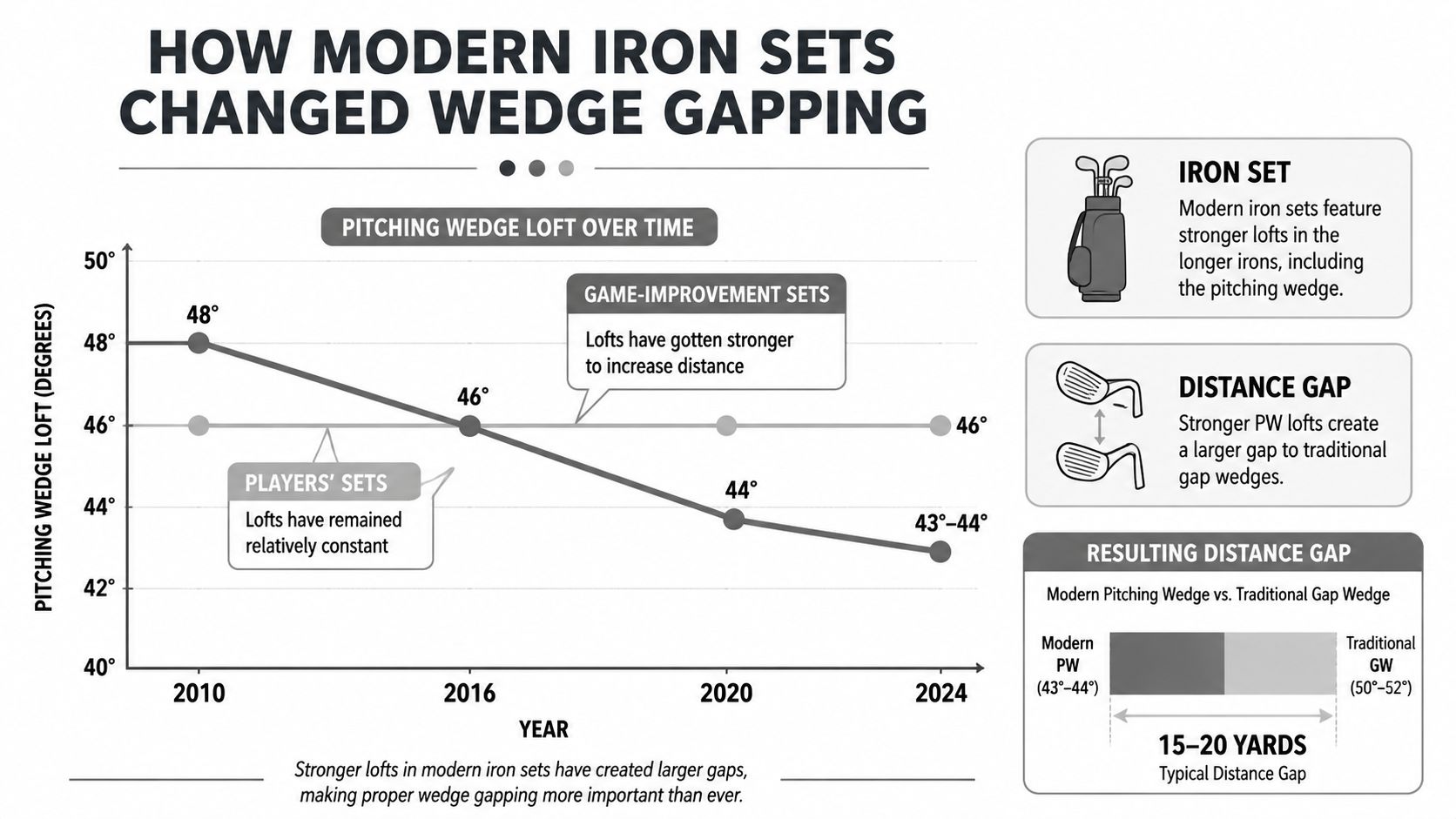
Modern iron sets can create a wedge problem before you buy a single specialty wedge. A pitching wedge that once sat near the upper end of the traditional range may now be much stronger, leaving more space between it and a conventional sand wedge. The Callaway wedge buying guide specifically notes that some modern pitching wedges can be as strong as 42 degrees, which may make an additional 46 to 48-degree wedge useful before the traditional gap-wedge position.
That changes how you should build the bottom of the bag. If your pitching wedge is 44 degrees and your next wedge is 56 degrees, the loft difference is 12 degrees. A golfer may still cover that space with partial shots, but those shots demand more precise tempo and contact than a stock swing. The issue isn't that partial shots are bad. The issue is having to hit them for every awkward distance.
Build from the pitching wedge downward
Start by finding the actual loft of your pitching wedge, then work down in sensible intervals. A 4 to 6-degree progression is a useful starting framework, but loft alone doesn't guarantee equal distance spacing. Shaft, speed, strike, delivery, and turf contact all affect carry.
The provided example illustrates the practical consequence. A 44-degree pitching wedge carrying 135 yards paired with a 52-degree gap wedge carrying 105 yards leaves a 30-yard distance hole. Those figures describe that example, not a universal expectation, but they show why labels and assumptions can mislead you.
A launch monitor session can expose the pattern. Hit stock shots with every wedge, record carry rather than one unusually long result, and look for overlap or empty spaces. Then compare those numbers with your guide to selecting the right golf club. You may discover that adding a lower-lofted specialty wedge makes more sense than jumping straight to a lob wedge.
The best setup gives you several comfortable stock swings. It doesn't force you to turn every approach into a creativity contest.
Understanding Bounce and Grind Options
Loft controls the launch window. Bounce and grind control the conversation between the sole and the ground. A wedge with the right loft can still feel awful if its sole fights the turf you play most often.
Bounce is the part of the sole that helps the club resist digging. Low bounce brings the leading edge closer to the ground and can suit firm conditions or a shallow delivery. High bounce gives the sole more ability to slide across soft turf and sand. Mid bounce sits between those extremes and often provides the most adaptable starting point.
| Bounce Level | Degrees | Best For | Turf Conditions | Swing Type |
|---|---|---|---|---|
| Low | 4°–6° | Tight lies, clean contact | Firm, dry ground | Shallow attack |
| Mid | 7°–9° | General versatility | Mixed conditions | Moderate delivery |
| High | 10°–14° | Bunkers, soft lies, digging prevention | Soft turf, lush grass, soft sand | Steeper attack |
The ranges above are fitting guidelines, not laws. A player can use low bounce successfully on soft ground with the right delivery, and a shallow player may prefer more bounce for bunker shots. Your strike pattern matters more than a number chosen in isolation.
Grind changes how the wedge opens
Grind describes how material is shaped or removed from the sole. Heel relief can make it easier to open the face without lifting the leading edge too far. Toe relief can support face manipulation and certain lies, while trailing-edge relief can help the club sit more cleanly when the shaft leans forward.
A steep swinger who plays lush Florida turf may appreciate a sole that resists digging. A shallow player on firm links-style ground may prefer a lower-bounce shape that keeps the leading edge close to the surface. Neither golfer should choose solely by copying a Tour player.
A wedge fitting should begin with your divot, your miss, and your home-course turf, not with the most impressive specification on the rack.
A modern players' wedge line illustrates the range of customization, offering 46 to 60 degrees of loft, 8 to 12 degrees of bounce, and three grind choices across 13 configurations in the TaylorMade MG3 database listing. That variety exists because the same loft can behave very differently when sole geometry changes.
Test wedges from real grass if possible. Mats hide digging, skidding, and poor sole interaction, while turf tells you whether the head enters and exits the ground in a way you can repeat.
Building the Right Wedge Setup for Your Game
A practical wedge setup begins with the bag already in your hands. Check the loft stamped on your pitching wedge, then record the carry of every wedge using the same controlled, stock motion. A personal best does not show the gap you can trust over a demanding shot. Repeatable carry does.
Start simple if you're learning
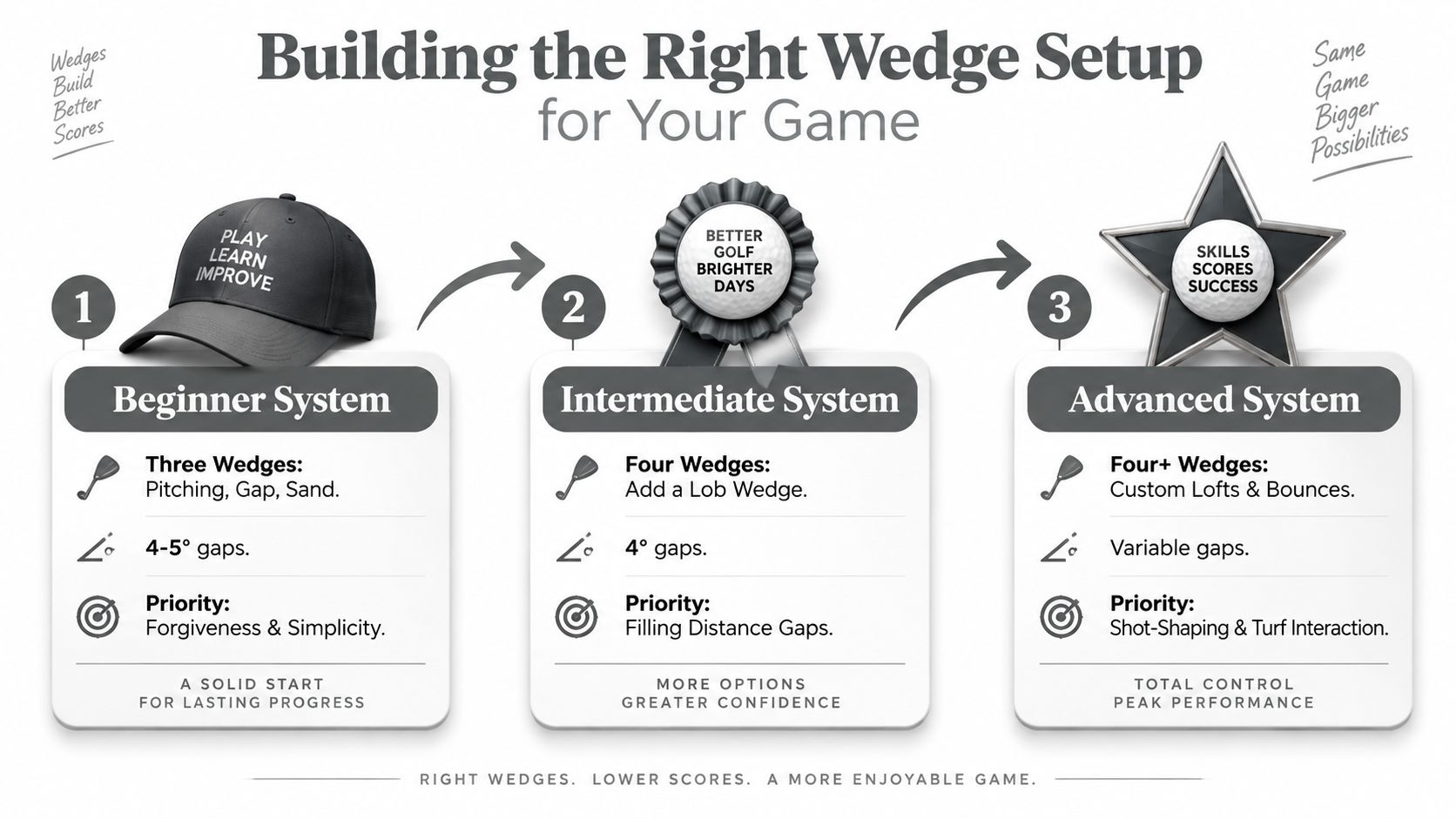
For a beginner, pitching, gap, and sand wedges often provide a sensible foundation. They cover the space between an iron-set pitching wedge and a bunker-focused club without creating too many short-game choices. Treat loft spacing as a starting map, then check whether the actual carries form useful intervals.
The sand wedge needs a sole that suits your regular turf and bunker conditions. A gap wedge should cover a distance that currently forces an awkward partial swing. If it does not solve a real distance problem, it may not deserve a place in the bag.
Intermediate golfers can add a lob wedge when they regularly face shots requiring more height or a shorter landing. Four wedges also mean another club to clean, practice, and select under pressure. A lob wedge used only for rare flop shots has not automatically improved the setup.
Advanced players can refine loft, bounce, and grind around their delivery and course conditions. The wedge selection guide from 2ndShotMVP offers a useful starting reference, while a fitter can observe contact from fairway, rough, and bunker lies.
Use a launch monitor to map carry distances, then test the soles from real turf. Mats can hide digging or skidding. Grass shows whether the club enters and exits the ground consistently. If practice produces elbow discomfort, review technique and equipment guidance, including this taping golfers elbow expert guide, before adding repetitions.
A simple fitting sequence keeps the decision clear:
- Map the bag: Record lofts and reliable stock carries.
- Find the holes: Mark distances that require uncomfortable partial swings.
- Choose loft first: Add coverage without duplicating another wedge.
- Match the sole: Fit bounce and grind to delivery and conditions.
- Practice the decisions: Rehearse stock, bunker, and greenside shots.
This video offers a practical way to consider club selection before a fitting session.
The goal is not the maximum number of wedges. It is enough coverage for meaningful distances, with enough practice to commit to each club.
Groove Rules and Spin Performance Explained
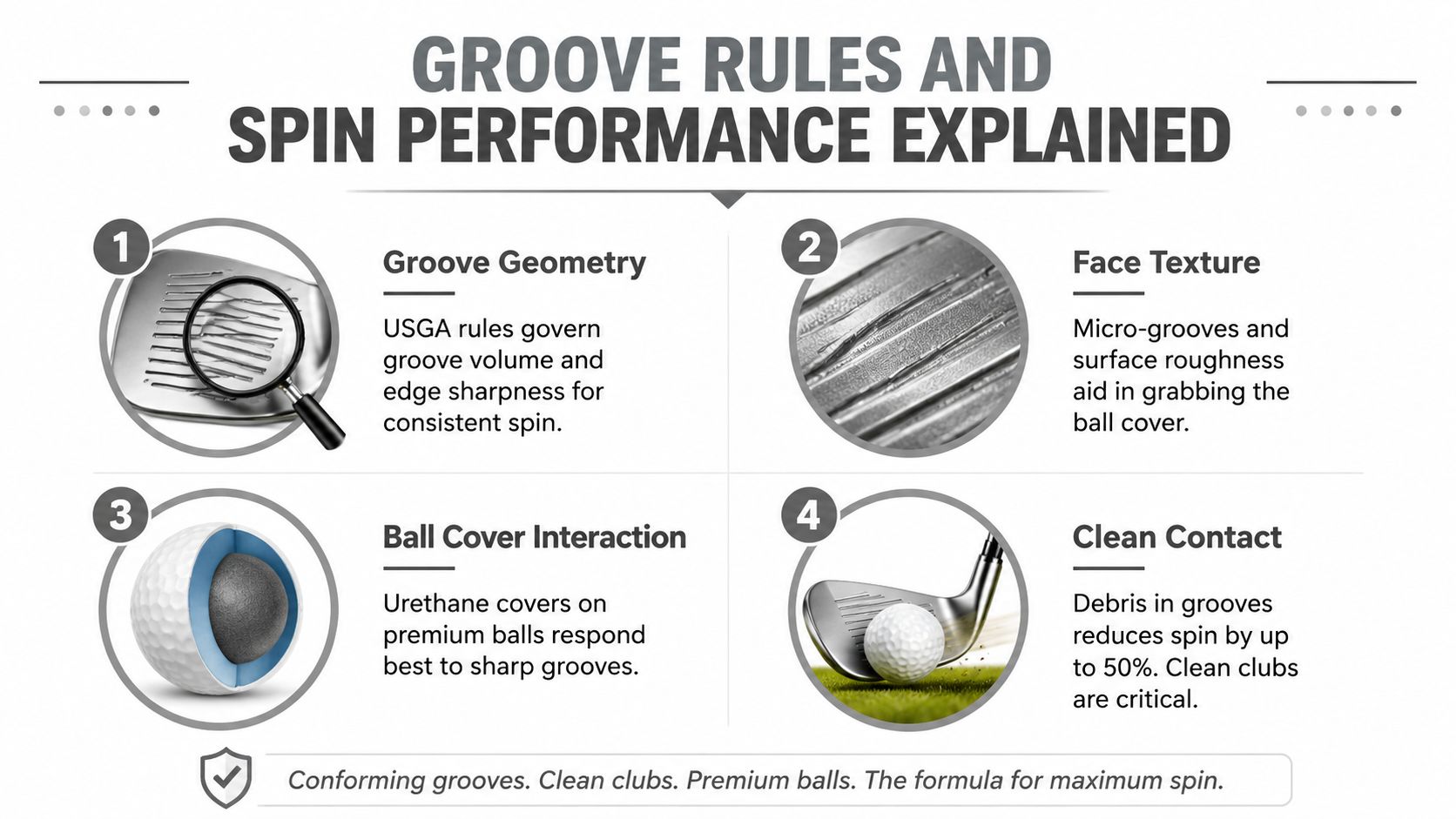
A wedge doesn't create spin through grooves alone. Spin depends on groove geometry, face texture, ball-cover interaction, and clean contact. The USGA and R&A limit groove dimensions for irons and wedges with lofts of 25 degrees or higher. The rules specify straight, parallel grooves with a symmetrical cross-section, a maximum width of 0.035 inches, a maximum depth of 0.020 inches, a maximum cross-sectional area of 0.0030 square inches per inch, and groove-edge radii between 0.010 and 0.020 inches, as detailed in the USGA groove rules guidance.
Those limits standardize how much moisture and grass a face can channel away. Manufacturers therefore use sole design, face texture, and loft to create different performance characteristics within the rules. A clean, sharp face can still lose effectiveness when grass, sand, or water sits between the ball and the grooves.
Maintenance affects real shots
Clean the face and grooves before each round and during practice, especially after bunker work. A groove brush or tee can remove packed debris, but avoid damaging the face with aggressive tools or careless scraping. Inspect the grooves under good light. If the edges look visibly rounded or the face has lost its texture, ask a qualified fitter or club technician whether replacement makes sense.
Wet rough is especially demanding because debris can reduce friction. From a clean fairway lie, strike quality often matters more than chasing a specialized face pattern. The ball, contact location, delivered loft, and friction all work together.
New wedge technology is moving toward tighter groove pitch spacing, progressive sole designs, and more grind choices for amateur swings, according to Golf Digest's wedge buying coverage. That direction reinforces a useful point: spin performance is becoming more fit-specific, not merely a race to make grooves more aggressive.
Choose a face you can keep clean, a sole you can deliver consistently, and a loft that gives you the flight you need. Those choices will matter more than a marketing phrase on the box.
Choosing Wedges That Match Your Confidence and Style
A technically suitable wedge still has to look inviting at address. If the head appears too small, too bulky, too shiny, or too different from the rest of your set, you may make a guarded swing before the club ever reaches the ball. Confidence changes commitment, and commitment affects contact.
Blade-style wedges appeal to golfers who like a compact profile and a clear view of the face. Cavity-backed designs can look more familiar to players whose iron sets use perimeter weighting and a larger silhouette. Neither shape automatically makes a golfer better. The right choice is the one that lets you aim, set the face, and swing without second-guessing the club.
Finish matters for the same reason. Satin, chrome, or darker finishes create different visual impressions in sunlight, and sound and feel can influence whether you trust a partial shot. Match the wedge profile to your irons when a smooth transition helps you, or choose a distinct scoring-club shape when that separation improves focus.
Avoid building around a professional's setup or the newest release. Check your loft gaps, common miss, course turf, bunker sand, and short-game comfort zone first. Then use this checklist:
- Verify lofts: Read the manufacturer specifications for every wedge.
- Test the sole: Hit from real turf and sand, not only a mat.
- Watch the miss: Too much digging and too many heavy shots may point toward more bounce or a wider sole.
- Clean the grooves: Remove grass and sand before every round.
- Simplify decisions: Carry clubs that give you distinct, trusted shots.
You can also choose golf lifestyle gear that keeps your equipment routine and on-course identity consistent. 2ndShotMVP offers golf hats, beanies, and lifestyle apparel for men and women, with designs intended for use on and off the course. Visit 2ndShotMVP after you map your wedge lofts, then head to the practice area with a setup that makes your next scoring shot easier to choose and easier to trust.

