

A gap wedge is typically 48° to 54°, with most modern sets centered at 50° to 52°, and it should sit 4° to 6° above your pitching wedge to fill the 90 to 110 yard gap. The right gap wedge degree isn't a universal number, though. It depends on the loft of your pitching wedge, the loft of your sand wedge, and how you use the club.
You've probably faced the classic version of this problem. Your approach shot leaves 95 yards to the flag, your pitching wedge flies too far when you catch it cleanly, and your sand wedge demands a full, forced swing. One ball finishes short, the next flies long, and suddenly a simple scoring opportunity feels like a coin toss.
The gap wedge exists to remove that awkward guess. Think of it as the missing rung in your wedge ladder, not merely another club to add because the label says “A-wedge.” Once you know your pitching wedge loft and build sensible spacing from there, choosing between 48°, 50°, and 52° becomes far easier.
That Awkward Distance Between Clubs and Why It Exists
Your playing partner asks, “What are you hitting?” You say, “A soft pitching wedge,” while secretly hoping the ball doesn't come up short. The shot needs more than a pitching wedge but less than a sand wedge, which is exactly where many golfers discover an uncomfortable hole in their set.
A gap wedge is generally defined by loft rather than one fixed specification. Independent golf references place it around 48° to 54°, with many modern guides focusing on 50° to 52°. The reason for that spread is simple. Pitching wedges have become stronger, so they now carry less loft and create more distance, leaving more room between them and traditional sand wedges. The history and loft definition of the gap wedge explains why the club became useful as iron-set specifications changed.

Why modern sets created the need
For many years, pitching wedges sat near 50°, while sand wedges were around 54° to 55°, leaving little separation. As pitching wedges moved toward 46°, some sets developed a separation of roughly 8°, which made a dedicated middle wedge practical.
That change explains why a 52° wedge can be perfect for one golfer and redundant for another. A player with a 48° pitching wedge may find a 52° club useful. A player with a 50° pitching wedge may discover that the same club produces almost the same flight and carry.
The label can confuse matters, too. Manufacturers may call the club an approach wedge, A-wedge, or utility wedge, but those names don't guarantee a particular loft. Read the number stamped on the sole or check the manufacturer's specifications.
Practical rule: Don't buy the name on the club. Buy the loft that restores the missing distance in your set.
By the end of your fitting process, the useful question won't be “What degree is a gap wedge?” It'll be “What loft creates a reliable step between my pitching wedge and sand wedge?”
What Gap Wedge Degree Really Means on the Course
Loft is the angle that helps the club launch the ball. More loft generally produces a higher flight and a shorter full-swing distance, while less loft creates a stronger, longer trajectory. A gap wedge sits between your pitching wedge and sand wedge, so its job is to create a controlled middle flight rather than win a contest for the highest launch.
Think of your wedges as a ladder. Your pitching wedge is the lower rung, your sand wedge is the higher rung, and the gap wedge fills the space between them. If two rungs sit too close together, they do the same job. If they're too far apart, you're left stretching for a shot that doesn't fit either club.
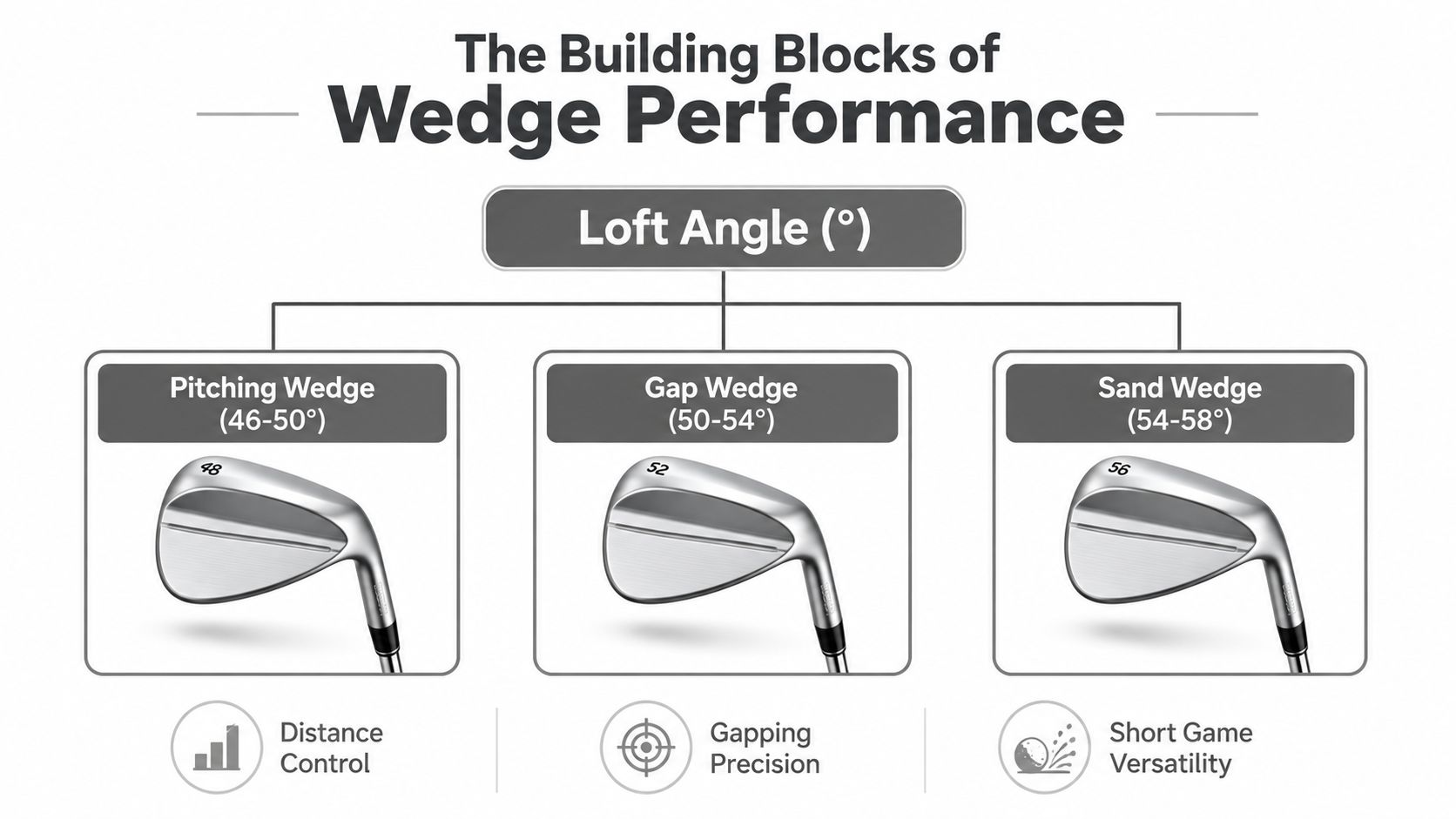
Read the set, not the label
A pitching wedge near 50° and a sand wedge near 54° to 55° leave limited room for a separate club. A pitching wedge around 46° creates more space, which is why a gap wedge around 50° or 52° can become valuable. The precise choice depends on the rest of the ladder and your actual carry distances.
A gap wedge also has a different on-course personality from a pitching wedge. It's often useful for full approaches, controlled three-quarter swings, low pitches, and shots where a sand wedge would launch too high. That versatility makes it more than a distance filler, but distance gapping should still be the starting point.
The same club can be called an approach wedge in one iron set and a gap wedge in another. The club's role is relative. Its degree tells you the loft, but the surrounding clubs tell you what the club does.
Loft is a relationship, not a job title.
A golfer carrying a 46° pitching wedge, a 50° gap wedge, and a 54° sand wedge has a different setup from someone carrying a 48° pitching wedge, a 52° gap wedge, and a 56° sand wedge. Both may use a gap wedge, but the number on the sole changes because the starting point changes.
A visual explanation can help you see how these clubs divide launch, carry, and stopping power.
Finding Your Perfect Loft Spacing and Distance Windows
A golfer with a 46° pitching wedge may need a 50° gap wedge. Someone with a 48° pitching wedge might find that same 52° club useful, while another player could create a duplicate distance. The better question is not “What degree should a gap wedge be?” Build a 4° to 6° loft ladder from your pitching wedge, then check whether each club produces its own carry window.
Start by measuring the actual loft stamped on your pitching wedge. The name of the iron set does not reveal that number, because modern designs vary. Check your sand wedge as well. Those two clubs mark the ends of the space you need to fill.
Three common starting points
A 48° gap wedge can suit a golfer whose pitching wedge is strong and whose next club must stay close. A 50° gap wedge often fits behind a pitching wedge around 44° to 46°. A 52° gap wedge may sit neatly behind a 46° or 48° pitching wedge when the remaining wedges follow the same pattern.
Loft provides a useful map, not a guaranteed distance. Strike quality, swing speed, shaft, and delivery also affect carry. Test around the 90 to 110 yard window, using both full and controlled swings, and record actual carry distances instead of choosing from a chart alone.
| Your Pitching Wedge | Ideal Gap Wedge | Next Wedges | Why It Works |
|---|---|---|---|
| 46° | 50° | 54° and 58° | Creates a consistent four-degree progression |
| 46° | 50° or 52° | 54° or 56°, then 58° or 60° | Lets you choose between tighter full-shot spacing and more greenside loft |
| 48° | 52° | 56° and 60° | Preserves a four-degree ladder through the set |
A 46° pitching wedge paired with 50°/54°/58° creates one clear four-degree ladder. A 48° pitching wedge paired with 52°/56°/60° creates another. These are starting frameworks, not rules. If your 52° wedge flies almost the same distance as your pitching wedge, it is taking up space without adding a useful shot. If a large yardage window sits between two clubs, adjust the ladder or test a different wedge.
Before buying, compare your full setup with a practical guide to the wedges you should have in your bag. Then test normal swings and partial swings on the course or launch monitor. Your carry chart should show separate windows, like evenly spaced rungs on a ladder, rather than two clubs reaching for the same rung.
Why Bounce and Grind Matter More Than One Extra Degree
A golfer can spend an afternoon debating 50° versus 52° and still choose the wrong wedge for the course. Loft affects distance, but the sole determines how the club arrives at the ball. Bounce helps the sole resist digging, while grind changes how that sole behaves when you open the face or contact different lies.
Even a 1° loft adjustment can alter bounce, and strengthening a wedge reduces bounce while weakening it adds bounce. Changes beyond about 2° can harm turf interaction, according to guidance on wedge loft, bounce, and turf performance.
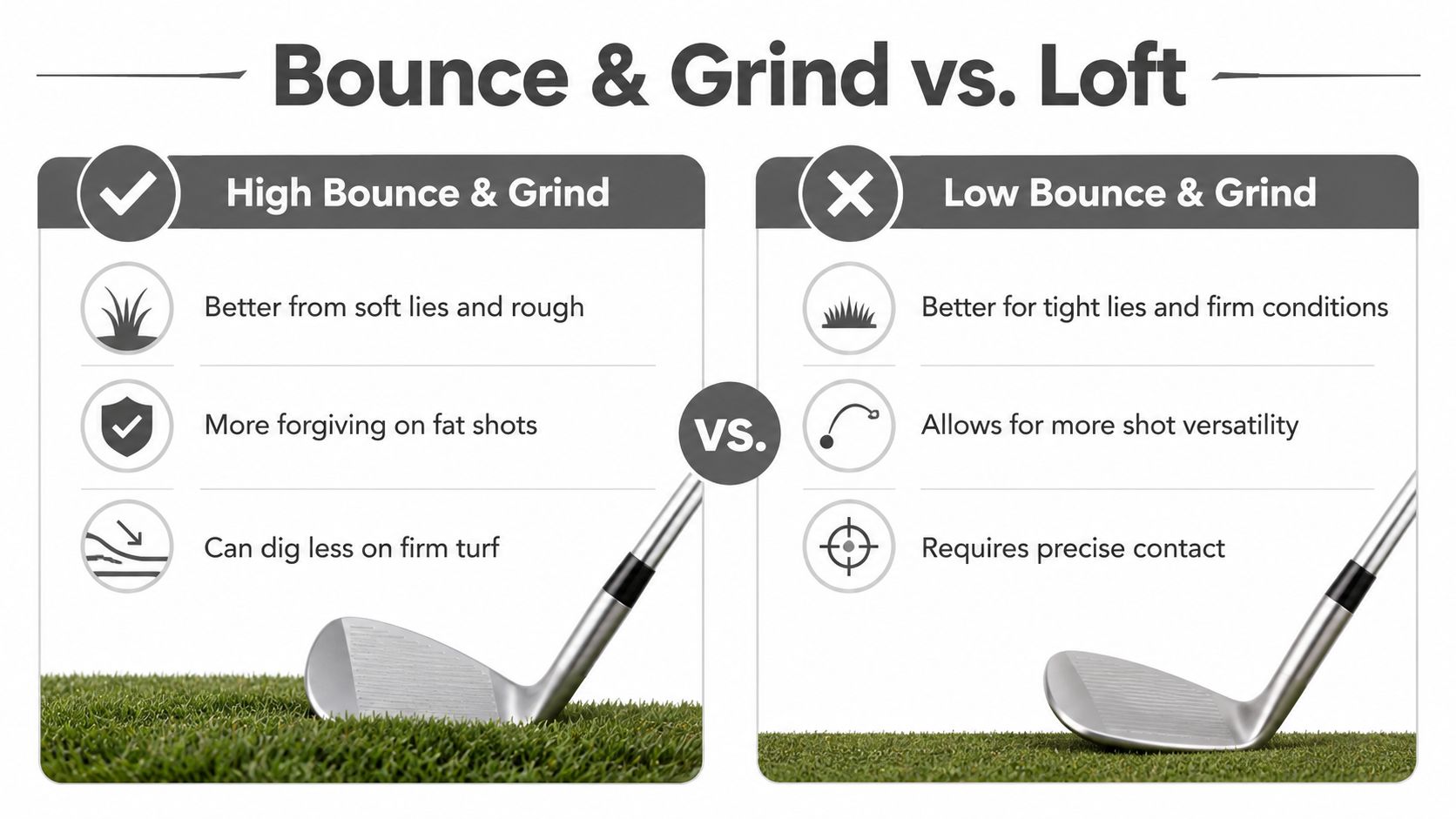
Let the turf tell you
Suppose you play on firm fairways and tend to sweep the ball. A lower-bounce sole may help the leading edge sit closer to the ground, especially when you play a square-faced pitch from a tight lie. On soft ground, or if you take deep divots, more bounce can help the club slide instead of burying itself.
The same distinction appears around the green. A fuller sole can provide stability on ordinary pitches, while a more versatile grind may make it easier to open the face for a higher, softer shot. You don't need the most exotic grind to play good golf, but you do need a sole that matches your contact pattern.
A 50° wedge with suitable bounce is usually more useful than a perfect loft number paired with a sole that fights your turf.
Don't bend a wedge several degrees to force a preferred yardage. The loft may move into place while the bounce moves out of place, leaving you with a club that looks correct on paper but produces inconsistent contact. If you're unsure how the sand wedge's sole influences your setup, compare its design with this guide to sand wedge angles.
Use your divot as evidence. A shallow brush, a deep trench, and a thin strike from tight turf each point toward different sole requirements. The right gap wedge degree starts the conversation, but bounce and grind often decide whether the conversation ends with solid shots.
How to Choose Your Gap Wedge for Your Game and Your Courses
Choosing a gap wedge becomes straightforward when you combine four questions: What is your pitching wedge loft? How far does it carry? How do you strike the turf? Which shots do you expect the club to play?
A mid-handicap golfer using a strong-lofted game-improvement set may need a 50° gap wedge to bridge the pitching wedge and sand wedge. Another golfer with a 48° pitching wedge may need 52°, not because 52° is more “standard,” but because it preserves the spacing of the set. This loft-based fitting explanation illustrates why the same 52° club can be useful in one bag and unnecessary in another.
Match the sole to your delivery
A steep swinger who takes heavy divots will usually benefit from more bounce because the sole can help the club move through the ground. A shallow sweeper on firm turf may prefer less bounce and a sole that sits neatly under the ball. Neither player should choose solely by handicap.
Course conditions matter just as much. Soft parkland turf, wet fairways, and fluffy rough reward a different sole behavior from firm links turf and tight summer lies. If your gap wedge will handle many partial shots, bunker-adjacent pitches, and open-face approaches, grind deserves the same attention as loft.
Decide what the club must do
Ask yourself which of these jobs matters most:
- Full-swing gapping: Choose the loft that creates a useful carry window between your pitching wedge and sand wedge.
- Partial-shot control: Favor a setup that gives you comfortable three-quarter and half-swing options.
- Greenside versatility: Consider bounce and grind that support both square-face pitches and open-face shots.
- Shaft continuity: A wedge shaft that feels drastically different from the rest of the set can change timing and contact, so test the club rather than selecting by label alone.
A launch monitor can show carry, launch, and dispersion, but grass testing matters too. Hit from a fairway lie, a tighter patch, and a softer section if possible. Observe whether the sole slides, digs, or bounces into the ball.
For broader club-selection principles, use this guide to selecting the right golf club. The best fitting result is not the most fashionable degree. It's the club you can trust when the flag sits just beyond comfortable pitching-wedge range.
Lock In Your Yardage Gaps and Play With Confidence
You stand over a shot that sits between a comfortable pitching-wedge swing and a three-quarter sand-wedge swing. The right gap wedge degree is the one that fills that space in your set, not a number chosen in isolation. A gap wedge often ranges from 48° to 54°, while modern sets commonly place it near 50° to 52°. The same 52° club can be perfect in one bag and redundant in another.
Start with your pitching-wedge loft. Build a ladder of roughly 4° to 6° between wedges, then check whether that spacing creates useful carry windows through your sand wedge. For example, a 46° pitching wedge may pair naturally with a 50° or 52° gap wedge, while a stronger or weaker pitching wedge may call for a different choice.
Use this checklist before buying:
- Check the loft: Confirm the specifications for your pitching wedge and sand wedge.
- Build the ladder: Set the gap wedge where it creates a distinct distance window.
- Measure carry: Test full, three-quarter, and half swings, recording carry rather than total distance.
- Inspect contact: From tight lies, note whether you sweep, dig, or catch the ball thin.
- Test bounce and grind: Try the club from the turf and rough you regularly play.
- Watch for duplication: If it produces the same shots as your pitching wedge, adjust the loft or setup.
- Keep the useful club: A wedge earns its place when it covers a distance and shot type you face.
The goal is a usable ladder, not a perfectly symmetrical set of numbers. Stand over a scoring shot and know which club gives you the flight, carry, and landing behavior you want.
Your wedge ladder should answer the shot before you swing.
Bring your current wedges to a fitter, test likely loft options, and record results from real turf instead of relying only on the sole stamp. For golf lifestyle gear, explore the hats, beanies, and apparel from 2ndShotMVP, then take your tested setup to the course.

