

A beginner's golf handicap is your official starting line in the game, and the highest it can be is 54.0. Don't think of it as a grade on a report card; it's more like a head start in a race. It’s the game’s brilliant equalizer, making sure a complete newbie can have a fair and ridiculously fun match against a seasoned veteran.
Your Starting Point in Golf: The Handicap System
Welcome to the most rewarding, maddening, and wonderful game you'll ever play. Before you can properly gripe about a cruel lip-out or a tree that jumped in front of your ball, you need to get familiar with golf’s secret weapon for fairness: the handicap. This whole system is designed to turn a match between Tiger Woods and, well, you, into a genuine competition.
Think about it like this: imagine you're challenged to a 100-meter dash against an Olympic sprinter. If you both start from the same line, the race is over before it begins. A golf handicap is your head start—a certain number of strokes you get to "take off" your final score—letting you and the sprinter (or scratch golfer, in this case) finish the race in a comparable time. It’s all about leveling the playing field.
The Universal Language of Golf
So, where does this magical number come from? Under the World Handicap System (WHS), which rolled out globally in 2020, every new golfer—man or woman—can start with a maximum handicap of 54.0. This unified system is fantastic because it lets total beginners get in on the action right away, often without even needing a fancy club membership. The cap at 54.0 ensures everyone has a fair shot from their very first round. You can get more great details on the WHS from National Club Golfer.
This system is your passport to the social and competitive soul of golf. It’s a language understood on courses from St Andrews to your local muni. Here's what you really need to know:
- Maximum Handicap: Your journey begins at 54.0. There's nowhere to go but down!
- Purpose: It's purely for fair play, not a judgment of your worth as a human being.
- Accessibility: You don’t need to be a pro to get a handicap and start having competitive fun.
To put it simply, here are the core concepts a new golfer needs to grasp.
Beginner Handicap Quick Reference
| Concept | What It Means For You |
|---|---|
| Maximum Handicap | You'll start at 54.0. This is your ceiling, and your goal is to lower it. |
| The Equalizer | It allows you to compete fairly against players much better than you. |
| Net Score | This is your real score. It's your gross score minus your handicap strokes. |
| World Handicap System (WHS) | The single, global system that calculates your handicap. |
Think of this table as your cheat sheet. These are the building blocks for understanding how you fit into the game's competitive structure.
A handicap isn’t a measure of how good you are; it's a measure of your potential on a good day. It's an invitation to compete, improve, and dive headfirst into the game's culture, no matter how many times you find the sand. Your handicap will become a badge of honor, especially as you watch it shrink over time.
The Two Numbers That Really Matter
Alright, let's get into the nitty-gritty. Every golfer with a handicap actually has two numbers to keep in mind. Don't worry, it's not complicated, but knowing the difference is key to playing a fair game anywhere, against anyone.
Think of it this way: your Handicap Index is like your car's base horsepower. It’s a fixed number that shows what your engine is capable of. Your Course Handicap, on the other hand, is how that horsepower performs on a specific road—is it a smooth, flat highway or a winding, uphill mountain pass?
Your Portable Skill Rating: The Handicap Index
Your Handicap Index is the main event. It's your official, take-it-anywhere skill rating. This is a single, precise number (like 54.0 or 28.5) that represents your potential on a course of average, everyday difficulty.
This is the number that travels with you, whether you're playing your home course or a bucket-list track on vacation. It’s calculated from the best of your recent scores, giving a true picture of what you're capable of. When a buddy asks, "What's your handicap?"—this is the number you'll proudly (or sheepishly) tell them.
But here’s the crucial part: it's not the exact number of strokes you get on a given day. For that, we need to look at the battlefield itself.
Your Handicap Index is the "who"—it's your official skill level. Your Course Handicap is the "where"—it's how that skill translates to the specific course you're about to tackle.
Your On-Course Strokes: The Course Handicap
Now we're talking. Your Course Handicap is the actual number of strokes you get to use for this specific round, on this specific course, from these specific tees. It's your Handicap Index adjusted for the real-world challenge you're facing.
Why the adjustment? Simple. No two golf courses are created equal. One might be a wide-open, friendly par-72, while the next is a monster with tight fairways and water everywhere. The handicap system smartly accounts for this using two key ratings you'll see on every scorecard:
- Course Rating: This number estimates what a "scratch golfer" (a player with a 0 handicap) would likely shoot on that course. If the rating is 73.1, it means the course plays a little tougher than its par of 72.
- Slope Rating: This measures how much more difficult the course is for a "bogey golfer" (someone who shoots around 90) compared to that scratch player. A low slope is easier, while a high slope (up to a max of 155) means us regular folks are in for a serious challenge.
Thankfully, you don't need a calculator or a math degree. Every course has conversion charts posted in the pro shop or on an app. You just find your Handicap Index on the chart, and it spits out your Course Handicap for the day. That’s the number you’ll actually use on your scorecard.
This visual nails the core idea: it’s all about creating a level playing field.
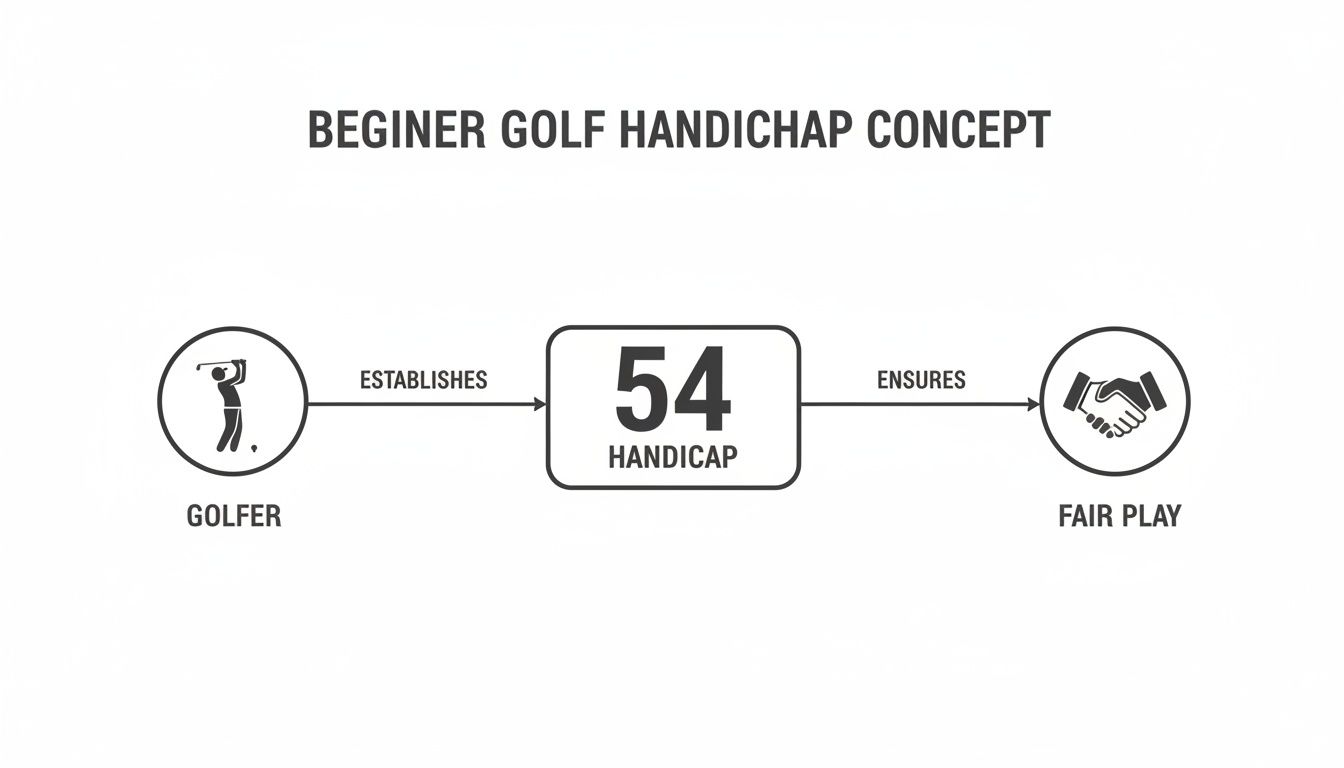
As you can see, the whole point is to connect a player's ability to the course they're playing for a fair and enjoyable game.
How to Get Your First Official Handicap
So, you're ready to make it official? Awesome. Getting your first handicap is way less intimidating than staring down a long par-3 over a lake, I promise. Let's walk through it.
First things first, you need to give the system some data to work with. To get your initial handicap, you need to play and record scores from a total of 54 holes.
Don't let that number scare you. You can break it up however you want. Play three 18-hole rounds, six 9-hole rounds, or any mix-and-match combo that gets you there. The system just needs a baseline to figure out what kind of golfer you are.
The golden rule? Just be honest. Seriously. Nobody cares if you shoot a 95 or a 135. Your handicap is a tool for fair competition and tracking progress, not a judgment on your talent.
Your Options for Posting Scores
Alright, you've played your rounds and have the scorecards to prove it. Now what? You need a place to officially post those scores. Gone are the days when you had to be a member of a stuffy country club to get a handicap. Today, it’s wide open for everyone.
Here are the most common ways to get in the game:
- Join a Local Golf Club: This can be your favorite daily-fee public course or a private one. They'll get you set up with an official handicap number, usually through the USGA's GHIN (Golf Handicap and Information Network) system.
- Use Your State or Regional Golf Association: This is my favorite tip for new golfers. Associations like the Southern California Golf Association or the Florida State Golf Association let you join online for a small yearly fee. It’s a super affordable way to get a legit GHIN number without being tied to a single club.
- Online Handicap Services: A bunch of apps and digital services are now authorized to issue official handicaps. They make it ridiculously easy to post scores right from your phone, sometimes even before you get back to the car.
The big idea here is that the system is built for you. Your job isn't to post good scores; it's to post honest scores. The handicap system does all the heavy lifting to figure out a number that truly reflects your game.
Once you pick your path and enter those first 54 holes, the magic happens. Your first official Handicap Index will be calculated. From then on, it’ll update automatically as you keep posting rounds.
And just like that, you're in. Welcome to the club
The Journey From 54 Downward
That initial 54.0 handicap isn't a life sentence; it’s just the starting line. Think of it as a launchpad, not a label. So, how do you get that number to start tumbling down? It all comes down to a clever system that's designed to celebrate your victories, not dwell on your disasters.

The World Handicap System (WHS) figures out your true potential by averaging the best 8 score differentials from your most recent 20 rounds. "Score differential" is just a fancy way of saying how well you really played on a given day, once the course's difficulty is factored in.
What this means for you is that the system is your biggest fan! It’s built to reward your good days and conveniently ignore the occasional shocker. One blow-up hole or a single round where nothing goes right won't torpedo your progress. Since only the top 40% of your scores count, that bad day will most likely get tossed out, giving you instant, encouraging feedback when you post a solid round.
Following Alex, Our New Golfer
Let's make this tangible. Meet Alex, a brand-new golfer who just got that shiny 54.0 handicap. Eager to see it drop, Alex hits the course and starts posting scores. The system is smart—it doesn't wait for all 20 rounds to get going; it starts crunching the numbers and adjusting as soon as it has data.
Here’s a peek into Alex's first few rounds:
- Round 1: Shoots a 125. With only one score, the system keeps the handicap high.
- Round 2: Catches fire and shoots a 115! This much better score immediately pulls the average down.
- Round 3: The golf gods are fickle. Alex struggles and posts a 128. But because the system favors the better round, this higher score doesn't hurt nearly as much.
This proves that, especially early on, one or two good rounds can have a massive impact. Every score you enter is another brushstroke that helps paint a more accurate picture of your game. Of course, a little practice helps, and these beginner golf drills are a fantastic way to build the consistency you need to shoot lower scores.
The handicap system is your personal progress tracker. It’s designed to reflect your demonstrated ability, which is why it focuses on your best performances. Think of it as a highlight reel of your potential, not a documentary of every single shot.
How Your Handicap Index Evolves
Let’s watch Alex’s journey unfold over the first five rounds. As more scores are logged, the calculation becomes more sophisticated and stable, giving a truer sense of ability.
Alex's First Five Rounds A Handicap Journey
This table shows how Alex's Handicap Index starts to take shape with each new score posted. Keep an eye on how the good rounds have a bigger impact than the bad ones.
| Round | Adjusted Gross Score | Course Rating/Slope | Score Differential | New Handicap Index (Approx.) |
|---|---|---|---|---|
| 1 | 125 | 71.5/125 | 55.1 | 54.0 (max) |
| 2 | 115 | 71.5/125 | 46.2 | 52.0 |
| 3 | 128 | 71.5/125 | 57.8 | 51.0 |
| 4 | 112 | 71.5/125 | 43.5 | 47.0 |
| 5 | 118 | 71.5/125 | 48.9 | 45.0 |
See that? A couple of strong rounds with differentials of 46.2 and 43.5 were all it took to knock Alex's index all the way down from the max of 54.0. This immediate feedback is one of the most motivating parts of the game—it’s proof that the hard work you’re putting in on the range is actually paying off on the course.
Setting Realistic Goals for Your First Year
Alright, so you’ve got your official starting Handicap Index: 54.0. Welcome to the club! Every single new golfer starts right there. But after you've spent a season chasing balls, celebrating that one perfect shot, and learning the hard way what a slice really looks like, what should you be aiming for?
Here's a little secret: forget about chasing some magic number. The real win is seeing tangible progress. Dropping from a 54 to a 35 isn't just a small step—it's a massive victory, and you should absolutely celebrate it. This whole journey is about finding your footing in the wild world of golf and setting a course that keeps you excited to play. Don't let those single-digit handicaps you see on TV get you down; those guys are practically a different species. The real game is played by millions of us, just trying to get a little bit better every time we tee it up.
Finding Your Place in the Golf World
It's so easy to think you're the only one out there struggling to break 100. Trust me, you're not. In fact, you're in very good company. The data from the USGA paints a clear picture: only a tiny 9.77% of golfers in the United States have a handicap index below 5.0. You can see for yourself how your handicap compares on Golf.com.
Your starting point of 54 puts you squarely in the majority of players who are still learning the ropes. The most common handicap range for men actually hovers between 13.0 and 13.9. For women, the biggest group is right around 27.0 to 27.9.
These numbers aren’t meant to put a ceiling on your potential; they’re meant to set you free! They show that getting to a mid-teens handicap (for men) or a high-20s handicap (for women) plants you firmly in the "average golfer" camp. That’s a fantastic—and totally achievable—long-term goal.
Your first year isn't about becoming a scratch golfer. It's about falling in love with the game, learning its quirks, and seeing yourself improve. Knocking 10, 15, or even 20 strokes off your handicap is a huge win.
Actionable Benchmarks for Your First Season
Instead of getting obsessed with a single-digit handicap that’s years away, let's break it down into smaller, more satisfying wins. This keeps the game fun and the frustration low. Our guide on the best golf tips for beginners is a great place to start building the skills you need to hit these milestones.
Here are a few realistic targets to shoot for:
- First Big Win: Break 40. The moment your handicap index dips below 40.0, you've hit a major milestone. It proves you're building consistency and starting to think your way around the course.
- Mid-Season Target: Get into the 30s. A handicap in the 30s means you're regularly shooting around 110-115. This is the sign of real, steady improvement. You're officially a golfer.
- The Stretch Goal: Break 30. If you can get your handicap into the 20s by the end of your first full season, that's an incredible achievement. You’re way ahead of the curve.
Remember, consistent play is about more than just your swing. You need to be comfortable and have the stamina to walk 18 holes. Looking into things like choosing insoles for golf can make a surprising difference in your endurance and overall enjoyment. This is a marathon, not a sprint, and every little improvement adds up to big results on your scorecard.
Using Your Handicap to Have More Fun
So, you've got this number. A handicap. What now? Well, my friend, that number is your golden ticket to unlocking the real fun in golf. Think of it less as a label and more as a superpower that levels the playing field, turning what could be a lopsided match into a nail-biting showdown.

This is the secret sauce that lets a weekend warrior with a 25 handicap go head-to-head with their buddy who plays off a 10—and actually have a shot at winning. Without the handicap system, the better golfer would clean up every single time. Boring! With it? Game on.
It’s about shifting your focus. Instead of obsessing over the raw score, you're now competing against your own potential. That’s where the magic happens.
Playing Different Golf Games
Your handicap isn't just for bragging rights; it's what makes all the classic golf games work for everyone, regardless of skill. It breathes life into formats that would otherwise be out of reach for newcomers.
Here are a couple of the most popular games where your handicap does the heavy lifting:
- Stroke Play (Net Score): This is the one you see on TV, but with a twist. You play 18 holes and add up every single shot—that's your gross score. Then, you subtract your Course Handicap. What's left is your net score, and that's the number that matters. So if you shoot a 105 with a 30 handicap, your net score is a fantastic 75!
- Stableford: This format is a beginner's best friend. Why? Because one blow-up hole won't torpedo your entire round. Instead of counting strokes, you earn points based on your net score on each hole. Maybe a net bogey gets you one point, a net par two points, and a net birdie three. It completely changes your mindset and encourages you to go for it.
Your handicap isn't a static number. It’s a dynamic tool that turns a round of golf into a strategic puzzle. The real goal is to beat your own average performance, which makes every shot feel a whole lot more meaningful.
With golf experiencing a massive 16.5% growth spurt in the U.S., tons of new players are hitting the links. The handicap system is what keeps the game from feeling intimidating, making sure everyone can find their competitive footing.
At the end of the day, understanding and using your handicap is just as crucial as grooving your swing. It’s what opens the door to friendly wagers, club tournaments, and the simple satisfaction of knowing you played better than your average—no matter what the final number says. If you're looking to lower that number, start on the greens with these golf putting practice drills and watch the strokes fall off your score.
Answering Your Burning Handicap Questions
Alright, let's tackle some of the biggest head-scratchers that new golfers have about the handicap system. Getting these sorted out will make the whole thing feel a lot less like a math test and a lot more like, you know, fun.
"Do I Really Have to Join a Fancy Private Club?"
Nope! Absolutely not. This is probably the most common myth out there, and it keeps way too many people from getting an official handicap. While joining a club is one way to do it, the whole point of the World Handicap System (WHS) is to make the game more accessible for everyone.
You can easily get an official handicap number online through authorized golf associations. Here in the U.S., you can get a GHIN number—the official handicap ID—straight from your state or regional golf association's website. No stuffy clubhouse membership required.
"What’s a Realistic Handicap Goal for My First Year?"
This is a great question. A fantastic and totally achievable goal for your first year is to get your handicap index to drop below 30.
You'll start at the maximum of 54.0, so even breaking 40 is a huge milestone worth celebrating. Getting into the 20s? That means you’re making some serious progress and starting to figure this game out.
Quick reality check: The average handicap for a male golfer is around 14, and for a female golfer, it's about 28. Don't get caught up comparing your day one to someone else's chapter ten. Focus on your own improvement—that’s the real win.
"Help! Will One Horrible Round Completely Wreck My Handicap?"
Take a deep breath. No, it won't. This is one of the best things about the modern handicap system. Your Handicap Index is calculated using the average of your best 8 scores from your last 20 rounds.
Think about that for a second. That one round where you couldn't hit the broad side of a barn? It's almost certainly not going to be one of your top 8 performances, so it probably won't even factor into the calculation. The system is designed to reflect your potential ability, not to punish you for an off day. It’s your personal highlight reel, not the blooper reel.
Ready to look the part while you lower that handicap? 2ndShotMVP offers premium, stylish golf hats and apparel that bring confidence to your game, whether you're a 54 or a 4. Check out our latest designs.

