

Alright, let's get that scorecard sorted. It might look like a cryptic spreadsheet at first glance, but it's really your best friend on the course. Once you know what you're looking at, it's a simple map that tells the story of your round.
The whole game boils down to matching the hole number you're on with your score, then doing a bit of simple addition for the front nine, the back nine, and the grand total. You're mainly keeping an eye on the hole number, its par, the yardage, and, of course, your strokes. These are the building blocks of your game right there in black and white.
Your Guide To The Scorecard Grid
That little grid of boxes can feel more intimidating than a water carry over 200 yards, but it’s actually your roadmap for the round. Let's break down the essentials you'll find on every scorecard, turning that confusion into confidence. Think of this as your playbook—not just for tracking shots, but for planning your attack on each hole before you even pull a club.
At its heart, the scorecard is just a hole-by-hole breakdown. You’ll see columns for the hole number (from 1 to 18), the yardage from different colored tees, and the 'Par' for each hole. And hey, having all your gear in order, especially a trusty pencil, is half the battle. If you're double-checking your setup, our guide on golf bag essentials can be a real lifesaver.
The Core Components
On every single hole, three key pieces of information guide your play: the hole number, the yardage, and the par. These tell you where you are, how far you have to go, and what score the golf gods consider "good."
-
Hole Number: This one's easy. It tells you which hole you're on, usually running from 1 to 9 for the "Front 9" and 10 to 18 for the "Back 9."
-
Yardage: This shows how long the hole is from different tee boxes, which are almost always color-coded (think blue, white, red, gold). Just find the color you're playing from to help with club selection.
-
Par: This is the target score an expert golfer is expected to make. It’s the benchmark you'll measure your own performance against for the day.
This diagram really simplifies how you should be looking at the card on each tee box.
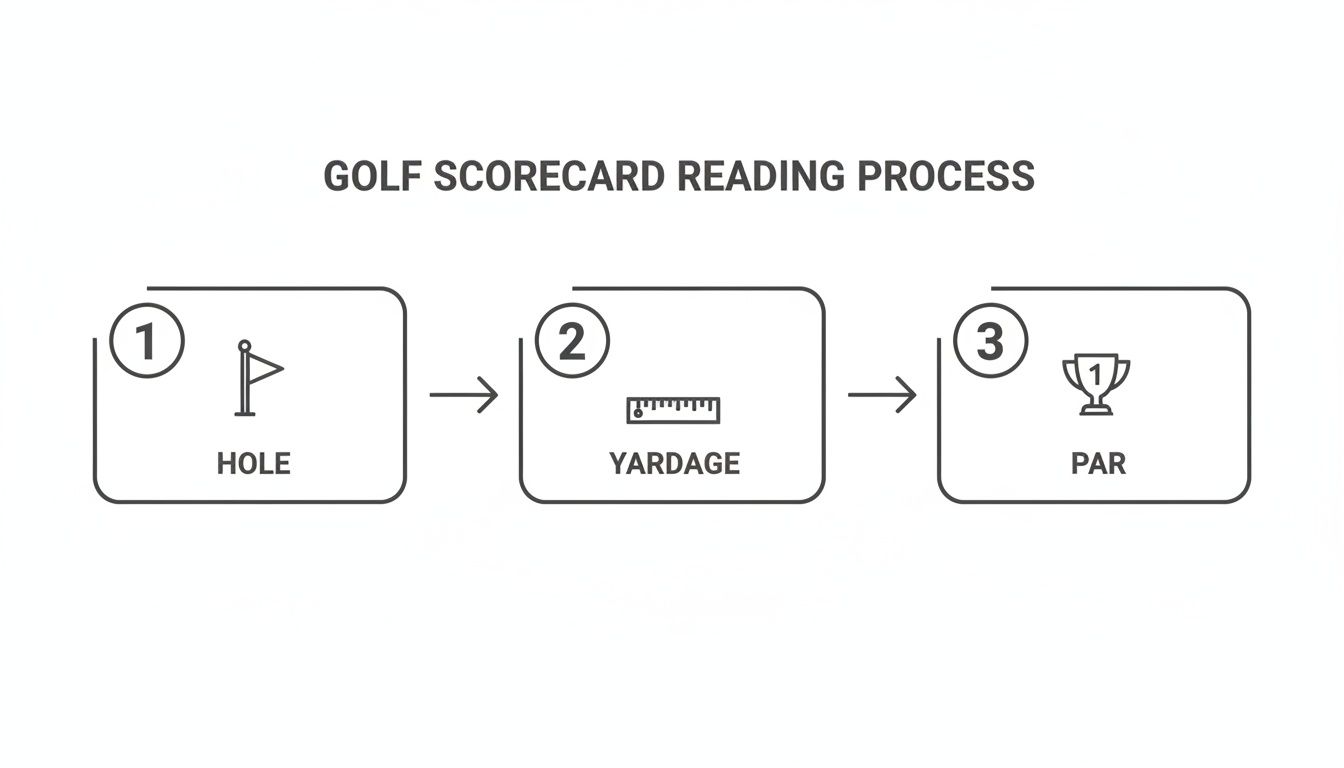
This little routine—find the hole, check the distance, note the par—becomes second nature after just a few holes. You'll be doing it without even thinking.
Before we go deeper, here’s a quick-reference table to demystify the main parts of the card.
At-a-Glance Scorecard Anatomy
| Scorecard Element | What It Means | Why It's Important |
|---|---|---|
| Hole Number | The sequential number of the hole you're playing (1-18). | Keeps your scoring organized and in the right order. |
| Tee Box Yardage | The distance of the hole from different starting points (e.g., Blue, White, Red). | Crucial for choosing the right club and planning your shots. |
| Par | The expected number of strokes for a scratch golfer on that hole. | It’s the standard you measure your performance against (birdie, bogey, etc.). |
| Stroke Index/Handicap | Ranks the holes from 1 (hardest) to 18 (easiest). | Determines where players with handicaps get their extra strokes. |
| Player's Score | The box where you write down the number of strokes you took. | This is the most fundamental part—it’s your actual score! |
| Totals (Out/In/Total) | Sums of your scores for the Front 9, Back 9, and the full 18 holes. | Gives you a final tally and shows how you performed on each side. |
Think of this table as your pocket caddie—a simple guide to what matters most on that piece of paper.
Understanding Par And Totals
Par is typically set at 3, 4, or 5 strokes, mostly depending on the hole's length. Shorter holes are par-3s, medium ones are par-4s, and the long bombers are par-5s.
After you finish the first nine holes, you’ll see a box to add it all up. The "Out" total is for the front nine (holes 1-9), and the "In" total is for the back nine (holes 10-18). Don't ask me why it's "Out" and "In"—it's just one of those classic golf traditions from the old Scottish courses that went out away from the clubhouse and then came back in.
Key Takeaway: The grand total at the end is your Gross Score—the actual, unfiltered number of strokes you took for the entire round. It’s the purest measure of your game before any handicap voodoo comes into play.
Making That Handicap Work for You
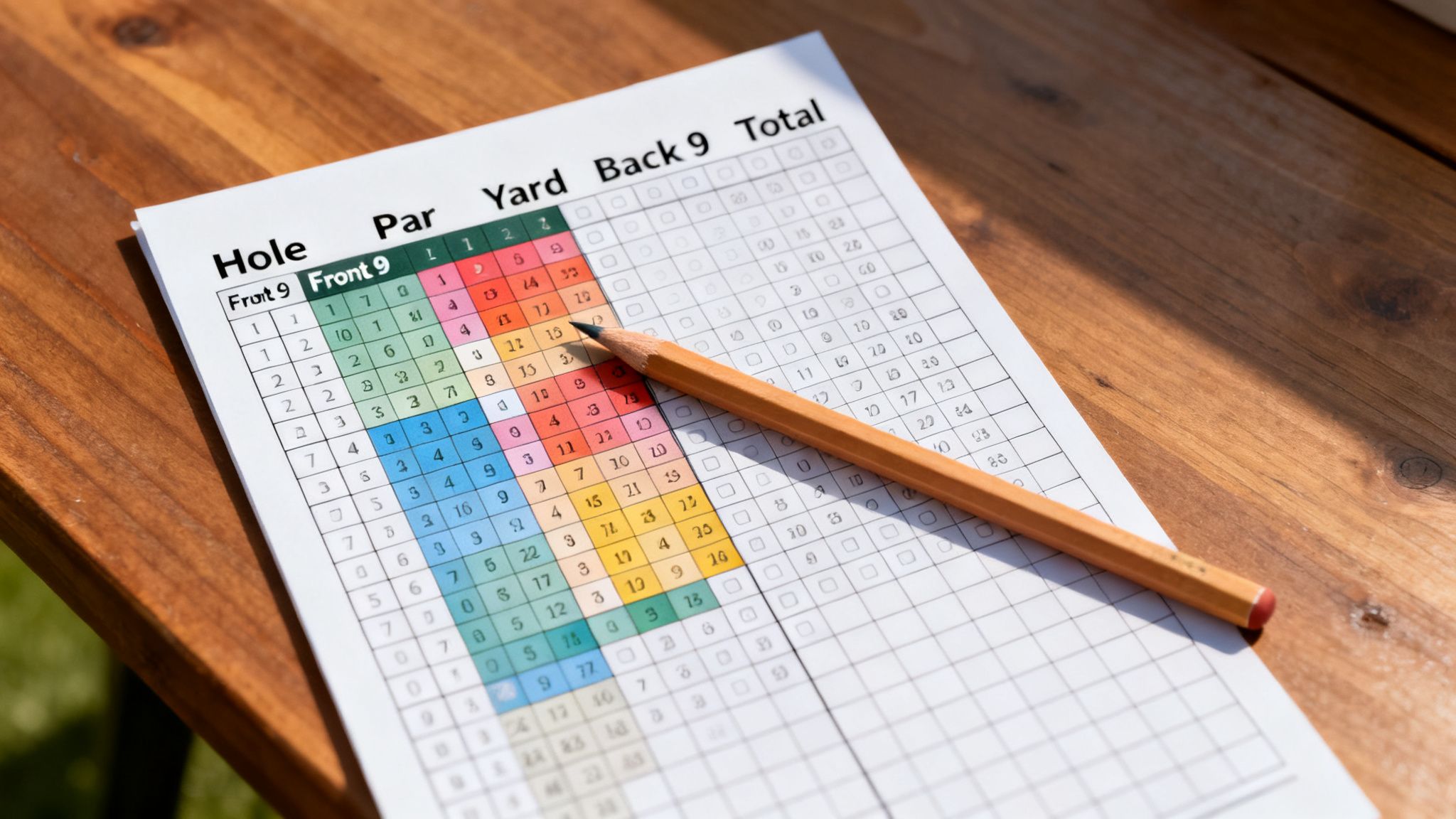
Ever glanced at that ‘HCP’ or ‘SI’ column on the scorecard and just shrugged? Don’t! That little number is your secret weapon, and it’s time you learned how to use it. Known as the Stroke Index (SI), it ranks every hole from 1 (the beast) to 18 (the breather) based on pure difficulty.
Think of it as the course’s own cheat sheet. Before you even stick a tee in the ground, a quick look at the Stroke Index tells you which holes demand respect and which ones might offer up a birdie. It’s your game plan, right there in black and white.
Truly understanding a scorecard is about more than just adding up numbers. It’s about squeezing every last drop of intel from it, and the Stroke Index is where the real fun begins.
How to Dish Out (or Receive) Handicap Strokes
This is where things get personal, especially when a friendly wager is on the line. Your handicap isn't just a number to flash in the clubhouse; it gives you extra shots—or "pops," as you’ll hear them called—to even things out.
The Stroke Index tells you exactly where you get those pops. If you have a course handicap of 10, you get one extra stroke on the 10 toughest holes (those with an SI of 1 through 10). Simple as that.
Let’s put this into a real-world match play showdown.
- You’re a 15-handicap.
- Your buddy is a 10-handicap.
The math is easy: you’re getting five strokes (15 - 10 = 5). Your friend has to give you one shot on each of the five hardest-rated holes—the ones marked SI 1, 2, 3, 4, and 5.
So, when you get to the 3rd-handicap hole, you can make a 5 while your buddy makes a 4, and you still tie, or "halve," the hole. It's a game-changer.
Pro Tip: When you get a stroke on a hole, your entire mindset should shift. On a par 4 where you get a pop, your personal "par" is now 5. This takes the pressure off. Suddenly, you don't need to force a hero shot over that water hazard; you can play it safe and still win the hole.
Using the Stroke Index for Smarter Golf
Beyond settling bets, the Stroke Index is your roadmap for smart course management. The hole with the #1 index isn’t just statistically difficult; it’s the one most likely to blow up your entire round.
When you step onto the tee of that hole, your brain should scream, "Play for bogey!" Aim for the fat part of the fairway, avoid the trouble, and walk away with a 5 on a par 4 feeling like you just made a birdie.
On the flip side, when you see the #18 handicap hole coming up, it’s a green light. That’s your chance to be a bit more aggressive, fire at the pin, and go hunting for that elusive birdie.
Learning to read these little clues turns a simple scorecard into a tactical map. It’s how you start playing smarter, not just harder, and watch your scores begin to drop.
Gross Score vs. Net Score: The Great Equalizer

Alright, this is where the real fun begins. Everything we've tallied up so far—every swing, duff, and miraculous putt—adds up to your Gross Score. It's the raw, unfiltered truth of your round. The pure number of strokes you took from the first tee to the final pin.
But then comes golf's brilliant invention: the handicap. This system introduces a second, often much friendlier number: your Net Score. Think of it as the great equalizer. It’s what lets a weekend warrior who shoots in the 90s go head-to-head with a scratch player and have a genuinely competitive match.
Your gross score is what you actually shot. Your net score is how you played against your potential. This is the magic that makes the game fair and fun for everyone.
The Simple Math Behind Your Net Score
Figuring out your net score is beautifully simple. There's no fancy algorithm, just a single bit of subtraction you'll do after you've tallied up your final score. You only need two things: your gross score and your course handicap.
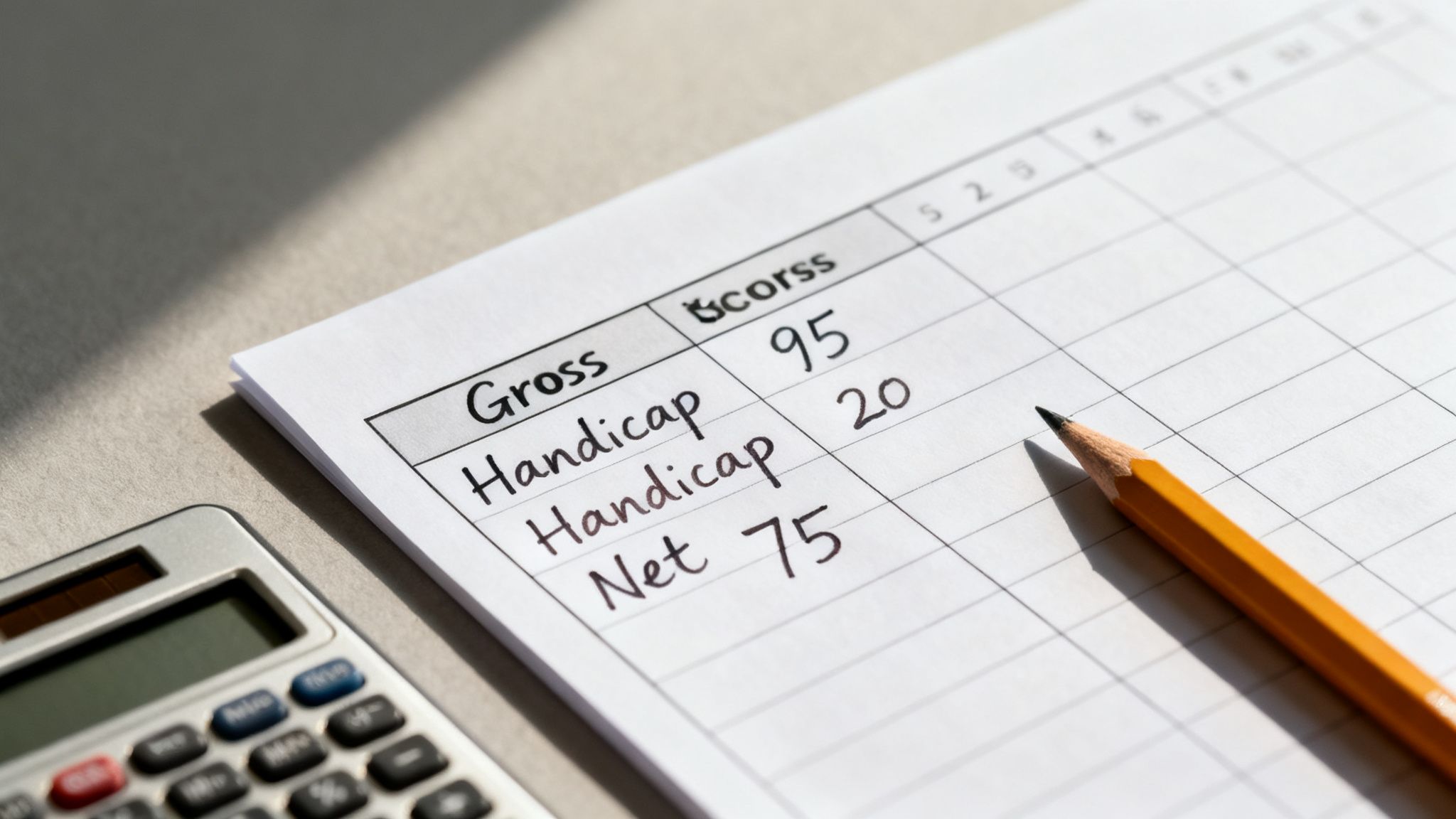
The formula couldn't be easier: Gross Score - Course Handicap = Net Score
Let's put it into practice. Say you've battled through 18 holes and ended up with a 95 scrawled in the "Total" box. Before you teed off, you found out your course handicap for the day was 20.
Time for some quick math: 95 (Your Gross Score) - 20 (Your Course Handicap) = 75 (Your Net Score)
And just like that, your hard-fought 95 turns into a shiny net 75! This is the number that really matters when you're comparing scores with your buddies. It’s what fuels the trash talk and determines who's buying the first round at the 19th hole.
The Golfer's Takeaway: Your net score is the ultimate "How'd I really play today?" number. If the course par is 72 and you shot a net 75, you can honestly say you played to a 3-over-par level for your handicap. It adds crucial context to your performance.
Why Every Golfer Needs to Know This
Getting the hang of gross vs. net is essential for enjoying the competitive and social fabric of golf. It’s the very system that prevents a blowout every time a 25-handicapper plays against a 5-handicapper.
When you're learning how to read a golf scorecard, this final calculation is the big payoff. It transforms a simple list of numbers into a meaningful story about your game, giving you a real yardstick to measure your improvement over time.
Scoring for Different Golf Games and Formats
Alright, let's get into the fun stuff. A golf scorecard is much more than a ledger for counting every single stroke. It’s your battlefield map for all sorts of games that make a weekend round truly memorable. Your foursome probably isn't just about grinding out the lowest total; it's about the banter, the side bets, and the thrill of different formats.
Getting comfortable with how to mark your card for these games is what separates the rookies from the vets. It's your ticket to jumping into any club event or friendly wager with total confidence, ready for anything.
Marking Your Card for Match Play
Forget your total score. Seriously, it doesn't matter here. Match play is golf’s version of a head-to-head duel, where you're playing against one opponent, not the entire course. The only thing that counts is winning more individual holes than the other guy.
The scoring is beautifully simple, tracked with pluses (+), minuses (-), and zeros (0).
- If you win a hole, you get a
+. - If you lose a hole, you get a
-. - If you tie (or "halve") a hole, it’s a push—mark it with a
0orASfor All Square.
After each hole, you tally the running score. If you're "2 up," you've won two more holes than your opponent. The match is over when one player is ahead by more holes than there are left to play. A "3 and 2" victory means you were three holes ahead with only two remaining. That's a walk-off win!
The Point System of Stableford
Ever had one blow-up hole completely derail your round? We all have. That’s where Stableford comes in—it’s a fantastic format that rewards you for going for it and doesn't punish you too harshly when you fail. Instead of counting strokes, you're chasing points.
A common point system looks something like this:
- Double Bogey or worse: 0 points
- Bogey: 1 point
- Par: 2 points
- Birdie: 3 points
- Eagle: 4 points
This system encourages you to be aggressive. If you go for a tough pin and end up with a triple bogey, who cares? You just write down a 0, pick up your ball, and head to the next tee with a fresh start. It keeps the game moving and the mood light.
Why It Works: Stableford is a fan favorite because it puts a cap on the damage. A dreaded 10 on a par-4 is an absolute round-killer in stroke play. In Stableford, it’s just zero points—the exact same score as a double bogey.
Scoring Team Games Like Scrambles
Scrambles are all about teamwork, and the scoring is as relaxed as the format itself. In a typical four-person scramble, everyone tees off, the team picks the best drive, and all four players hit their next shot from that spot. You repeat this process until someone sinks the putt.
Because you’re playing as a single unit, you only need to record one score per hole. Just pick one person in the group to be the scorekeeper. They’ll jot down the team's score—say, a birdie 4 on a par-5—in one of the player columns on the card and leave the rest blank. It’s the ultimate "we're in this together" game, perfect for charity tournaments and laid-back corporate outings.
For a deeper look into the wild world of tournament play, you can check out this complete guide to golf tournament scoring.
Every golf game tells a different story on the scorecard. Understanding these popular formats helps you track the narrative, whether it's a tight match, a high-scoring points race, or a collaborative team effort.
Common Golf Scoring Formats
| Format | How to Mark the Scorecard | Winning Objective |
|---|---|---|
| Stroke Play | Record the total number of strokes for each hole (e.g., 4, 5, 3). | Lowest total score for the entire round (18 holes). |
| Match Play | Use + for a hole won, - for a hole lost, and 0 for a tied hole. |
Win more individual holes than your opponent. |
| Stableford | Award points based on the score relative to par (e.g., 2 for par, 3 for birdie). | Accumulate the highest total number of points. |
| Scramble | Record only one team score for each hole. | Achieve the lowest team score for the round. |
While these are the most common, there are countless variations out there. The key is to always clarify the rules and scoring method on the first tee before you start
The Unwritten Rules of Scorecard Etiquette
Knowing how to jot down numbers on a scorecard is easy. But understanding the rituals that make those numbers official? That's what separates the weekend hacker from a true golfer. These aren't just suggestions; they're the bedrock of the game's integrity, ensuring every round is fair and every score is respected.
In any official round, you'll hear two key terms: the player and the marker. You're the player, and the marker is someone in your group tasked with keeping your score. It’s a simple system of checks and balances that’s been part of golf for over a century. You keep their score, they keep yours.
Player and Marker Responsibilities
It’s a straightforward partnership, but a little communication on the course goes a long, long way. The whole point is to avoid that awkward clubhouse confrontation over a forgotten stroke.
The best habit you can possibly develop is to verbally confirm scores with your marker right after you putt out. As you walk to the next tee, a quick, "I got a 5 on that one, you too?" is all it takes. This simple exchange prevents memory lapses and kills any potential for a debate on the 18th green about what you really made back on hole 4.
The Golfer's Code: Your marker is responsible for recording your score, but you are ultimately responsible for its accuracy. Never, ever just hand in your card without checking their math.
This leads us to the final, most crucial ritual of the entire round.
The Sacred Act of Signing the Card
Before you even think about turning that card in, you have to "attest" it. This is the formal sign-off, the handshake that makes your score legit. Mess this up, and you’re looking at a swift disqualification in any real competition—from the club championship to the PGA Tour.
Here’s exactly how to finish the round right:
- Review Your Score: Go through your card hole by hole. Check what your marker wrote down against what you remember. Double-check the math for the front nine, back nine, and the total gross score.
- Sign as the Player: Once you’re 100% certain every number is correct, sign your name in the "Player" or "Contestant" signature box. Your signature is your bond—you're certifying that you agree with every score listed.
- Get the Marker’s Signature: Finally, hand the card over to your marker. They will sign it in the "Marker" signature box, confirming they witnessed and recorded your round.
A card is only official once both signatures are on it. This is your final stamp of approval on the day's work.
And while you're focused on the rules of scorekeeping, don't forget the other parts of on-course etiquette. If you want to make sure you're fitting in, check out our guide on how to dress for golf. Treating the scorecard—and the game—with this level of respect shows you truly get it.
Your Scorecard Questions, Answered
Alright, so you’ve got the basics down, but let's be honest—a few head-scratchers always pop up when you're staring at a scorecard for the first time. It happens to everyone. Let's knock out some of the most common points of confusion so you can get back to focusing on your swing, not your paperwork.
Think of this as your quick-and-dirty FAQ for everything that might make you go "huh?" on the first tee.
What Do All These Tee Colors Mean?
Those little colored boxes on the scorecard—gold, blue, white, red—aren't just there to make it look pretty. They correspond to the different tee boxes on each hole, and each one offers a totally different challenge by changing the hole's length. The goal is simple: pick the tees that match your game to have the most fun.
While every course is a bit different, here's a general rule of thumb:
- Gold/Black/The Tips: You'll find these at the very back. They're built for pros and serious low-handicap players. It's a long walk from here.
- Blue: A solid choice for skilled amateur golfers who can hit the ball a good distance.
- White: Often called the "member's" or "men's" tees. This is the sweet spot for the average male golfer.
- Red/Forward: The shortest set of tees, perfect for ladies, seniors, and anyone just starting out.
Your scorecard will have a dedicated row of yardages for each color. Just find the line that matches the color of the tee markers you’re playing from and follow it across. Trust me, choosing the right set of tees is one of the easiest ways to enjoy your round more. For more tips on getting started on the right foot, check out our guide with the best golf tips for beginners.
How Do I Mark Penalty Strokes?
This one's simpler than you think. There's no secret symbol or weird notation for penalty strokes. You just add them to your score for that hole. A penalty stroke is just another stroke.
Let's walk through it. Say you're on a par-4. Your tee shot makes a splash in the lake. That's one shot you hit, plus a one-stroke penalty. You take your drop, hit your third shot onto the green, and then two-putt. Here's the math: 1 (tee shot) + 1 (penalty) + 1 (approach) + 2 (putts) = 5. You just write a plain old 5 on the card. Easy as that.
What in the World Is an Adjusted Gross Score?
Okay, now for some handicap lingo. An Adjusted Gross Score (AGS) is your best friend when it comes to keeping your handicap fair. It stops one catastrophic, "I-want-to-throw-my-clubs-in-the-woods" hole from wrecking your handicap index.
The World Handicap System has a cap on the maximum score you can post on any single hole: Net Double Bogey.
Here's the formula: Par of the hole + 2 + any handicap strokes you get on that hole.
Let's say you get one handicap stroke on a Par 4. Your max score for that hole is a 7 (which is 4 + 2 + 1). So even if you ping-ponged your way to a disastrous 10, you’d only post a 7 when entering your score for handicap purposes.
Why This Matters: The AGS is designed to make sure your handicap reflects your potential playing ability, not your absolute worst moments. It keeps things fair for everyone.
Can I Just Use an App for This?
Absolutely! In this day and age, digital scorecard apps are a fantastic tool for your casual rounds. Many of them automatically calculate your score, track cool stats like fairways hit and putts per round, and make it ridiculously easy to post your score to your handicap service.
But, a quick heads-up: for most official club competitions or tournaments, a physical, signed paper scorecard is still the gold standard—the official document. It's a good idea to be comfortable with both, even if you lean on an app for your weekend game with friends.
At 2ndShotMVP, we believe that looking good and playing well go hand-in-hand. Whether you’re carding a personal best or just enjoying the walk, do it in style with our premium golf hats and apparel. Shop the collection today!

