

You're standing on the first tee, the sun is bright, your regular cap is still in the car, and the only hat in your golf bag has small ears and embroidered horns. It sounds like a joke until you put it on. The brim shades your eyes, the adjustable fit stays comfortable, and a playing partner asks where you found it before you've even reached the fairway.
That's the appeal of a highland cow hat. It can be playful without being disposable, provided its silhouette, fabric, fit, and details suit the setting. The design borrows from established Western headwear, then adds the shaggy character of a Highland cow. On a golf course, at the 19th hole, or on a patio, those choices determine whether it feels like a lifestyle accessory or something pulled from a costume box.
A Hat You Didn't Expect to See on the Fairway
The morning light falls across a par-four as a golfer reaches into his bag. His playing partners expect a plain mesh-back cap. Instead, he pulls out a soft, tan hat with rounded ears, small embroidered horns, and a relaxed Western-inspired crown.
A few heads turn, but the reaction isn't mockery. The hat looks considered. Its earthy color works with a navy polo, the brim keeps the glare out of his eyes, and the cow details add just enough humor to make the outfit memorable. By the time he reaches the front nine, one partner asks, “Where did you buy that?”

The same hat reads differently as the day moves on. On the course, it functions as sun-conscious headwear with personality. Inside the clubhouse, it becomes a conversation starter. Later, on the patio, the playful shape feels closer to lifestyle fashion than golf equipment.
That crossover works because the design starts with something familiar. The modern cowboy hat was standardized in 1865, when John B. Stetson created the “Boss of the Plains” model, a durable outdoor hat made with fine fur from beaver, rabbit, and other small animals. The National Cowboy Museum's history of the cowboy hat also traces earlier Western hat influences to the Fulani people of northern and western Africa, alongside later vaquero and Mexican horse culture.
A highland cow hat softens that broad-brimmed or trucker-style outline with ears, horns, shaggy textures, or embroidery. You can see the broader novelty-golf context in this guide to funny golf hats for men, but the useful question isn't whether the motif is funny. It's whether the materials and fit make the hat wearable beyond the first laugh.
What Exactly Is a Highland Cow Hat
A highland cow hat is best understood as a design family, not one fixed product. It combines a recognizable hat shape with visual cues associated with Highland cattle, especially rounded ears, long or tufted horns, shaggy texture, and warm natural colors.
Start with the base silhouette. Some versions use a structured Western crown and a curved brim. Others adapt a trucker cap, a simple baseball cap, a knitted beanie, or a full plush novelty shape. The shared identity comes from the cow details, not from one mandatory crown or brim.
The Western connection matters because it gives the motif a practical visual foundation. The Stetson “Boss of the Plains” helped establish the modern cowboy-hat form in 1865, and later Hollywood exposure helped make the cowboy hat a widely recognized Western fashion staple by the 1940s and 1950s. A Highland cow design borrows that established language rather than creating an entirely new form.
Four details create the character
- Ears and horns add the immediate animal reference. They can be soft and dimensional or reduced to clean embroidery.
- Shaggy trim creates a winter or novelty impression, especially when paired with plush polyester or fleece.
- Earthy color palettes such as ginger, brindle, tan, brown, and black echo the animal's visual identity without requiring a cartoon face.
- Embroidery and patches keep the design quieter, making it easier to wear with ordinary golf or casual clothing.
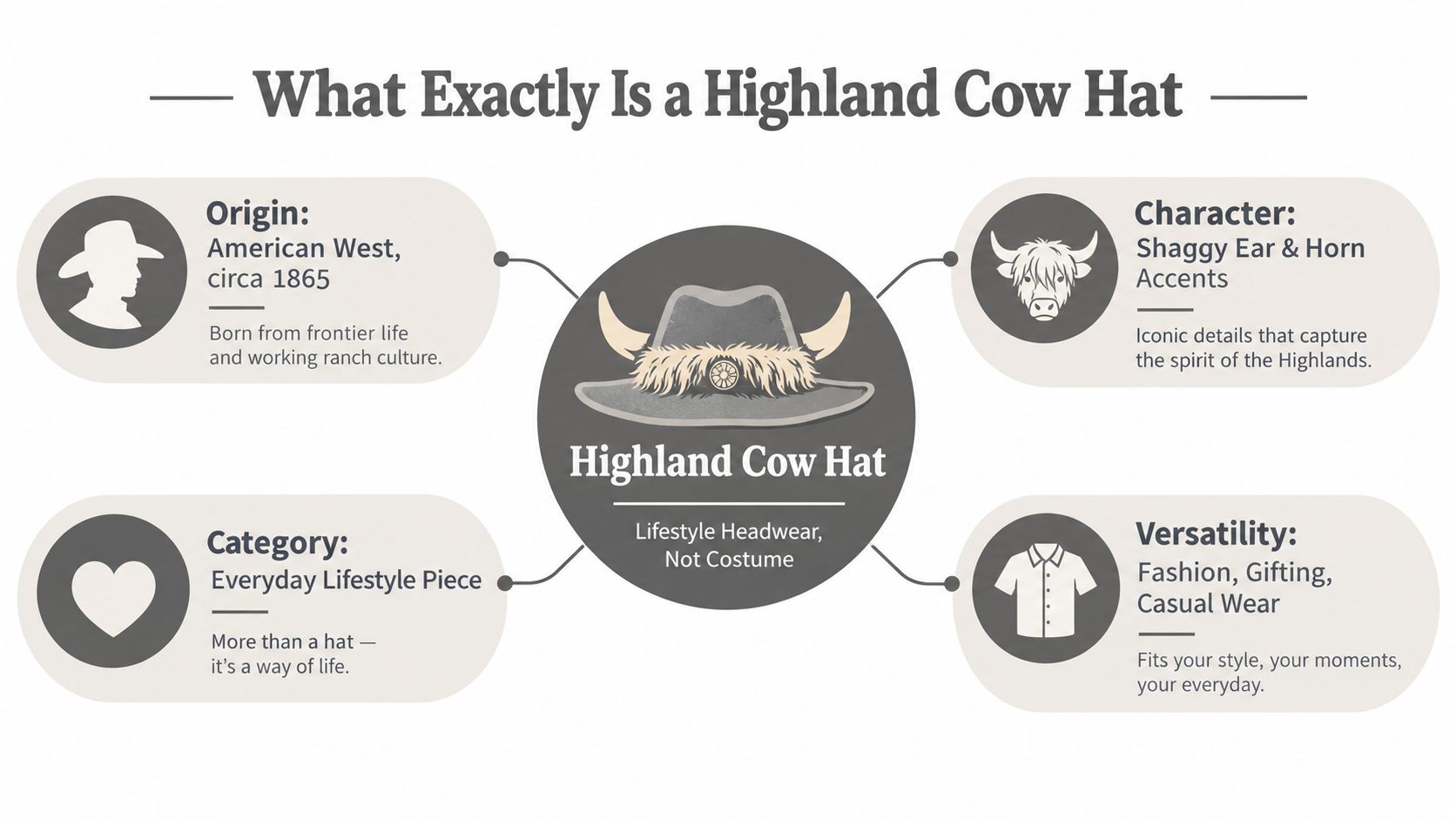
That variety explains why one shopper may mean a cotton cap while another means a fleece-lined plush hat. Wholesale and retail listings across Faire's highland cow hat marketplace and Etsy show caps, beanies, trucker hats, and plush versions. The category has spread across gift retail, independent shops, casual fashion, and outdoor-adjacent products.
If you enjoy headwear with a story, a related example such as the whiskey hat from Blind Barrels shows how a hat can carry a strong theme while still being treated as an accessory. The same principle applies here. The motif should support the hat's shape and use, not overwhelm them.
The Anatomy of a Highland Cow Hat
The quickest way to understand a highland cow hat is to compare two builds: a cotton summer cap and a plush winter beanie. They may share horns, ears, or embroidery, but almost every structural decision changes with the intended climate.
The crown comes first. A cotton cap usually has a cleaner, more stable profile. One documented example uses 100% cotton, an adjustable strap, and an unlined single-layer construction, a combination that favors lightness and airflow for warm-weather wear. A plush winter hat uses a roomier, softer crown, often with fleece or pile that holds the novelty shape and adds warmth.
The brim also changes the experience. A summer cap benefits from a curved, shape-retaining brim that shields the eyes without adding much weight. A beanie may have a short turned-up cuff instead of a projecting brim, or it may use a full plush form where the cow character becomes the main visual feature.
| Component | Cotton Summer Cap | Plush Winter Beanie |
|---|---|---|
| Crown | Light, structured cap profile | Softer, fuller crown with more volume |
| Brim or cuff | Curved brim for shade | Turned cuff or plush edge for warmth |
| Main material | Cotton, often unlined | Polyester plush or fleece-backed fabric |
| Cow details | Embroidery, rope, patch, or subtle accents | Ears, horns, pile, lining, or dimensional features |
| Fit system | Adjustable strap or closure | One-size construction, cuff, or chin fastening |
| Best strength | Breathability and portability | Insulation and character retention |
The detail work reveals how seriously the design was made. Tonal embroidery gives a restrained cap a lifestyle feel, while contrast stitching, faux-fur tufts, and raised ears push the piece toward novelty. Neither approach is automatically better. The right choice depends on whether you want the hat to blend into an outfit or announce itself from across the patio.
Closures deserve equal attention. An adjustable strap gives a summer cap flexibility, while hook-and-loop fasteners can make a plush design easier to stabilize. A traditional sweatband changes how the hat feels during extended wear, and a chin closure can keep a novelty winter hat secure when the design has extra weight.
Practical rule: Treat the brim, closure, and lining as performance features, not decoration. They tell you where the hat will feel comfortable.
Built for Summer Versus Built for Cold
A summer highland cow hat should behave like warm-weather headwear first and novelty apparel second. Look for light cotton, an open construction, a curved brim, and a fit that can be adjusted without squeezing the forehead. The documented cotton example uses a single-layer, unlined build and an adjustable strap, which prioritizes breathability and portability over insulation. That cotton Highland cow cap is a useful reference for the kind of construction that suits sun-exposed wear.
For golf, this is the practical option for a warm afternoon. A lightweight cap packs easily, takes up little room in a golf bag, and won't create the same heat retention as a lined plush hat. The trade-off is straightforward. It won't provide serious warmth, and a thin unlined construction may need more careful handling around the brim and embroidery.
Cold-weather versions make the opposite decision. A plush hat documented by The Shepherd's Knot uses 100% polyester, a soft fleece inner lining, and a Velcro closure under the chin. A knitted beanie example uses a 3GG knit made from a 50% acrylic and 50% recycled-polyester blend. Denser knits and synthetic or fleece linings trap more air, improving warmth and comfort, while adding bulk.
Match the build to the round
- Early spring golf: Choose a light cap if sun protection matters more than insulation, or a knit beanie if the temperature stays low.
- Late-fall patio sessions: A fleece-lined or knitted version makes more sense when you'll be sitting outside after play.
- Travel and gifting: Cotton packs more easily, while plush versions create a stronger unboxing moment.
- Frequent cleaning: A simple cap may be easier to spot clean, while plush pile and knit fibers often need gentler care.
The choice isn't about the Highland cow theme. It's about whether the construction matches the weather you'll face.
Where and How to Actually Wear It
A highland cow hat works best when the rest of the outfit gives it room. Strong cow details already provide the visual interest, so surrounding them with solid colors and familiar shapes keeps the look deliberate.
On the golf course
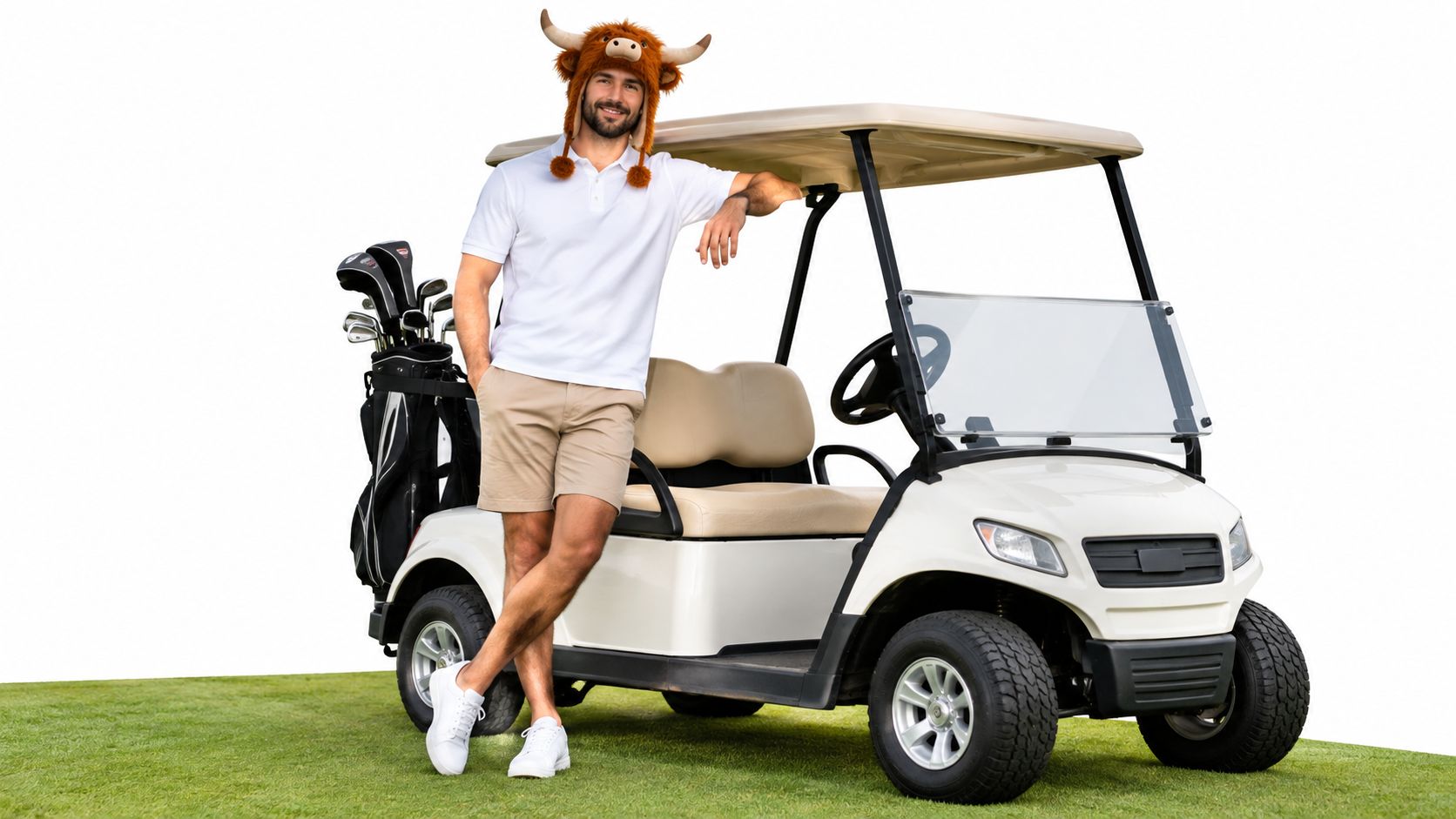
Pair a cotton version with a neutral polo, shorts, and classic golf shoes. A beige, brown, black, or muted green hat can sit comfortably beside navy, white, charcoal, or olive clothing. The motif reads as personality rather than a clash of competing graphics because the outfit stays quiet.
Fit matters during play. The hat shouldn't slide when you bend to read a putt, and the brim shouldn't block peripheral vision. An adjustable strap is useful when you want to change the fit between walking the course and relaxing afterward.
At the 19th hole
A knit or brushed version suits a quarter-zip, dark denim, and simple boots or clean sneakers. Here, warmth and texture become part of the outfit. A plush hat can work particularly well with a plain jacket because the ears, horns, or shaggy trim act as the single playful feature.
For everyday wear
Try a simple tee, chinos, and low-profile sneakers. Avoid stacking the hat with loud animal graphics, novelty socks, and a patterned jacket. The hat should be the memorable element, not one of several competing jokes.
As a gift
A highland cow hat makes sense for a birthday, a retirement gag gift, or a tournament swap prize when you know the recipient enjoys golf, Scottish themes, farm imagery, or relaxed outdoor style. For uncertain sizing, look for an adjustable cap or a flexible beanie. Neutral colors also make the gift easier to wear.
Brim width should suit the wearer's proportions. A broad brim can balance a longer face, while a shorter brim and lower crown may feel more natural on a shorter frame. Try to keep the crown from dominating the face, especially when the hat includes dimensional horns or ears.
How to Spot Quality Before You Buy
A funny design still needs sound construction. Start with the seams, especially where the brim joins the crown and where the closure attaches. Tight, even stitching with reinforced stress points usually indicates that the maker considered repeated wear rather than a single novelty occasion.
Inspect the cow graphic closely. Dense embroidery should have clean outlines, stable fill, and no obvious puckering where the design crosses a curved panel. Raised ears and horns should feel securely attached, not loosely stitched to a thin layer of fabric. On plush hats, gently check whether the decorative pieces return to shape after handling.
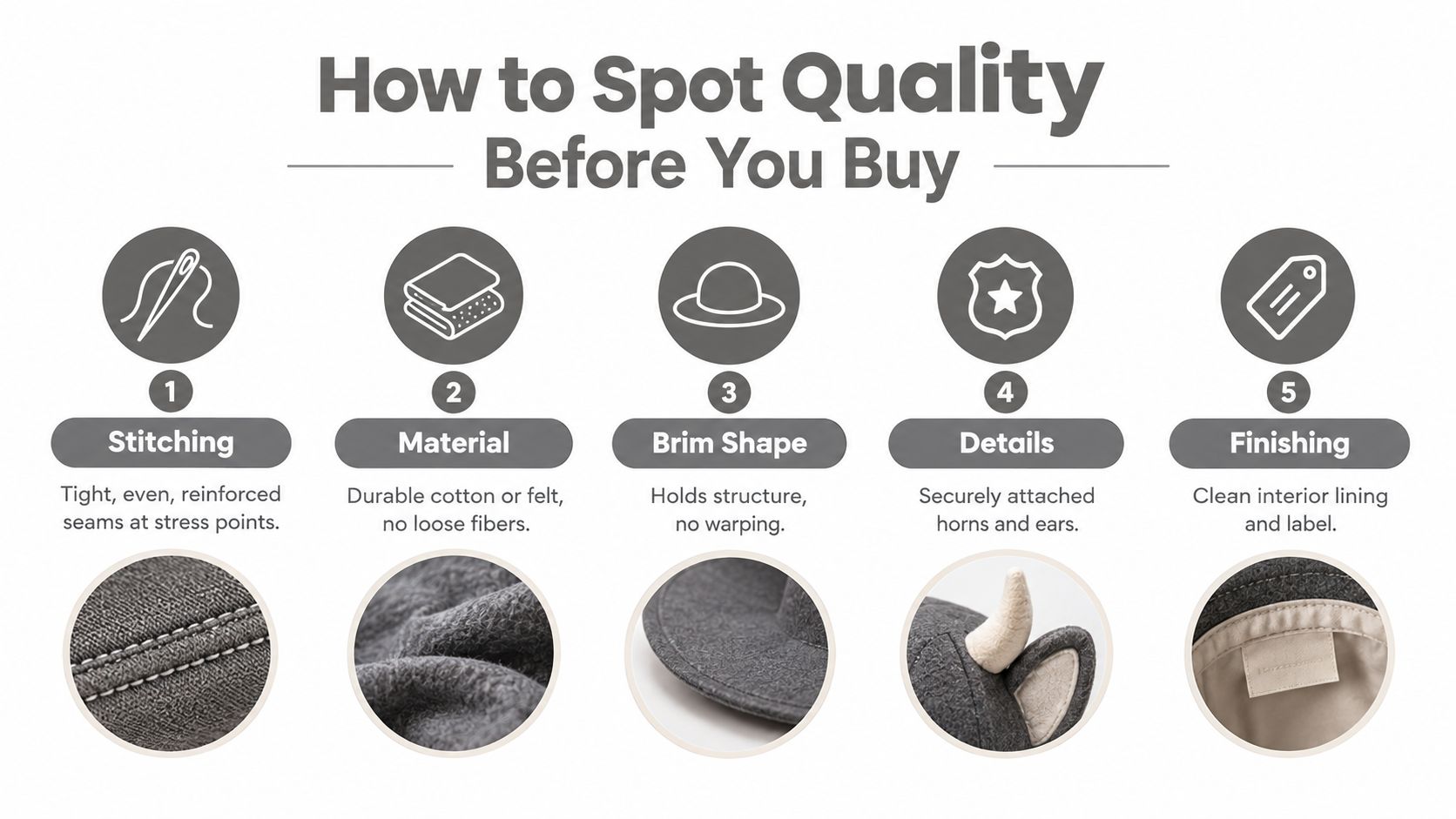
Use this five-point inspection
- Stitching: Look for even seams around the brim, closure, panels, horns, and ears. Loose threads around the embroidered cow are a warning sign.
- Material: Summer cotton should feel crisp rather than papery. Plush winter fabric should feel dense and springy, with no easy shedding of fibers.
- Brim shape: A cotton cap needs a brim that holds its curve without warping. If the hat arrives crushed, it should recover without permanent ripples.
- Details: Touch the horns, ears, patches, and trim gently. Secure attachments should not shift or expose unfinished backing.
- Finishing: Check the inside for clean taping, a comfortable sweatband, a consistent label, and tidy edges.
The closure should operate smoothly and sit flush against the head. A snapback, adjustable strap, fitted band, or cuffed beanie fold can all work, but none should catch hair, dig into the skin, or leave the hat unbalanced.
For a knit version, squeeze the crown lightly and watch how it responds. A well-formed knit should recover its shape rather than staying flattened. On a structured cap, press the brim gently and check whether it retains its intended curve.
A durable novelty hat still follows ordinary hat-making rules. Clean seams, stable shape, and comfortable contact points matter more than the number of decorative features.
Care and Cleaning Without Ruining It
Care depends on the material, and the safest routine starts with the interior label. A cotton cap, knitted beanie, and plush winter hat shouldn't all go into the same wash cycle.
For a cotton summer cap, remove loose dirt with a soft brush or dry cloth. Spot clean with mild soap, and hand wash in cool water when the label allows it. While the brim is damp, reshape it carefully, then air dry the hat away from direct sunlight. High heat can distort the brim and fade embroidery.
A knit beanie needs a gentler approach. Hand washing is usually the safer choice, though some labels permit a gentle machine cycle inside a mesh laundry bag. Lay the beanie flat on a towel and avoid wringing it, since twisting can stretch the fibers and alter the crown.
Give plush hats less water
Plush versions need special care because full submersion can flatten or damage the pile. Brush surface dirt away with a soft pet brush, spot treat marks, and use a fabric refresher suitable for the material. Work slowly around horns, ears, and stitched facial details.
Keep these habits consistent:
- Read the label first: Care symbols take priority over general advice.
- Skip bleach and high heat: Both can weaken fibers, fade thread, or change the hat's shape.
- Support the crown: Store the hat on a form or stuff it lightly with tissue.
- Protect embroidery: Don't leave the hat on a car dashboard, where ultraviolet exposure can fade fabric and thread.
- Dry completely: Put the hat away only after moisture has left the interior and decorative sections.
For golf hats, the practical guide to cleaning golf hats offers useful context for dealing with sweat, dust, and regular course wear. Light, consistent cleaning is safer than waiting until dirt has worked into the fabric.
Choosing the Right Highland Cow Hat for You
Start with the setting, not the artwork. Ask where you'll wear the hat most often, then choose the construction that supports that use.
If golf and patio time lead your list, look for a breathable cotton cap with a curved brim, adjustable closure, and a comfortable sweatband. The hat should sit securely without pressing against the temples. A subdued embroidered cow, rope detail, or leather patch can keep the design distinctive without making it difficult to pair with a polo or quarter-zip.
For cold-weather walks, outdoor gatherings, and relaxed autumn clothing, move toward a knit or plush build. A fleece lining or denser knit adds warmth, while a cuff or chin closure can help stabilize the fit. Remember that added insulation also means more bulk, so this version may be less convenient to pack into a golf bag.
Use fit as the second filter
Measure the head according to the seller's instructions, then consider how you like hats to sit. Some people want a snug beanie that covers the ears, while others prefer a cap with a little room above the crown. Adjustable sizing is the safer gift choice, especially when you don't know the recipient's exact measurement.
Color helps with versatility. Tan, brown, black, cream, and muted green are easier to combine with ordinary casual clothing than a highly contrasting cartoon palette. For a child or dedicated novelty fan, a more dimensional plush version may be the point of the gift.
Before buying, return to the construction checks:
- Match fabric to weather: Choose breathable cotton for heat and lined or knitted materials for cold.
- Inspect the artwork: Look for dense embroidery, clean outlines, and securely attached features.
- Test the fit system: Closures should adjust smoothly and sit comfortably.
- Check structural quality: Seams, brim shape, interior finishing, and crown recovery should all look dependable.
- Confirm care needs: A hat that requires delicate cleaning may not suit someone who wears headwear daily.
For golfers who prefer personality-led accessories, collections such as unique golf hats show how themed headwear can sit within a wider course-to-clubhouse wardrobe. The most useful decision remains simple: choose the primary use first, then validate quality. That order turns a highland cow hat from a drawer novelty into a reliable part of your rotation.
2ndShotMVP offers golf hats, beanies, and lifestyle apparel with fun designs for men and women, including options suited to the course and the 19th hole. Visit 2ndShotMVP to browse headwear that adds personality without giving up everyday wearability.

