

We've all felt it. That panicky, rushed, out-of-control lurch at the top of the swing. It's the silent killer of consistency, and it’s absolutely costing you strokes.
If you want to unlock that effortless power and dead-eye accuracy you see on TV, the secret isn't a new driver—it's mastering your rhythm with some simple golf swing tempo drills. These are all about building that silky smooth 3:1 backswing-to-downswing ratio that the pros have.
Why Your Swing Tempo Is Sabotaging Your Game
Let’s get one thing straight about 'tempo'—it isn't just about swinging slowly. Not at all. It’s the specific, repeatable rhythm that separates the pros from the rest of us weekend warriors.
A great tempo is the glue that connects your entire swing, from the takeaway all the way to a balanced finish, into one fluid, powerful motion. Without it, you’re just making a series of disconnected, jerky movements that bleed power and send the ball flying everywhere but the fairway.
Think of it like a perfectly timed dance. When every step flows seamlessly into the next, the result is graceful and powerful. But if one part rushes ahead or falls behind, the whole thing becomes a clumsy mess. That’s exactly what’s happening in your golf swing when your tempo is off.
The Myth of Swinging Slower
One of the biggest misconceptions in golf is that good tempo means a slow tempo. That's just not true. The pros have surprisingly quick swings, but what makes them look so effortless is their incredible rhythm.
The magic number you hear a lot is a 3:1 ratio—meaning the backswing takes three times longer than the downswing.
This idea was brought into the spotlight by John Novosel's Tour Tempo system back in the early 2000s. He analyzed the swings of legends from Ben Hogan to Tiger Woods and found this remarkably consistent 3:1 timing across the board. For example, a pro might take 0.8 seconds for their backswing and just under 0.3 seconds for their downswing. If you want to dive deeper, you can check out more on the fascinating research into pro swing ratios.
The goal isn't to be slow; it's to be synchronized. A smooth tempo lets your lower body lead the downswing, which is how you create lag and whip that club through impact. A rushed tempo does the exact opposite, forcing your arms and hands to take over in a desperate attempt to save the shot.
The Real Cost of Poor Tempo
When your rhythm breaks down, it’s not just one thing that goes wrong—it’s a total system failure. That rushed feeling from the top is the real culprit behind so many of the swing flaws we all struggle with.
Here’s a quick look at the critical differences between a pro's tempo and what we often see on the course on a Saturday morning.
Pro vs Amateur Tempo Breakdown
| Tempo Aspect | Tour Pro Benchmark | Typical Amateur Flaw |
|---|---|---|
| Backswing-Downswing Ratio | A consistent 3:1 ratio | An erratic 2:1 or even 1.5:1 ratio |
| Transition | A smooth, patient pause at the top | An abrupt, jerky lurch from the top |
| Sequence | Lower body initiates the downswing | Arms and shoulders yank the club down |
| Pacing | Controlled acceleration through the ball | Rushing to get to the ball |
| Under Pressure | Tempo remains constant, even on the 18th | Tempo gets quicker and more frantic |
This table really highlights that the problem isn't just one thing, but a chain reaction. When your rhythm goes, so does everything else.
- You Lose Power: An abrupt transition from the top means you can't use the ground for leverage. All that potential clubhead speed? Gone.
- Your Contact is Inconsistent: Rushing throws you off your swing plane, which is a one-way ticket to slices, hooks, and those dreaded thin or fat shots.
- You Have No Feel Under Pressure: On-course nerves love to mess with bad tempo. It’s the main reason your beautiful range swing often vanishes by the time you reach the first tee.
Getting your rhythm right is probably the single most impactful change you can make to your game. The golf swing tempo drills we're about to cover are designed to fix these deep-seated issues, not just slap a bandage on them. And if you're looking for more ways to build a swing you can trust, you can also check out our complete guide on how to improve your golf swing.
Building Your Rhythm Foundation Without a Club
Before you even touch a golf ball, we need to get your body’s internal metronome ticking correctly. The whole point here is to strip away the distraction of hitting the ball and just focus on creating a fluid, connected motion. Think of these golf swing tempo drills as basic training for a swing that flows from your body, not from a frantic, handsy lurch at the ball.
The best part? You can do these right in your living room. No range fees, no buckets of balls needed. This is where you bake that smooth tempo right into your muscle memory, building a foundation that won't crumble when the pressure is on.
So many swing flaws trace back to one single culprit: a rushed tempo. When you rush, you get inconsistent. When you're inconsistent, your scores go up. It's a vicious cycle.
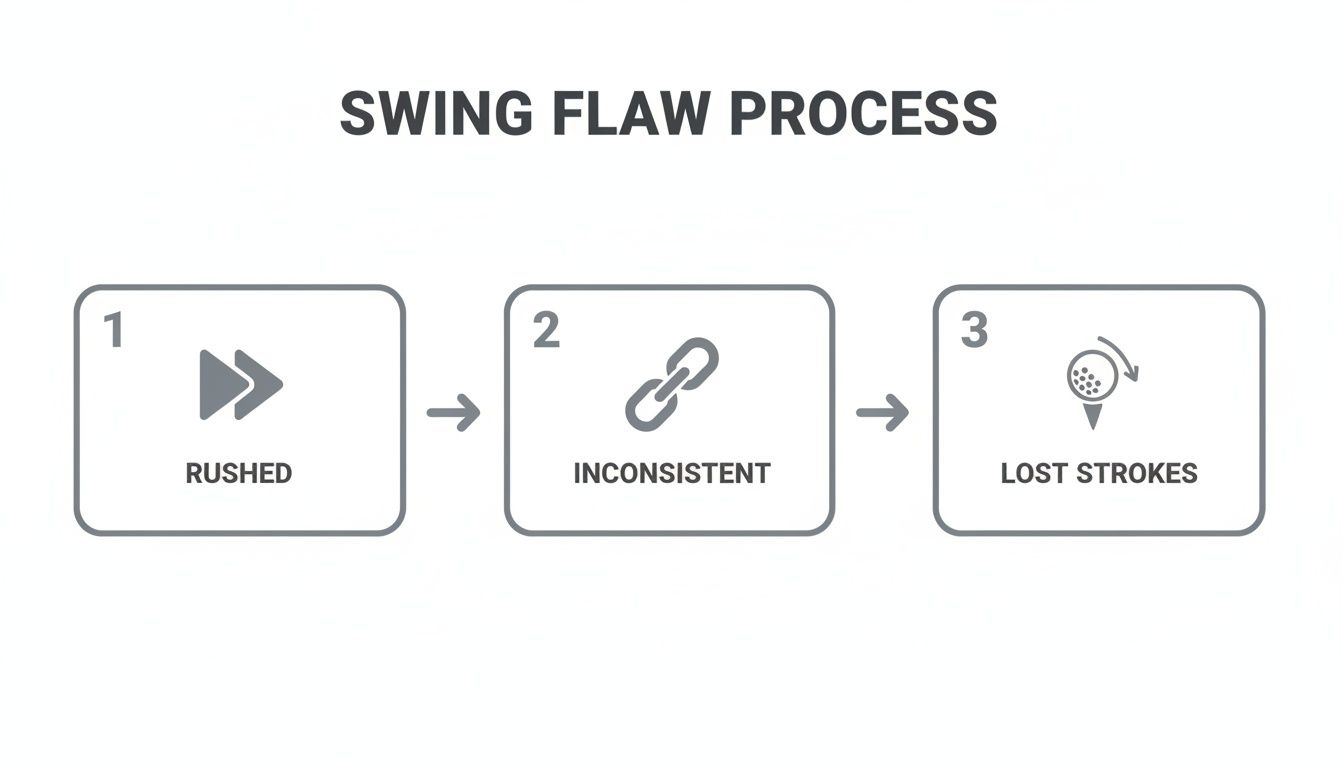
This simple diagram says it all. A bad tempo is the root of the problem, leading directly to lost strokes.
The Classic Feet Together Drill
This drill has been around forever for one simple reason: it works. It physically forces your body to move as a single, coordinated unit. It’s nearly impossible to get wild with your arms when your feet are touching—you'll fall right over.
Here’s the plan:
- Get into your normal golf posture, but slide your feet together until they're touching.
- Start making some easy half-swings. You’ll immediately feel how your chest and hips have to rotate together to get the club moving. Your arms are just passengers on this ride.
- The only thing that matters is staying in perfect balance. If you start to wobble, it's a dead giveaway that you're using your hands to generate speed instead of your body's turn.
Zero in on the sensation of your core leading the way. This drill is a masterclass in teaching a one-piece takeaway and a connected downswing, which is the absolute heart of good tempo.
Pro Tip: Don't swing hard! This isn't about power; it's about rhythm. Knock out 20-30 smooth swings, focusing completely on staying balanced and feeling your body turn as one piece. You're building coordination, not clubhead speed.
Grooving the Pendulum with Continuous Swings
Alright, let's keep that rhythm going with a drill that feels more like a dance move than a golf swing. The continuous swing drill is my go-to for helping players find a natural, unforced tempo.
Simply start by making small, waist-high swings back and forth without a pause. Picture your club as the pendulum on a grandfather clock, just swinging freely under its own momentum.
Slowly let the swing get bigger and bigger until you're making full, continuous motions. Let the weight of the clubhead be your guide. As you swing back, feel its momentum carry you to the top; on the way down, let it pull you through to a perfectly balanced finish.
This drill is the ultimate cure for the destructive impulse to hit the ball. Instead, you learn to let the swing just happen. And if you're hungry for more ways to solidify your fundamentals, these beginner golf drills are a great place to continue building.
The feeling you're chasing here is one of constant, flowing motion. The end of your backswing should seamlessly blend into the start of your downswing. That's the secret to a smooth transition and the perfect antidote to that jerky, rushed move from the top that kills so many shots before they even start.
Finding Your Perfect Beat With Auditory Drills
Alright, let's stop thinking about tempo and start feeling it. We're going to turn that vague idea of "rhythm" into something you can hear, feel, and repeat. By tapping into the power of sound, we can trick our brains into learning this stuff way faster than just by feel alone.

This is a lot easier than it sounds. Honestly, all you need is a metronome app on your phone. We're going to find your swing's signature cadence and groove it in with a couple of game-changing drills.
The Magic of the 1-2-3-1 Count Drill
This drill is pure gold. It's the simplest way I know to bake that pro-level 3:1 tempo ratio right into your swing. We're breaking the swing into four distinct beats, giving your mind a clear, simple roadmap to follow until it becomes completely automatic.
Here’s the breakdown:
- Set the Beat: Fire up your metronome and set it to a nice, slow pace. Something around 60-70 beats per minute (BPM) is a great starting point. Each click is a count.
- Assign the Beats: The count goes like this: '1' is the takeaway, '2' is halfway back, '3' is the very top of your swing, and the next '1' is the moment of truth—impact.
- Swing to the Music: Get into your setup and let the metronome start. On the first click (1), begin your backswing. You should hit the halfway point on the second click (2) and reach the top on the third click (3). That fourth beat (1) is your cue to make contact with the ball.
Start with smooth, deliberate practice swings. No ball needed just yet. It's going to feel incredibly slow at first, and that's the point! It forces you to feel every part of the sequence. As you get comfortable, slowly crank up the BPM until the rhythm feels athletic and powerful, not hurried. For those who get really into this, digging into mastering a clean click sound can help you create your own perfect auditory cues.
Kill the Rush: The "Pause at the Top" Drill
If there's one habit that kills a good golf swing, it's rushing the transition. That frantic, jerky move from the top is a round-wrecker. This drill is the antidote. By forcing a deliberate pause, you eliminate that herky-jerky momentum and teach your lower body to lead the dance.
This simple drill is a game-changer because it teaches one of the most important feelings in golf: patience at the top. It separates the backswing from the downswing, giving your body time to sequence correctly for effortless power.
The execution couldn't be simpler. Take the club to the top of your backswing and just... stop. Hold it there for a full one or two seconds. From this dead stop, your only real option is to initiate the downswing the right way: with a weight shift and hip rotation. And that, my friend, is how you create that beautiful, pro-level lag.
This has been a go-to drill for amateurs for decades, especially since the PGA Tour's data explosion in the 1990s confirmed the 3:1 ratio as the gold standard. When regular golfers use simple drills like this one, their accuracy skyrockets because it virtually eliminates those ugly mis-hits that come from rushing from the top.
From Smooth Tempo to Effortless Power
Alright, so you’ve got that buttery-smooth rhythm down. That’s fantastic, but it's only half the battle. Now, let’s plug that newfound tempo directly into some serious, explosive distance. A great tempo isn’t about being slow; it’s about unleashing speed at precisely the right moment.
These dynamic golf swing tempo drills are all about generating power from the ground up, starting with your feet and working its way up to the clubhead.

This is where you stop just hitting at the golf ball and start swinging powerfully through it with some real authority.
The Tour Pro Secret: The Step Drill
If you’ve ever wanted to truly feel how the lower body is supposed to lead the downswing, this is your drill. The 'Step Drill' is a tour pro favorite for a reason—it practically forces you to ingrain the correct kinematic sequence. That’s just a fancy term for the perfect order of movement that creates massive clubhead speed without you feeling like you're swinging out of your shoes.
Here's how to do it:
- Start Narrow: Get into your normal address position, but slide your feet together until they're touching.
- Step Back: As you begin your backswing, take a small step to the side with your trail foot (that's your right foot for righties). This naturally loads your weight onto that trail side.
- Step Through: Just as you reach the top of your swing, right before you start down, take a step toward the target with your lead foot (your left foot). This move forces your hips and lower body to kickstart the downswing, creating a powerful weight shift and that beautiful, effortless lag we all chase.
The whole thing feels a bit like a baseball player stepping into a pitch, and honestly, that’s the exact feeling you want. It physically stops your arms and shoulders from getting jumpy and yanking the club down from the top.
Feeling the Flow with Weighted Training Aids
Sometimes, you just need a tool to teach your body a new feeling. Weighted trainers are absolutely perfect for this. They exaggerate the sensation of momentum, helping you groove a fluid, powerful release without overthinking it.
- Orange Whip/Swing Trainer: These things are magic for teaching patience. Their flexible shafts will get all out of whack if you rush the transition. It forces you to wait for the weight to "load" at the top before you can smoothly start the downswing.
- Weighted Club/Donut: A classic for a reason. Swinging a heavier club encourages a fuller body turn and helps you feel the clubhead's path throughout the swing. It’s an incredible tool for warming up and ingraining that body-led motion.
The real goal here is to feel the club swinging you. Let its momentum guide your body all the way into a full, balanced finish. It's one of the fastest ways to develop a powerful, rhythmic release. For more gear that can really boost your practice sessions, check out our guide on the best golf accessories: https://2ndshotmvp.com/blogs/news/best-golf-accessories.
The 80% Effort Trick for 100% Distance
This might be the most important mental switch you can flip. Trying to swing at 100% effort almost always backfires. It leads to tension, a rushed tempo, and—ironically—a huge loss of power.
Think about this: pros swing from the start of their swing to impact in about 0.7 seconds, which is way faster than most amateurs. Yet, they look smooth because they focus on rhythm, not raw, brutish force. In fact, data shows that dialing back your swing to about 80% of your perceived effort with a perfect tempo absolutely crushes a 100% rushed hack. You could see your ball-striking consistency jump by 30-40%.
To really understand how your body generates this kind of force efficiently, it's worth diving into the basics of the biomechanics of sport and exercise. It’s the science behind the effortless power you see on TV every Sunday.
Taking Your New Tempo From The Range To The Course
Let's be honest. Grooving a silky-smooth tempo on the driving range is one thing. But keeping it together when you’re standing over a tight tee shot with water left and a couple of bucks on the line? That's a different beast entirely.
The range is a sterile lab. The course is the real world, filled with nerves, funky lies, and actual consequences for a bad swing. This is where the rubber meets the road, and where we bridge that critical gap between practice and performance.
The secret to making your new rhythm stick is to weld it into your pre-shot routine. It has to become an automatic, non-negotiable part of every single swing you make out there. Think of your routine as your anchor—the one constant you can fall back on when pressure starts creeping in and your brain is screaming at you to just hit it.
This is where you need to learn the 'Waggle with a Purpose'. It's not some nervous twitch; it’s a full-blown dress rehearsal for your tempo.
The Purposeful Waggle
Forget those quick, jerky waggles you see from anxious amateurs. This new waggle is your tempo’s final sound check before the big performance. It's a slow, deliberate, one-piece takeaway and return that perfectly mimics the first few feet of your actual swing.
As you stand behind the ball, take one last, full practice swing, focusing entirely on your tempo cue—whether it’s the “1-2-3-1” count or just the feeling of the clubhead’s momentum. Then, when you step up to address the ball, perform two slow, purposeful waggles that match that exact rhythm. This simple move drills the feeling you want into your muscle memory right before you pull the trigger.
Your pre-shot routine isn't just about getting your feet and shoulders aligned. It's your last chance to remind your body of the smooth, unhurried rhythm you've worked so hard to build. Make the waggle your final tempo checkpoint.
On-Course Tempo Resets
Look, even with the world's best routine, your tempo can still get jumpy under pressure. When you feel that old, familiar rush coming on, you need an emergency brake. A quick reset.
Here are a few on-the-spot fixes that work wonders:
-
The Deep Breath Reset: Before you even set the club behind the ball, take one slow, deep breath. Try inhaling during your imaginary backswing and exhaling through your downswing. It’s a trick that physically calms your nervous system and helps slow down your internal clock.
-
The "Feet in Concrete" Feel: Facing a particularly nerve-wracking shot? Imagine your feet are slowly sinking into wet concrete as you set up. This gives you a feeling of immense stability in your lower body and helps kill any impulse for a quick, snatchy takeaway.
-
Hum Your Rhythm: Yeah, it might sound a little goofy, but audibly humming a simple "one-and-two" or even the melody of a slow song can override your brain's tendency to rush. It gives your body an external beat to sync up with.
These aren't complex swing thoughts designed to paralyze you. They are simple mental tricks to get you back in rhythm when the heat is on. Mastering these little adjustments is the final piece of the puzzle, turning all that hard work on the range into a swing you can actually trust on the course.
Got Questions About Golf Swing Tempo? Let's Talk.
When you start digging into the nitty-gritty of swing tempo, a lot of questions pop up. It's a bit of an art and a science, so let's clear the air on some of the most common ones I hear from golfers trying to lock in their rhythm.
How Do I Figure Out My Perfect Tempo?
This is the big one, right? While your personal rhythm is unique, the holy grail we're all chasing is that tour-pro-proven 3:1 ratio—three counts for the backswing, one count for the downswing.
So, how do you find it? Your new best friend is a metronome app. Seriously, download one.
Fire it up and set it somewhere around 70 BPM. Now, let’s use a simple "1-2-3-1" count. "1" is your takeaway, "2" is the top of your backswing, "3" is that crucial transition, and the next "1" is impact. If you want to get nerdy with the numbers, a common benchmark for pros is a 24/8 cadence. That's a 0.8-second backswing and a lightning-fast 0.27-second downswing. The point isn't just to be slow; it's to find a rhythm that feels powerful and athletic, one you can repeat with every club in the bag.
Is It Possible for My Swing Tempo to Be Too Slow?
You bet it is. This is one of the biggest myths in golf. Everyone hears "slow down your swing," but great tempo isn't about moving in slow motion; it's about proper rhythm and sequencing.
A sleepy, sluggish tempo is a recipe for disaster. It lets your arms and body get completely out of sync, leading to those ugly pushes and blocks. Worse, you bleed power because the energy you're building up never gets transferred to the ball efficiently. The truth is, pros have pretty quick backswings, often clocking in at under a second.
The goal isn't "slow and disconnected." It's "smooth and connected." Think of a fluid, continuous motion that feels deliberate but never, ever lazy.
Why Does My Tempo Go Haywire Under Pressure?
Ah, the first tee jitters. It’s that classic fight-or-flight response kicking in. Adrenaline floods your system, your brain screams at your muscles to go, go, go, and your beautifully practiced tempo flies right out the window.
Your entire sequence gets thrown into a blender.
This is exactly why having a rock-solid, non-negotiable pre-shot routine is one of the most important things you can do for your game. It's your anchor in the storm.
The next time you're standing over a shot that makes your palms sweat, take a breath. Make one extra practice swing focusing only on your tempo cue. Whether it’s that "1-2-3-1" count in your head or just feeling that slight pause at the top, that simple reset is often enough to calm the nerves, kill that frantic urge to rush, and give you a fighting chance to hit a great shot.
At 2ndShotMVP, we know that confidence on the course starts with looking the part. Explore our collection of premium golf hats and apparel that blend unique style with on-course performance. Shop now and find your new favorite gear

