

You're standing on the first tee, the sun is already warming your shoulders, and a light breeze keeps tugging at your outfit. Your swing feels ready, but your skort keeps creeping upward, the inner shorts cling to your legs, and you're suddenly wondering whether the hem meets the club's dress code. That's not a style problem. It's a fit and function problem.

A well-designed golf skort for women combines the polished look of a skirt with the coverage and freedom of shorts. The right one should stay secure through hip rotation, feel comfortable while walking, manage sweat in warm weather, and pass the rules of the course you're playing. Cute is welcome, but it's not the buying brief.
The women's golf apparel category has become a substantial commercial market. One industry estimate valued it at about USD 1.5 billion in 2025, while another 2024 estimate placed women's combined golf equipment and apparel sales above USD 2.14 billion (Industry Research). With more options on the rack, shoppers need a sharper way to compare them.
This guide treats the skort like a piece of golf equipment. We'll look at its anatomy, decode fabric labels, test rise and coverage, separate useful features from decorative marketing, and build outfits that work on the course and beyond it.
What Makes a Golf Skort Different From a Regular Skort
You bend to read a putt, rotate through your swing, and climb into a cart. A regular skort may look right for the first few minutes, but a golf skort for women is built to stay covered, stable, and comfortable through those repeated movements. Its parts are designed for course rules and practical use, not appearance alone.
Start with the four working parts
The skirt overlay creates the polished skirt-like look. It may be pleated, A-line, or flat-front, but it should move without ballooning during a swing. A pleat that catches every gust can become a distraction before the second hole.
The built-in shorts provide coverage when you bend, sit, or turn through impact. They should follow the body without squeezing the thighs. If the liner rides upward, each walk becomes a clothing adjustment, and that distraction has no place in a round.
The waistband keeps the skort positioned as you twist, reach, and tuck in a polo. A structured elastic or high-rise band can improve stability. Some designs add grip details, but the practical test is simple: it should stay secure without pressing into your stomach when you sit.
Pockets determine whether the garment functions as golf apparel or merely resembles it. Flat, deep pockets can hold tees, a ball marker, or a glove without tugging the overlay sideways. Zippers help secure valuables, although bulky hardware may feel awkward beneath a belt or while seated.
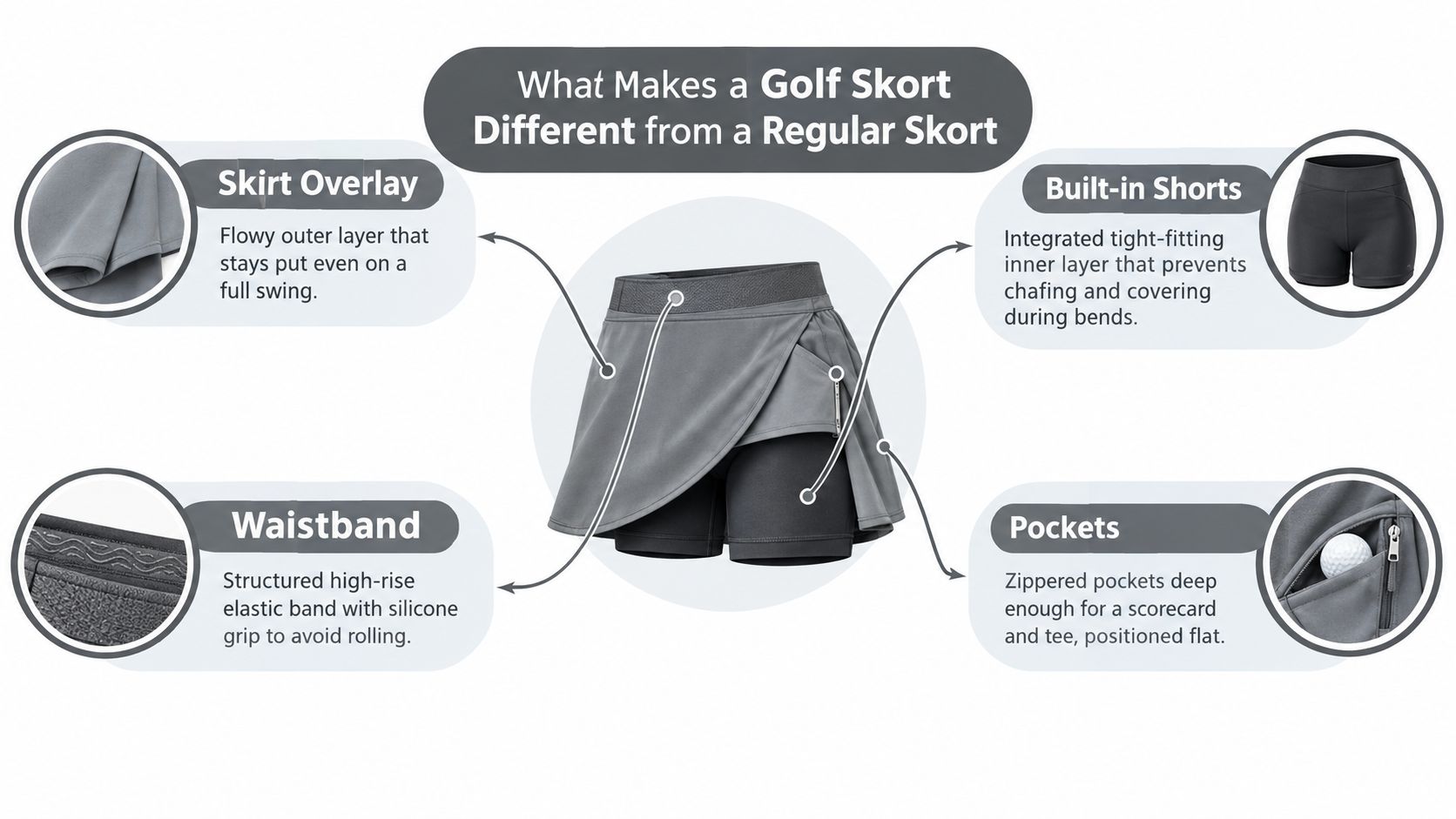
Each part has a distinct functional role: the overlay handles presentation and movement, the liner provides coverage, the waistband controls stability, and the pockets carry small essentials.
A short history with a useful lesson
Women's golf skorts became a distinct apparel category in the postwar period. Historical accounts place early adoption in the 1950s, and Montgomery Ward's 1959 Spring/Summer catalog used the modern “skort” label for a short pleated skirt with an attached bloomer underneath (Women's Golf).
The design supported a less restrictive approach to women's golf clothing. It provided coverage without requiring a stiff, formal silhouette. By the 1960s, accounts describe the skort as part of the broader move toward shorter, more functional golf clothing.
That history clarifies the buying decision today. A golf skort is a movement garment with a skirt finish. Check whether its hem meets the course dress code, whether the liner stays squat-proof, and whether the waistband remains comfortable in heat and motion.
For another view of women's golf bottoms, compare the construction and styling choices in this guide with women's golf shorts. The useful question is whether the skort's overlay, liner, waistband, and pockets suit your body and your course.
Fabrics That Move With You and Keep You Cool
On a humid walking round, the right skort feels like a helpful second skin. The wrong one feels like a warm plastic wrapper. Fiber blend, knit structure, and finish affect stretch, drying speed, cling, friction, and how the garment behaves after washing.
Performance skorts commonly use polyester-spandex or polyamide-elastane blends. Polyester helps move perspiration away from the skin and usually dries quickly. Elastane adds stretch and shape recovery. One example uses 81% polyester and 19% spandex, with breathable, moisture-wicking construction and UPF 50+ protection measured under ASTM D6603 (Dick's Sporting Goods). The rating applies to the covered fabric, not exposed skin.
Read the blend like a golfer reads a lie
Moisture management works more like a straw than a sponge. A sponge absorbs and holds water. A well-designed performance fabric moves moisture toward the outer surface, where it can evaporate more easily. For a plain-English explanation, read what moisture-wicking fabric means.
Stretch behaves like a dependable rubber band. During a squat or hip turn, elastane lets the fabric expand. Afterward, the blend should recover instead of staying stretched across the seat or knees. That recovery helps reduce sagging and cling during a long round.
Polyamide-elastane can also feel smooth against the skin, which may reduce friction between the liner and thighs. The label is a prediction tool, not a final verdict. Bend, rotate, and sit before trusting the fabric description.
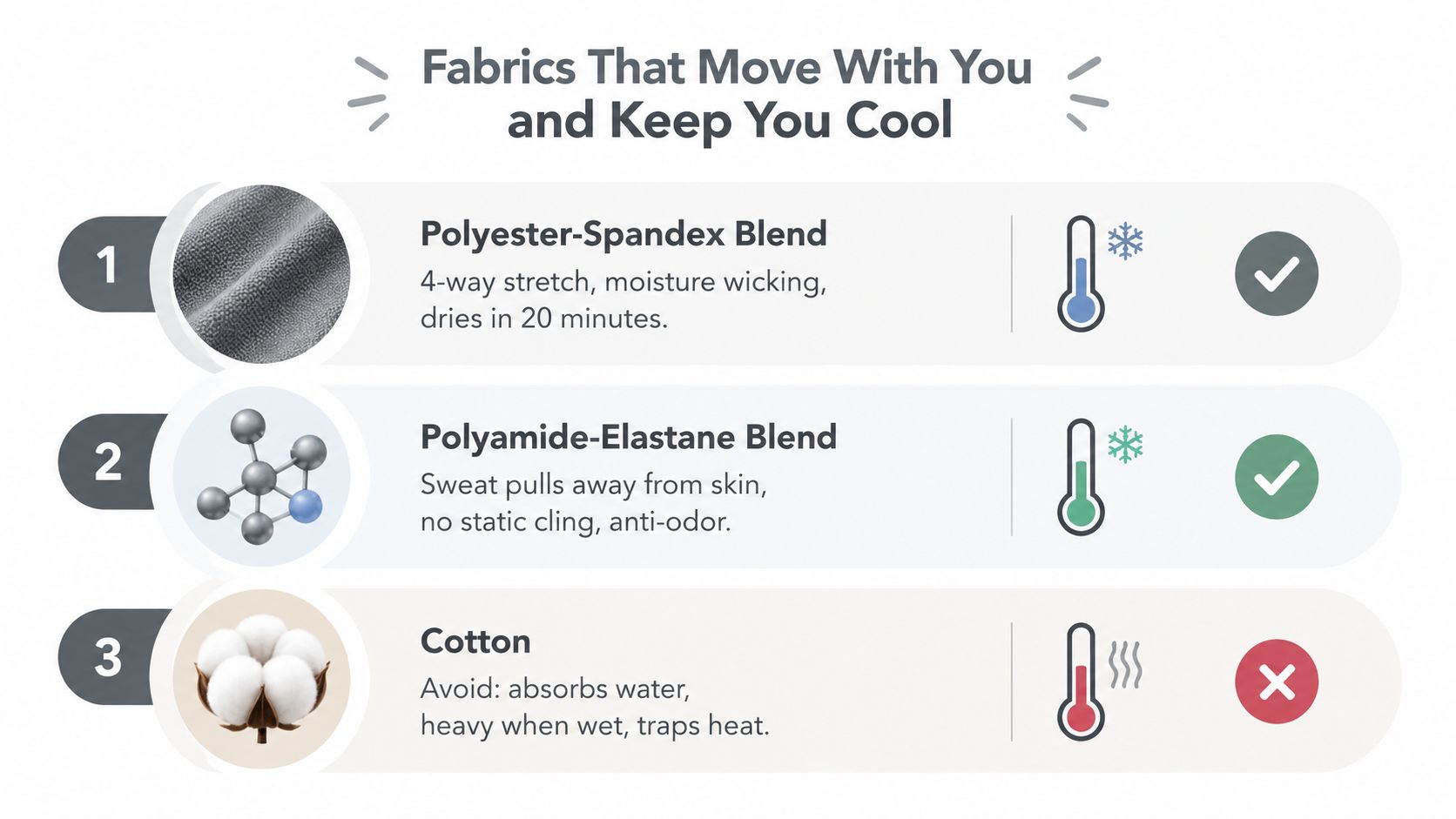
Pure cotton may feel soft initially, but it can hold moisture and become heavier when wet. That matters during humid walks or time spent in direct sun. A cotton blend may feel softer while still offering useful stretch, so check for both stretch fibers and moisture-management features.
Fabric-reading shortcut: Look for stretch fibers, moisture-wicking language, and breathable construction. Then squat, rotate, and sit before relying on the label.
For winter layering ideas outside the skort category, the 2026 guide to winter tights offers a comparison point for cold-weather activewear. On the course, fabric choice should support coverage, movement, and comfort rather than feel light on the hanger.
Finding Your Perfect Fit Length Rise and Coverage
A skort can look polished in front of a mirror and still fail its first real golf test. Bend toward a ball, turn through a swing, climb into a cart, and notice what shifts. The waistband should stay level, the overlay should cover the liner, and the inner shorts should remain comfortably in place.
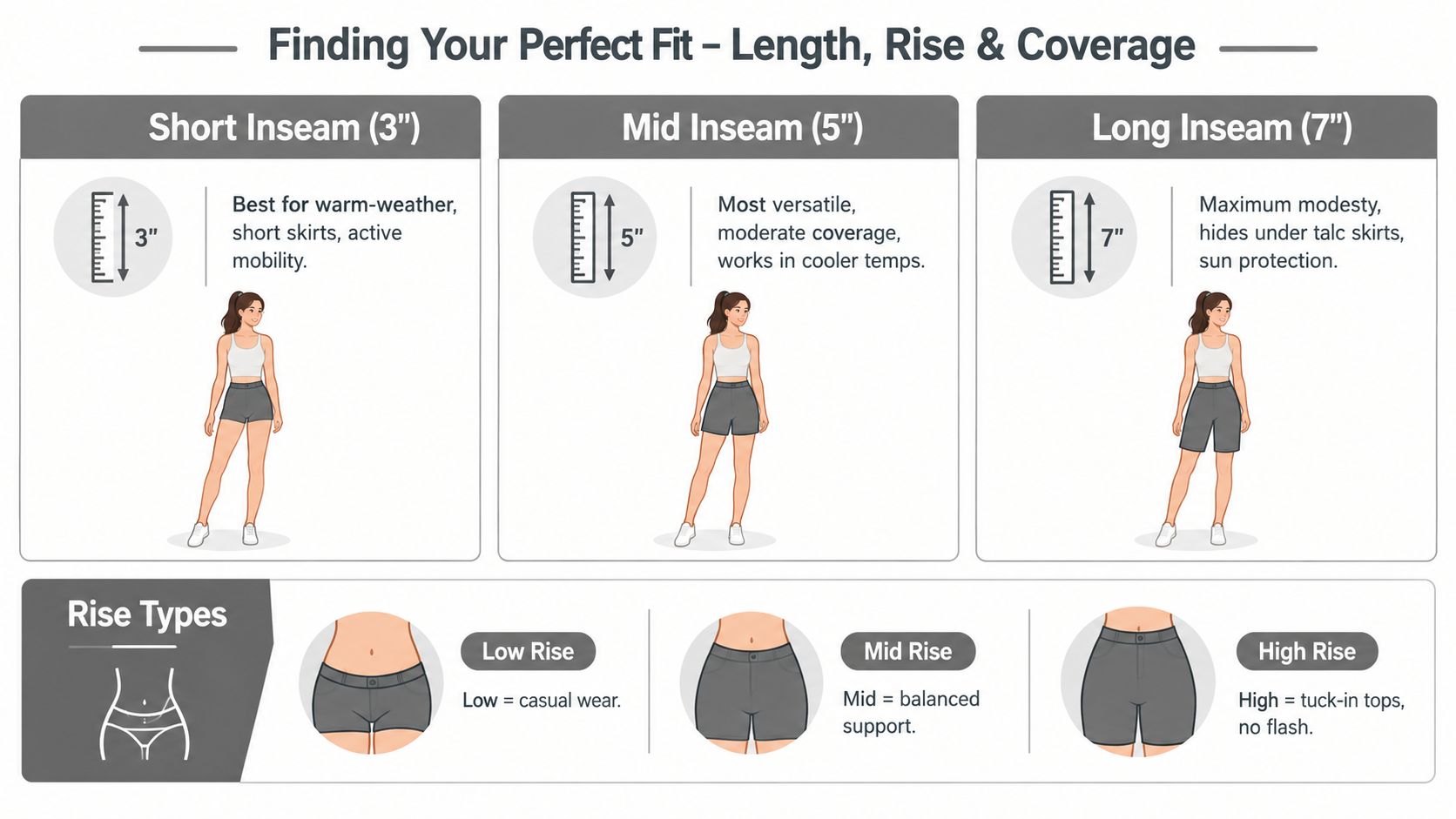
A commonly marketed golf-skort length sits around 16 to 17 inches, with shorter and longer options also available. Use that range as a starting reference rather than a rule. Your proportions, comfort, and club requirements should guide the final choice.
Compare the fit variables
Length sets your coverage and visual proportion. A shorter hem feels airy and athletic, but leaves less room for error when you bend or encounter wind. A longer hem offers more security and may work better with conservative club expectations. Too much length, however, can brush the knees, trap heat, or restrict a natural stride.
Rise determines where the waistband anchors. A low rise may suit casual outfits but can shift during rotation. A mid rise usually balances freedom and stability. A high rise can stay secure with a tucked-in polo and cover more of the waist when you hinge forward.
Liner cut deserves the same attention as outer length. The inner shorts should cover the areas you want covered without extending so far that they bunch beneath the overlay. Compression should feel like gentle support, not a tight band that distracts you on every fairway.
Use a fitting-room movement test
Try these movements before buying:
- Squat as if you are reading a putt. Check for gaping, transparency, and liner exposure.
- Rotate your torso through a backswing. Watch for a rolling waistband or twisted skirt.
- Take a long step and climb onto an imaginary cart step. Notice any ride-up around the inner shorts.
- Put your phone or a few golf essentials in the pockets. The overlay should remain flat instead of pulling toward one hip.
- Sit briefly. A waistband that feels comfortable while standing may dig in under pressure.
During the squat test, check whether the hem still provides the coverage your club's written policy requires. A skort that passes the movement test at a relaxed public course may still need a more conservative length for a private club. Rules are part of fit, because clothing that draws questions at the first tee is not doing its job.
Performance Features That Actually Help Your Game
A skort earns its place in your golf wardrobe when each feature solves a course problem. During a round, your hips rotate, knees bend, stride changes, and pockets fill with small essentials. Four-way stretch supports those movements in every direction. Fabric that stretches only across the body can feel comfortable while standing yet pull when you turn through a shot.
Heat management matters just as much. Mesh or breathable panels release warmth from places where fabric tends to hold it, while moisture-wicking fibers move perspiration toward the surface for evaporation. In humid weather, that difference can keep the liner from clinging to your skin and creating friction. A smooth, quick-drying liner also feels more comfortable after repeated squats and walks.
Built-in undershorts provide coverage when you bend, reach, or take a long step. They also create a steadier base beneath the outer layer, helping the skirt stay in position. Compression can add gentle support, but it should never feel like a tight band around your thighs.
Match the feature to the day
| Playing condition | Features worth prioritizing | What to check |
|---|---|---|
| Hot, sunny round | Breathable construction, moisture management, covered-area UV protection | Whether the liner feels airy and the outer layer avoids cling |
| Humid weather | Quick-drying synthetic blend, smooth liner, four-way stretch | Whether damp fabric sticks after a squat |
| Windy course | Secure waistband, stable overlay, adequate coverage | Whether the skirt lifts or twists during rotation |
| Long walking round | Smooth seams, flexible fabric, useful pockets | Whether anything rubs after repeated strides |
| Cooler conditions | Room for layering, comfortable rise, compatible tights | Whether added layers create bunching |
As noted in the fabric section, UPF ratings apply only to covered areas. Your legs, hands, and other exposed skin still need their own sun-protection plan.
Course rules belong on this checklist too. A breathable skort can perform beautifully yet fail a club's coverage requirement, while a secure waistband helps prevent distracting adjustments during play. Check the written dress code before buying, then test the skort with a swing, squat, sit, walk, reach, and loaded pockets. If it stays comfortable and composed through those motions, its technical details are doing useful work instead of merely decorating the hangtag.
Styling Your Golf Skort On Course and Off
A golf skort earns wardrobe status when it can change personality without changing its core fit. The easiest approach is to keep the bottom consistent and alter the top, layer, color balance, and accessories.
Three outfit formulas that travel well
Tournament-ready: Pair a pleated or clean A-line skort with a polo, a neat belt, and structured golf shoes. Keep the color story controlled, such as a neutral skort with a solid top, so the outfit looks intentional rather than busy. A lightweight quarter-zip can add polish for a cool morning without hiding the silhouette.
Relaxed twilight round: Choose an athletic skort with a breathable sleeveless polo or fitted performance top. Add a cap, low-profile golf shoes, and a lightweight layer in the cart. This combination should feel easy, but the waistband and hem still need to meet the course's expectations.
Fairway to errands: Start with a flat-front skort in a neutral shade, then swap the golf polo for a simple knit top or casual performance tee after the round. Clean sneakers and a compact crossbody can take over once tees and markers no longer need the pockets.
A printed skort can be the statement piece, but balance it with a solid polo. A vivid top works better with a quiet bottom. Pleats add movement and visual texture, while a flat front creates a cleaner line under a tucked shirt or vest.
Make the pockets part of the styling
Pocket placement affects appearance as well as convenience. Heavy objects can pull the fabric and distort the skirt, so keep the scorecard or phone in the deepest, most stable pocket and reserve smaller compartments for tees and markers. Avoid adding a bulky belt pouch unless the skort's pockets can't handle your essentials.
For course-specific clothing etiquette, use this practical guide to dressing for golf. It can help you adjust the outfit formula for different club environments without abandoning your personal style.
Color can work hard in a small wardrobe. Navy, black, white, and other neutrals coordinate easily, while one brighter skort or patterned option adds personality. A single piece can look refined with a polo, sporty with a tank, and casual with a relaxed top, provided the fabric and fit remain polished.
Smart Buying Guide and Final Takeaways
A golf skort for women should pass three tests before it earns space in your wardrobe: it must meet the course's dress expectations, stay secure through a swing, and remain comfortable in the heat. Start with the club's rules, your usual weather, and the movements you make most. A traditional club may call for more coverage and a steadier waistband. A hot-weather round needs lighter, breathable fabric that still holds the liner in place during a squat, lunge, or swing.
Use this filter before comparing colors or pleats:
| Your priority | Look for | Be cautious about |
|---|---|---|
| Traditional club polish | Stable overlay, moderate coverage, refined waistband | Very short hems or dramatic volume |
| Maximum movement | Four-way stretch, smooth liner, secure rise | Tight thigh openings |
| Hot-weather comfort | Breathable fabric, moisture management, covered-area UPF | Heavy cotton and thick inner shorts |
| Course-to-casual wear | Flat-front styling, useful pockets, restrained details | Oversized logos or fragile embellishment |
| Athleisure crossover | Soft hand feel, flexible construction, clean silhouette | Features that look sporty but restrict movement |
A hybrid skort can move from golf to everyday wear, but lifestyle styling does not automatically make it course-ready. Check the coverage, waistband stability, and pocket placement instead of judging by appearance alone. Compression shorts, adjustable waists, and sporty details help only when they support your fit and the rules you need to follow. The category's changing designs are covered by Global Growth Insights and Mordor Intelligence. A wider selection still requires careful checking.
Before checkout, read the listed length and rise. Then inspect liner coverage, pocket dimensions, fabric blend, and care instructions. If squat-proof coverage matters, test the garment in a deep squat and a full address position. The waistband should stay put like a well-set tee, while the inner shorts should cover without riding up or pinching. Review the return policy too. A skort can look right online and fail the movement test in person.
The right purchase becomes background equipment once play begins. You should not tug at the hem on the back nine, guard against every bend, or feel a phone pulling one pocket sideways. Choose coverage, movement, and heat performance first. Color, pleats, and styling can then make the outfit feel personal.
For course-ready pieces beyond the skort, browse 2ndShotMVP, which offers golf hats, beanies, and lifestyle apparel for men and women. Choose an item that complements the skort, works around the 19th hole, and suits the way you play.

