

You're packing for a golf trip, and the duffel is already making fun of you. Three rounds are booked, Friday night has a steakhouse reservation, and a Monday client meeting has appeared on the calendar without warning. The polo at the top of the pile needs to survive the range, dinner, travel, and a video call without making you look like you slept in a clubhouse locker room.
That's the appeal of golf lifestyle apparel. The category sits between technical golf clothing and everyday wardrobe staples, giving you pieces that move well, manage heat, and still look intentional away from the course. The smart buying question isn't, “What should I wear for golf?” It's, “Which garment can earn its place in several parts of my week?”
Why One Shirt Needs to Work Everywhere
The old golf wardrobe had clear borders. You had a shirt for the course, something else for dinner, and a separate outfit for work. That system made sense when golf clothing looked unmistakably technical or carried oversized logos that belonged only on a fairway.
Today, the same polo may need to handle a warm practice session, a post-round meal, airport travel, and a casual office. A garment that performs in one setting but looks awkward in the next isn't versatile. It's just specialized clothing with optimistic marketing.
The modern packing problem
Consider two golfers on the same trip. The first packs a bright performance polo for the course, a crisp cotton shirt for dinner, and a third top for Monday. The second chooses a restrained, stretch polo, adds a lightweight overshirt, and changes only the shoes and outer layer between settings.
The second suitcase is doing more with less because the main shirt has the right balance of fabric performance, fit, and visual restraint. It doesn't need to become formalwear. It only needs to avoid looking trapped in a single environment.
Recent market research found that 54% of premium golf apparel buyers wore the same garment to the course, work, travel, or social events within 72 hours. Golf Business News reports on the 2026 golf apparel data and the behavior it captures. That figure doesn't mean every item works everywhere. It does show that buyers expect crossover use rather than a strict on-course and off-course split.
The practical test: If you can't name at least two non-golf situations for a piece before buying it, it probably isn't lifestyle apparel yet.
The rest comes down to decisions you can see and feel. Does the shirt dry quickly without looking shiny? Can the shoulder move through a swing without pulling? Does the collar hold its shape at dinner? Can a subtle logo live comfortably in a work setting? Those details determine whether one garment pulls triple duty.
What Golf Lifestyle Apparel Actually Means
Golf lifestyle apparel is crossover clothing designed for golf movement and everyday wear. It usually combines technical fibers, stretch construction, breathable panels, and practical details with a cleaner silhouette than traditional performance gear.
Traditional golf wear often announces its purpose immediately. It may use high-sheen polyester, prominent logos, strong color blocking, or a cut designed almost exclusively around the swing. Those features can work on the course, but they limit where the garment feels natural afterward.
Lifestyle-oriented pieces take a quieter route. A polo can still wick moisture and stretch across your back, but it may use a matte knit, a simpler collar, a shorter logo treatment, or a shape that sits neatly under a casual jacket. The goal isn't to disguise the fact that you golf. It's to make the garment useful when golf isn't the activity.
Why the category has room to grow
The global golf apparel market was estimated at USD 4.42 billion in 2024 and is projected to reach USD 6.61 billion by 2030, implying about 49% growth over six years at a 6.9% CAGR, according to Grand View Research's golf apparel market analysis. The same report identifies North America as the largest regional market in 2023, with USD 2.2 billion in revenue, while the U.S. market was estimated at USD 1.55 billion in 2023.
A broader market view places golf apparel, footwear, and accessories at USD 11.14 billion in 2024, with a projection of USD 15.49 billion by 2032 at a 4.20% CAGR. Data Bridge Market Research also reports that North America held 36.48% of revenue, Asia-Pacific is forecast as the fastest-growing region at 7.98% CAGR, tops represented 33.3% of product share in 2024, and men represented 50.1% of consumers.
Those figures describe a substantial, diversified industry. Golf lifestyle apparel is not a niche aesthetic attached to a few fashion-conscious golfers. It belongs to a market shaped by athleisure crossover, comfort, fit innovation, and off-course use.
| Attribute | Traditional Golf Wear | Golf Lifestyle Apparel |
|---|---|---|
| Fabric appearance | Often technical or visibly synthetic | Technical performance with a quieter, more everyday finish |
| Branding | Prominent logos or strong graphics | Tonal, hidden, or restrained branding |
| Silhouette | Built mainly for the course | Cut for movement but refined for casual settings |
| Best use | Tee box, range, clubhouse | Course, travel, dinner, work, and social plans |
| Styling flexibility | Usually needs golf-specific pairing | Works with sneakers, casual trousers, shorts, or a jacket |
For more examples of the crossover mindset, browse lifestyle golf brands and compare how different labels handle branding, proportions, and everyday styling. The category's core promise is simple: technical comfort without a costume-like appearance.
The Four Elements That Define the Category
A good crossover garment needs four things working together: fabric, fit, function, and finish. Remove one, and the piece usually falls back into a familiar trap. It becomes either a gym shirt, a fashion item that fights your swing, or a dated country-club uniform.
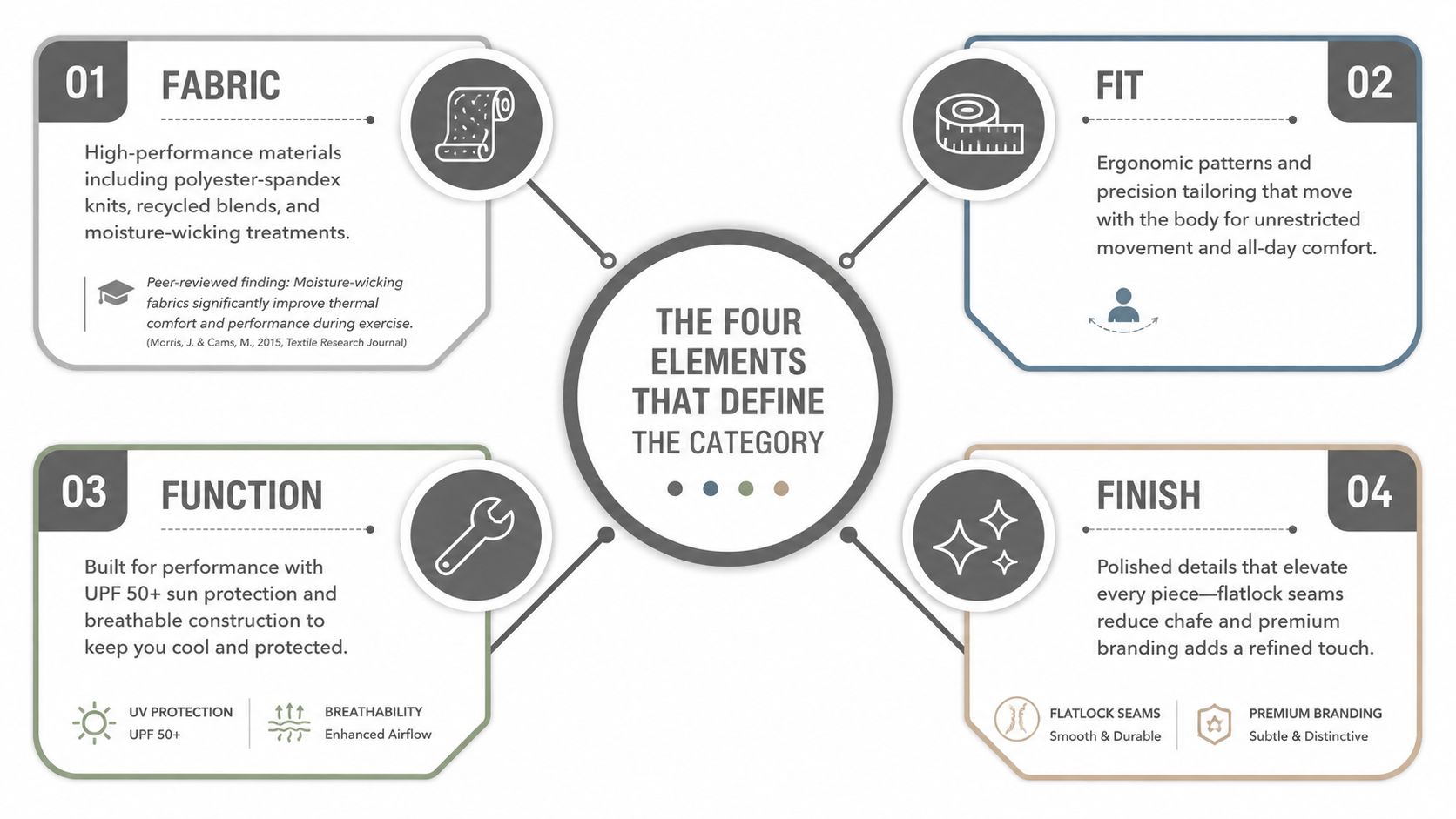
Fabric sets the comfort ceiling
Polyester, nylon, and spandex are common in active apparel because their chemistry supports moisture movement and stretch. Fabric structure matters just as much as fiber content. In a 2025 engineered-fabric study, the best-performing construction reduced average diffusion time by 86.4% before washing and 66.5% after washing, while increasing evaporation rate by 25.6% and 18.5%, respectively. The peer-reviewed textile research demonstrates why two shirts with similar fiber labels can feel very different in humid conditions.
Look for a knit that feels smooth rather than glossy, has enough body to hold a collar, and doesn't cling immediately when you sweat. Recycled blends can also serve the crossover purpose, but the label alone doesn't tell you how the fabric will drape or dry.
Fit should support movement quietly
A lifestyle polo shouldn't hang like a gym top or squeeze like a compression layer. Check that the shoulder seam lands near the shoulder bone, the sleeve finishes around mid-bicep, and the chest leaves enough room for a full turn without excess fabric billowing around your waist.
Trousers and shorts need the same discipline. A tapered leg keeps the outfit clean, but the seat and thigh still need room to rotate, squat, and walk. Try the actual movement you'll make on the course before deciding that a sleek silhouette fits.
Function earns its place
UV protection, stretch, breathability, and odor control can all matter during a long round. But don't assume a golf logo means verified sun protection. A 2025 peer-reviewed review of 671 golf-apparel items found that only 7.1% to 16.7% of clothing options carried UPF labeling, while coverage for the arms, hands, and neck remained limited. The study in the National Library of Medicine supports a useful buying rule: look for certified UPF labeling and add sleeves or neck coverage when exposure matters.
For adjacent outdoor apparel ideas, browse top fishing apparel with attention to sun coverage, ventilation, and layering. The environments differ, but the design questions overlap.
Finish decides whether it leaves the course
A clean collar, tonal buttons, matte hardware, polished seams, and a discreet logo help a garment cross into casual settings. These details don't improve your swing, but they change how the shirt reads at a restaurant or social event.
The strongest pieces don't shout “performance.” They let the fabric handle the technical work while the finish keeps the outfit composed.
Styling It for Different Golfers and Occasions
Style advice works better when it starts with the person wearing the garment. A range session, a brunch, and a client dinner may all involve golf apparel, but they don't demand the same visual balance.
The men's golfer often needs a fast transition from practice to a pub or casual restaurant. Start with a neutral polo, tapered shorts or joggers, and low-profile footwear. A curved-brim cap can keep the look athletic, while a clean overshirt or lightweight jacket gives the outfit enough structure for the next stop.
Women's golf lifestyle apparel needs equal attention to movement and proportion. Skorts, sleeveless polos, stretch trousers, and lightweight layering pieces can cover a round and post-golf plans, but the fit should reflect the wearer's actual activity rather than imitate men's proportions. A shorter layer can work over a skort, while a relaxed shirt may balance a more fitted bottom.
The executive golfer has a narrower margin for error. Choose a structured collar, muted palette, clean trousers, and a layer that can sit under a blazer or overshirt. Avoid loud graphics unless the setting clearly supports them. The objective is polished and mobile, not corporate golf costume.
| Segment | Core Silhouettes | Color Palette | Typical Occasions |
|---|---|---|---|
| Men | Neutral polo, tapered short or jogger, low-profile cap | Navy, stone, olive, white, charcoal | Range, round, pub, travel |
| Women | Sleeveless polo, skort, stretch trouser, light layer | Muted neutrals, soft earth tones, selective accent color | Golf, brunch, errands, social plans |
| Executives | Structured polo, tailored trouser, refined overshirt or jacket | Navy, gray, cream, dark green, restrained blue | Client outing, clubhouse dinner, travel, casual office |
The crossover case is supported by buyer behavior. Recent golf apparel market research found that 54% of premium buyers wore the same garment to golf and non-golf settings within 72 hours. That makes versatility a practical purchase criterion, not just a style preference.
For readers designing a practice area at home, call Modern Yard Landscapes today for ideas about backyard golf greens. Your clothing still needs to work when the “course” is a quick session before dinner, not only during a formal round.
A simple styling rule helps: keep the garment's performance features invisible, then use shoes, layers, and accessories to signal the occasion.
Fit, Fabric, and Care Habits That Matter
Performance fabric only works well when you care for it properly. Sweat-management research shows that fiber chemistry and knit structure influence drying and moisture transport, so laundering habits that damage the structure can gradually change how a garment feels.
Start with moisture-wicking knits. Use a cold wash, skip fabric softener, and tumble dry on low if the care label permits it. Fabric softener can coat fibers and interfere with the movement of moisture through the knit. A mild detergent is usually a safer choice than a heavily fragranced formula that leaves residue.
Treat collars differently
Structured collars and plackets need shape, not stiffness. Avoid building up starch, which can flatten the memory and make the collar look rigid rather than clean. Remove polos promptly after washing, smooth the collar by hand, and either lay the garment flat or use a hanger that doesn't distort the shoulder.
Stretch bottoms need special care. High heat can permanently reduce spandex recovery, which is why line drying or low-temperature drying is a safer routine for stretch shorts and trousers. Turn those garments inside out before washing to reduce surface friction and protect the face of the fabric.
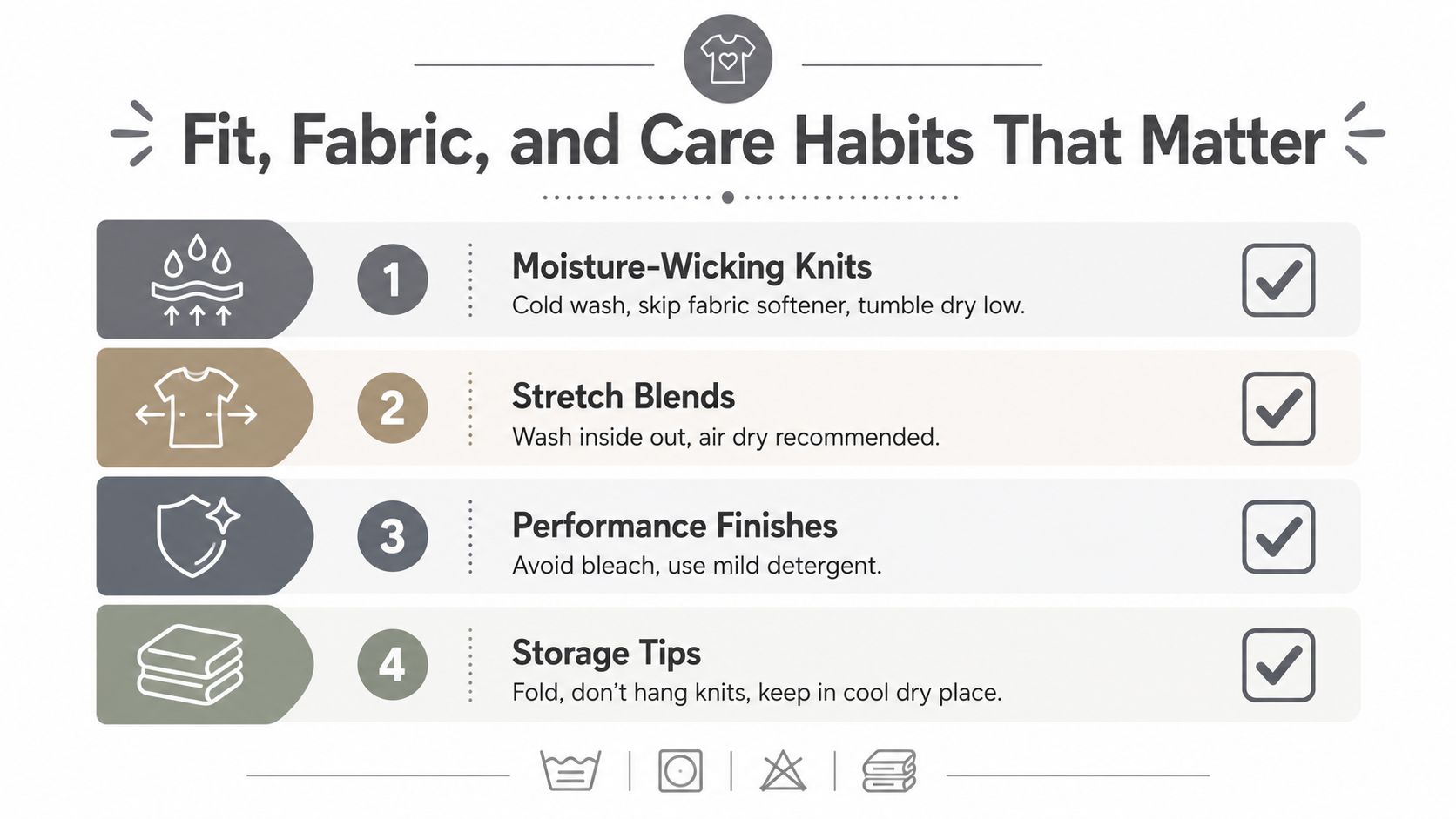
UPF finishes also deserve attention. Pilling, detergent residue, and fabric wear can reduce confidence in sun protection over time. If a garment claims UPF, follow its care instructions carefully. A UV-reactive card can offer a rough home check for whether light is passing through fabric, but it isn't a substitute for certified labeling.
For a broader packing routine that covers workout gear and post-gym grooming, think of golf clothing as part of a complete day rather than a single activity.
Keep moisture-wicking fabric terminology in perspective. The label matters, but your wash routine determines whether the garment keeps delivering the feel you bought.
- Polos: Cold wash, avoid softener and bleach, reshape the collar, and dry gently.
- Bottoms: Turn inside out, use mild detergent, and line dry stretch blends when practical.
- Headwear: Spot clean first, avoid harsh scrubbing, and air dry away from direct heat.
- Outerwear: Follow the care label closely, especially when the piece has a water-resistant or breathable finish.
Building a Wardrobe Around 2ndShotMVP
The best golf wardrobe feels like a system, not a pile of disconnected souvenirs. Start with a small rotation that covers the moments around the round: one performance polo for heat and movement, one lifestyle polo for dinner or travel, one hybrid short, and one structured cap.
That approach fits the culture of the 19th hole, where the round is only part of the day. Golfers may want clothing that reflects humor, personality, hometown pride, or a particular visual identity instead of another anonymous uniform. Technical fabric still matters, but it shouldn't erase the wearer.
2ndShotMVP offers golf hats, beanies, and lifestyle apparel, including the Ohio MVP Golf Pique Polo for men. Its headwear range includes adjustable snapback profiles and curved-brim silhouettes, giving golfers options that can look deliberately styled rather than purely athletic.
The crossover logic is straightforward. A polo that moves during a swing can pair with shorts at the course, denim at a casual lunch, or a lightweight jacket during travel. A cap with a clear shape can finish the outfit in all three settings without demanding a complete wardrobe change.
The 54% within-72-hours wear figure supports building around repeat use, rather than buying pieces for one imagined occasion. Legacy golf labels still occupy plenty of shelf space, but design-forward niche brands have room to attract golfers who treat apparel as self-expression.
For a focused starting point, explore the men's golf polo category and judge each piece by the same question: where else would you wear it?
What to Watch in the Category Next
Golf lifestyle apparel is moving toward a more useful definition of versatility. The next strong pieces won't merely claim to work on and off the course. They'll show it through adaptable fits, quieter branding, better layering, and designs that respect how different golfers dress.
Women's apparel deserves particular attention. One market report says men held 63.71% of 2025 demand, while women's apparel is forecast to grow at a 7.68% CAGR from 2026 to 2031. The AGM Golf fashion report also highlights women's interest in muted colors and more subtle branding, pointing to a need for more specific fit and styling guidance rather than generic unisex advice.
Use this buying checklist before your next purchase:
- Check the fabric: Look for stretch, breathable construction, and a finish that doesn't look overly glossy.
- Test the movement: Raise your arms, rotate your torso, and sit down before accepting the fit.
- Verify sun protection: Choose certified UPF labeling instead of assuming coverage.
- Inspect the finish: Prioritize collars, plackets, seams, buttons, and logo placement.
- Plan the second outfit: Decide how the piece works with non-golf trousers, shoes, or a jacket.
- Read the care label: Performance features depend on proper washing and drying.
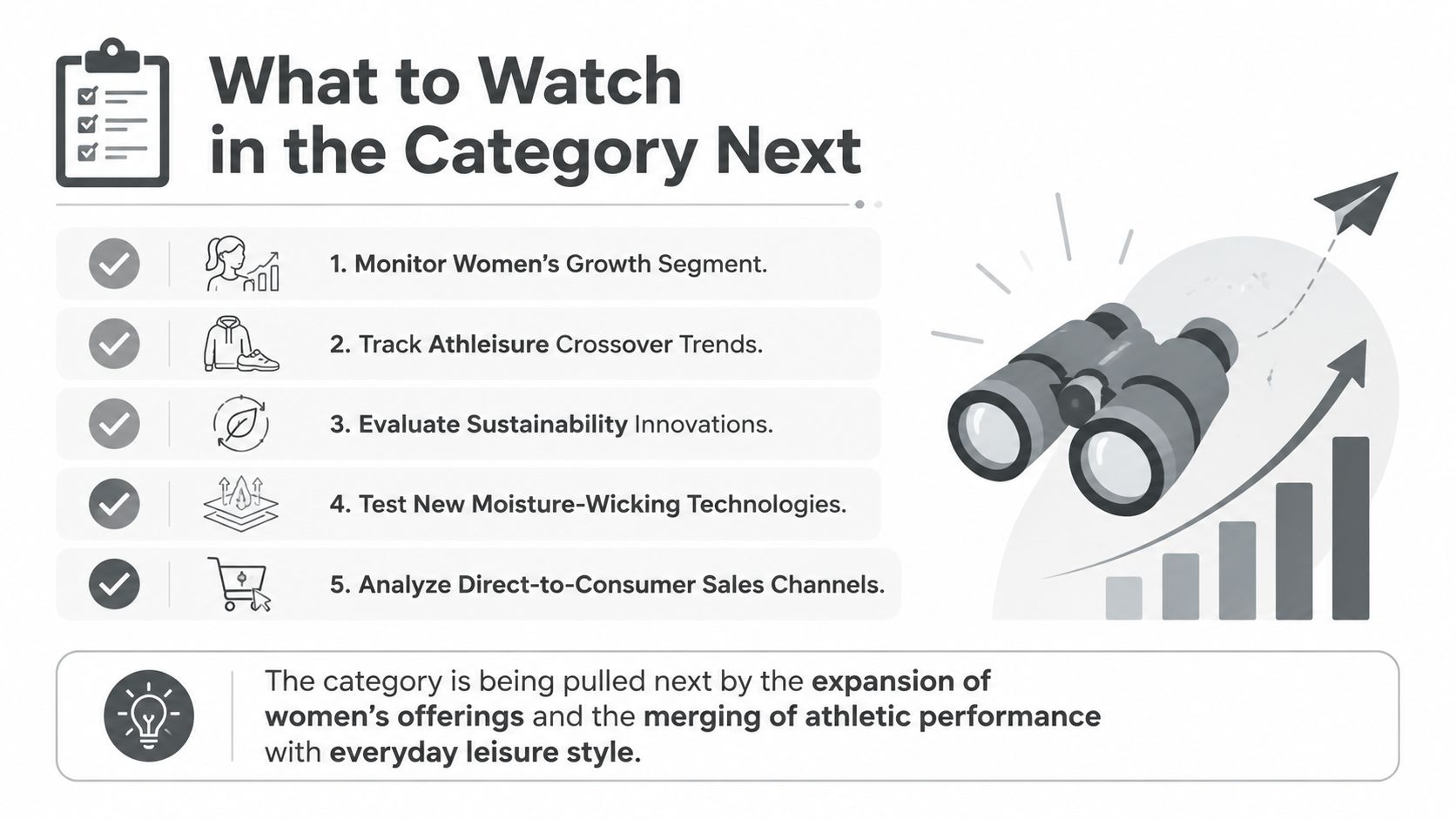
The category is being pulled by two connected ideas: women's offerings are expanding, and athletic performance is merging with everyday leisure style. Buy for the life around your round, and your wardrobe will keep up with the game.
2ndShotMVP offers golf hats, beanies, and lifestyle apparel built around expressive designs you can wear on and off the course. Visit 2ndShotMVP to choose a polo or headwear piece that can handle your next round, the 19th hole, and the rest of your week.
