

You're standing on the 14th tee, one hand on the driver and the other on your hat. The wind has found the exposed fairway, your cap is trying to join the foursome behind you, and the sweatband has left a bright red stripe across your forehead. Or perhaps the opposite has happened. The hat feels fine in the shop, then starts clamping down by the back nine.
A flex fit hat sizing chart helps, but it isn't the whole fitting job. Head circumference gives you the starting point. Head shape, hair volume, crown depth, fabric, heat, and how long you'll wear the cap determine whether it stays comfortable through the round. Use the chart as a guide, then fit the hat like equipment, not like a souvenir.
Why Standard Hat Sizes Fail on the Golf Course
A rigid fitted cap offers a precise size, but precision isn't always comfort. If the crown is slightly too small, the sweatband presses against your forehead every time you bend over a putt. If it's too large, the cap shifts during a practice swing and disappears the moment the wind turns up.
Generic apparel labels don't solve the problem. A label such as small or large says very little about where the cap will sit, how much room the crown provides, or whether the band can accommodate your head throughout an afternoon. Your head isn't shaped like a mannequin, and a golf course doesn't have the same temperature or movement as a fitting room.

The stretch-fit advantage
The modern Flexfit model traces to 1994, when Flexfit caps were introduced as the original stretch-fit cap. Yupoong later described that technology as the “backbone” of its Flexfit line, which explains why its sizing system is built around flexible bands rather than only fixed numeric hat sizes. You can read the brand's history in the Flexfit account of its stretch-fit technology.
That design fills the gap between a traditional fitted cap and an adjustable snapback. You get a closed-back appearance, but the fabric can accommodate neighboring head sizes. One cap size can cover a broader circumference window than a rigid fitted cap, provided the crown and shape suit you.
For golfers, that flexibility matters. Your cap needs to stay secure during a swing without squeezing your forehead for several hours. It also needs enough structure to hold its shape when you remove it at the turn.
Shop-floor rule: A cap should feel secure when you shake your head, not tight when you forget you're wearing it.
The construction still matters. A structured, high-profile cap can feel more restrictive than an unstructured, lower-profile model even when both carry the same alpha size. If you want a deeper explanation of those design differences, compare structured and unstructured hats before choosing a model.
How to Measure Your Head for a Perfect Fit
Start with a soft tailor's tape. A rigid metal tape won't follow the curve of your head accurately, and guessing from an old cap usually produces the same result as guessing a yardage with your eyes closed.
Stand naturally and measure where the sweatband will sit. The practical position is about 2.5 cm above the eyebrows and above the ears, around the head's circumference. This placement reflects the cap's wear position and helps reduce errors caused by forehead shape or hair volume, as shown in the Flexfit sizing chart guidance.
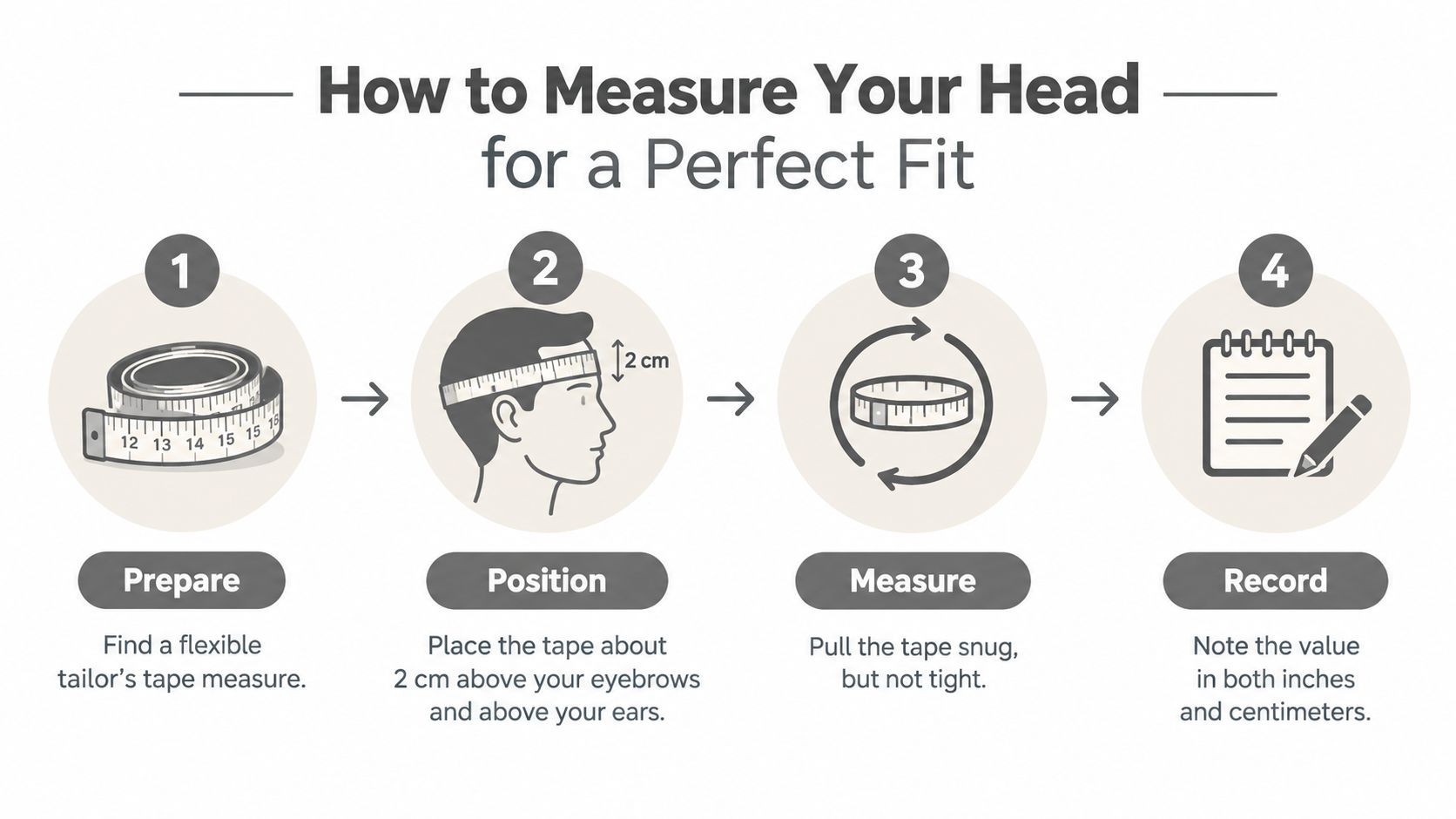
Follow these steps
- Prepare. Use a flexible tape, or wrap a piece of string around your head and measure the string with a ruler afterward. Keep your hair in the condition you'll usually have on the course.
- Position. Place the tape above your eyebrows, pass it above your ears, and bring it around the widest practical part of your head. Don't angle the tape upward at the back.
- Measure. Pull the tape snugly so it touches your head, but don't compress your hair or skin. A tight measurement creates a cap that feels acceptable for five minutes and irritating by the ninth hole.
- Record. Write down the result in centimeters and inches. Measure again to confirm it, especially if the first reading lands near a size boundary.
The tape should lie flat rather than twist. Don't measure over a bulky hairstyle if you normally wear your hair flatter under a cap, but don't flatten substantial hair artificially just to obtain a smaller number. Hair volume is part of your real fit.
For a more visual walkthrough, use this head-measurement guide and keep the final number available when you compare product charts. Flexfit-style sizing commonly works within a practical benchmark of roughly 53 to 65 cm, with retail products often using bands such as S/M, L/XL, or one size rather than exact fitted numbers.
The Ultimate Flex Fit Hat Sizing Chart
Use circumference first, then check the product's own chart. Global hat sizing is based on head circumference, and common reference points map 56 cm to M, 58 cm to L, 60 cm to XL, and 62 cm to XXL. U.S. fitted hats commonly move through eighth-size increments such as 6 5/8, 6 7/8, 7, 7 1/8, and 7 1/4, as outlined in this hat-size conversion reference.
The table below is a practical reference, not permission to ignore the label sewn into the cap. Alpha sizing differs across manufacturers, and a stretch-fit S/M from one product line may not feel like an S/M from another.
| Inches | Centimeters | Flexfit Alpha Size | US Fitted Size |
|---|---|---|---|
| Approximately 20.5 to 25.2 | Approximately 52 to 64 | XS through XXXL equivalents | Use the product's fitted conversion |
| 56 | M reference point | See product chart | |
| 58 | L reference point | See product chart | |
| 60 | XL reference point | See product chart | |
| 62 | XXL reference point | See product chart | |
| 6 5/8, 6 7/8, 7, 7 1/8, 7 1/4 are common U.S. fitted increments |
The broad adult reference span of approximately 52 to 64 cm, or about 20.5 to 25.2 inches, runs through XS to XXXL equivalents. That span is useful for understanding the market, but it doesn't mean every cap offers every size. A specific model may stop at S/M and L/XL, or use a different combination such as M/XL or L/XXL.
Reading the chart at the boundary
If your measurement sits cleanly inside one band, choose that band. If it lands directly on a cutoff, don't treat the number as a verdict. A golfer who prefers a firm, low-profile hold may choose the smaller compatible band, while someone playing in heat or wearing fuller hair should usually choose the roomier option.
Check the crown as well as the band. A larger alpha size won't fix a shallow crown, and a smaller size won't make a tall crown sit lower. The chart identifies the neighborhood. The try-on decides the address.
Navigating Borderline Sizes and Overlapping Bands
The frustrating answer is that two legitimate retail charts can recommend different sizes for the same head. One chart maps S/M to 21 to 22.5 inches and L/XL to 22.5 inches and up. Another maps S/M to 21.2 to 22.8 inches and L/XL to 22.4 to 23.9 inches, according to this Flexfit retail sizing comparison.
That overlap isn't a measurement error. Stretch-fit products use bands, and manufacturers make different decisions about how much a band should cover. Product construction also changes the experience. A cap with a firm structured front won't behave exactly like a softer performance model.
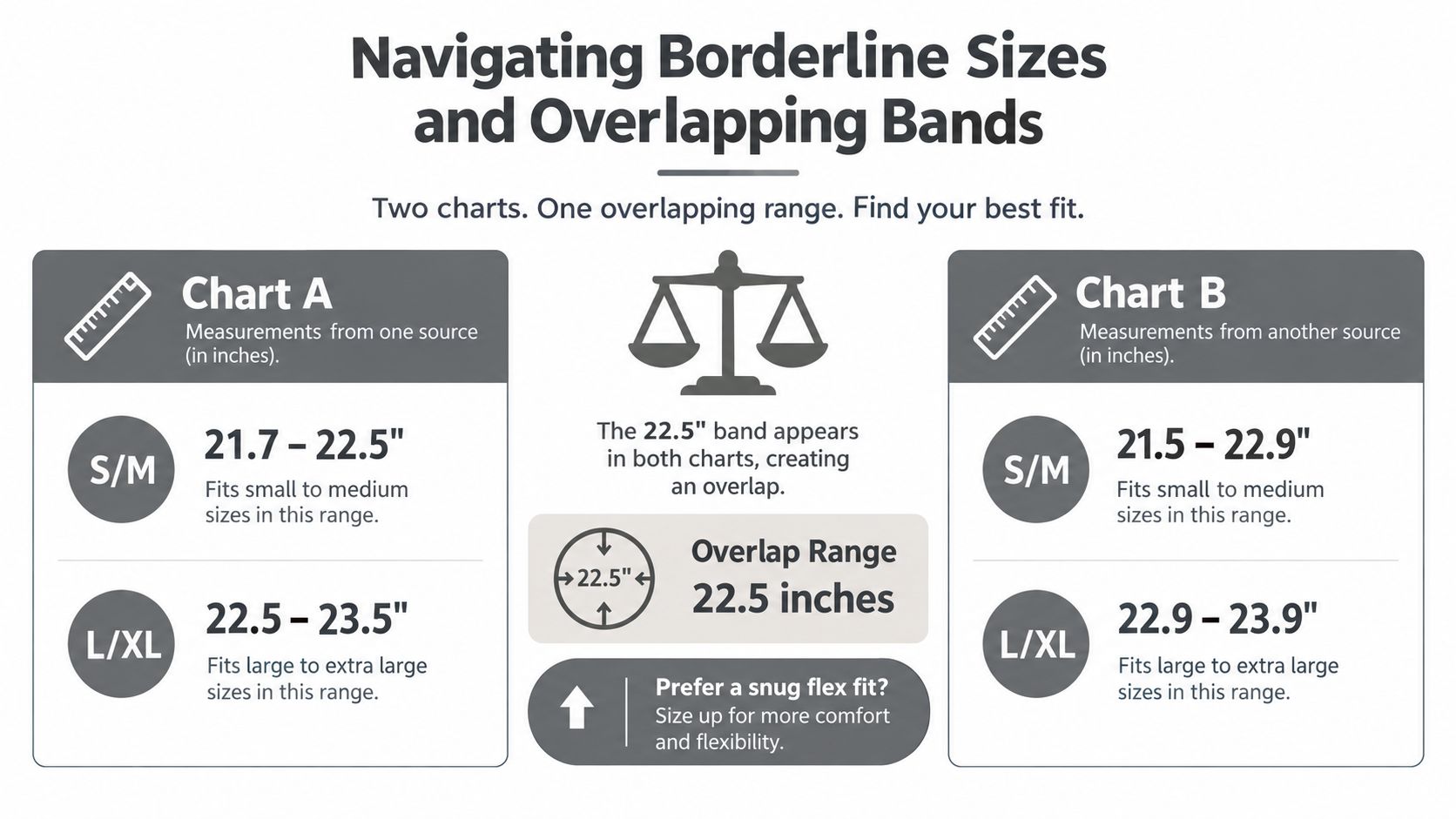
Use the right tie-breaker
At a borderline measurement, choose according to the job the cap must perform.
| Your situation | Better starting choice | Why |
|---|---|---|
| You like a close, secure fit | Smaller adjacent band | It creates a firmer hold, provided pressure stays comfortable |
| You wear fuller hair | Larger adjacent band | Hair volume occupies space that the tape measurement may not fully represent |
| You play long rounds in warm weather | Larger adjacent band | Extra room reduces the chance of a progressively tighter feel |
| You want a low, tailored look | Smaller compatible band | A firm band can help the cap sit neatly, if the crown fits |
| The cap already feels tight in the store | Size up or change crown profile | Stretch is not a substitute for adequate room |
Don't size down just because the smaller cap looks sharper on the rack. A red forehead mark isn't a style feature. On the other hand, don't automatically size up if the band already moves when you rotate your head.
Borderline rule: If both bands fit, choose the one that stays comfortable after movement, not the one that feels impressive for the first thirty seconds.
Try the cap with the brim level, then turn your head, bend forward, and make a slow practice swing. If the band presses at one spot, the issue may be head shape or crown construction rather than the circumference number.
Head Shape and Crown Depth Variables
Circumference is only one measurement. Two golfers can record the same number and have completely different experiences because one head is rounder while the other is longer and more oval.
A rounder profile distributes pressure more evenly around the crown. An oval profile may create pressure at the temples while leaving extra space at the front or back. Stretch fabric follows that shape to a degree, but it can't redesign the cap's panels. If the sweatband grips in the wrong places, changing alpha size may only trade one problem for another.
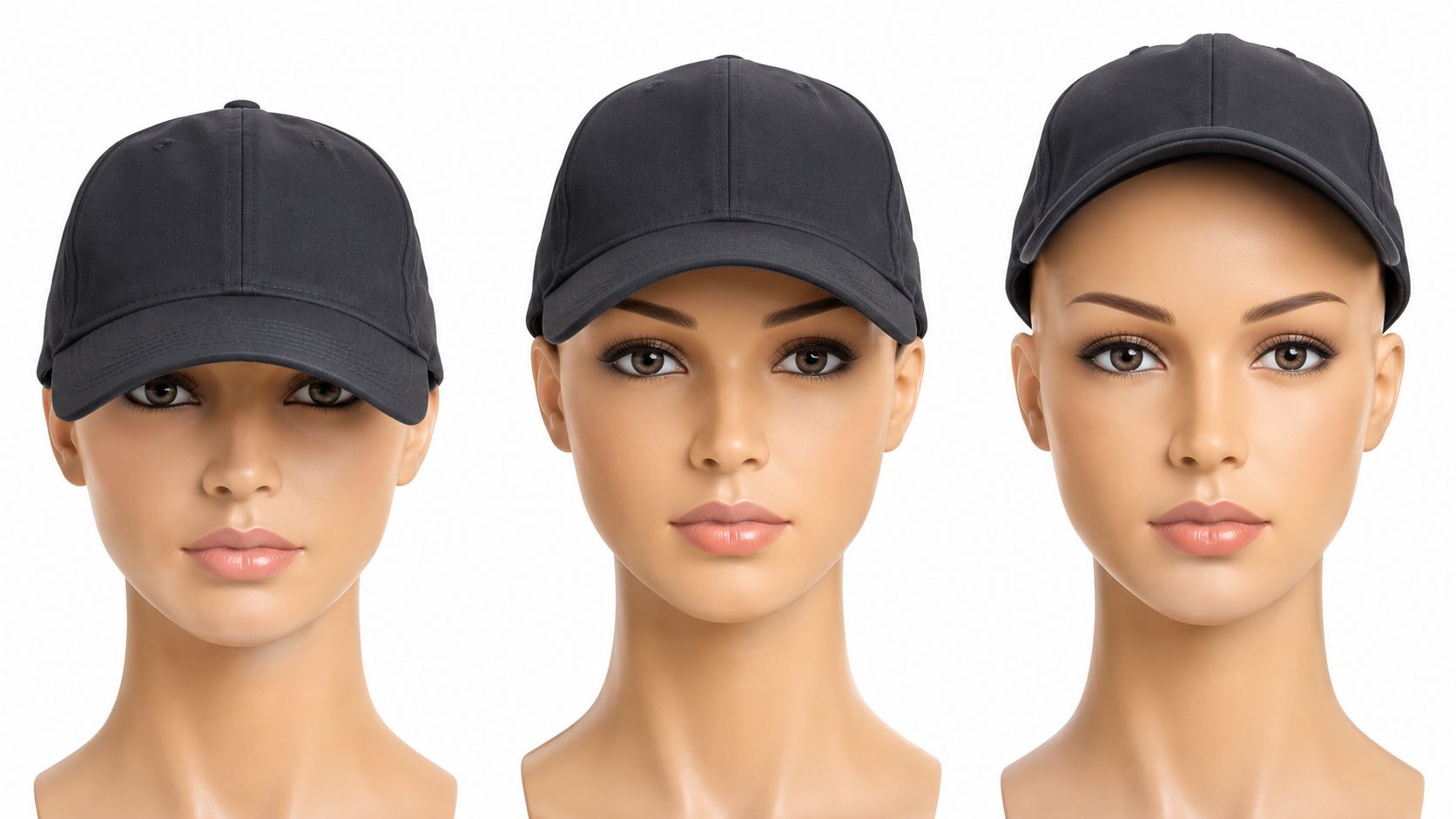
Crown depth changes the verdict
A high-profile structured crown holds more shape above the head. A low-profile unstructured crown collapses closer to it. The same circumference can therefore look and feel very different depending on whether you prefer a tall, firm front or a softer, lower fit.
Watch for these signs:
- Pressure at the temples: The cap may be too narrow for your head profile, even if the circumference appears correct.
- A gap behind the sweatband: The crown or head shape may not match, especially if the band fits at the sides.
- A mushroomed silhouette: The crown is likely too tall or too full for your head, rather than just too large.
- The brim riding high: The crown may be shallow, or the band may be sitting above its natural position.
Retail guides show that Flexfit formats can range from broad one-size spans of approximately 20.2 to 24.5 inches to separate buckets from XS through XXL, so a universal assumption about every Flexfit cap is a mistake. The product format matters as much as the label, as illustrated by this Flexfit product sizing reference.
A useful test is to try the cap with your usual hairstyle and with the brim positioned as you wear it on the course. If the number is right but the silhouette is wrong, change the crown profile before changing your head size.
A cap that fits your circumference but fights your head geometry won't become comfortable through optimism. Choose the shape that matches your head, then use the stretch in the fabric for fine adjustment.
On-Course Fit Dynamics and Material Behavior
A cap's fit changes during a round because the conditions change. Heat, sweat, hair volume, and repeated movement all affect how the band feels against your head. The cap that feels perfect beneath a shop's cool lights may feel more noticeable after hours outdoors.
Don't shop by material name alone. Look at how the cap is built. A soft, flexible fabric may settle differently from a firmer performance crown, while mesh panels can change the way the cap ventilates and holds its shape. The point isn't to crown one fabric the winner. The point is to match the construction to your playing conditions.
Make the course part of the fitting room
For warm-weather golf, avoid buying a borderline-tight cap with the hope that stretch will solve everything. A cap can relax with wear, but you shouldn't rely on that to compensate for pressure at the forehead or temples. Start with a comfortable fit and let the fabric provide gentle security.
Hair needs the same practical treatment. If you play with hair tucked under the cap, measure and try it that way. If you switch between a flat style and a fuller style, choose the fit that works for the hairstyle you wear most often on the course.
Your movement test should include more than standing in front of a mirror:
- Bend to address an imaginary ball.
- Turn your head toward the target.
- Make a controlled practice swing.
- Look upward as though tracking a high shot.
- Wear the cap long enough to notice pressure points.
If the cap stays put but leaves a concentrated mark, the band is probably too aggressive for your preference. If it moves when you rotate your head, the band or crown may be too generous. If it feels fine until you add hair, hair volume is the deciding variable, not a mysterious defect in the chart.
For golfers choosing a cap from a brand such as 2ndShotMVP, use the listed head-circumference guidance as the first filter, then compare the product's alpha size and crown style with how you play. A cap is equipment you wear for the entire round. Fit it with the same honesty you'd use for a pair of golf shoes.
Preserving the Stretch and Shape of Your Cap
A good fit can disappear through poor care. Sweat, sunscreen, and dust collect in the band, but aggressive washing can change the fabric's feel and the crown's shape.
Check the care label first. If it allows hand washing, use cool or lukewarm water, a small amount of mild detergent, and a soft cloth. Work gently around the sweatband and stained areas rather than scrubbing the entire crown as if you're cleaning a golf cart tire.
A simple care routine
- Clean by hand: Soak or wipe the cap according to the label, then rinse thoroughly so detergent doesn't remain in the band.
- Reshape while damp: Restore the crown and brim with your hands before drying. This keeps the cap from setting into a lopsided form.
- Air-dry naturally: Place it over a rounded support or a clean towel. Avoid high heat unless the care instructions specifically permit it.
- Store with room: Don't crush the crown beneath heavier clothing or leave the brim bent at an unnatural angle.
- Handle the band carefully: Pulling the sweatband sharply can reduce its ability to return to its intended shape.
The dryer is a poor place for a fitted golf cap unless the manufacturer explicitly approves it. Heat can alter elastic components, adhesives, and shaping materials. A hot wash can create a fit problem that no sizing chart caused.
For a broader look at how stretch construction affects wear and care, see this guide to stretch-to-fit hats. The practical principle is simple: clean sweat from the band, preserve the crown, and let the cap dry at its own pace.
Don't store a damp cap in a golf bag overnight. Air it out first, then place it where the crown won't be crushed. Care won't change an incorrect size into a correct one, but it can prevent a comfortable cap from becoming misshapen.
Quick Troubleshooting for Common Fit Issues
A fit complaint usually points to a specific mismatch. Diagnose the symptom before reaching for a new size.
| Problem | Likely cause | Practical fix |
|---|---|---|
| Red mark on the forehead | Band is too tight, or crown shape concentrates pressure | Try the larger adjacent band or a different crown profile |
| Cap flies off in wind | Band is too loose, crown doesn't grip, or the cap sits too high | Recheck the measurement and try the smaller compatible band |
| Brim sits high above the ears | Crown depth or shape doesn't match your head | Choose a lower-profile or better-shaped crown |
| Back of the sweatband gaps | Head shape and cap panels don't align | Try another construction before changing circumference |
| Cap feels fine at first, then tightens | Borderline fit, fuller hair, or extended wear | Choose more room rather than hoping the fabric will behave |
| Cap looks oversized but doesn't move | Crown is too tall or broad | Keep the circumference and change the crown profile |
If the cap is only slightly loose, a removable foam sizing strip can provide a small adjustment. Place it behind the sweatband, test the cap with the brim level, and remove it if the band begins to press. Don't pack the crown with bulky material. That changes the shape and can create new pressure points.
For a slightly tight cap, gentle hand stretching may help, but don't force the elastic or pull aggressively on the panels. If the pressure remains concentrated at one temple, the problem is probably head shape or construction rather than a simple need for more circumference.
Final fitting test: The right cap stays secure through a practice swing, sits level above the ears, and becomes easy to forget.
The flex fit hat sizing chart gives you the measurement range. Your head shape chooses the crown, your hairstyle affects the room you need, and the course exposes every bad decision. Check all three before you buy.
2ndShotMVP offers FlexFit golf hats, beanies, and lifestyle apparel with designs made for wear on and off the course. Use your measured circumference and the product's size guidance to choose a cap that won't distract you by the back nine, then visit 2ndShotMVP to find your next golf hat.

