

Ever feel like you’re trying to crack a secret code when you hear golfers talk? All that lingo about "birdies" and "bogeys" can sound like a foreign language. But here's the secret: golf scoring is really just about counting how many swings (or strokes) it takes you to get that little white ball into the hole.
The goal is simple: get the lowest score possible. Each hole on the course has a target score, known as par. Your mission, should you choose to accept it, is to meet or beat that number on every hole you play.
Why Understanding Golf Scoring Is Your Secret Weapon
Alright, let's get you your official golf scoring decoder ring. If you've ever found yourself just smiling and nodding when your buddies start throwing around terms like 'birdie,' 'bogey,' and 'par,' you've come to the right place. We're going to break down golf scoring in a way that actually makes sense, ditching the stuffy jargon for simple, real-world examples.

Knowing the lingo does more than just help you keep score. It's the key to truly getting the game, whether you're battling it out with friends for bragging rights or watching the pros make it look easy on a Sunday afternoon. Suddenly, you'll understand the drama behind every shot and appreciate the difference between a fantastic hole and a total train wreck.
What You Will Learn Here
We're going to build your scoring knowledge from the ground up, piece by piece. By the time we're done, you'll feel right at home on the first tee.
Here's what's on the menu:
- The Core Concepts: We'll nail down what 'par' really is and how those awesome scores like 'birdie' and 'eagle' happen.
- Practical Skills: You'll learn how to fill out a scorecard like you've been doing it for years.
- Game Variations: We’ll untangle the two main ways to play: Stroke Play vs. Match Play.
- The Great Equalizer: You'll finally understand handicaps and how they make the game fair for everyone with Net vs. Gross scoring.
Think of learning golf scoring like learning the rules of your favorite board game. Once you know the basics, the real fun begins, and you can start thinking strategically about your next move.
When you're through with this guide, you won't just be faking it. You'll be the one explaining the rules to your friends. This is your first step to tracking your game with confidence. And while you're at it, get your swing started right with our essential golf tips for beginners.
Ready? Let’s tee off.
The Building Blocks of Golf Scoring
Alright, let's get down to brass tacks. To make any sense of golf scoring, you have to wrap your head around one crucial word: par. Think of par as the "expected" score for a hole—the number of swings a scratch golfer should take to get the ball from the tee into the cup. It’s the benchmark, the gold standard for every hole you play.
Every time you tee it up, you're facing a new puzzle. Can you solve it in the target number of strokes? Or, if you're really on your game, can you do it in even fewer? Your performance against that simple number is where golf’s quirky, bird-themed vocabulary comes to life.
Scoring Better Than Par
This is where the high-fives happen. Nailing a score that’s better than par is what keeps us all coming back for more. Each level of "under-par" brilliance has its own name, like a little badge of honor you get to pencil onto your scorecard.
- Birdie: You finished a hole in one stroke under par. Sinking a putt for a 3 on a Par 4? That’s a birdie, my friend, and it feels fantastic.
- Eagle: Even better. An eagle is when you conquer a hole in two strokes under par. Imagine hitting a great drive and a perfect approach shot to card a 3 on a Par 5. That's eagle territory.
- Albatross (or Double Eagle): Now you're just showing off! An albatross is three strokes under par—like making a 2 on a Par 5. This is the unicorn of golf. Seriously, the odds of an amateur golfer making one are about six million to one.
Fun Fact: These names weren't just pulled out of a hat. "Birdie" came from early 20th-century American slang where "bird" meant something cool or excellent. An "eagle," being a bigger, more impressive bird, was the logical next step for an even better score.
Scoring Over Par
Look, golf is hard. Sometimes, a hole just fights back. Just as we celebrate the good scores, there are names for when you need a few extra swings. Don't sweat it—it happens to everyone, from the weekend warrior to the pros you see on TV. The key is to shake it off and be ready for the next shot. Staying organized helps, which is why having your gear in order is so important. Check out our guide on how to properly organize a golf bag to make sure you're always prepared.
- Bogey: This is a score of one stroke over par. Taking 5 shots on a Par 4 is a bogey. It's the most common "oops" in golf.
- Double Bogey: Just like it sounds—two strokes over par. That would be a 6 on a Par 4.
- Triple Bogey: You guessed it, three strokes over par. From here, the numbers just keep climbing, but we don't need to dwell on those!
This whole system—par, birdie, bogey—is the language of the game. Here’s a quick cheat sheet to pull it all together.
The Language of Golf Scoring at a Glance
This little table is your Rosetta Stone for golf scores. Keep it handy, and you'll be talking like a seasoned pro in no time.
| Term | Score Relative to Par | Simple Explanation |
|---|---|---|
| Albatross | -3 | The rarest bird of all. Truly a once-in-a-lifetime shot. |
| Eagle | -2 | A fantastic score that can supercharge your round. |
| Birdie | -1 | A great feeling and a common goal on any hole. |
| Par | E (Even) | The target score. You met expectations perfectly. Solid work. |
| Bogey | +1 | One more than you wanted. Shake it off and move on! |
| Double Bogey | +2 | Two strokes over. Time to hit the reset button. |
Once you've got these terms down, you're ready to understand how a full round comes together on the scorecard.
How to Keep a Golf Scorecard Like a Pro
That little piece of paper they hand you in the pro shop or stick in your golf cart? It might look like an accountant's day planner, but it’s actually your best friend on the course. Learning to use it is a rite of passage for any golfer. It’s what separates someone who just hits a ball around from someone who’s actually playing the game.
Think of the scorecard as your personal story for the day—a record of your triumphs, your disasters, and everything in between, one hole at a time.
Each row on that grid is a new chapter: one of the 18 holes on the course. You'll see columns for the hole number, its par, and how long it is (the yardage). Your only job is to scribble down the number of whacks it took you to get the ball in the cup for each hole. Simple as that.
And a lot of people are doing that scribbling. Recent golf participation statistics show the game is booming, with millions of golfers logging tens of millions of scores. What’s really interesting is the huge jump in 9-hole rounds being played, proving that plenty of us are happy to squeeze in a quick game without committing to a five-hour marathon.
Stroke Play vs. Match Play: The Two Ways to Win
Alright, before you start adding up numbers, you need to know what game you're playing. Golf scoring really boils down to two main formats, and your strategy will change completely depending on which one you choose.
-
Stroke Play: This is the format you see in most professional tournaments and what most of us play on a Saturday. It’s you against the course. Every single shot counts, from the first tee to the last putt. The player with the lowest total score at the end of the round wins. Be warned: one epic meltdown on a single hole can absolutely wreck your entire day in Stroke Play.
-
Match Play: Forget the total score. This is a gritty, head-to-head duel. You're competing to win individual holes, not the whole round. If you shoot a 4 and your opponent gets a 5, you win the hole. That's it. The person who wins the most holes wins the match. The beauty here? If you have a total disaster and score a 10, you just lose that one hole. You can shake it off and start fresh on the next tee.
On the scorecard, you'll see boxes to add up your front nine (holes 1-9), your back nine (holes 10-18), and the grand total. In Stroke Play, that total is your final score. In Match Play, you're just keeping a running tally of who is "up" or "down."
This diagram really breaks down the three possible outcomes for any hole you play.
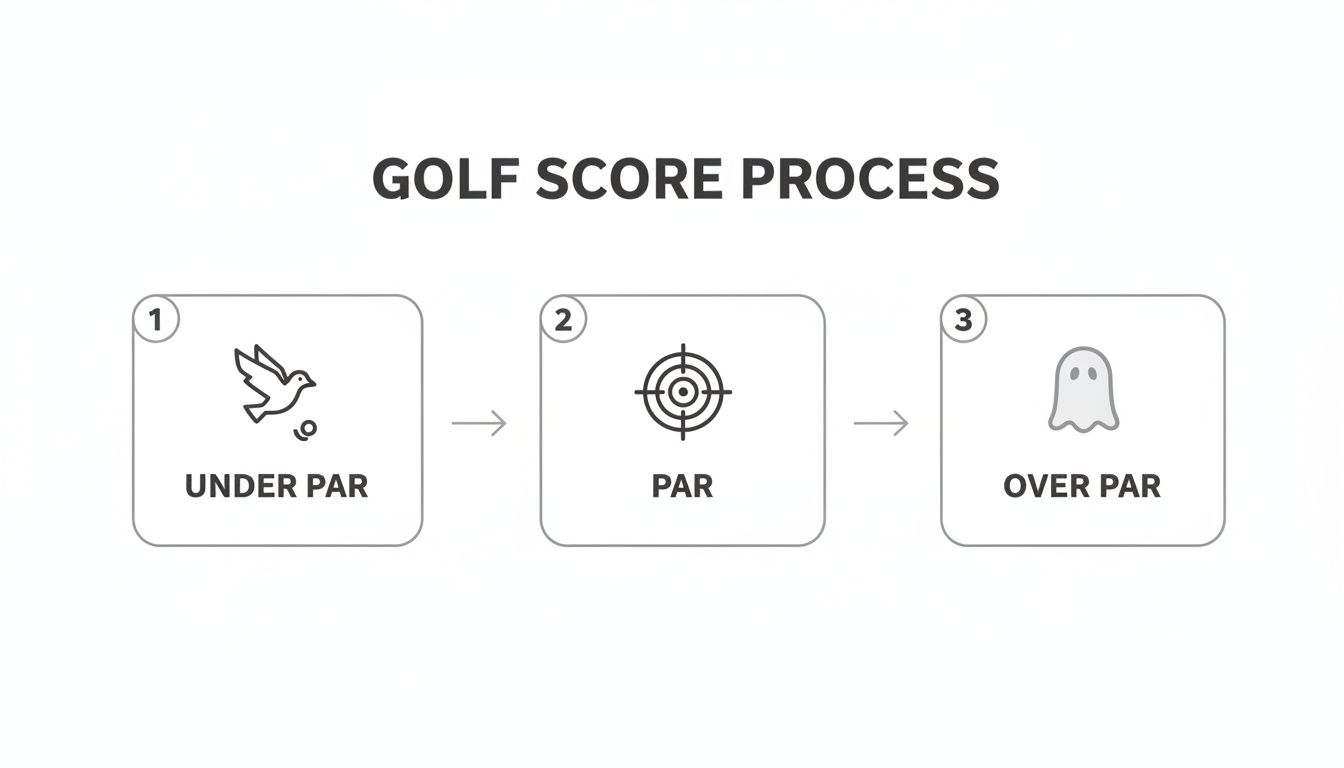
Essentially, every swing you take either gets you to the target (Par), beats it (Under Par), or falls short (Over Par).
Tips for Flawless Scorekeeping
Keeping an honest score is part of the soul of the game. It’s all about integrity. A few simple habits will keep things accurate and, just as importantly, keep your group moving.
Keep it simple. As you walk off the green, just ask, "What did everyone get?" Jot down the numbers right then and there. If you wait three holes to try and remember, you're just guessing.
Here’s how to avoid those rookie mistakes:
- Pick a Scribe: Decide on one person in the group to be the official scorekeeper. It just prevents a whole lot of confusion and "Wait, did you write that down?" moments.
- Count 'Em All: A whiff (swing and a miss), a penalty stroke for hitting it in the water, that chili-dipped chip that only went two feet... they all count. Honesty is everything in golf.
- Check Your Math: Before you sign that card—especially if you're in any kind of competition—add up your nines and the total again. You’d be surprised how many simple addition errors happen after a long day in the sun.
Getting comfortable with a scorecard is just as important as grooving your swing. And speaking of which, if you really want to see those numbers on the card drop, try some proven golf putting practice drills to clean up your short game.
Understanding Handicaps: Gross vs. Net Score
This is where golf gets really clever. Ever wondered how a total beginner can have a genuine, down-to-the-wire match against a friend who’s been playing for twenty years? The secret sauce is the handicap system, and it's the game’s ultimate equalizer.
Think of a handicap like your personal difficulty setting in a video game. It's a number that reflects your playing potential, figured out from your recent scores. This little number is what lets golfers of all stripes—from scratch players to weekend hackers—compete on a surprisingly even footing. It’s what turns a potential blowout into a proper dogfight and makes club tournaments and friendly bets fun for everyone.
Gross Score: The Raw Truth
Let's get the simple one out of the way first. Your Gross Score is just the cold, hard number of strokes you took to play 18 holes. You count up every single swing, add any penalties, and whatever that final number is—say, 95—that’s your Gross Score.
It's the unvarnished truth of how you played that day. It's the purest measure of your performance, warts and all, but it doesn't tell the full story when you're teeing it up against someone else.
That’s where the Net Score comes in and changes everything.
"The handicap system is designed to promote fairness and enjoyment. It’s not just about who shot the lowest number, but who played best relative to their own ability."
Net Score: The Great Equalizer
Now for the magic. Your Net Score is your Gross Score minus your handicap. This is the number that truly levels the playing field, showing how you actually performed against your own potential.
Let’s run through a quick example. Imagine two players:
- Player A (The Veteran): Shoots a Gross Score of 78. They have a handicap of 6.
- Player B (The Weekend Warrior): Shoots a Gross Score of 95. Their handicap is 20.
To see who really won, we just do a little subtraction:
- Player A's Net Score: 78 (Gross) - 6 (Handicap) = 72
- Player B's Net Score: 95 (Gross) - 20 (Handicap) = 75
So, Player A takes the win by just three strokes. Even though their raw scores were 17 shots apart, the handicap system brought them together for a tight, competitive match.
The modern World Handicap System (WHS) has made this even more precise. In fact, recent data shows the WHS has massively shrunk the scoring advantage low-handicappers used to have, proving it's doing its job to balance the scales. You can dig into the numbers and see how the WHS is improving competitive fairness on Golf Monthly.
Spice Up Your Round: Fun Golf Formats to Try

Sure, the classic grind of stroke play is the heart of golf, but sometimes you need to shake things up! Diving into different formats like Stableford, Skins, or a Scramble can transform a regular round into an unforgettable day with your buddies. It’s all about finding new ways to compete and have a good time.
These games aren't new inventions. The very idea of fair play and standardized scoring has deep roots. In fact, the first official USGA Handicap System was hammered out on October 11, 1911, at the legendary Baltusrol Golf Club. This moment laid the foundation for the competitive, yet equitable, game we all love. You can dive deeper into that history if you're a golf nerd like me.
Stableford: The "No Bad Vibes" Game
Hate it when one blow-up hole torpedoes your entire scorecard? Meet your new best friend: Stableford. Instead of counting every last stroke, you're chasing points. It’s a brilliant system that rewards you for going low without punishing you too harshly for the occasional disaster.
Here’s the breakdown of points you earn based on your score relative to par:
- 0 points for a double bogey or worse (just pick up and move on!)
- 1 point for a bogey
- 2 points for a solid par
- 3 points for a birdie
- 4 points or more for an eagle or that once-in-a-lifetime albatross
So, if you make a birdie, you get a cool 3 points. If you end up with a snowman (8), you just get zero and head to the next tee with your chin up. It keeps the mood light and encourages you to play aggressively.
“Stableford is perfect for groups that want to stay upbeat even on rough holes.”
Skins: High-Stakes Hole-by-Hole Drama
If you love a little friendly wager and a shot of adrenaline on every swing, a Skins game is where it's at. This isn't about the final score; it's about winning holes outright.
The concept is simple but creates incredible drama:
- Every hole is worth a "skin" (which could be a dollar amount, a drink, or just bragging rights).
- The player with the lowest score on a hole wins the skin. Simple.
- But here's the twist: if there's a tie, the skin "carries over" and is added to the pot for the next hole.
- This can lead to some massive, pressure-packed putts on later holes when 3 or 4 skins are up for grabs at once.
Skins makes every hole a self-contained battle, keeping everyone locked in from start to finish.
Scramble: The Ultimate Team Game
The Scramble is the go-to format for charity events, corporate outings, and casual rounds for a reason: it’s pure, unadulterated fun. It's a team game that takes the pressure off any one individual and lets everyone contribute.
Here’s how a four-person scramble typically works:
- Everyone on the team tees off.
- The team walks up and decides which drive was the best. Was it the longest? The one in the middle of the fairway? You pick!
- Everyone else picks up their ball and plays their second shot from that best spot.
- You repeat this process for every shot—including putts—until the ball is in the hole.
This format is fantastic for groups with mixed skill levels. It allows beginners to contribute without feeling overwhelmed and almost always leads to some ridiculously low team scores and a lot of high-fives.
Popular Golf Game Formats Compared
Deciding which game to play can be tough, so here’s a quick comparison to help you pick the perfect format for your next round. It all comes down to the vibe you're going for.
| Format | How It Works | Best For |
|---|---|---|
| Stableford | You score points on each hole based on your performance against par. Highest point total wins. | Groups with varied handicaps who want a relaxed, competitive game without scorecard-destroying blow-ups. |
| Skins | Players compete to win each hole outright. Ties push the prize (the "skin") to the next hole. | Golfers who enjoy a bit of gambling, pressure-packed moments, and hole-by-hole excitement. |
| Scramble | A team format where all players hit from the spot of the previous best shot. | Charity events, corporate outings, and casual rounds with beginners. It's fast, low-pressure, and great for teamwork. |
Ultimately, choosing the right format is about knowing your crew.
- Want a fast-paced game that keeps everyone in it? Go Stableford.
- Looking to add some thrilling, high-stakes moments to every hole? It has to be Skins.
- Just want to have a laid-back, social day focused on teamwork and laughs? Scramble is your answer.
Now you have a few new tricks up your sleeve. So get out there, pick a game, and have some fun
Got a Few More Scoring Questions? Let's Settle Them.
Still have some questions rattling around in your head? Good. You're thinking like a golfer. The rulebook can feel like it has more doglegs and water hazards than Pebble Beach, so a little confusion is part of the game. We've rounded up the most common head-scratchers we hear on the course and in the clubhouse to get you sorted.
Think of this as your secret weapon for settling those "friendly" arguments that always seem to pop up on the back nine. From the dreaded whiff to that ball you swear landed in the fairway (but didn't), we've got you covered.
What Happens If My Ball Disappears or I Hit It Out of Bounds?
Ah, the classic "uh-oh" moment. You pipe a drive, watch it sail beautifully... and then it hooks right into the trees, never to be seen again. We've all been there. The rules for this are designed to be fair, even if they don't feel like it at the time.
When your ball is lost or you hit it out of bounds (look for the white stakes), you take a one-stroke penalty and have to hit again from the same spot you just played from. This is called playing under "stroke and distance."
So, let's say you hit your tee shot OB. That's stroke one. You add a penalty stroke (that's two), and now you're hitting your third shot from the tee box all over again. It's a tough pill to swallow, but it’s a fundamental rule that keeps the game honest.
Do I Really Have to Count a Whiff?
Yep. Sorry. You absolutely do. A "whiff" is when you take a mighty swing with every intention of launching that ball into orbit, but you connect with nothing but air. It's frustrating, maybe a little embarrassing, but as far as the rules are concerned, that swing counts as one full stroke.
The core idea is simple: your intent is what matters. If you intended to hit the ball and swung, it’s a stroke. If you were just taking a lazy practice swing and accidentally nudge the ball off the tee? That’s usually not a penalty, but you do have to put the ball back.
How Do I Post a Score for My Handicap?
This is where things get interesting. Posting your scores is how you get and maintain an official handicap, but you don't always write down the exact number you shot on every hole, especially if you had an absolute train wreck on number 7. The World Handicap System (WHS) has a built-in safety net called Net Double Bogey to stop one disaster hole from blowing up your handicap.
Your maximum score on any given hole, for handicap purposes, is a Net Double Bogey. Here’s the formula:
- Par of the hole
- + 2 strokes (for the double bogey)
- + any handicap strokes you get on that hole
Let’s say you’re playing a Par 4 where your handicap gives you one stroke. Your maximum score for that hole is a 7 (4 + 2 + 1). Even if you wrote a 9 on the scorecard after a heated argument with a tree, you’d only post a 7 for your handicap. This genius little rule ensures your handicap reflects your actual potential, not your worst blow-ups.
What's a Gimme and Does It Count?
A "gimme" is that friendly gesture from your playing partner on a two-foot putt. They see it's short, they want to keep playing, and they say, "That's good, pick it up!" In casual games and especially in Match Play, gimmes are a godsend for speeding up the pace of play.
But when it comes to the official rules? There’s no such thing as a gimme. If you're playing in a Stroke Play tournament or posting a score for your handicap, you have to hole out every single putt. Every. Last. One. So, while they're great for a Saturday morning round with your buddies, they have no place on an official scorecard.
Now that you're armed with this insider knowledge, you can stride onto any course with the confidence of a seasoned pro. Here at 2ndShotMVP, we believe looking the part is half the battle. That confidence gets a little boost when you feel good and look sharp. Check out our collection of premium golf hats and apparel that are perfect for any round, from a club championship to a casual twilight nine. Shop the collection today at 2ndshotmvp.com

