

Let's be honest—the world of golf gadgets is a jungle. The best golf training aids aren't magic wands; they're specific tools designed to fix a specific problem in your swing. You wouldn't use a hammer to turn a screw, right? Same idea here. The key is matching the gadget to your game's biggest leak, whether it's a wonky putting stroke or a slice that loves the woods.
Finding a Training Aid That Actually Works for You
We’ve all been there. You see some flashy new training aid on Instagram, promising 20 more yards or dead-straight iron shots. You drop a small fortune on it, use it twice, and then it joins the pile of other "game-changers" collecting dust in the corner of your garage.
This guide is your ticket out of that expensive, frustrating cycle. We're cutting through the marketing fluff to connect you with gear that delivers real, measurable results where it matters most: on your scorecard.
Think of this as your personal game-improvement roadmap. But the first step isn't browsing Amazon. It’s a brutally honest look in the mirror. What's really holding you back? Are you constantly battling a slice? Do three-putts have a nasty habit of wrecking your rounds? Is your tempo more heavy metal than smooth jazz? Nailing down the root cause is half the battle.
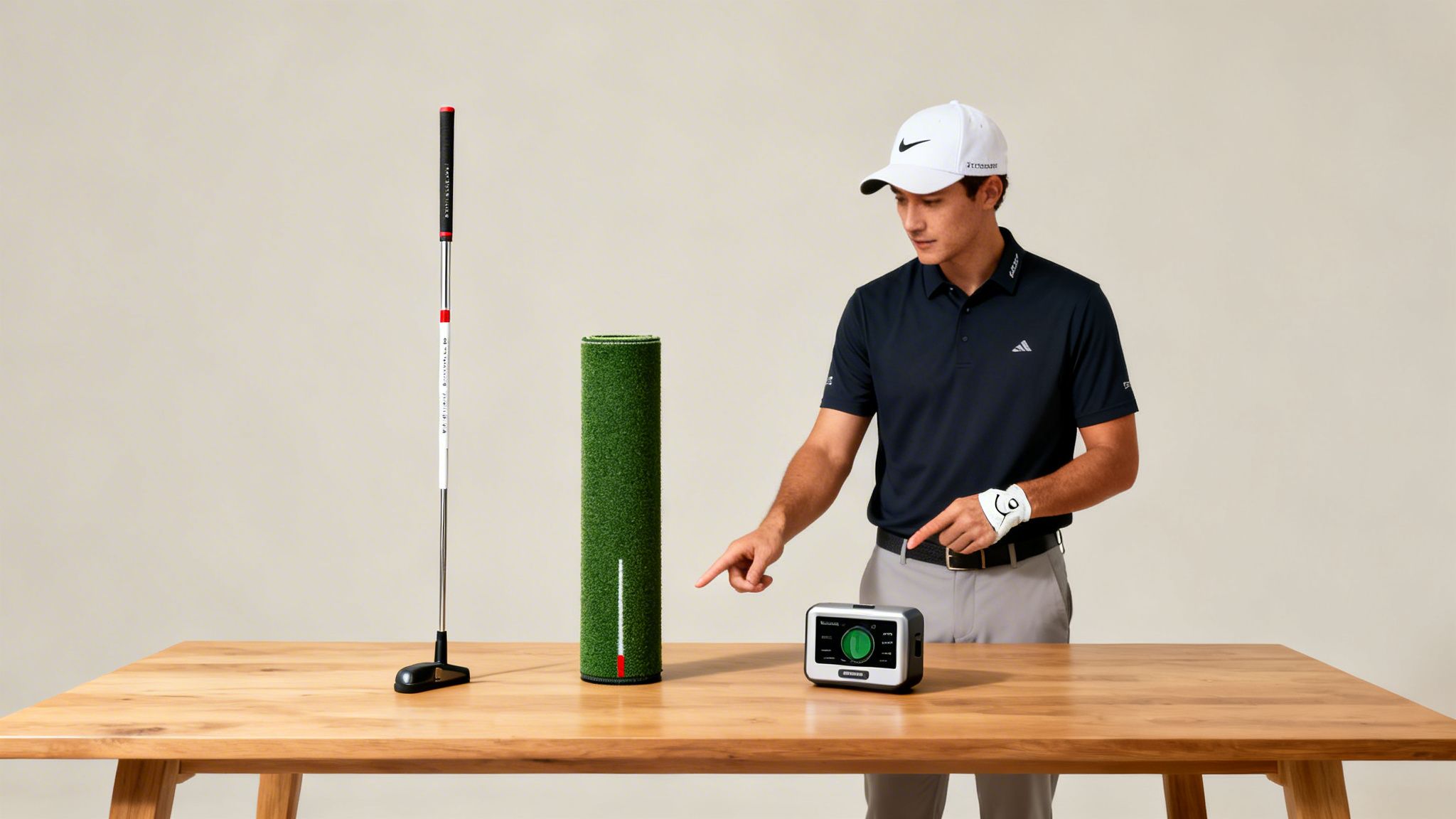
Diagnose Before You Buy
Before you can even think about finding the best golf training aids, you need that honest self-assessment. A tool designed to fix a slice is completely useless if your miss is a hook.
A great starting point? Take a few slow-motion videos of your swing on your phone. You’d be amazed at what you’ll see—things you’d never feel, like swaying off the ball or "casting" the club from the top.
Once you have a clear picture of your main fault, then you can start searching for a tool built specifically to give you feedback on that exact move. You're not just buying another product; you're investing in a solution.
The most effective training aids provide immediate, unambiguous feedback. You should know instantly if you've performed the drill correctly or incorrectly without needing to check a video or ask a coach.
This targeted approach saves you money and, way more importantly, makes your practice time infinitely more productive. Instead of mindlessly whacking balls and hoping for a different result, you’ll be actively grooving a better mechanic with a tool that forces you to improve.
To make this dead simple, I’ve put together a little cheat sheet to match common on-course frustrations with the right type of training aid.
Matching Training Aids to Your Swing Problems
Use this quick reference guide to identify which type of training aid is best suited to fix your specific swing or putting problems. This table will help you zero in on the gadgets that will have the biggest impact on your scores.
| Your Common Problem | Best Training Aid Category | How It Delivers Results |
|---|---|---|
| Inconsistent contact (thin or fat shots) | Impact Trainers & Swing Arcs | Provides instant tactile feedback on where the club bottomed out, training you to strike the ball before the turf. |
| Slicing or hooking the ball | Alignment & Path Aids | Uses visual guides (like sticks or gates) to ensure your club path and clubface are square at impact. |
| Lack of distance and power | Speed Training Systems | Uses weighted clubs or resistance bands to increase swing speed through overspeed training protocols. |
| Poor tempo and rhythm | Tempo Trainers | Often features a weighted head and flexible shaft to help you feel a smooth, connected transition from backswing to downswing. |
| Three-putts and missed short putts | Putting Mats & Alignment Mirrors | Provides guides for a straight-back, straight-through stroke and ensures your eyes are directly over the ball. |
| Aiming issues and poor setup | Alignment Sticks | Offers a simple, effective visual reference to ensure your feet, hips, and shoulders are aligned to your target. |
Think of this table as your starting point. By identifying your biggest headache and the tool designed to cure it, you’re already on the path to smarter practice and lower scores.
Breaking Down the Different Types of Golf Gadgets
Alright, let's talk gear. The world of golf training aids is a wild place, packed with everything from simple sticks to high-tech gadgets that look like they belong on a spaceship. It's easy to get overwhelmed. But if you know what you're looking for, you can cut through the noise and find something that actually moves the needle on your game.
Think of it like building a workshop. You don't just buy a random pile of tools; you get a hammer for nails, a saw for wood, and a wrench for bolts. Each tool has a specific job. The same goes for golf gadgets. A putting mirror won't fix your slice, and a swing speed trainer isn't going to help you drain more 6-footers.
So, let's break down the main families of training aids you'll run into. Knowing the difference will help you spend your money wisely and target the part of your game that's really holding you back.
Swing Trainers for a Repeatable Motion
Ever had a coach tell you to "feel" the right position? It's tough, right? Swing trainers are designed to do just that—they literally force your body to feel the correct motion. They’re all about building muscle memory for a consistent, repeatable swing.
These often come in the form of weighted clubs, flexible shafts, or molded grips that guide your hands into the perfect spot. They're not about hitting balls a mile; they're about grooving the right sequence and tempo so it becomes second nature.
A swing trainer is your new best friend if you struggle with:
- A crazy-fast tempo: You know, that jerky, rushed feeling from the top.
- The dreaded "over the top" move: The classic amateur slice-inducer.
- Getting your body and arms out of sync: This is a massive power leak for most golfers.
If your swing just feels like a jumble of disconnected parts, one of these can sync everything up without you having to juggle a dozen different swing thoughts on the range.
Putting Aids for a Rock-Solid Stroke
Putting is its own little universe, and the aids here are all about precision and repetition. Think putting mats with alignment lines, mirrors to check if your eyes are over the ball, and little gates that force you to start the ball on the right line.
The whole point is to take the guesswork out of your stroke. They help you build a simple, mechanical motion that you can trust when the pressure is on.
If you’re a chronic three-putter or get the yips over a short one, these are for you. Just rolling a few putts on a mat in your living room for 10 minutes a day can make a world of difference. While these tools are golf-specific, it's interesting to see how the broader category of performance training equipment applies similar principles of feedback and repetition to all kinds of athletic improvement.
Hitting Nets and Mats for At-Home Practice
Let's be honest, the biggest hurdle for most of us is just finding the time to practice. That’s where hitting nets and mats come in. They are the ultimate convenience play, turning your backyard, garage, or even a spare room into your own private driving range.
This setup is a total game-changer for anyone who can't get to the course every day. You can get your reps in whenever you have a spare 30 minutes, rain or shine. Sure, you can't see your ball flight, but you can absolutely work on solid contact and dial in the feel of your swing. Pair a net with a good mat and a few other gadgets, and you've got a killer home practice station. For more ideas on what to add, check out our guide on the best golf accessories.
Launch Monitors for Tour-Level Data
Not too long ago, getting pro-level data on your swing—ball speed, launch angle, spin rate—would have cost you a small fortune. Not anymore. Personal launch monitors have brought this incredible technology to the masses, making every practice session smarter.
These are for the golfer who loves to know the "why" behind every shot. It’s no surprise that around 25% of amateur golfers are now using smart devices to track their performance and get better, faster.
A launch monitor turns practice from pure guesswork into an actual science. You stop just banging balls and start gathering real, actionable data to map your distances, find your flaws, and actually see if the changes you're making are working.
How to Choose Your Perfect Practice Partner
Picking the right training aid is a lot like finding the perfect caddie—what works for your buddy might be a total disaster for you. It’s a personal decision, not something you grab just because you saw a flashy infomercial. The real secret is to tune out the hype and get honest about your own game.
Your mission is to find a tool that becomes a trusted sidekick, not another piece of gear collecting dust in the garage. This all comes down to taking a hard look at four key parts of your golf life. Get these right, and you’ll invest in something that actually shaves strokes off your scorecard.
Assess Your Actual Skill Level
First things first: get real about where your game is right now. Are you a total beginner battling a slice that has a mind of its own? Or are you a single-digit handicapper trying to dial in that perfect weight shift for more power? The tool you need is completely different for each of those golfers.
A beginner usually gets the most bang for their buck with simple, foundational aids. Think alignment sticks to nail your setup or a basic swing plane trainer to feel the right path. On the other hand, a more seasoned player might need the granular feedback from a launch monitor or a fancy wrist-angle sensor to fine-tune tour-level mechanics.
Bottom line: don't buy a Formula 1 car if you're still learning to drive stick.
To help point you in the right direction, this decision tree is a great starting point.
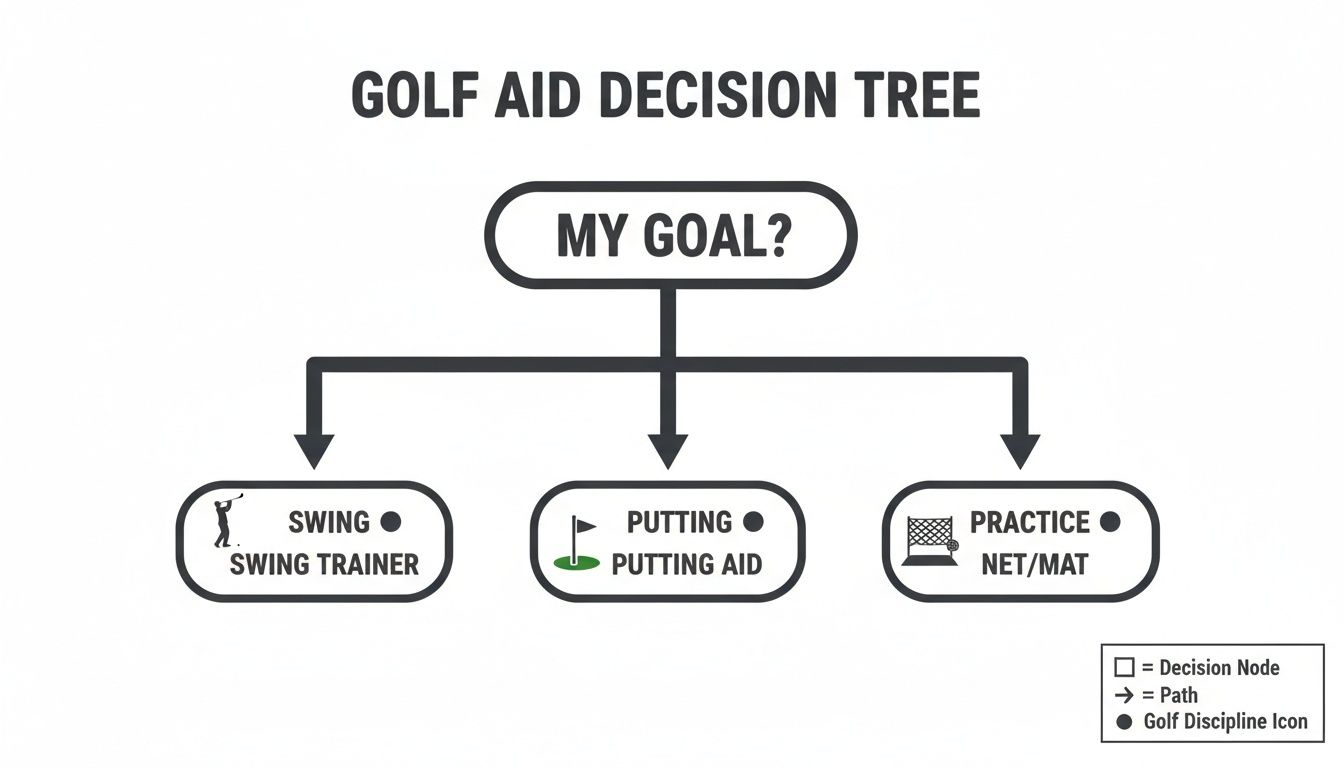
It’s a simple visual that cuts through the noise, guiding you toward the right category of aid whether you’re fixing your swing, your short game, or your whole practice setup.
Consider Your Budget and Practice Space
Alright, let's talk brass tacks: money and space. The market for the best golf training aids is massive, with prices ranging from a $20 set of putting gates to a $2,000 personal launch monitor. Figure out your budget before you start shopping. It’ll keep you from getting suckered into buying a complex device you don’t actually need.
Just as important is where you’ll be practicing. Your environment pretty much dictates your options.
- Limited Indoor Space: Living in an apartment? A good putting mat or a short-swing trainer is your best friend. You can get in some quality reps without needing high ceilings or worrying about taking out a lamp.
- Garage or Basement: This opens things up quite a bit. You can create your own personal driving range with a hitting net and mat combo, ready for action 24/7, rain or shine.
- Spacious Backyard: If you've got the room, you've hit the jackpot! You can set up a full hitting net, chipping targets, and have all the space you need for full-speed swing training.
Don’t buy a giant hitting net if your only practice spot is a tiny patio. Matching the aid to your space is the only way to make sure you’ll actually use it. And if you're focused on the flat stick, you might want to check out these awesome golf putting practice drills you can do right at home.
Your Personal Training Aid Checklist
This little checklist is designed to help you think through what you really need. Jot down your answers and see where you land—it's a great way to avoid buyer's remorse and find an aid that you'll stick with.
| Key Criteria | Your Situation (e.g., Beginner, Limited Space) | Recommended Aid Type | Typical Budget |
|---|---|---|---|
| Skill Level | Beginner trying to learn the basic swing motion. | Swing Plane & Path Trainers | $40 - $120 |
| Practice Space | Apartment dweller with only indoor space. | Putting Mat, Mirror, Gates | $20 - $150 |
| Time Commitment | Busy professional; can only spare 15 mins/day. | Impact Bag, Short-Swing Trainer | $30 - $100 |
| Biggest Weakness | Inconsistent contact and "chicken wing" swing. | Swing Connection Bands | $25 - $70 |
| Ultimate Goal | Lower handicap from 12 to 8 this season. | Launch Monitor, Speed Trainer | $500 - $2,500+ |
Once you've filled this out, you'll have a much clearer picture of what kind of "practice partner" will fit your life, not just your golf bag.
Be Realistic About Your Time Commitment
This might be the most important factor of all. How much time can you honestly set aside for practice each week? The most amazing training aid on the planet is completely worthless if it never leaves its box.
Your perfect practice partner is one that fits seamlessly into your existing lifestyle. The goal is to make practice easier and more accessible, not add another chore to your to-do list.
Think about a busy parent with a demanding career. A complicated system that takes 30 minutes just to set up isn't happening. But a putting mat they can roll out for 10 minutes while dinner is in the oven? That’s a massive win. On the flip side, a retiree with plenty of free time might get incredible value from a full home simulator they can enjoy for hours every single day.
Choosing an aid that lines up with your real-world schedule is the key to consistency, and consistency is the only way to see real, long-term improvement.
Turning Your New Gadget Into Lower Scores
So, you’ve unboxed that shiny new training aid. It’s sitting there, practically humming with the promise of straighter drives and fewer three-putts. We’ve all been there—that rush of hope is part of the fun. But let's be real: the gadget itself doesn’t magically lower your scores.
The real transformation happens when you stop swinging it randomly and start weaving it into a smart, repeatable practice routine. This is where we turn that hopeful purchase into your secret weapon, building a system so effective that the confidence you feel on the range actually shows up on the first tee.
No more mindless ball-beating. It's time for purposeful, game-changing work.
From Garage Swings To On-Course Gains
The biggest mistake I see golfers make is using a new toy without any sort of plan. They'll make a few swings, feel a little different, and then toss it in the corner of the garage. To see any real, lasting results, you have to structure your sessions so they feel more like a game and less like a chore.
Once you have your perfect practice partner, the goal is to integrate it into effective practice drills. This is how you turn aimless whacking into focused skill development. You’re no longer just hoping for improvement; you're actively building it, one specific move at a time.
For instance, stop just "practicing putting." Instead, create a Pressure Putting Challenge on your mat. Set up a simple drill: make five 3-footers in a row. If you miss, you start over. This tiny change mimics the do-or-die feeling of a putt to save par and builds some serious mental toughness.
Structuring Your 45-Minute Power Session
Time is our most valuable asset, so let's make every minute count. A focused 45-minute session can do more for your game than two hours of zoned-out practice. The trick is to work on different parts of your game with a clear goal for each segment.
Here’s a sample structure you can tweak based on your own needs and the best golf training aids in your arsenal:
-
Minutes 0-10: Warm-Up & Feel
- Grab your tempo trainer or swing connection band.
- Start with slow, deliberate swings, focusing only on rhythm and proper sequencing. Forget about hitting balls—the goal here is to groove the feeling of a connected, fluid motion.
-
Minutes 10-25: Skill Development
- Now, break out your main training aid (like an impact bag, alignment sticks, or a wrist sensor).
- Zero in on one specific move you're trying to fix, whether it's a better impact position or a more on-plane backswing. Hit just 15-20 balls, but with intense focus on the feedback your aid is giving you.
-
Minutes 25-45: Performance & Transfer
- Okay, put the training aid away. This part is crucial.
- Alternate hitting one shot with your normal swing, then one while trying to recreate the "feel" you just learned from the aid. This is how you transfer the new skill from a conscious drill to an unconscious, natural swing. Finish up by playing a few imaginary holes in your head.
The most critical part of practice is that transfer phase. An aid helps you find the right feeling, but you have to learn to recreate that feeling without the tool. That’s when you know the change is actually sticking.
This kind of structured practice is changing the game for amateurs and pros alike. The market for these aids is exploding, with professional settings like courses and trainers making up about 52% of the market in 2025, and personal, at-home usage accounting for the other 48%.
Make Practice Fun With Themed Days
To keep from getting bored and burning out, give your practice days a theme. It’s a simple mental trick that adds a layer of fun and focus, making it far more likely you’ll stick with your routine. You start looking forward to it instead of dreading it.
Here are a few ideas to get you rolling:
-
Tempo Tuesday: Dedicate the entire session to rhythm. Use a weighted swing trainer for 15 minutes before you even touch a golf ball. Hum a song or count "one-two-three" in your head to find a smooth, unhurried pace.
-
Data Day Thursday: Got a personal launch monitor? This is your day to geek out. Don't even try to fix your swing; just gather information. What's your actual carry distance with your 7-iron? How much does a mis-hit really cost you in yards? Knowledge is power.
-
Feel Friday: Leave all the technical thoughts behind. Use an impact trainer or a connection band for just a few minutes to get a core feeling, then spend the rest of the session trying to replicate that feeling on real shots. This is all about trusting your body, not your brain.
By building a system like this, your new gadget becomes more than just a piece of plastic—it becomes the catalyst for real, lasting improvement. You’ll not only hit better shots but also gain a much deeper understanding of your own swing. To dig deeper into the mechanics, check out our guide on how to improve your golf swing.
Bringing Your Range Confidence to the First Tee

Let's be honest. Real improvement in golf isn't about hitting perfect shots in your garage. It's about owning your swing when you're standing on the first tee, with out-of-bounds stakes staring you down on the left and a pond grinning at you from the right. The true test of the best golf training aids is whether they build the kind of trust that actually survives the walk from the practice mat to the course.
That perfect, flushed shot you grooved with an impact bag? It feels incredible, but it's doing more than you think. Every single correct repetition is like a small deposit into your confidence bank. You’re not just training your muscles; you’re training your brain to believe that a great swing isn’t just possible—it’s what you do, even when the pressure is on.
This is the gap every single golfer is trying to cross. That feeling of invincibility on the range somehow vanishes into thin air on the way to the first tee. The secret is realizing that the hard work you put in with those aids isn't just about swing mechanics. It's about forging the mental armor you need to execute when it actually matters.
Building Your On-Course Swagger
Confidence is a funny beast in golf. It’s part skill, part muscle memory, and a healthy dose of pure, unapologetic swagger. After you’ve spent weeks with a tempo trainer, you start to trust your rhythm without overthinking it. When you’ve drained hundreds of six-footers on a putting mat, you start to look at those same putts on the green with expectation, not just hope.
This is where the physical and mental sides of the game finally shake hands. That feeling of being truly prepared is a powerful thing, and you can crank it up a notch by looking and feeling the part. It sounds almost silly, but your on-course gear plays a massive role in your mindset.
Think about it: when you pull on your favorite golf shirt and a clean hat, you’re flipping a switch in your brain. You’re not just some person about to hit a ball; you're a golfer. It’s a mental trigger that says, "Alright, I'm ready to play well today."
Your gear is the final piece of your mental prep. A great golf hat isn't just for sun protection; it's your crown. It completes the uniform and tells you—and everyone else—that you showed up to play.
The Power of a Pre-Round Routine
So, how do you make sure all that hard-earned range confidence doesn't just evaporate? You lock it in with a solid routine. It’s all about creating a sequence of small, repeatable actions that quiet the noise in your head and activate the muscle memory you’ve worked so hard to build.
Your pre-round routine is your sanctuary. It's the bridge that connects your practice world to your performance world.
- Warm-Up with Feel: Before you even touch a ball, take five slow-motion swings. Try to recreate the exact feeling your favorite training aid gave you. If you used a connection band, feel your arms and chest moving in sync.
- Visualize the Win: As you hit a few balls on the range, see the first tee shot in your mind's eye. Picture the ball flying exactly where you want it to go. This isn't just wishful thinking; it’s a mental rehearsal.
- The Final Touch: Putting on your hat should be a deliberate act. For me, it’s the very last thing I do before walking to the tee. It’s like flipping the switch from "practice mode" to "game time."
This whole journey, from unboxing a new gadget to building unshakeable on-course trust, is what makes this game so addictive. It’s a process of turning dedicated, often lonely practice into fun, confident rounds with your buddies. The tools help build the swing, but you build the golfer.
Now, go put on your hat and trust the work you’ve put in.
Your Top Questions About Golf Training Aids, Answered
Let's be honest, walking into the golf training aid section of a store (or scrolling online) can feel like trying to read the greens at Augusta. There are so many gadgets, gizmos, and doohickeys, all promising to fix your slice and add 30 yards overnight. It’s totally normal to wonder what’s actually worth the money and what’s just going to collect dust in your garage.
Think of this as your personal FAQ session with a seasoned pro. We’re going to cut through the marketing fluff and give you straight answers to the most common questions golfers have. My goal is to help you spend your money wisely and get real results from your practice time.
What are the must-have training aids if I’m just starting out?
When you’re new to the game, your mission is simple: build a solid foundation. Don’t get bogged down trying to master complex swing mechanics you saw on YouTube. Focus on the big three: aiming, hitting the ball solidly, and making a consistent putting stroke. Overloading on gadgets right now will just lead to what we call "paralysis by analysis."
A beginner’s toolkit should be lean, mean, and effective. The best aids for a newbie are the ones that tackle the absolute fundamentals of scoring.
Here are the three tools I always recommend. They’re cheap, but their impact is huge:
- A Good Putting Mat: You want to lower your scores fast? Get better on the greens. A simple putting mat with alignment lines lets you practice a straight-back, straight-through stroke in your living room. It’s the highest-leverage practice you can do.
- Alignment Sticks: These might be the most powerful and criminally underrated tool in all of golf. Seriously. They teach you how to aim your body—feet, hips, shoulders—at your target. This is a fundamental that trips up 90% of amateur golfers.
- An Impact Bag: So many beginners struggle to understand what a solid strike feels like. An impact bag gives you that satisfying "thump" of feedback, teaching your body to be in the correct position at the moment of truth.
That's it. These three things cover putting, aiming, and ball-striking. It’s a complete system to build your game on, and it won’t cost you an arm and a leg.
How often should I actually use these things?
Here’s a golden rule in golf: consistency beats intensity, every single time. That heroic, two-hour grind session you do once a month? It’s nowhere near as effective as hitting the mat for 15 minutes a few times a week. We’re trying to build muscle memory, and that only comes with repetition.
Think of it like learning guitar. You don't become a rockstar by practicing for five hours one Saturday. You do it by playing for a little bit every day.
Aim to use your training aids for 15-20 minutes, three or four times a week. That’s a totally manageable goal that fits into even the busiest schedules and keeps you from burning out.
Quick tip: The goal isn't to become dependent on the aid. You use it to find a specific feel, then you practice replicating that feel without the aid. It’s a guide, not a crutch.
For your putting mat, even 10 minutes while you’re waiting for the coffee to brew can be a total game-changer. With a swing trainer, every other day is plenty to reinforce the right moves. The trick is to make practice a simple habit, not another chore on your list.
Is it possible for a training aid to actually mess up my swing?
This is a brilliant question, and the answer is a huge, flashing, neon-sign YES. A training aid can absolutely ingrain bad habits if it's the wrong tool for your problem or if you're using it incorrectly. This is the #1 pitfall for golfers who buy a gadget hoping for a magic fix without first diagnosing their issue.
Imagine using an aid designed to cure a slice when your typical miss is a hook. It's a recipe for disaster. You’d be training your body to do the exact opposite of what it needs, digging yourself into a hole that’s even harder to get out of.
An aid is a powerful tool, but like a chainsaw, it can do some serious damage in the wrong hands. Before you buy anything, have a clear, specific goal in mind. If you’re not sure what your core issue is, get a quick lesson from a PGA pro. They can diagnose your swing and recommend the right tool for the job.
Are those super expensive, high-tech gadgets really worth the money?
The value of a fancy launch monitor or 3D swing analyzer comes down to one thing: your level of dedication. Are you a serious golfer who loves digging into the data? Do you geek out on numbers like ball speed, launch angle, and spin rate? If so, then yes, these tools can be a phenomenal investment. They turn every range session into a data-driven mission.
But for the weekend warrior who plays a couple of times a month, that steep price tag is almost impossible to justify. Why drop $2,000 on a launch monitor when a $50 tempo trainer could give you a more immediate and practical benefit?
Don't fall into the trap of thinking a higher price tag automatically equals lower scores. The best training aid on the planet is the one you’ll actually pull out of your bag and use.
Feeling good on the range is one thing, but taking that confidence to the first tee is the final piece of the puzzle. At 2ndShotMVP, we create premium golf hats and apparel that give you that little extra swagger. Shop our unique designs at 2ndshotmvp.com and find the perfect cap to complete your look.

