

Every great golf swing is built from the ground up, and it all starts long before you even think about taking the club back. Forget about power for a second. The real secret to a consistent, repeatable swing lies in your grip and stance. These are the two non-negotiables that create a stable platform for everything else to happen.
Get these right, and you're building your swing on solid rock. Get them wrong, and you're building on sand.
Build Your Swing From The Ground Up

Before you can dream of hitting those pure, towering iron shots, you've got to get your hands and feet sorted. Think of your grip and stance as the launchpad for your swing. A shaky launchpad guarantees a wobbly, unpredictable rocket. But a solid one? That lets you unleash all your power with a smooth, athletic motion.
Mastering Your Connection to the Club
Your hands are your only link to the golf club. How you hold it dictates everything from where the clubface is pointing at impact to how efficiently you transfer energy into the ball. There isn't one "perfect" grip that fits everyone, but the goal is always the same: get your hands working together as a single, cohesive unit without introducing a death grip of tension.
Let's look at the three most common ways to hold the club.
Find Your Perfect Golf Grip
Not sure which grip is for you? This quick comparison breaks down the big three to help you find the best fit for your hands and swing style.
| Grip Type | Ideal For | How It Feels |
|---|---|---|
| Interlocking | Golfers with smaller hands; players seeking a very connected feel. | The pinky and index fingers link together, locking the hands into one unit. |
| Overlapping (Vardon) | The most common grip on Tour; great for a wide range of hand sizes. | Offers a fantastic blend of unity and freedom for your wrists to hinge properly. |
| Ten-Finger (Baseball) | Beginners, juniors, and players with arthritis or weaker hands. | The most natural and intuitive feel; can help generate more clubhead speed. |
Experiment on the range to see which one gives you the most control and comfort. It's all about finding what works for you.
A quick tip on grip pressure: On a scale of 1 to 10, where 10 is squeezing the life out of the club, your pressure should be a light 3 or 4. You want to hold it securely, like you're holding a small bird—firm enough so it can't fly away, but gentle enough not to crush it.
Creating an Athletic Stance
Once your hands are set, it’s time to build your base. A sloppy stance will sabotage a swing before it even starts, killing your rotation and throwing you completely off balance. The goal here is to get into a balanced, athletic posture that practically begs you to make a powerful turn.
Here are a few simple checkpoints for a great setup:
- Proper Width: For a mid-iron, your feet should be about shoulder-width apart. This gives you a stable base without locking up your hips.
- Ready Knee Flex: Bend your knees just enough so you feel athletic and ready to move, almost like a shortstop waiting for a ground ball. Avoid being too stiff or squatting too low.
- Correct Spine Angle: The most important part! Hinge forward from your hips—not your waist—while keeping your back relatively straight. This creates the room you need for your arms to swing freely.
Think of your stance as your anchor. It keeps you from swaying and sliding, which are two of the biggest swing-killers out there. To really improve your ability to get into these positions, physical readiness is huge. You might want to incorporate some of these top golf mobility exercises for a better swing to boost your flexibility and balance.
By locking in these fundamentals, you’re setting the stage for massive improvement. Once your setup feels natural, you can start grooving it with practice. These beginner golf drills are a fantastic way to reinforce good habits. Your journey to a better swing starts right here, before the club even moves an inch.
Unlock the Engine of Your Golf Swing
If you're trying to muscle the ball for more distance by just swinging your arms harder, you're basically trying to power a race car with a lawnmower engine. It's just not going to work. The real source of that effortless, booming power you see from the pros isn't brute strength; it’s a beautifully sequenced chain reaction, and the engine driving it all is your body's rotation.
This is where you graduate from simply hitting at the golf ball and start moving like a genuine athlete. We're talking about coiling up like a spring on the way back and then unleashing all that stored energy through impact.
The Secret Sauce: The X-Factor
The magic ingredient in a powerful, repeatable swing is what biomechanics geeks call the "X-Factor." Forget the confusing jargon—it's just the difference in the angle between your shoulders and your hips at the top of your backswing.
Picture wringing out a wet towel. The more you twist the top half one way while the bottom half resists, the more tension and potential energy you build up. That's the secret sauce. You create this powerful separation by making a full shoulder turn while keeping your lower body relatively stable. This "X" is what lets you snap back through the ball with incredible speed.
This isn't just a swing theory I cooked up; it’s a measurable advantage that draws a clear line between amateurs and pros. A massive review of 92 different golf swing studies confirmed that pros have a huge edge in key biomechanical metrics. They exceeded amateurs by up to two standard deviations in their X-factor—that's a colossal performance gap. The good news? Research also showed that making just 100 practice swings can measurably improve this critical separation. If you want to dive into the science, you can explore the full biomechanics study here.
Building Your Backswing Coil
A powerful turn doesn't start with a violent, jerky rip of the club away from the ball. It’s a smooth, coordinated move that sets the stage for everything that follows.
Here’s how to build a tour-level backswing turn:
- One-Piece Takeaway: For the first couple of feet, your hands, arms, and chest should all move away from the ball together, as one solid unit. A huge mistake is getting "handsy" and snatching the clubhead away immediately.
- Feel the Stretch: As you get to the top, your goal is a full 90-degree shoulder turn. You should feel a nice, athletic stretch across your back and down your side. That’s the feeling of your spring being coiled.
- A Stable Base: Now, your hips are going to turn, but way less than your shoulders—think around 45 degrees. The trick is to feel like your lower body is resisting the turn of your upper body. You'll feel the pressure building in your trail leg and glute as you load up.
That feeling of loading into your trail hip is your signal that you're creating real power, not just lifting the club with your arms.
Kicking Off the Downswing
Alright, you've coiled the spring. Now, how do you unleash it? The single biggest power-killer for most amateurs is starting the downswing with the arms and shoulders. That's the dreaded "over-the-top" move that leads to that weak, ugly slice.
The correct sequence is a thing of beauty, and it starts from the ground up.
First, fire the hips. The very first move from the top of your swing should be your lead hip turning back toward the target. It might feel like a tiny bump or a shift of pressure into your lead foot. This is what starts to unwind your lower body.
Next, the torso follows. As your hips clear out of the way, they pull your torso, chest, and shoulders along for the ride. Notice your arms haven't really done anything yet—they're just passengers at this point.
Finally, the arms and club release. All that energy you stored in your turn is now transferred down the chain, whipping your arms and the club through the impact zone with ridiculous speed.
To really max out your clubhead speed, you want to improve your body's ability to generate force quickly—what sports scientists call your rate of force development (RFD). This ground-up sequence naturally trains your body to do exactly that.
Think about a big-league pitcher. They don't start their throw with their arm. They start with a powerful leg drive and hip rotation, and their arm is the very last thing to come through. The golf swing is the exact same concept, just on a different plane of motion. Nailing this kinetic chain is your golden ticket to the powerful, consistent swing you've been looking for.
Find Your Path to a Consistent Swing Plane
Ever pipe a drive dead straight down the middle, only to follow it up with a wild slice into the next fairway? If that sounds familiar, you’ve experienced the pure frustration of an inconsistent swing plane.
Think of the swing plane as an imaginary hula hoop your club travels on around your body. When that path stays true, your shots are predictable. When it doesn't, well, you already know what happens. Let’s cut through the confusion and find the secret to turning those wild misses into reliable, repeatable shots. It's not about forcing your body into some textbook position; it’s about finding the most efficient path for you to deliver the clubface squarely to the ball.
The first step is just to get a mental picture of the core sequence. This simple visual breaks a powerful, on-plane swing down into its three key phases.
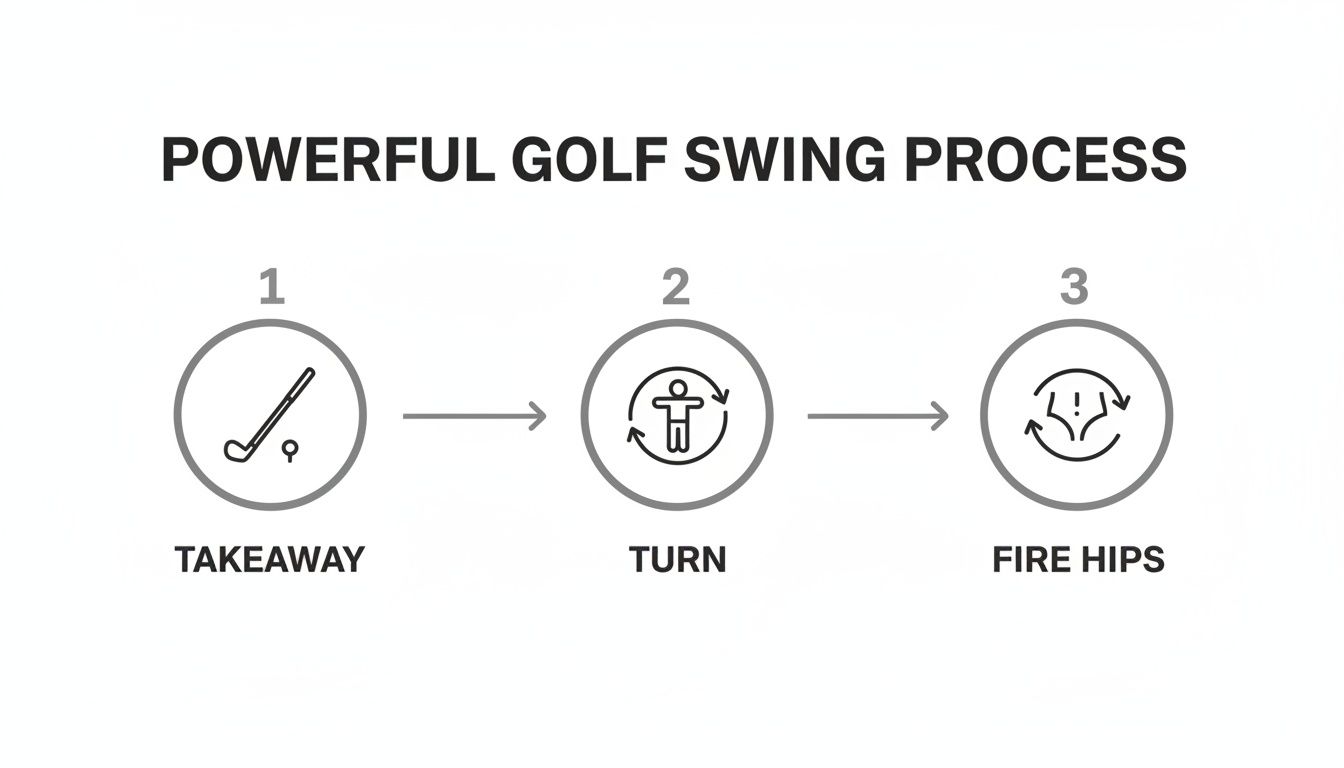
As you can see, a great swing isn't one jerky, violent motion. It's a connected flow of energy, moving from the takeaway, through the turn, and unleashing with a hip-driven downswing.
One Plane or Two? What's Your Style?
You'll often hear coaches tossing around terms like "one-plane" or "two-plane" swing. Don't let the jargon intimidate you. They're much simpler than they sound and just describe how your arms and shoulders relate during the swing.
-
The One-Plane Swing: Think of a swing that’s more rotational, like a merry-go-round. Here, the arms and shoulders tend to turn back on a similar plane. Golfers like Ben Hogan and Matt Kuchar are classic one-planers. For many players, this style feels more connected and easier to repeat under pressure.
-
The Two-Plane Swing: This is a more upright swing, kind of like a Ferris wheel. The arms lift to a higher position than the plane of the shoulder turn. Picture legends like Jack Nicklaus or modern bombers like Justin Thomas. This can generate a ton of power, but it often requires better timing to get everything synced back up on the downswing.
One isn't "better" than the other—it all comes down to your body type, flexibility, and natural motion. Your goal isn't to perfectly copy a pro but to find a consistent path that works for your build. A taller, more flexible player might naturally fall into a two-plane swing, while a shorter player might find a one-plane motion far more efficient. Get out there and experiment.
Diagnosing and Fixing Common Plane Faults
For amateur golfers, the most common and destructive swing plane fault is, without a doubt, the dreaded "over-the-top" move. This is what happens when your first move from the top is with your shoulders and arms, throwing the club outside the ideal plane. The result? A weak slice that peels off to the right or a nasty pull-hook.
Another frequent problem is getting the club "stuck" behind you on the downswing. This is when your arms drop too far to the inside, forcing you to flip your hands at the ball in a last-ditch effort to save the shot. It’s a recipe for pushes, hooks, and a general lack of solid contact.
The root of most swing plane issues isn't a lack of talent; it's a poor sequence. The average amateur is simply out of sync. According to data, scratch golfers save par around 50% of the time they miss a green, largely because their swing plane is reliable enough to produce predictable, manageable misses.
A fantastic and ridiculously simple drill to feel the correct plane involves an alignment stick. Seriously, this one is a game-changer. Stick it in the ground a few feet behind you, angled so it matches the shaft of your club at address.
- Takeaway Check: As you take the club back, your hands and club should track just inside or directly along the line of that alignment stick.
- Downswing Slot: Now for the magic. On the way down, your goal is to have the club drop under the stick. This forces you to start the downswing with your lower body and makes it nearly impossible to come over the top.
This drill provides immediate, undeniable feedback. If you smack that stick on the way down, you know your shoulders and arms jumped the gun. Grooving this feeling helps build the muscle memory for a swing that attacks the ball from the inside—the true hallmark of every great ball-striker.
Use Modern Tools to Accelerate Your Progress
Hitting endless buckets of balls at the range without any feedback is like driving blindfolded. Sure, you might eventually get where you're going, but it’s going to take a long time and you'll hit a lot of bumps along the way. If you really want to improve your golf swing, you have to stop guessing and start measuring.
Today’s golf tech isn't just for the pros anymore. Affordable, accessible tools can give you the kind of instant, actionable feedback that used to require an expensive lesson. This is all about practicing smarter, not just harder, and it can shave months off your learning curve.
Your Smartphone is Your Best Coach
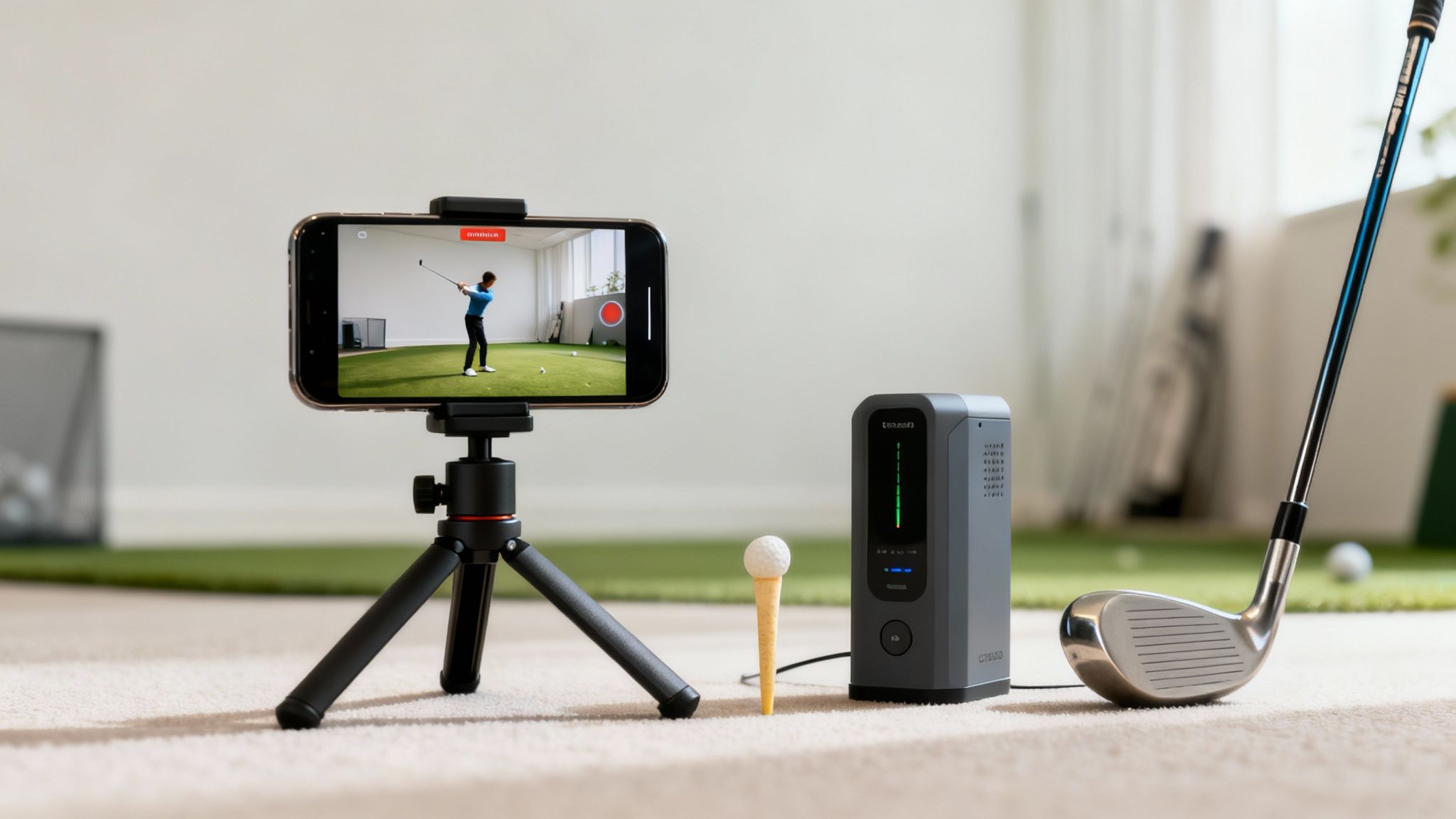
Before you spend a single dime, just pull out the device you already own. Your smartphone's slow-motion camera is one of the most powerful diagnostic tools you can get your hands on. I can't tell you how many times a golfer has told me they feel like they're doing one thing, only to see the video and realize it's something else entirely.
Set your phone on a tripod or lean it against your bag, either "down the line" (facing your target) or "face on" (looking at you from the side). Record a few swings and play them back in slow motion. You'll be floored by what you see—that over-the-top move, the early extension, or the loss of posture will be right there in high-def.
This simple act gives you undeniable proof of where your swing is breaking down. Suddenly, you have a crystal-clear focus for your next practice session.
Unlock Your Data with Launch Monitors
Ready to take the next step? A personal launch monitor is a total game-changer. These devices have come way down in price and they serve up the crucial data points that tell the full story of every shot you hit.
Here are a few of the key metrics they measure:
- Clubhead Speed: This is the raw horsepower behind your swing.
- Ball Speed: How well did you transfer that power to the ball?
- Launch Angle: The vertical angle the ball takes off at impact.
- Spin Rate: The amount of backspin (or sidespin) on the ball, which is a huge factor in its flight.
Seeing these numbers in real-time lets you connect a specific feel with a specific result. You'll finally learn exactly what a slight change in your swing does to your ball flight, helping you build a more consistent motion based on facts, not guesswork.
The global golf training aids market was valued at USD 827.1 million in 2022 and is projected to skyrocket to USD 1,238.1 million by 2030. Swing trainers are a massive driver of this growth because they provide the real-time feedback needed to build muscle memory and consistency. You can discover more about this industry surge and its impact on the game.
Choosing Training Aids That Actually Fix Your Flaws
The market for training aids is a jungle, and it's easy to get lost. The secret isn't to buy every shiny new gadget, but to pick a specific tool that targets your unique weakness.
Think of it like getting a prescription. You wouldn't take medicine for a headache if your foot was hurting, right?
| Swing Fault | Recommended Training Aid | How It Helps |
|---|---|---|
| Slicing (Over-the-Top) | Impact Bag | Gives you a physical target to swing into, forcing you to deliver the club from the inside and promoting a proper impact position. |
| Poor Tempo/Rhythm | Tempo Trainer | A weighted, flexible shaft that helps you feel the proper sequence and smooth out a jerky or rushed transition from backswing to downswing. |
| Casting/Early Release | Hinge Trainer | Cradles your wrists to ensure you maintain the proper angle (lag) deep into the downswing, unleashing power at the last second. |
By matching the right tool to your specific problem, you can speed up the process of building correct muscle memory. This targeted approach is way more effective than just mindlessly hitting balls. For a deeper look into helpful gear, you can also check out our guide on the best golf accessories to round out your practice setup. By bringing these modern tools into your routine, you can turn frustrating practice sessions into productive training that leads to real, measurable improvement on the course.
Design a Practice Routine That Actually Works
Let's be honest. Showing up at the range and mindlessly blasting a jumbo bucket of balls isn't practice—it's just a workout. Sure, it feels productive, but if your scores aren't dropping, you're just getting better at repeating the same old mistakes.
To really improve, you need a plan. Every single ball you hit should have a clear purpose. This is what we call purposeful practice, and it's the bridge that connects the swing you make on a flat mat to the one you can actually trust on an uneven lie with water on the right. It's how you stop just hitting balls and start training for golf.
Block Practice vs. Random Practice: Know the Difference
This is a game-changer. Understanding these two practice styles is the first step toward a routine that gets real results. Most golfers, probably 99% of them, live and die in the first category, and it’s what's holding them back.
-
Block Practice: This is your lab work. You're hitting the same club to the same target, over and over again. It's absolutely brilliant for burning a new swing feel into your muscle memory. If you're trying to fix that slice with your 7-iron, hitting twenty of them in a row while focusing on just one key move is exactly what you should be doing.
-
Random Practice: This is where you bring the golf course to the range. You're constantly changing your club, your target, and even the shot shape you're trying to hit. You might hit a driver, then a delicate wedge, then a 5-iron. It feels chaotic and you won't hit as many perfect shots, but this is the secret sauce for making your swing travel.
The biggest mistake golfers make is never moving on from block practice. Once a new move starts to feel comfortable, you have to introduce randomness to see if it holds up when you're not in a rhythm.
A Killer 60-Minute Practice Plan
Don't just wing it. Walk onto the range with a mission. Here’s a blueprint for a 60-minute session that will actually make a difference.
- Warm-Up & Feel (10 Minutes): Start with some light stretching, then grab a wedge. The goal isn't to hit a target yet; it's simply to make solid contact and find your rhythm for the day. Feel the clubhead.
- Technique Block (20 Minutes): Now, get specific. Pick one—and only one—swing thought or drill you’re working on. Maybe it’s your takeaway, or starting the downswing with your hips. Settle in with one or two clubs and give that single element your full attention.
- Performance Games (20 Minutes): Time to switch gears to random practice. Put yourself under a little heat with a game. This is where you train your brain to execute shots, not just make pretty swings.
- Pressure Putts (10 Minutes): A tour-level swing is worthless if you can't get the ball in the hole. End every session on the putting green. Do drills that simulate pressure, like making ten 4-footers in a row before you're allowed to go home. If you need inspiration, our guide to golf putting practice drills has some great ideas to sharpen your short game.
Pro Tip: The 9-Shot Challenge
One of the best performance games comes from Tiger Woods. Pick a single target and one club, like a 7-iron. Your mission is to hit all nine possible shots: a low draw, a mid-height draw, a high draw; a low straight ball, a mid-straight ball, a high straight ball; and finally, a low fade, a mid-fade, and a high fade. This is the ultimate test of clubface and swing path control.
The Power of Knowing Your Numbers
The best players and coaches in the world don't guess—they measure. Thanks to modern tech, everyday golfers now have access to the kind of data that used to be reserved for tour pros. Just look at a company like GOLFTEC, which has analyzed a mind-boggling 90 million swings to figure out what separates the best ball strikers from everyone else.
Their SwingTRU Motion Study has identified the exact body movements, like optimal hip sway and shoulder tilt, that lead to better golf shots. And the proof is in the pudding: 96% of their clients report improving, with the average student knocking seven strokes off their scores. You can learn more about their data-driven approach to swing improvement and see how powerful specific metrics can be.
When you embrace a structured, goal-oriented routine, every trip to the range becomes a deliberate step toward a swing you can finally rely on.
Got Questions About Your Swing? We've Got Answers.
As you're hammering away at the range, trying to iron out the kinks in your swing, you're bound to run into a few head-scratchers. It’s totally normal. Here are some of the most common questions I hear from golfers trying to get better, along with some straight-up answers.
Seriously, How Long Does This Take?
Look, there's no magic number. But if you can get in 2-3 focused practice sessions a week, most folks start to feel a real difference in about 4-6 weeks. The key word there is focused. Mindlessly whacking 200 balls is just cardio. A solid 45-minute session with a specific goal in mind will do ten times more for your game.
Building a truly reliable swing is a long game, for sure. But you can see real, tangible progress—like that pure feeling of a well-struck iron or a ball flight that doesn't banana-slice into the next county—surprisingly fast if you know what you're working on. Patience, my friend.
What's the #1 Mistake Amateurs Make?
Easy. It's starting the downswing with the arms and shoulders. This is the classic "over-the-top" move you hear about, and it's the grim reaper of good golf shots. It's a sequencing disaster that throws the club onto a steep, out-to-in path.
This one little mistake is the mother of all slices. It's what causes those weak, high-spinning shots that haunt millions of golfers. When you manage to square the face, it turns into a wicked pull. The right way to do it is from the ground up: your hips fire first, which then pulls your torso, then your arms, and finally the club through the ball. Find a drill that forces this "ground-up" sequence, and you'll unlock power you didn't know you had.
Should I Try to Swing Like Rory McIlroy?
Watching the pros is fantastic for inspiration, but trying to perfectly copy someone else's swing is usually a one-way ticket to Frustration Town. Everyone's body is different. We have different heights, flexibility levels, and natural rhythms. What works for a 6'3" tour pro is probably not going to work for a 5'8" desk jockey.
Instead of trying to copy a look, steal the principles all great swings share:
- Rock-Solid Balance: They look athletic and stable from the takeaway to the finish.
- A Massive Turn: They coil their shoulders over a quiet lower body to generate torque.
- Flawless Sequencing: They unwind from the ground up. Every. Single. Time.
Use the pros as a blueprint for what's possible, then get on video or see a coach to find the swing that works for your body. The best swing is the one you can own, not one you're borrowing.
The Hard Truth About Reaching Scratch: It's an elite goal. Only about 1.85% of male amateur golfers and just 0.69% of women ever achieve a scratch handicap. The journey requires immense dedication, but the lessons learned in discipline and perseverance are invaluable, whether you reach the 0.0 handicap or not.
How Often Should I Get My Clubs Checked?
If you're serious about getting better, you need to get your clubs checked at least once a year. Pay special attention to your loft and lie angles. Smacking balls off hard turf or range mats can slowly bend your irons out of whack, causing you to hit shots offline even when you put a great swing on it.
Think of it this way: a good swing with bad equipment is like trying to drive a sports car with flat tires. Getting your clubs dialed in for your swing is one of the easiest wins you can find. It makes sure all that hard work you put in actually pays off on the scorecard.
Ready to look as good as your new swing feels? The confidence you build on the range should extend to your style on and off the course. At 2ndShotMVP, we create premium golf hats and apparel with unique designs that let you express your passion for the game. Shop our collection and find your new favorite piece at https://2ndshotmvp.com.

